
If your North Indian panchanga says Kartik while a Marathi, Gujarati, Telugu, or Kannada calendar says Ashwin or Ashwayuja, you are not necessarily looking at different days. Regional calendars can assign different month names to the same lunar tithi and civil date.
For this part of the 2026 festival calendar, put November 1 and November 5 into your household plan first. November 1 carries two Ashtami observances, while November 5 is Rama Ekadashi. In Maharashtra, the first of those dates also opens the Diwali festive period through Karashtami. These are the confirmed dates for the three vratas covered here, not a substitute for a complete local Diwali panchanga.
The two dates to place on your 2026 calendar
The most reliable way to prevent calendar confusion is to record three pieces of information together: civil date, lunar tithi, and regional observance name. That makes the relationship visible without forcing every tradition into one label.
| Civil date | Lunar position | Observance | Regional calendar label | Planning significance |
|---|---|---|---|---|
| November 1, 2026 | Krishna Paksha Ashtami | Dampatya Ashtami | Kartik in North Indian calendars; Ashwin in Marathi, Telugu, Kannada, and Gujarati calendars | Keep it as a distinct family vrata even when another Ashtami observance falls on the same date. |
| November 1, 2026 | Krishna Paksha Ashtami | Karashtami | Ashwin in the Marathi calendar; Kartik in North Indian reckoning | It marks the beginning of Diwali festivities in Maharashtra, with Bhaldevi Puja as the principal ritual. |
| November 5, 2026 | Krishna Paksha Ekadashi | Rama Ekadashi | Kartik in North Indian calendars; Ashwayuja in Gujarati, Maharashtrian, Andhra Pradesh, Telangana, and Karnataka calendars | Reserve it as a separate Ekadashi vrata day rather than treating it as part of the November 1 observances. |
This table resolves the dates, but it does not prescribe one universal ritual procedure. A date identifies when an observance is kept; your sampradaya, temple, or household tradition determines how it is kept.
Why Kartik in one calendar can be Ashwin in another
Krishna Paksha is the waning half of a lunar month. Ashtami is its eighth tithi, and Ekadashi is its eleventh. Those tithi identities remain the practical anchors here. The month label changes because regional calendar systems place and name their month boundaries differently.
That distinction matters in a family using more than one panchanga. A North Indian relative may call November 1 Kartik Krishna Ashtami, while a Maharashtrian relative calls the same date Ashwin Krishna Ashtami. Neither label, by itself, proves that someone has selected the wrong day.
- Compare the civil date first: November 1 for the two Ashtami observances and November 5 for Rama Ekadashi.
- Compare the paksha and tithi next: Krishna Ashtami or Krishna Ekadashi.
- Only then compare the month name, allowing for Kartik, Ashwin, or Ashwayuja according to regional usage.
- Use one trusted local panchanga for the actual observance timings so that information from different locations is not combined accidentally.
This method is more dependable than searching only for a month name. If you search for “Kartik Ashtami” in one regional calendar and “Ashwin Ashtami” in another, the results can look contradictory even when they identify the same civil date.
Keep the three vratas distinct even when dates overlap
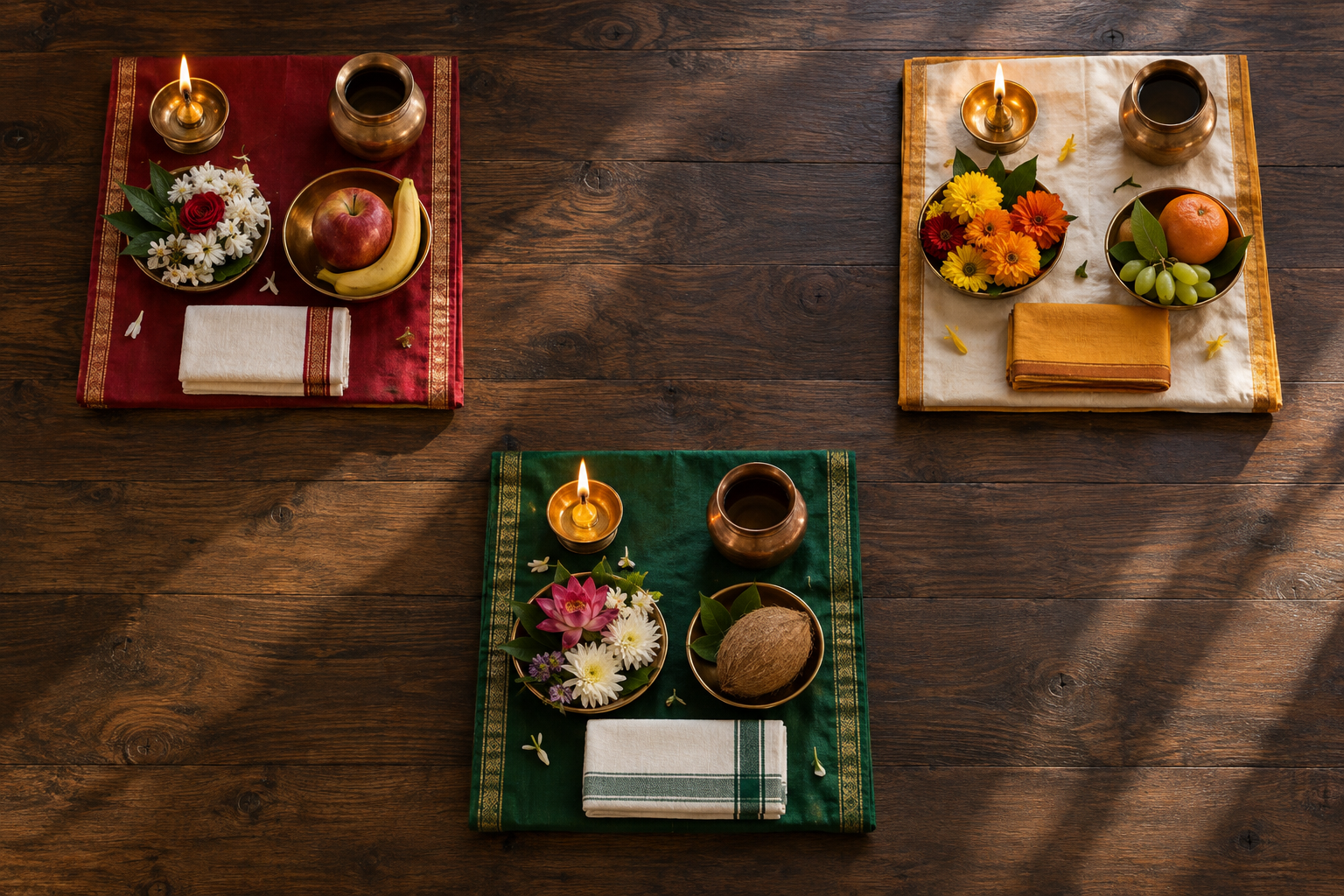
Dampatya Ashtami: preserve the household vidhi
Dampatya Ashtami falls on November 1 in 2026. In the North Indian calendar it is Kartik Krishna Ashtami; in several western and southern calendars the corresponding tithi is placed in Ashwin.
The calendar name is not a complete vrata-vidhi. If Dampatya Ashtami belongs to your family tradition, write “family procedure to confirm” beside the date and speak with the elder or priest who normally guides it. Confirm who undertakes the vrata, what form of worship is followed, and what completes the observance. Do not import Karashtami practices merely because both fall on Ashtami.
Karashtami: the Maharashtrian opening of Diwali
Karashtami also falls on November 1 in 2026. It is observed on Ashwin Krishna Ashtami in the Marathi calendar, corresponding to Kartik Krishna Ashtami in North Indian usage.
For a Maharashtrian household, this date is not simply another entry before Diwali. Karashtami marks the beginning of the festivities, and Bhaldevi Puja is its central ritual. Treat November 1 as the start of your household’s festive workload if this tradition is yours: confirm the puja arrangements, the people participating, and any customary food preparation before the day arrives.
Do not universalize that opening date for every Hindu community. Karashtami has a particular Maharashtrian setting. Other regions may begin their practical or ritual Diwali preparations differently even when they recognize the same tithi.
Rama Ekadashi: a separate vrata on November 5
Rama Ekadashi falls on November 5 in 2026. North Indian calendars place it in Kartik Krishna Paksha. Gujarati, Maharashtrian, Andhra Pradesh, Telangana, and Karnataka calendars place the corresponding Ekadashi in Ashwayuja Krishna Paksha.
Keep it as its own vrata day. Do not let its proximity to the November 1 Ashtami observances turn three distinct entries into one vague “Diwali fast.” If your family observes Ekadashi, confirm its customary worship, food discipline, and manner of completion within your own tradition.
Do not adopt an unfamiliar or severe fast from a bare calendar entry. If fasting could conflict with a health condition, medication, pregnancy, or another medical need, follow qualified medical advice and ask your religious guide about a safe form of observance.
Turn the dates into a workable household plan
A good festival calendar should tell you what still needs to be decided. Entering only the festival name creates last-minute uncertainty, especially when family members follow different regional conventions.
- Choose your timing authority. Use the panchanga followed by your local temple, family priest, or established community. Civil dates help with planning, but local tithi boundaries determine the appropriate ritual window.
- Record both month names where necessary. Write “November 1 — Kartik/Ashwin Krishna Ashtami” and “November 5 — Kartik/Ashwayuja Krishna Ekadashi.” This small note prevents the same disagreement from returning when another family member checks a different calendar.
- Give November 1 two lines. List Dampatya Ashtami and Karashtami separately if your household recognizes both. A shared date does not make them interchangeable.
- Assign preparations to the correct tradition. Put Bhaldevi Puja arrangements under Karashtami. Put any inherited Dampatya Ashtami procedure under its own heading. Reserve Rama Ekadashi preparations for November 5.
- Add the rest of Diwali only from a verified local calendar. Karashtami establishes the Maharashtrian beginning of the festive period, but it does not establish every later Diwali date or muhurta. Complete the schedule with the same regional panchanga rather than guessing from the sequence.
If relatives live in different cities or countries, send the civil dates first and ritual timings separately. A tithi can interact with the local civil day differently by location, so forwarding one location’s timing without its place can create avoidable confusion.
Key takeaways
- November 1, 2026 is Krishna Paksha Ashtami and carries both Dampatya Ashtami and Karashtami.
- Karashtami begins the Diwali festive period in Maharashtra, where Bhaldevi Puja is the main ritual.
- November 5, 2026 is Rama Ekadashi.
- Kartik, Ashwin, and Ashwayuja can be regional month labels for the same civil dates in this sequence; compare the tithi before assuming that calendars disagree.
- A date is not a complete ritual instruction. Confirm local timings and family-specific observance procedures with the panchanga and religious authority you actually follow.
Open your 2026 calendar now and make three separate entries: Dampatya Ashtami on November 1, Karashtami on November 1, and Rama Ekadashi on November 5. Add the regional month labels in parentheses, then leave space for locally verified timings and the remaining Diwali observances.
References
- Hindu Pad — Dampatya Ashtami 2026 | Dampat Ashtami
- Hindu Pad — Karashtami 2026
- Hindu Pad — Rama Ekadashi 2026

Leave a Reply
You must be logged in to post a comment.