
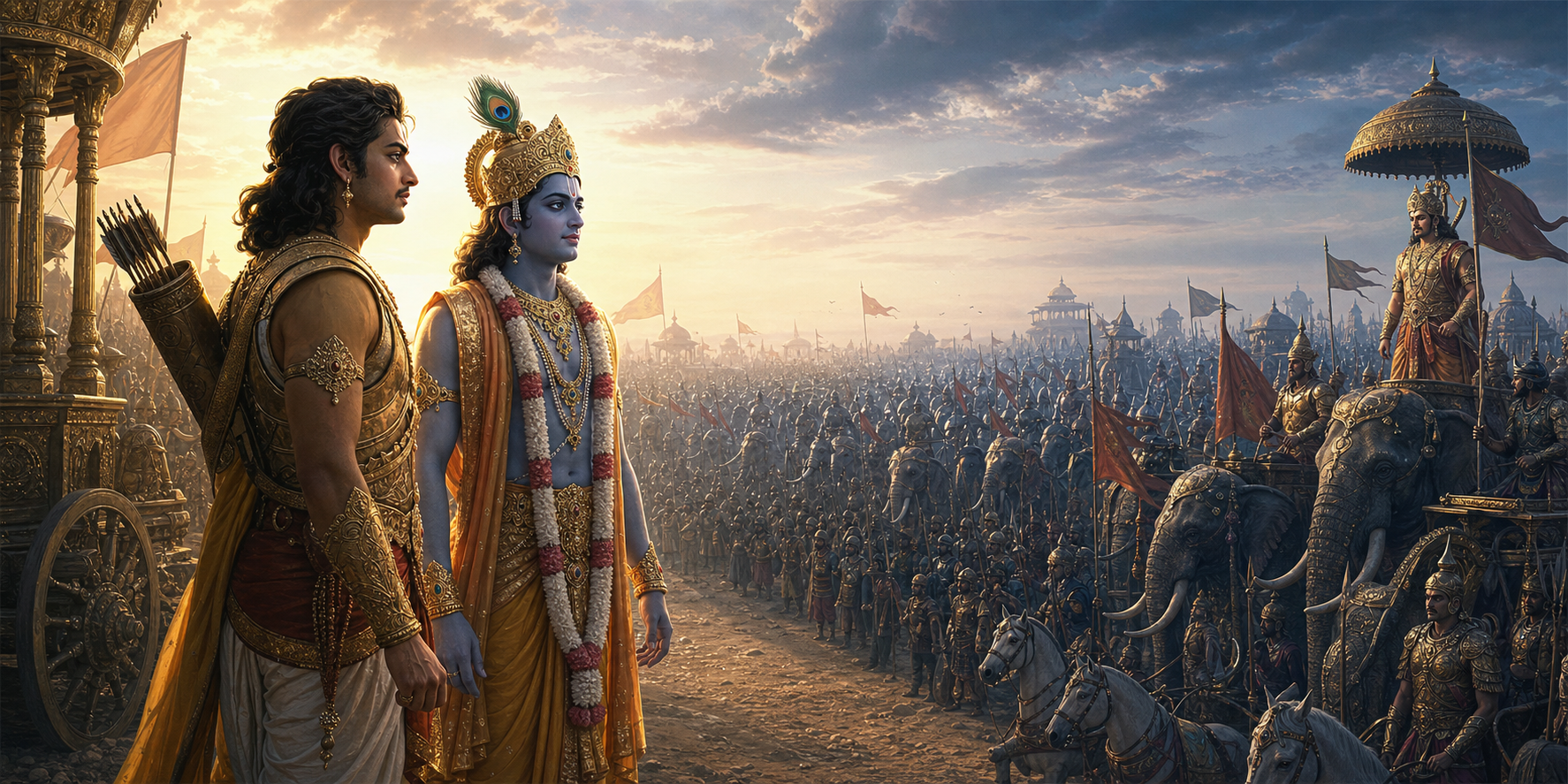
Arjuna’s prewar choice is often reduced to a simple contrast: devotion on one side, military numbers on the other. The episode is more exacting than that. It examines what makes power dependable when the legitimacy, purpose, and personal cost of action are all in question.
Read in relation to Krishna’s later roles as diplomat, charioteer, strategist, and teacher, Arjuna’s decision becomes neither a rejection of material strength nor a promise of effortless victory. It establishes a hierarchy: force remains necessary, but judgment must govern its use.
A choice staged before the battlefield
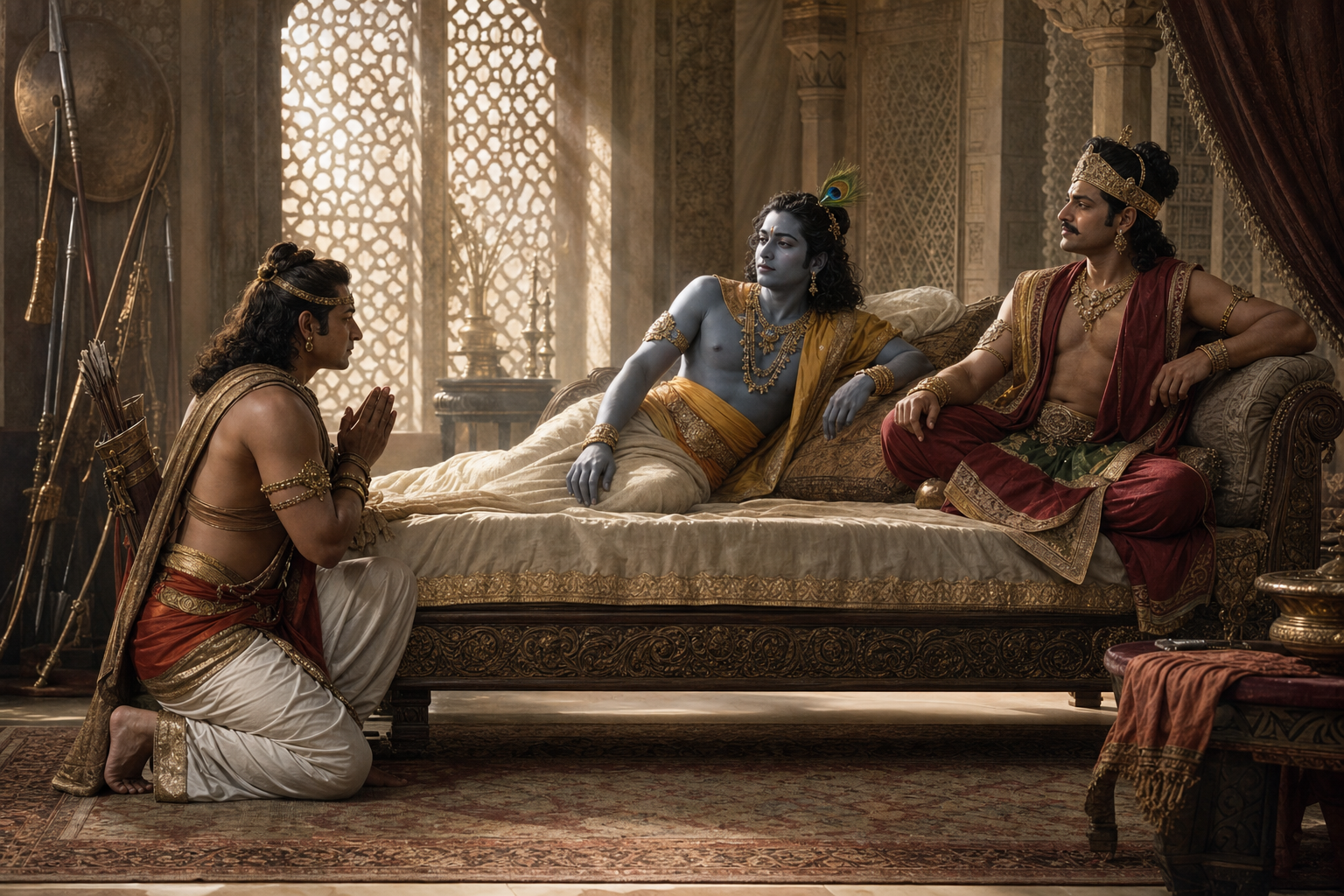
DharmaRenaissance’s earlier account places the encounter in the Udyoga Parva, as both Duryodhana and Arjuna seek Krishna’s assistance before the Kurukshetra War. It reports that Duryodhana arrives first and sits near the resting Krishna’s head, while Arjuna arrives later and stands respectfully near his feet. When Krishna awakens, he sees Arjuna first. Duryodhana claims priority because of his earlier arrival, but Krishna gives Arjuna the first choice on the grounds that he saw Arjuna first and that Arjuna is younger.
The offered alternatives separate personal guidance from visible military capacity. One side may have Krishna himself, unarmed and pledged not to fight; the other may have his formidable Narayani Sena. Arjuna chooses Krishna. Duryodhana, pleased to obtain the army, accepts the force that appears more immediately useful in war.
The positions near Krishna’s head and feet make the scene morally suggestive, but they should not be treated as a mechanical test with a formally announced answer. The source notes that the contrast is often interpreted symbolically: Duryodhana’s posture evokes entitlement and calculation, whereas Arjuna’s evokes reverence and openness to correction. The deeper distinction lies not in seating etiquette alone, but in the dispositions that the subsequent choices reveal.
Two rival definitions of usable power
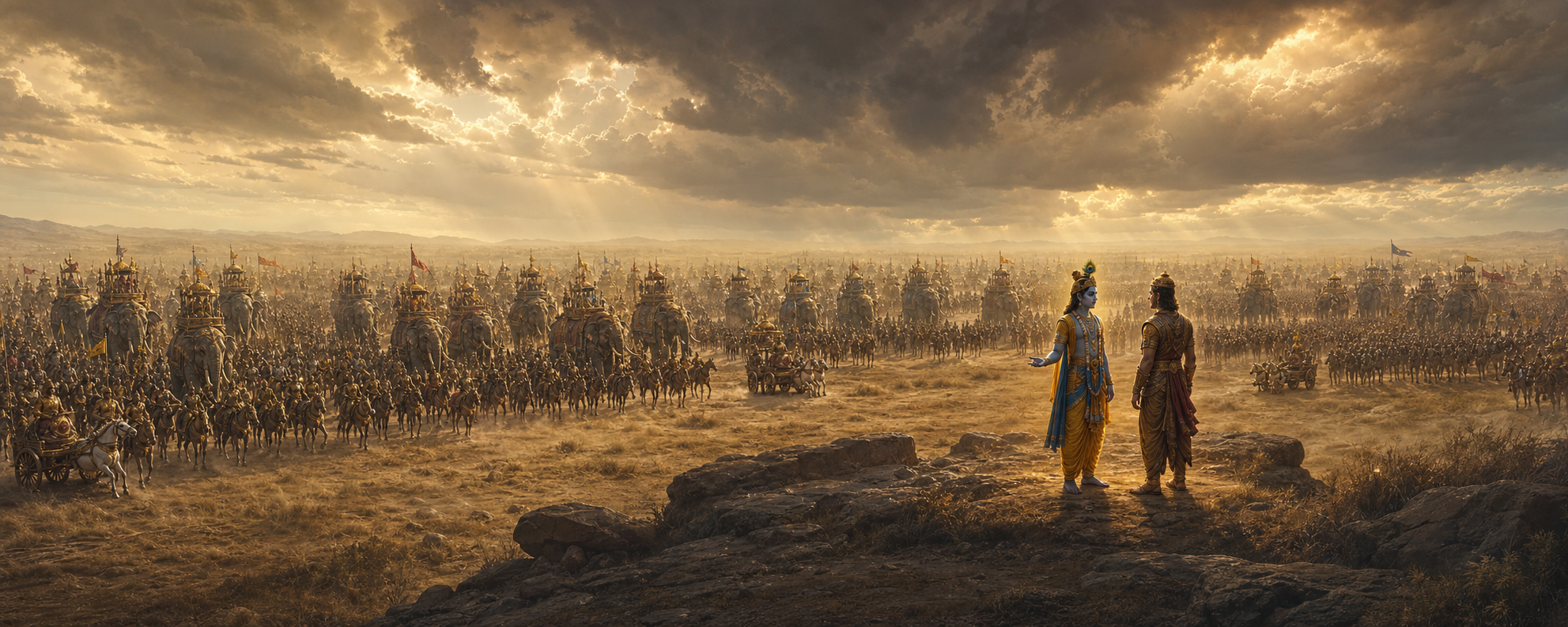
Dismissing Duryodhana’s decision as obviously foolish would weaken the episode. If the problem is defined solely as increasing battlefield capacity, an army is a rational selection and an unarmed ally appears limited. Duryodhana correctly recognizes one form of power; his error is treating that form as sufficient in itself.
Arjuna makes a different assessment of what the conflict will demand. As the source emphasizes, Krishna brings political authority, knowledge of character, strategic intelligence, emotional steadiness, and dharmic direction. None of these resembles an additional battalion, yet each can affect whether existing strength is directed coherently or squandered through confusion, pride, and attachment.
The contrast therefore is not spirituality versus strategy. Krishna’s guidance is strategic precisely because the war is not presented as a neutral contest of weapons. The source situates it after failed peace efforts, violations of justice, and refusal to restore the Pandavas’ due. When a conflict also concerns duty and moral legitimacy, the ability to distinguish necessary action from impulse becomes part of practical competence.
The unarmed charioteer and disciplined agency
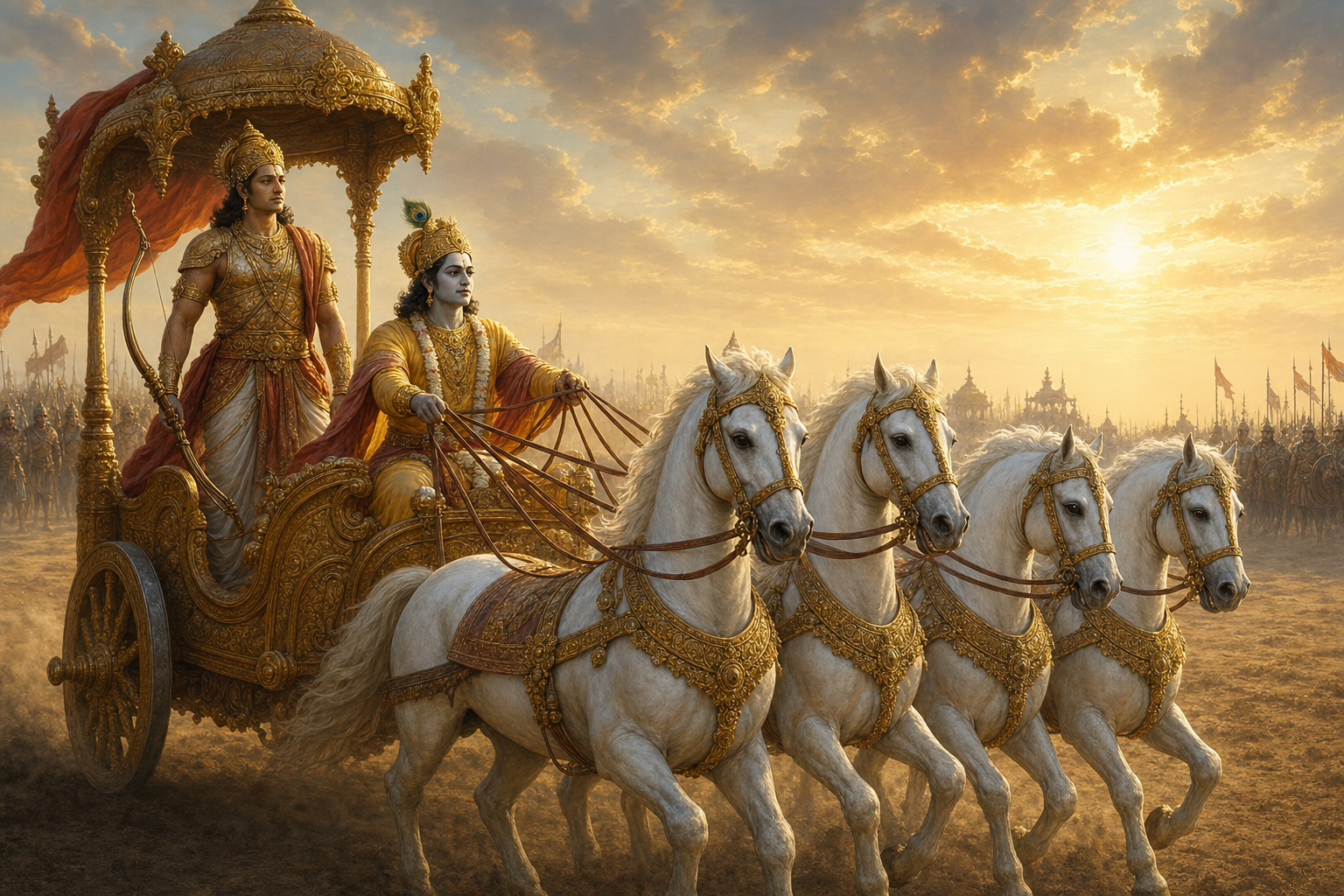
Krishna’s refusal to bear arms sharpens the meaning of Arjuna’s selection. According to the source account, Krishna does not become a divine combatant who removes the Pandavas’ burden. He serves as charioteer, counselor, diplomat, and witness. His self-limitation ensures that Arjuna must still decide, aim, act, and accept responsibility.
The chariot also rearranges ordinary images of status. Krishna, described in the source as a ruler, statesman, and divine figure, takes a role that outwardly resembles service. Yet holding the reins is not insignificance: it means directing movement while leaving the warrior’s task to the warrior. Guidance and agency operate together rather than cancelling one another.
The same account reports that Krishna’s understanding of personalities, vows, weaknesses, timing, and battlefield psychology informs crucial Pandava decisions against warriors who seem otherwise unbeatable. It also acknowledges that these moments remain ethically difficult. Krishna’s presence does not turn dharma into an automatic formula; it provides orientation within circumstances where every available course can carry a cost.
The later crisis reveals the choice’s full value
Arjuna does not yet know the precise form of his need when he chooses Krishna. On the battlefield, as the source recounts, he is overcome by the prospect of fighting relatives, teachers, and friends. More soldiers cannot answer the resulting crisis because it is not a shortage of combat power. It is a collapse of moral and emotional clarity.
The Bhagavad Gita becomes possible within the relationship Arjuna chose earlier. Krishna’s teaching does not replace Arjuna’s agency; it enables him to examine duty and act with restored understanding. The decision before the war thus acquires its deepest significance only when the external struggle exposes an internal one.
This does not make Krishna’s presence a guarantee against suffering. The source stresses that the Pandavas still have to fight, lose loved ones, endure hardship, and bear the consequences of war. Nor does the episode imply that resources and preparation are irrelevant. Arjuna remains a warrior within an army. His choice concerns which authority will govern strength, not whether strength has any place.
That distinction prevents a sentimental reading. Wisdom does not make tragic action painless, and association with a righteous guide does not erase ethical complexity. What it can do is keep action from being determined entirely by fear, ambition, or the apparent advantage of the moment.
Key takeaways
- Krishna’s offer separates unarmed personal guidance from the visible force of the Narayani Sena.
- Duryodhana’s selection is intelligible as a narrow military calculation; its weakness is the assumption that material capacity can direct itself.
- Arjuna chooses a source of strategic, moral, and emotional orientation before knowing how urgently he will need it.
- Krishna’s role as charioteer preserves Arjuna’s responsibility while placing his action under disciplined counsel.
- The outcome does not remove grief or moral ambiguity, so the episode cannot be reduced to a formula for easy success.
For readers carrying the episode into future decisions, the enduring question is not whether measurable resources matter. It is whether those resources are governed by judgment capable of surviving pressure, uncertainty, and moral conflict.