
Gurbani translation is often discussed as a problem of finding the right English words. The two source articles point to a larger task: the translator must carry meaning across languages without treating sacred song as if it were ordinary prose.
One account approaches that challenge through the US release of Prabh Ke Geet and the place of devotional music in diaspora life. The other, centered on Ek Ong Kaar Kaur Khalsa’s work, examines the linguistic and spiritual disciplines involved in translating Gurbani. Read together, they offer a practical framework in which script, sound, interpretation, performance and community use remain connected.
Sacred words are also musical and communal acts
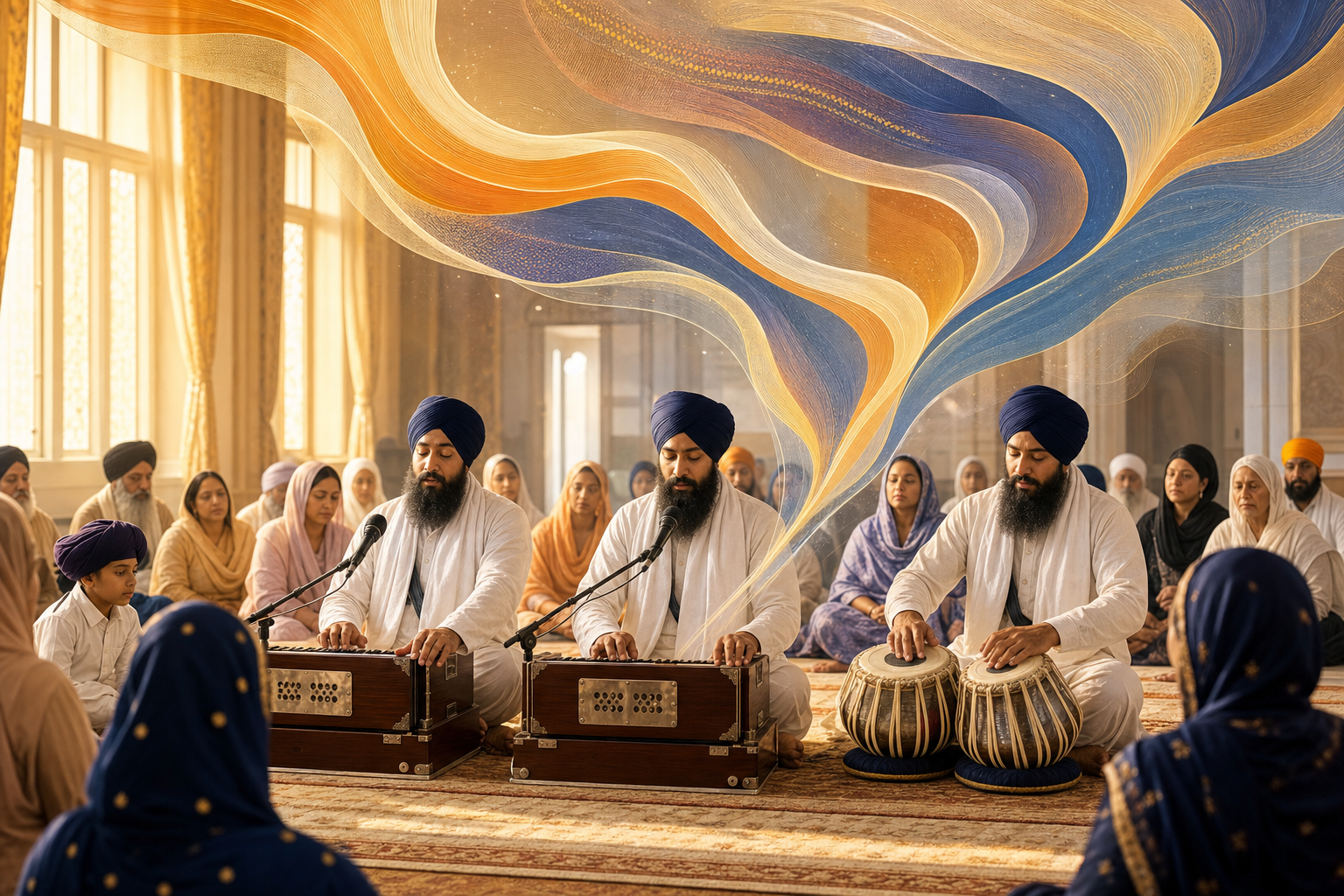
Both sources resist separating Gurbani’s language from its sound. The Prabh Ke Geet article places Sikh shabad kirtan alongside bhajans, Jain stavans and Buddhist chants while respecting their different liturgical settings. It describes devotional song as both text and performance, shaped through melody, rhythm, poetic cadence, repetition and congregational participation.
Translating the Infinite makes the point more specifically about Sikh scripture. It presents Gurbani as Shabad, or revealed Sound, carried in Gurmukhi, organized by raga and embodied through practice. In this account, raga, meter, internal rhyme and recurring sound patterns do not merely decorate a proposition. They help establish its emotional movement, contemplative pace and capacity to be remembered.
The combined implication is that the basic unit of translation cannot always be an isolated sentence. A shabad operates within an ecology that includes pronunciation, poetic structure, musical setting, congregational response and spiritual discipline. An English rendering may therefore be lexically defensible yet incomplete if it obscures how the composition is heard, sung or practiced.
Translation requires semantic, sonic and contemplative fidelity
Semantic fidelity begins with the linguistic density reported in Translating the Infinite. The Guru Granth Sahib contains Punjabi and Sant Bhasha registers as well as Braj, Sanskrit, Persian and Arabic vocabulary. According to that article, responsible interpretation may require attention to grammar, etymology, usage elsewhere in the scripture and respected explanatory traditions. This is why terms such as Naam, Shabad and Hukam cannot always be compressed into single English substitutes.
Sonic fidelity asks what happens to the composition when it crosses scripts. The Prabh Ke Geet article advocates original-script text, systematic Roman transliteration and guidance that supports accurate pronunciation. It also emphasizes raga, taal, meter and refrain as teaching resources. Transliteration in this model is not a decorative middle column: it is the bridge that enables a reader who does not know Gurmukhi to approach the audible form rather than depending entirely on an English paraphrase.
Contemplative fidelity is the distinctive third test proposed in Translating the Infinite. Alongside formal equivalence, which stays close to words and syntax, and dynamic equivalence, which seeks intelligible English, the article asks whether a rendering still serves Gurbani’s transformative purpose. Its discussion of the Mool Mantra illustrates the difficulty. It reports alternatives such as “the Creative Being” or “the Creator” for Karta Purakh, while presenting “Timeless Form” for Akaal Moorat and “by the Guru’s Grace” for Gurprasad. Each choice clarifies something while potentially narrowing another aspect.
No single English line has to bear every explanatory burden. A restrained translation can stand beside the original, transliteration and a short note that identifies legitimate interpretive range. Retaining a term such as Naam or Hukam after an initial gloss can likewise preserve conceptual depth while allowing readers to acquire its meaning through repeated encounters.
A trustworthy edition should make interpretation visible
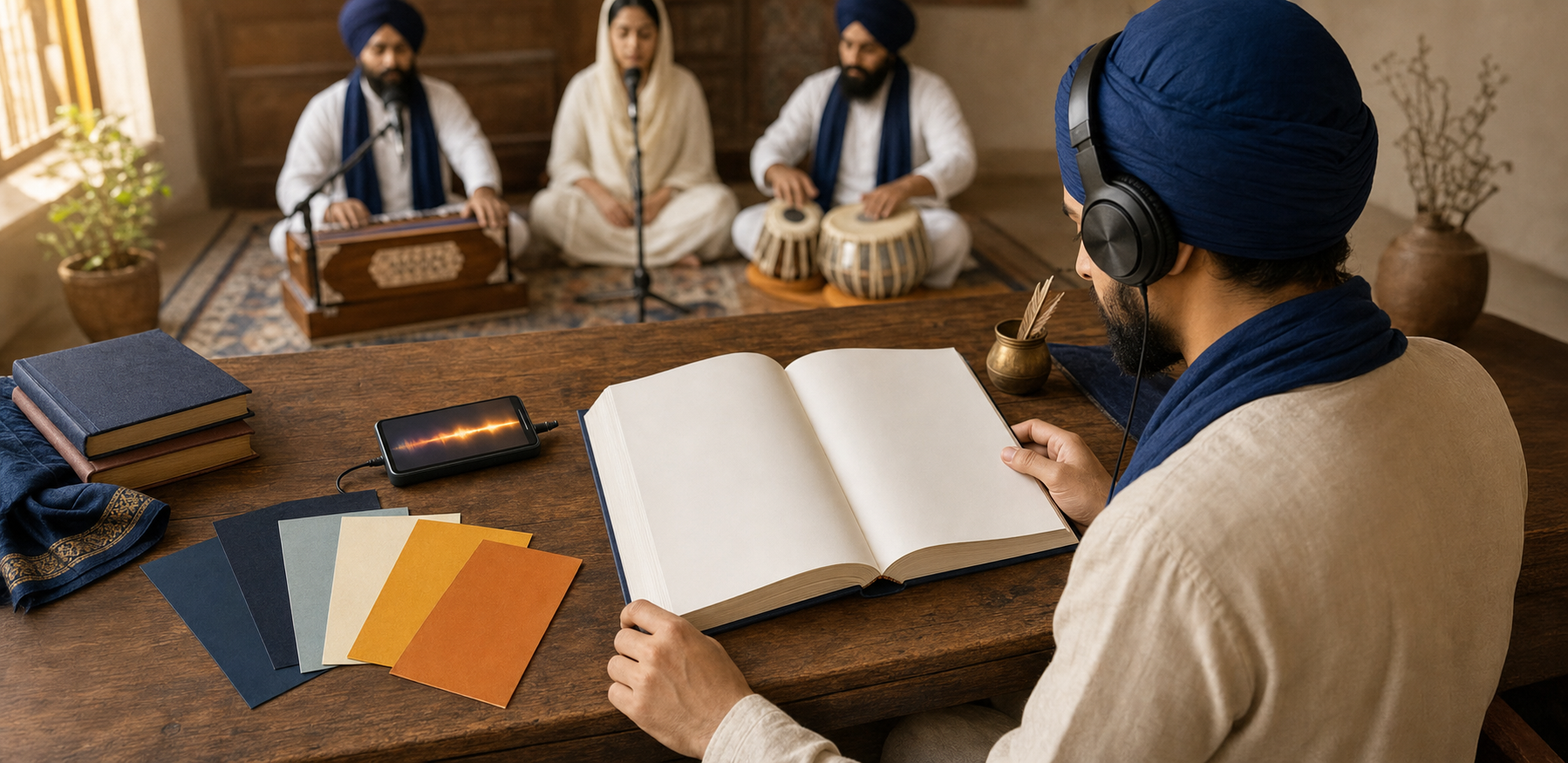
The two accounts converge on an editorial principle: accessibility should be created through layers rather than through simplification. The Prabh Ke Geet article recommends parallel presentation of original script, transliteration and translation, supported by glossaries and unobtrusive notes. Translating the Infinite describes a more detailed workflow that begins with a reliable base text, consults grammars and teekas, moves through close and idiomatic drafts, tests the result with readers, and documents consequential choices.
Combined, those proposals suggest a useful architecture for a printed or digital Gurbani edition. The reader should be able to distinguish the source text from phonetic assistance, a close semantic rendering, a more readable interpretation and contextual commentary. Raga information and performance guidance should remain attached to the composition rather than being relegated to unrelated background material.
The same principle applies online. The Prabh Ke Geet account proposes linked recordings, tutorials and consistent metadata, while Translating the Infinite points to version-controlled drafts, searchable corpora and structured markup capable of preserving lineation, raga information and meter. These are complementary functions. Audio makes the sonic dimension available; structured text and revision histories make interpretation inspectable.
Transparency also prevents a devotional paraphrase from quietly acquiring the authority of a literal translation. Notes need not overwhelm the page, but they should tell readers when a rendering is relatively direct, when English idiom required rearrangement and when a theological term remains open to more than one responsible reading.
Diaspora communities are participants, not merely audiences
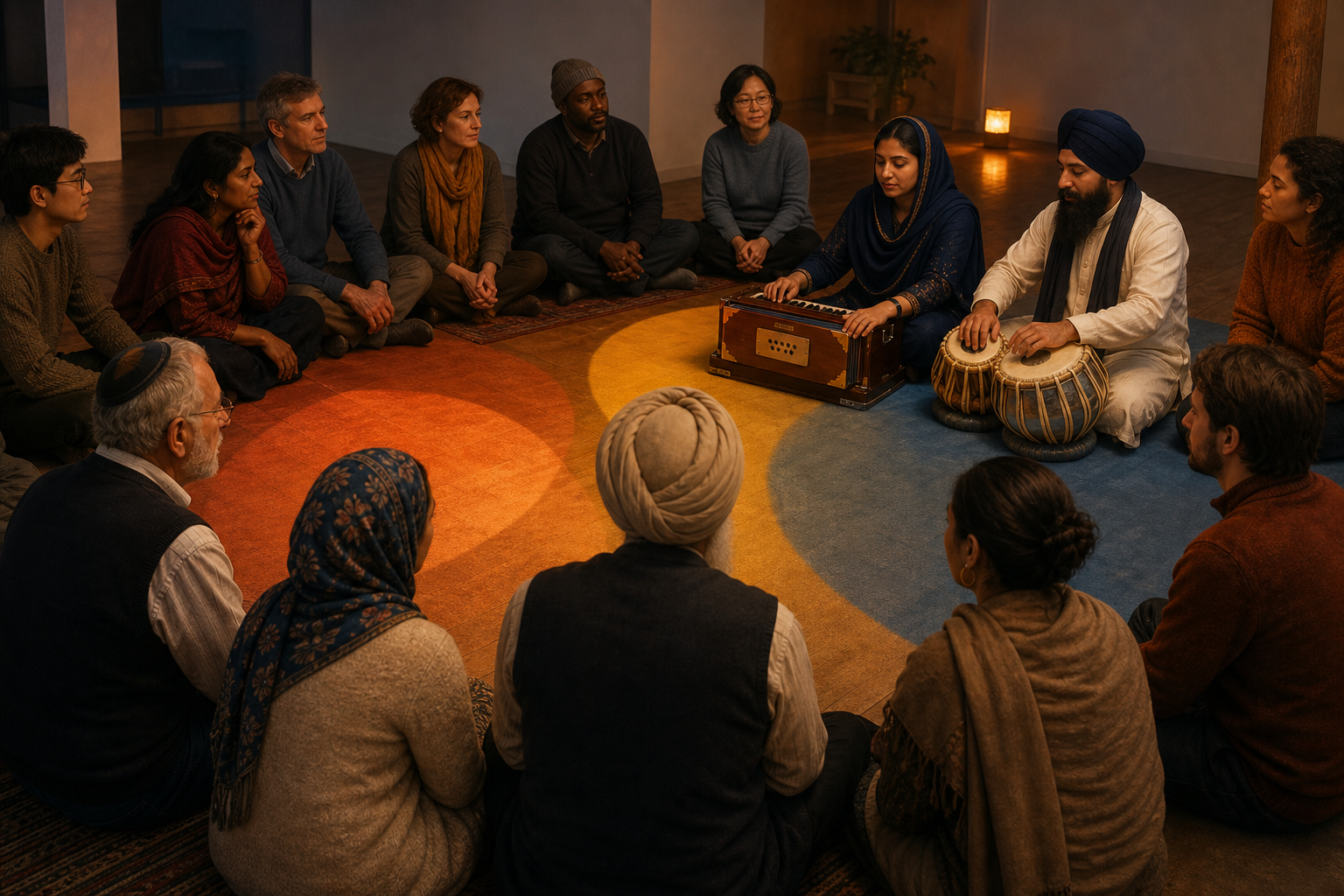
The diaspora setting gives these editorial questions practical urgency. The Prabh Ke Geet article describes devotional song as a form of cultural teaching through which children encounter language, elders sustain memory and mixed-proficiency congregations participate through melody and refrain. It also envisions temples, gurdwaras, community centers and university groups using transliteration, brief introductions and carefully curated performances to welcome newcomers without erasing liturgical distinctions.
Translating the Infinite adds an important method of accountability: testing translations in sangats and study circles. Community use can reveal whether a passage is understandable, theologically misleading or devotionally inert. This does not replace philology or grant popularity the final word. It recognizes that a translation intended for prayer, study and service should be evaluated in those settings as well as at a desk.
The interfaith possibilities require similar care. The Prabh Ke Geet article highlights shared devotional vocabularies and practices across Sikh, Hindu, Jain and Buddhist communities. Translating the Infinite identifies resonances involving unity, compassion, truthful living, remembrance and many-sided understanding, but also warns against sectarian claims and comparisons that flatten distinct teachings. The useful middle path is contextual hospitality: explaining a Sikh term clearly enough for another community to approach it while allowing it to remain grounded in Sikh scripture and practice.
Key takeaways
- A Gurbani translation should be assessed as language, sacred sound and contemplative guidance, not as English prose alone.
- Original script, systematic transliteration, translation and concise commentary serve different purposes and should remain visibly distinct.
- Raga, meter, pronunciation and audio access belong within the interpretive framework because performance carries meaning.
- Sangat feedback can test clarity and devotional usefulness, while documented linguistic work protects against convenient but unsupported readings.
- Interfaith presentation is strongest when it identifies genuine resonances without absorbing Sikh concepts into a generic spirituality.
Future editions can treat each translated shabad as a documented learning environment: accessible enough for a first encounter, layered enough for long study, and continually answerable to both the Guru’s language and the sangat’s living practice.


References
- DharmaRenaissance Blog — Prabh Ke Geet Debuts in the USA: A Powerful Devotional Bridge Across Dharmic Traditions
- DharmaRenaissance Blog — Translating the Infinite: Ek Ong Kaar Kaur Khalsa on Gurbani, Meaning, and Unity