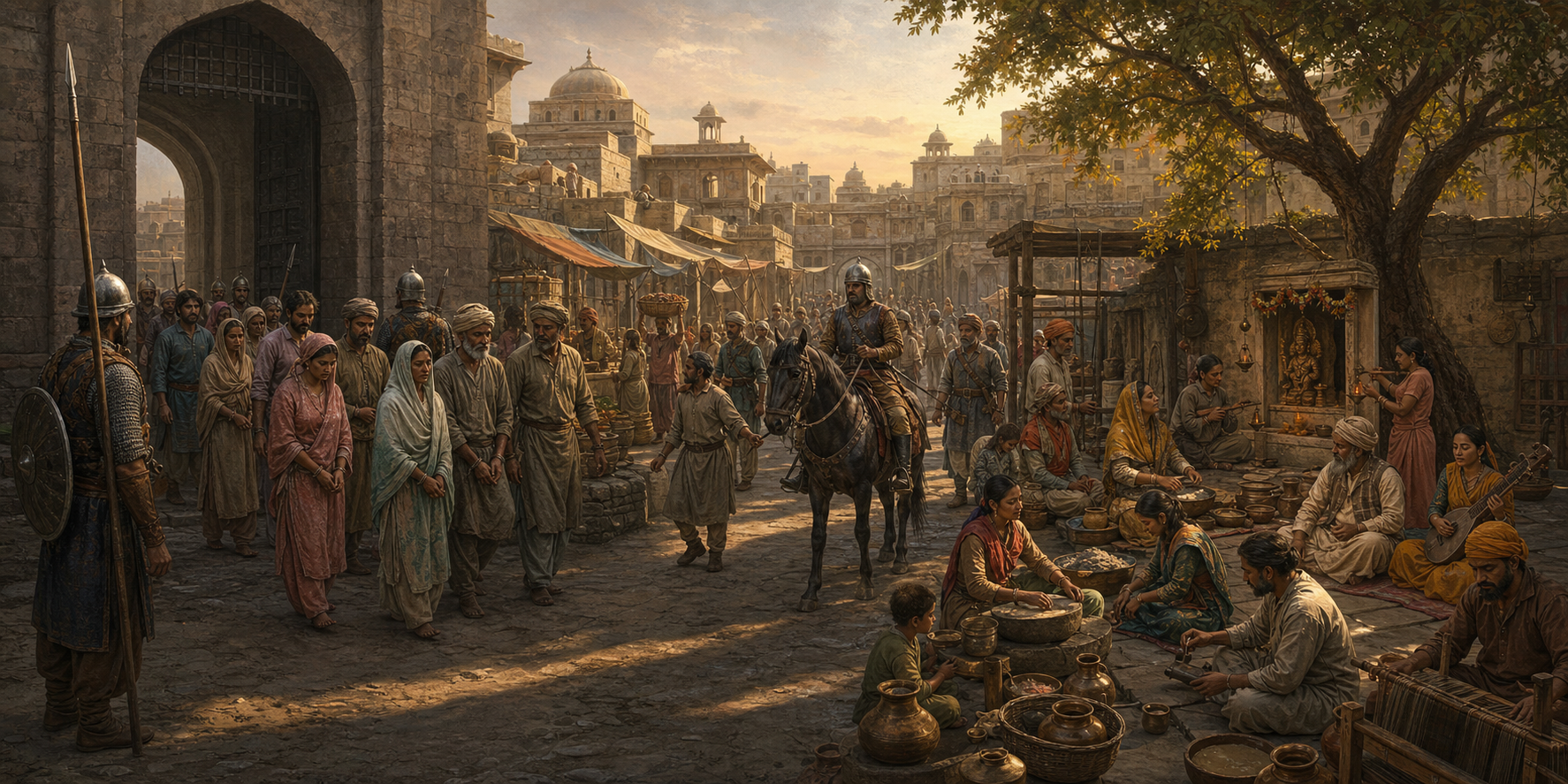
Medieval Indian slavery is best understood not through a single disputed total, but through the institutions that connected warfare, captivity, markets, households, royal workshops and court politics. That wider view also clarifies what dharmic resilience meant in practice: survival under pressure, adaptation to insecurity and the preservation of community life.
The supplied DharmaRenaissance article combines evidence about these systems with a debate over their scale and a reflection on public memory. Read critically, it supports a history that neither minimizes coercion nor treats every reported figure, region or period as interchangeable.
Bondage operated through several connected institutions
According to the article, people could be enslaved under various sultanates through warfare, punitive expeditions, debt and purchase. Court interpretations of Islamic jurisprudence intersected with political and elite practices governing sale, inheritance, gifts, marriage and manumission. Bondage was therefore more than an incidental consequence of conquest: it could become embedded in legal, fiscal and kinship arrangements.
The article distinguishes among military slaves, household servants, concubines and eunuchs known as khwajasara. These roles differed greatly in authority and living conditions. Some military retainers entered elite networks, while domestic captives remained subject to household power. Eunuchs could guard royal quarters, control access and carry sensitive communications, yet the article also emphasizes the dislocation, bodily injury and lifelong servitude associated with forced castration. It acknowledges that the number of victims is difficult to establish.
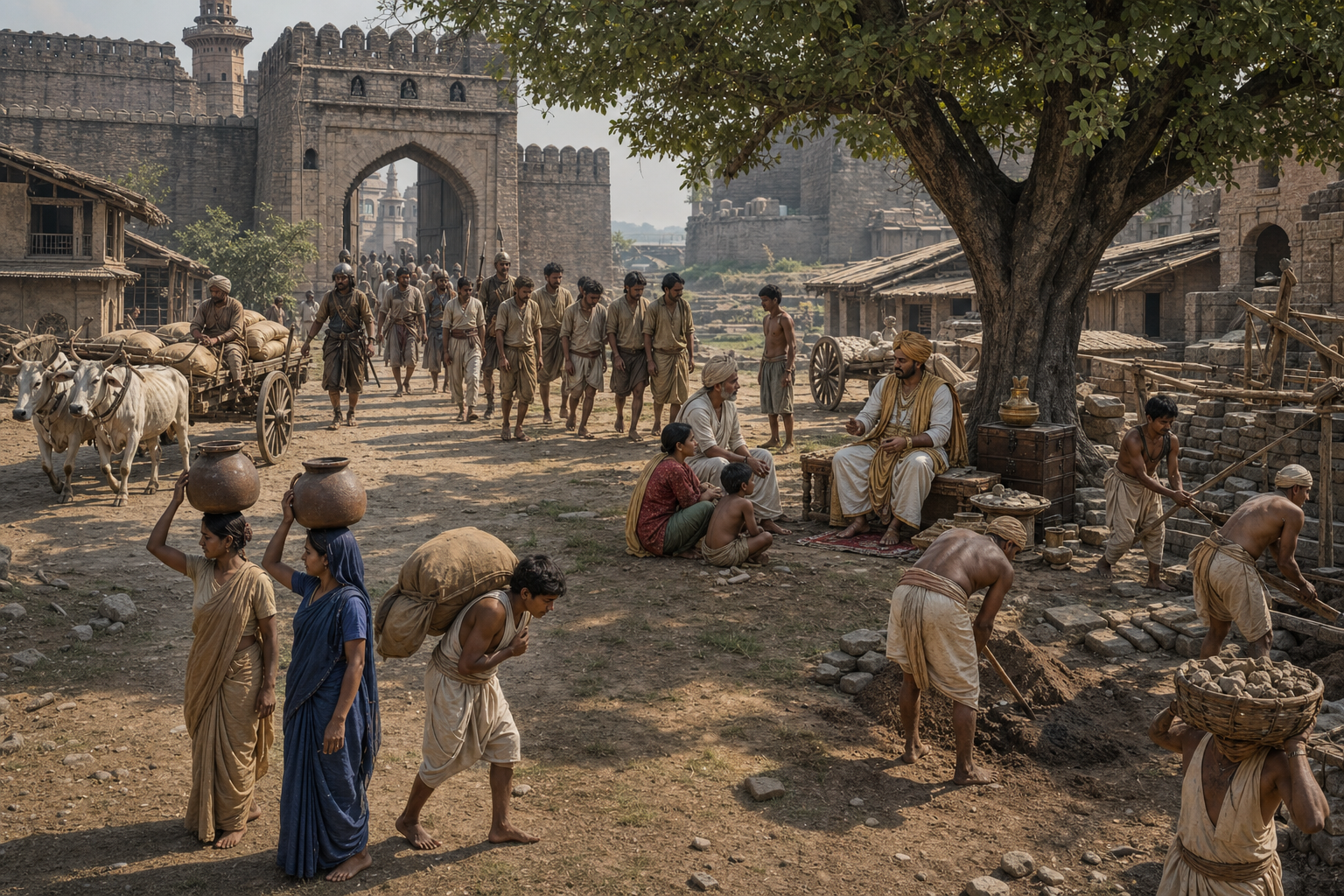
Economic administration provides another measure of institutional depth. The article reports that Ziya al-Din Barani described slaves as falling within Alauddin Khalji’s system of market oversight, alongside other resources important to the military economy. Price regulation did not soften bondage; it treated captive labor as something that could be provisioned and exchanged. Royal karkhanas reportedly used enslaved people among their workforces to produce textiles, weapons, luxury goods and construction materials.
Monumental architecture must consequently be interpreted on two levels. Fortifications, palaces and planned cities express political ambition and technical achievement, but the article argues that their grandeur should not conceal the coercive labor and agrarian extraction supporting them. Admiration for a surviving structure does not require silence about the conditions under which resources and labor may have been mobilized.
Elite advancement and mass coercion were not opposites
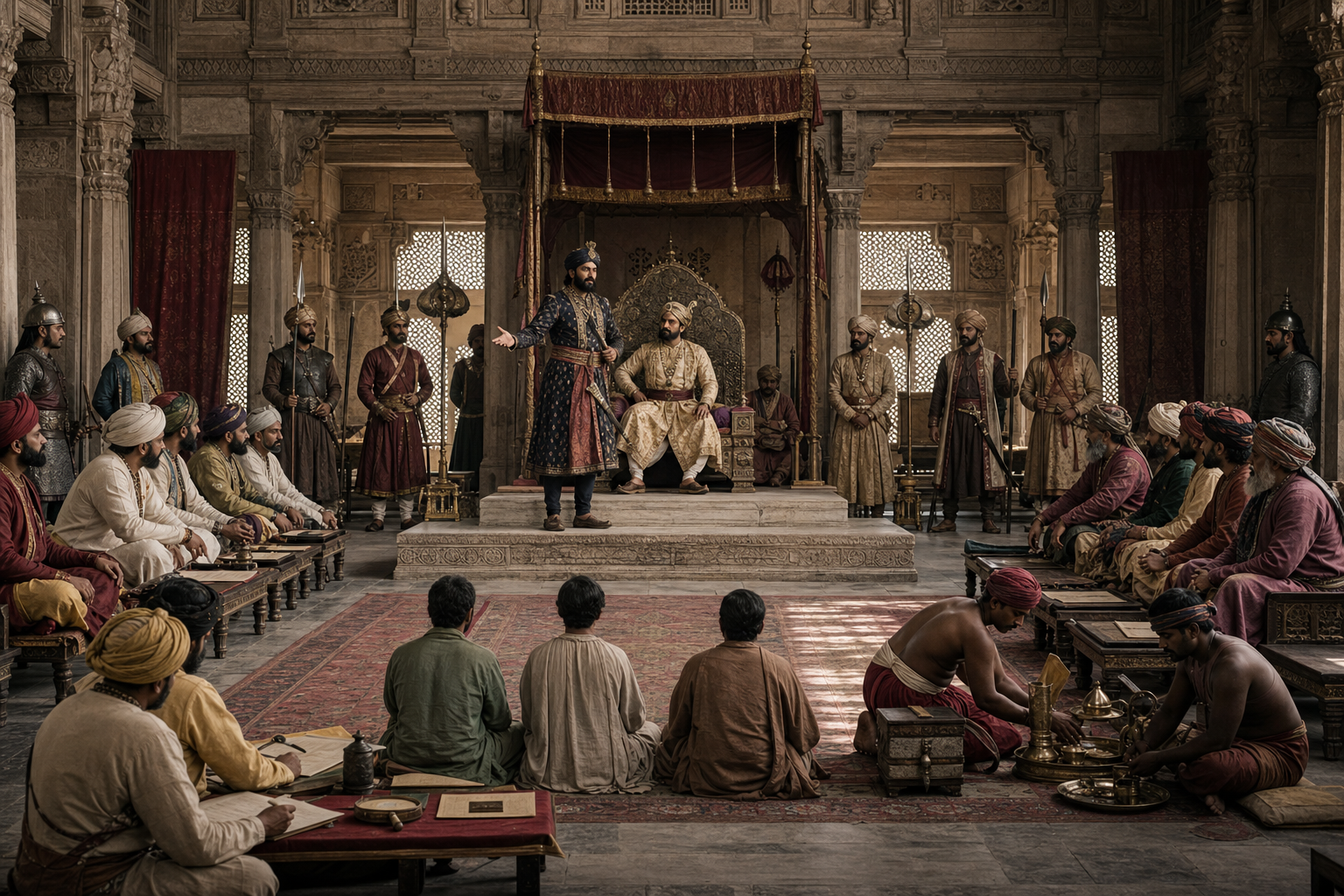
The most striking paradox is the rise of former military slaves to sovereign power. The article identifies Qutb al-Din Aibak, Shams al-Din Iltutmish and Ghiyas al-Din Balban as men who had been purchased as military slaves before advancing through patronage and martial service. It reports that Minhaj-i Siraj’s Tabaqat-i Nasiri and Barani’s Tarikh-i Firoz Shahi attest to the importance of slave-retainer networks in court politics.
Such mobility does not disprove the coercive character of slavery. It instead shows how a political order could use personal dependency as a route to trusted service. An exceptional retainer might accumulate power while the institution continued to expose many other captives to sale, separation and compelled labor. The existence of powerful former slaves therefore describes one feature of the system, not the typical prospects of everyone held within it.
Scale requires a separate judgment. The article presents K. S. Lal as assembling evidence for extensive enslavement, while noting that Richard Eaton, Peter Jackson, Sunil Kumar and Satish Chandra favor more conservative demographic conclusions or emphasize regional variation, episodic intensity and source bias. The defensible common ground, as the article frames it, is the institutional presence of slavery in warfare, government and elite households. That agreement should not be converted into certainty about every numerical claim.
A source-conscious reading should distinguish the existence of an institution from its prevalence, captives taken in a particular campaign from cumulative totals, and a chronicler’s description from demographic proof. In the present evidence base, the named chronicles and modern historians are known through the supplied article rather than through separate examination of their original works. Their positions are therefore reported here, not independently verified.
Dharmic resilience included retreat, adaptation and remembrance
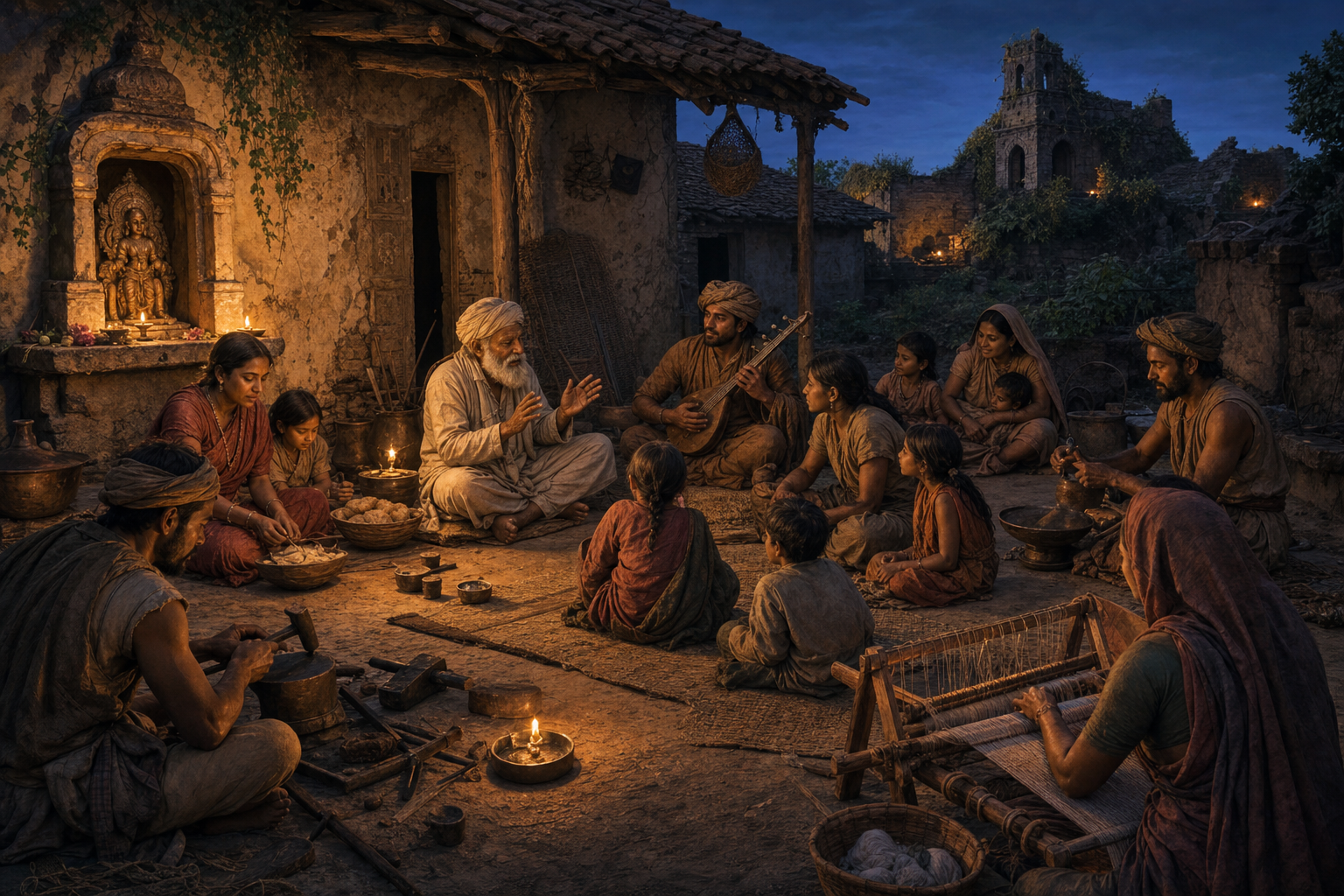
Resistance did not always take the form of a battlefield victory. The article describes communities moving toward forests, hills and marshlands to reduce their exposure to raids, captivity and coercive taxation. Such flight could exchange fertile or commercially connected locations for greater security. Under that interpretation, withdrawal was not simple passivity but a strategy for preserving families, worship and collective continuity.
The article further suggests that repeated displacement affected settlement patterns, social boundaries and frontier environments. This connection deserves caution because contemporary chronicles and later ethnographic patterns belong to different evidentiary layers. Later social geography may preserve the effects of insecurity, but it cannot by itself establish a single cause for every community or jati formation.
Intellectual awareness is another dimension of resilience. The article invokes Ram Swarup’s criticism that Hindu scholarship sometimes continued along inherited paths without adequately studying the motives or institutions of new political powers. His example concerns scholarly activity associated with the intellectual world of Sri Ramanujacharya during the era of Malik Kafur’s southern campaigns. This is best read as a normative warning against disengagement, not as proof that all religious scholars were unaware of political violence.
The article also connects medieval memory with family recollections of Partition and the violence of 1971 in the region that became Bangladesh. That comparison can illuminate how communities organize memories of repeated loss, but distinct eras should not be collapsed into one continuous institution or event. Intergenerational memory is an ethical and cultural phenomenon; it is not a substitute for period-specific historical evidence.
Key takeaways
- Medieval Indian slavery involved interconnected military, domestic, commercial and administrative practices rather than one uniform condition.
- The rise of a few former military slaves to political authority demonstrates elite mobility within the system, not the absence of coercion.
- Historians cited by the supplied article differ over demographic scale, even as the article identifies broader agreement that slavery was institutionalized.
- Dharmic resilience included armed defense, strategic migration, cultural continuity and the later work of preserving historical memory.
Public memory needs evidence, context and ethical limits
The article argues that museums and sustained exhibitions addressing medieval captivity and dharmic resistance remain sparse, while singling out the Chhatrapati Shivaji Maharaj Museum created by Francois Gautier. The larger need is not for a memorial culture built around accusation, but for institutions capable of showing evidence, disagreement and human experience together.
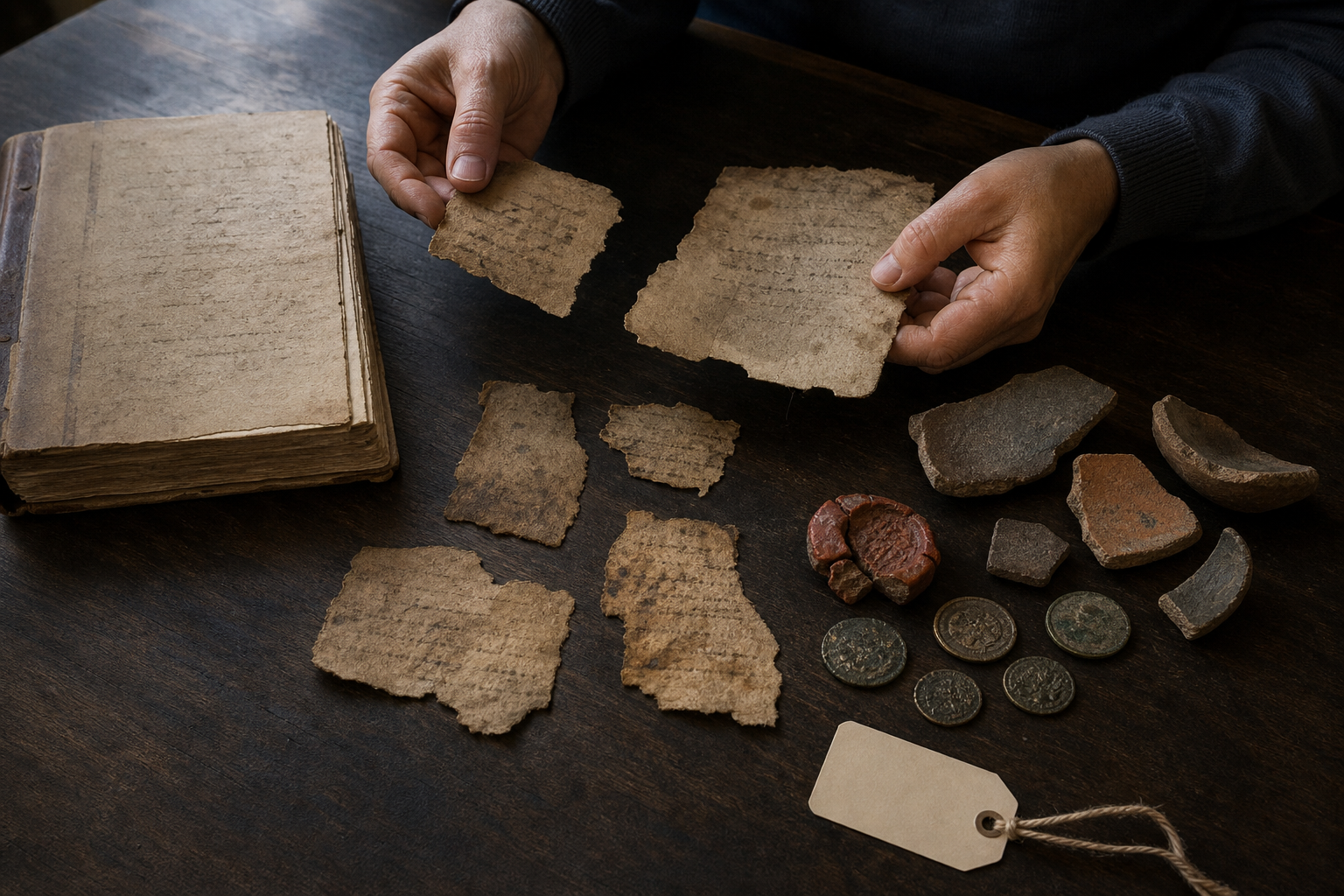
That standard can guide museums, curricula and digital archives. Exhibitions should identify whether a claim comes from a chronicle, administrative text, later historical interpretation or oral memory. Educational material should separate institutional evidence from contested estimates. Digitization and translation can widen access to Persian, Sanskrit and regional-language materials while preserving information about editions, provenance and uncertainty.
The ethical boundary is equally important. Remembering enslaved and displaced communities need not assign inherited guilt to people living centuries later. The article’s proposed combination of courage and compassion offers a productive direction: historical inquiry can acknowledge targeted suffering, honor Hindu, Buddhist, Jain and Sikh endurance, and reject the use of the past as permission for present-day prejudice. A durable culture of remembrance will depend on making evidence easier to examine and disagreement safer to discuss.