
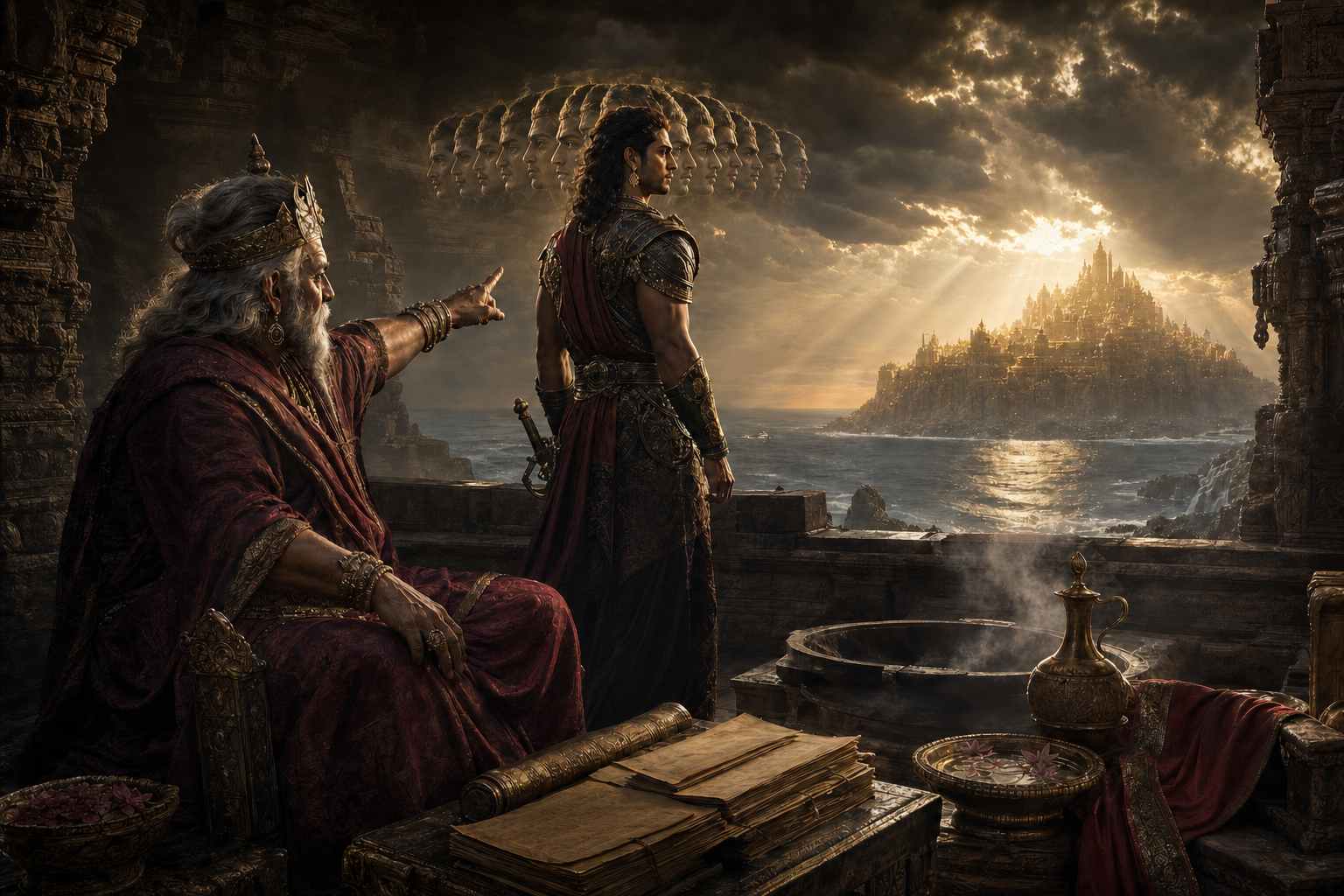
If you are trying to decide how much credit—or blame—Sumali deserves for Ravana, the clean answer is this: Sumali designed Ravana’s route to power, but he did not dictate the choices Ravana made once he possessed it.
That distinction changes how you read the struggle for Lanka. Ravana was neither an isolated prodigy nor a passive instrument of his grandfather. He was the beneficiary of a long dynastic project involving lineage, marriage, education, tapas, boons and political counsel. Sumali assembled the conditions for ascent; Ravana converted them into conquest and then attached his own moral character to the throne.
Begin with the family tree, because it is also a map of power
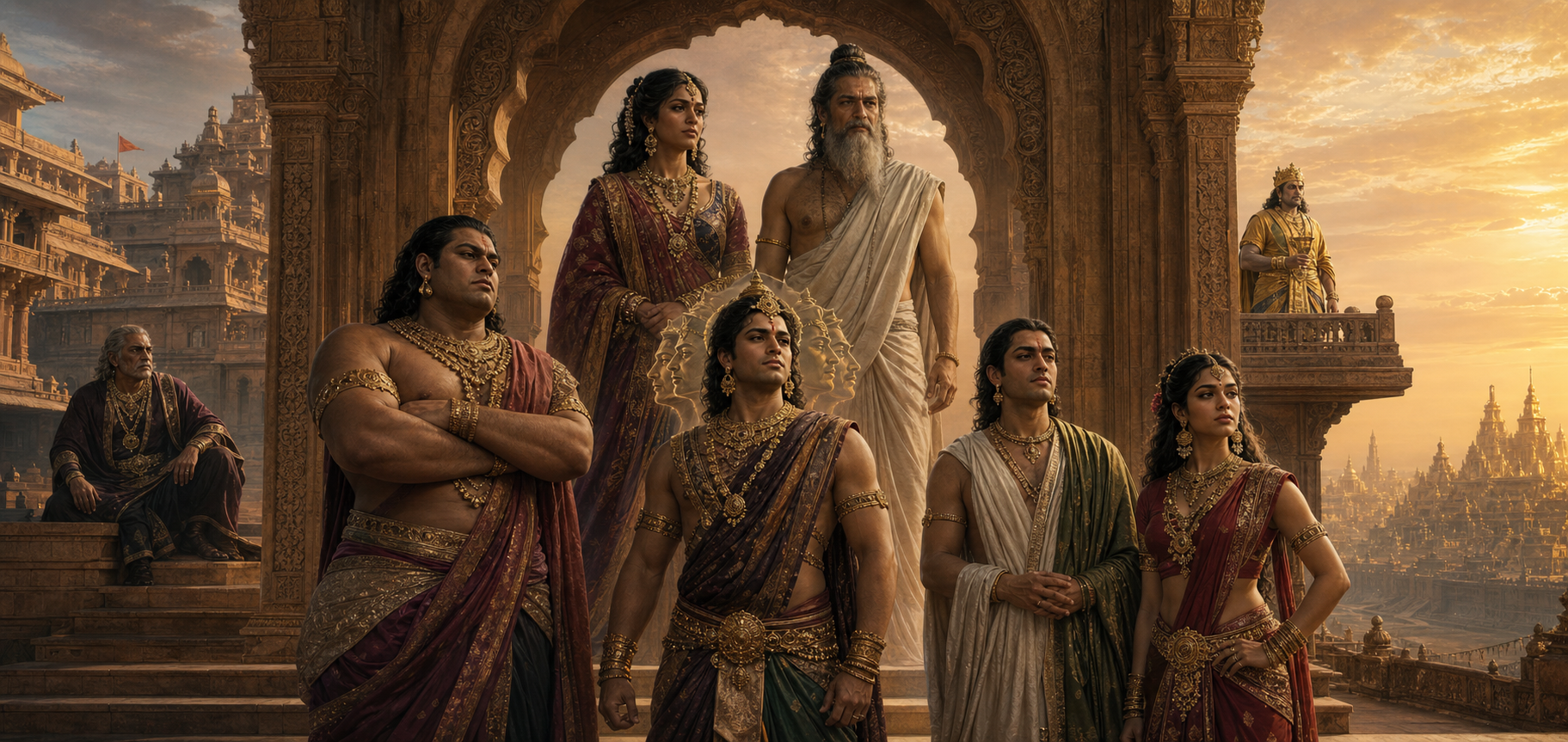
Sumali’s importance becomes visible when you stop treating genealogy as background information. In this part of the Ramayana, descent is political infrastructure. It establishes access to spiritual authority, inherited claims and alliances that raw strength alone cannot provide.
- Pulastya, a mind-born son of Brahma, stands at the beginning of the relevant rishi lineage.
- Vishrava descends from Pulastya and carries the authority associated with austerity and sacred learning.
- Vishrava and Ilavida are the parents of Kubera, the yaksha ruler of Lanka.
- Sumali is the father of Kaikesi, who approaches Vishrava and becomes the mother of Ravana, Kumbhakarna, Vibhishana and Shurpanakha.
- Kubera and Ravana are therefore paternal half-brothers, not unrelated kings competing for an arbitrary island.
This arrangement placed two branches of Vishrava’s family on opposing sides of Lanka’s succession. Kubera represented yaksha sovereignty joined to the same elevated paternal line that Ravana would later claim. Sumali recognized that defeating such a ruler required more than assembling another rakshasa army. His house needed a successor whose ancestry could rival Kubera’s as well as a warrior whose force could overcome him.
That is why Sumali chose Vishrava for his dynastic plan. A union between Kaikesi and Vishrava could combine rakshasa inheritance with the prestige of the Pulastya line. The resulting children would not merely possess strength; they would stand inside the same extended family as the ruler they were meant to displace.
Do not erase Kaikesi while noticing Sumali’s strategy. Sumali directed the match, but Kaikesi had to approach Vishrava and live with its consequences. Vishrava warned her that the time of her approach was inauspicious and that formidable, fearsome sons would result. Her piety and restraint are also associated with Vibhishana’s sattvic disposition. Sumali supplied the objective, while Kaikesi became the human hinge on which the plan turned.
Sumali advanced Ravana through four calculated moves
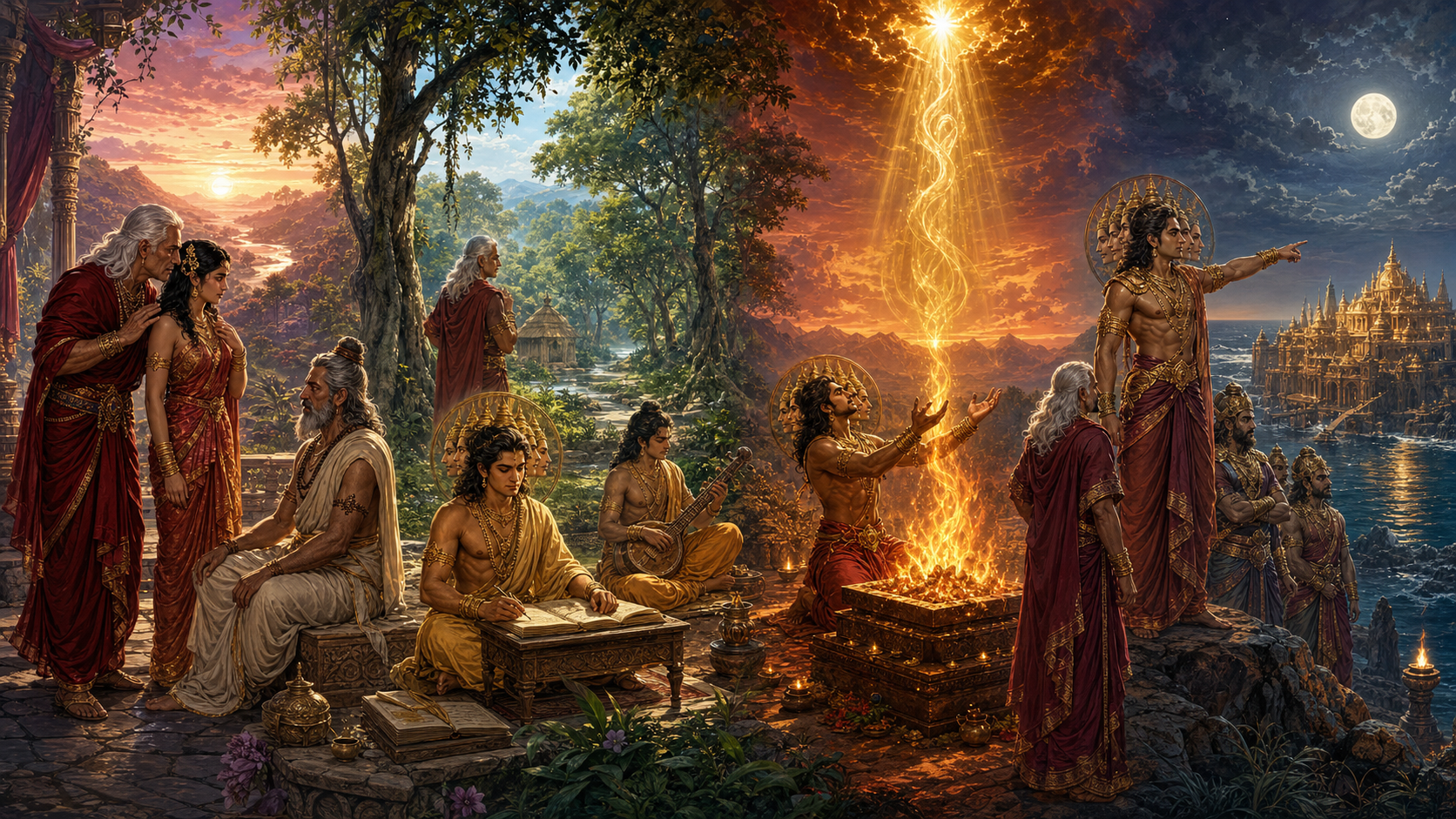
Calling Sumali “ambitious” is accurate but incomplete. What distinguishes him is the sequence by which he turned a dispossessed family’s memory into a viable transfer of power.
- He diagnosed exile as a dynastic problem. When Sumali saw Kubera’s splendour, he did not respond with an immediate attack. Kubera possessed Lanka, wealth, the Pushpaka Vimana and a prestigious connection to Vishrava. Sumali understood that his fragmented house first needed a successor capable of matching that concentration of advantages.
- He used marriage to fuse competing sources of legitimacy. Directing Kaikesi toward Vishrava joined rakshasa lineage to rishi ancestry. The marriage was not incidental to Ravana’s rise; it created the candidate around whom a restored rakshasa polity could be built.
- He allowed inherited potential to become exceptional capacity. Vishrava’s children received education within the disciplines of sacred knowledge and statecraft. Ravana and his brothers later undertook tapas and obtained boons from Brahma, while Ravana’s propitiation of Shiva further sharpened his power. Sumali did not perform these austerities for Ravana, but his original match made this combination of inheritances possible.
- He converted capacity into a territorial claim. Once Ravana was powerful enough, Sumali urged him to take Lanka from Kubera. Ravana then displaced his half-brother and seized the Pushpaka Vimana, completing the political objective around which Sumali’s dynastic work had been organized.
This sequence lets you define Sumali’s role precisely. He was not Ravana’s source of supernatural protection, the conqueror who captured Lanka or the sovereign who later ruled it. He was the sponsor, matchmaker, succession planner and political counsellor who made those later achievements plausible.
There is also an important limit to the language of “recovery.” Traditions do not present one uniform account of Lanka’s earliest sovereignty. Some preserve an older rakshasa association with the city; others emphasize its construction by Vishvakarma, its connection with Kubera or an association with Shiva’s golden city. Sumali could frame Ravana’s campaign as the return of an ancestral capital, but you need not treat that political framing as an uncontested property record. The variation preserves competing memories of possession, displacement and return.
Why Sumali’s design succeeded so completely
Sumali’s plan worked because it joined three things that are often confused: the ability to seize power, a story that can justify power and a ruler willing to act. Remove any one of them and Ravana’s rise becomes less likely.
Ravana acquired the power to win
Rakshasa vigour alone had not restored Sumali’s exiled house. Ravana added learning, tapas and divine boons to that inheritance. Kumbhakarna embodied immense force, while the siblings as a group demonstrated the extraordinary range produced by the union of Kaikesi and Vishrava.
The boons should not be read as certificates of moral innocence. They function within a transcendental order: austerity produces consequences, power comes with stated conditions, and even an immensely protected being remains responsible for how that protection is used. Ravana received greater room to act, not permission to abandon dharma.
His ancestry supplied a claim that force could not
By making Ravana a son of Vishrava, Sumali placed his grandson within a lineage that could compete with Kubera’s. The conquest was still coercive, but it was no longer the advance of an unrelated outsider. It became an intra-dynastic struggle between half-brothers attached to different maternal peoples and different visions of Lanka.
This is the deeper purpose of the marriage strategy. Sumali did not merely seek powerful grandchildren. He sought descendants who could make rakshasa restoration appear genealogically coherent. In political terms, the family tree supplied a narrative of rule at the same time that Ravana’s strength supplied enforcement.
Sumali knew when to turn preparation into action
Timing separates long-range strategy from fantasy. Sumali did not press an unprepared child into war with Kubera. The demand for Lanka came after Ravana’s abilities and protections had matured. The subsequent conquest of Lanka and seizure of Pushpaka show that Sumali’s chosen successor had become strong enough to realize the plan.
A guṇa-based reading sharpens the point. Sumali turns the inertia of dispossession into purposeful rajas: he observes, plans, waits and acts through family institutions. Yet rajas cannot preserve a realm by itself. Without sustained sattva, political energy becomes appetite, domination and refusal to accept correction. Sumali solved the problem of acquiring power; he did not solve the harder problem of governing desire.
Ravana’s rise and Ravana’s adharma must not be assigned to the same hand
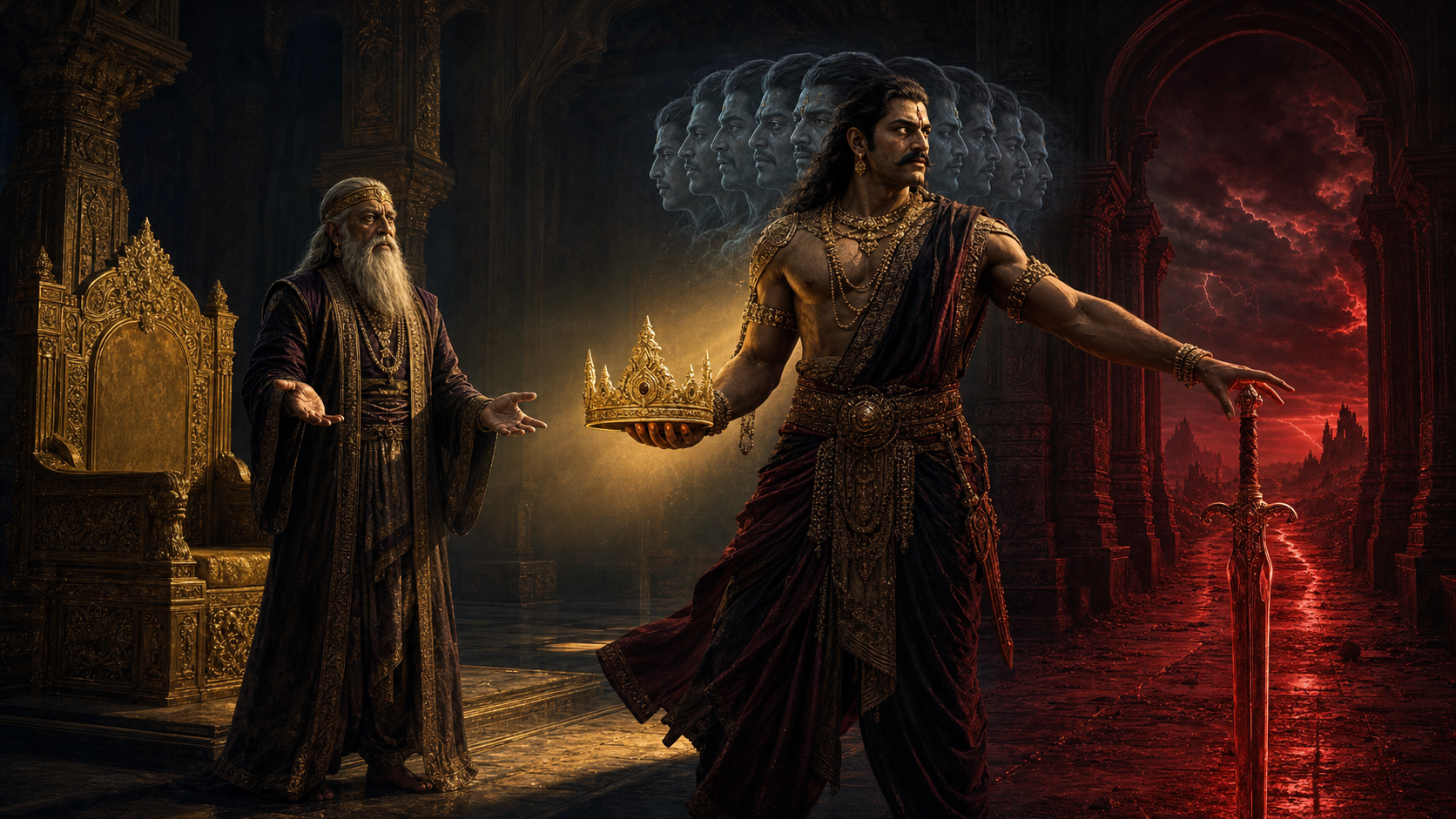
It is tempting to make Sumali responsible for everything his grandson later did. That reading gives the strategist too much power and the sovereign too little agency. Sumali deliberately cultivated a formidable claimant, but Ravana chose what kind of king that claimant would become.
The strongest evidence is found inside the same family. Vibhishana shares Ravana’s parents and much of his inherited environment, yet he chooses dharmic counsel over unconditional loyalty to blood. Malyavan, Sumali’s elder kinsman and a senior statesman in Ravana’s court, also urges prudence during the crisis involving Sita. Their presence means the rakshasa polity cannot be reduced to one collective moral nature. It contains conquest, preservation, restraint and truth-speaking at the same time.
Vibhishana is especially important when you assess causation. If Sumali’s lineage project mechanically produced adharma, Vibhishana’s conduct would be difficult to explain. His different path demonstrates that ancestry creates capacities and pressures, not moral inevitability. Ravana cannot transfer responsibility for his refusals to his maternal grandfather, his race, his boons or the circumstances of his birth.
That does not make Sumali ethically neutral. A succession planner is responsible for the qualities he rewards and the risks he leaves unaddressed. Sumali optimized for the recovery of sovereignty: lineage, force, endurance and ambition all served that goal. The narrative’s warning about the fearsome disposition of Kaikesi’s sons reveals the danger built into such a design. A ruler capable of defeating every external rival still requires the inner discipline to hear unwelcome counsel.
A fair judgement therefore separates three layers of responsibility. Sumali is responsible for constructing the pathway. Kaikesi and Vishrava are indispensable to the formation and education of the children, without being reducible to Sumali’s instruments. Ravana is responsible for using the resulting power. This distinction lets you acknowledge Sumali’s strategic brilliance without excusing the adharma that eventually overshadowed Lanka’s wealth, sophistication and strength.
It also explains why the same design contains its own corrective. Ravana emerges from the union as a conqueror, but Vibhishana emerges from it as a defender of dharma. Sumali successfully created a powerful dynasty; he could not make every member of that dynasty choose the same moral course.
Key takeaways for reading Sumali’s role accurately
- Sumali was the architect of Ravana’s opportunity, not the sole author of his conduct. He created a dynastic route to power; Ravana decided how to use the throne.
- Marriage diplomacy was the decisive first instrument. The union of Kaikesi and Vishrava joined rakshasa inheritance to the prestige of Pulastya’s line.
- Ravana’s contest with Kubera was a family struggle as well as a territorial one. The two rulers were paternal half-brothers connected to different maternal lineages.
- Tapas and boons made Ravana capable of fulfilling Sumali’s plan. They increased his power but did not release him from dharma or accountability.
- The conquest achieved Sumali’s immediate objective. Ravana took Lanka and the Pushpaka Vimana, restoring rakshasa sovereignty under Sumali’s grandson.
- Vibhishana prevents a deterministic reading of the dynasty. The same parentage produced a brother who placed dharmic counsel above blood loyalty.
- Strategic success and righteous kingship are different achievements. Sumali mastered succession planning, while Ravana failed to master himself.
When you next read the conquest of Lanka or the later crisis in Ravana’s court, keep three columns in mind: inherited advantage, counsel received and choice made. Sumali dominates the first, influences the second and cannot control the third. That simple distinction will help you recognize sophisticated statecraft without mistaking victory for dharma.