
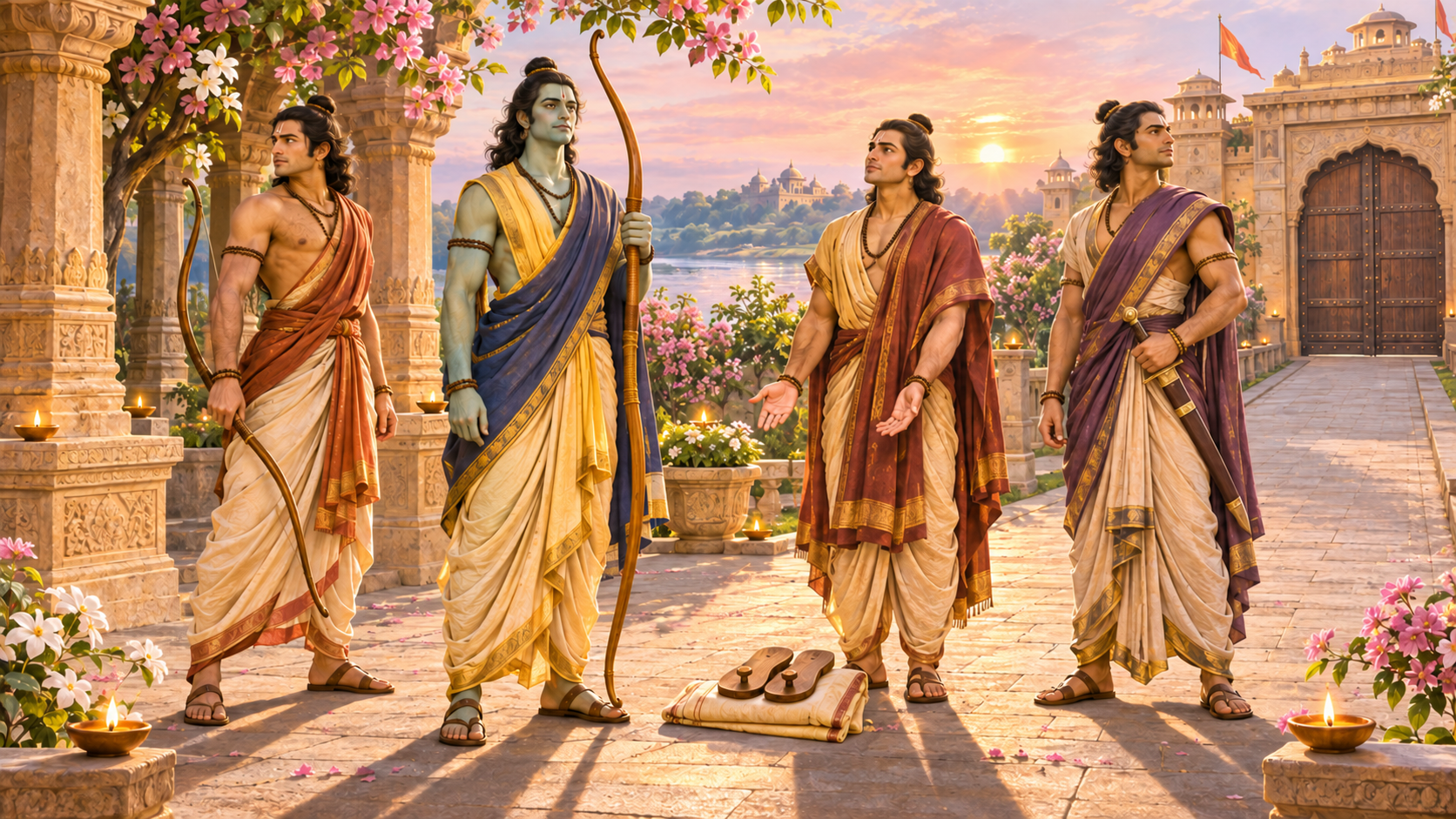
You may know what Rama, Bharata, Lakshmana and Shatrughna did, yet still wonder why the Ramayana gives us four brothers instead of one solitary hero. The answer becomes practical when you stop treating them as four versions of the same virtue. Each reveals a different demand of dharmic life.
Rama gives conduct its governing principle. Bharata shows how to hold authority without possessing it. Lakshmana turns loyalty into vigilant action. Shatrughna represents the quieter work of overcoming obstruction and sustaining what others cannot see. Read together, they offer you a way to examine duty, power, service and self-mastery before making a difficult choice.
The four brothers form one moral system
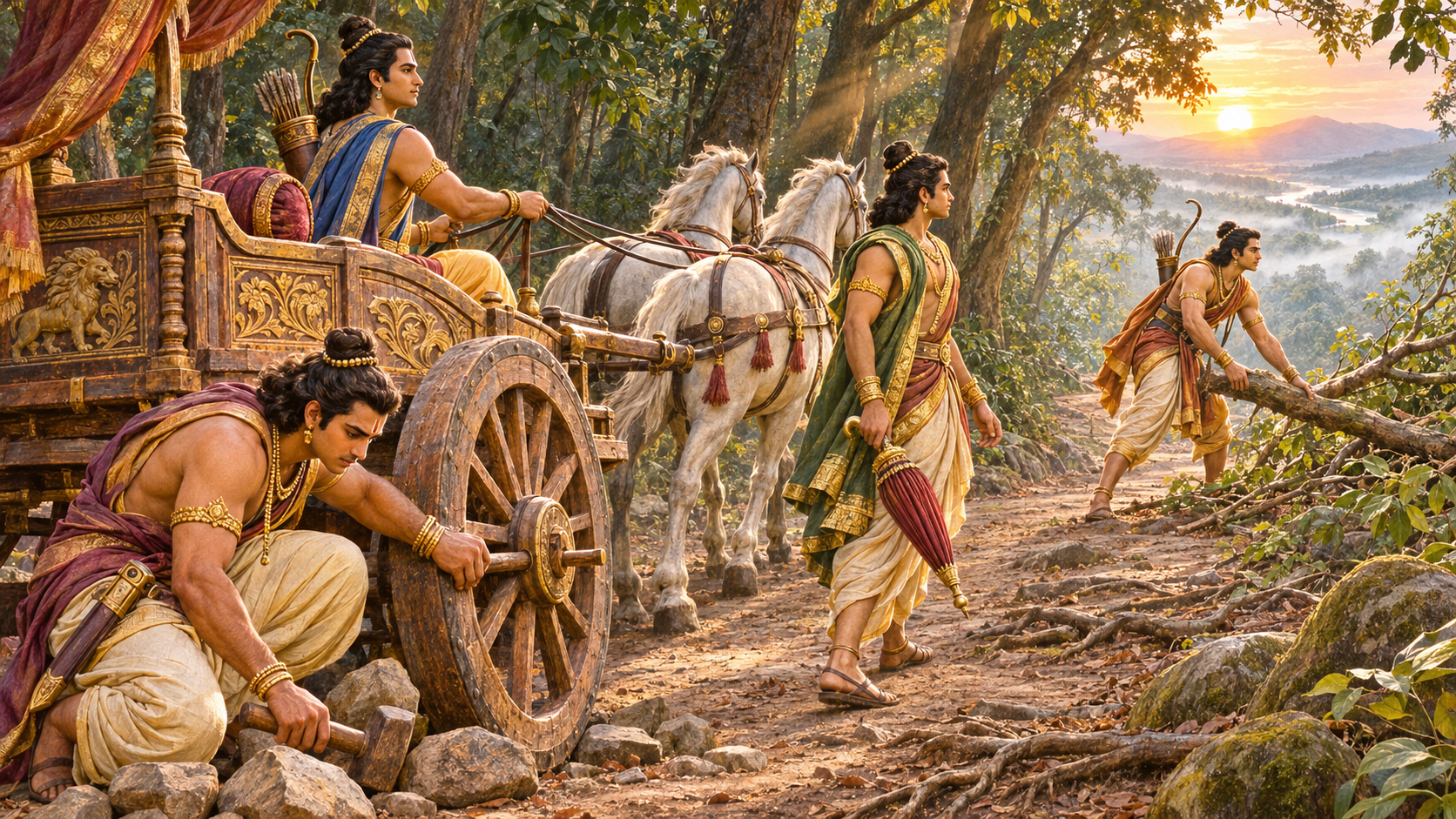
A useful inner reading of the Ramayana sees the brothers as four aspects of human life. This does not make them mere allegorical devices. For devotees, Rama is Bhagavan, and all four brothers remain persons within a sacred history. Symbolism adds a contemplative layer; it does not erase the devotional, narrative or theological layers.
The important word is together. Dharma is not sustained by correct intention alone. It needs discernment to identify the right course, restraint when power becomes available, energy to carry a decision through and mastery over the tendencies that corrupt good work. The brothers distribute these demands across distinct characters so that you can notice each one.
Rama: dharma as the governing centre
Rama represents the centre around which the other faculties become ordered. His symbolism begins with a demanding question: what remains right when personal preference, comfort and immediate advantage point elsewhere?
This is more exacting than rule-following. A rule can be obeyed mechanically. Dharma requires you to understand relationships, promises, responsibilities and consequences, especially when more than one legitimate duty presses upon you. Rama’s steadiness under altered circumstances shows that character is not merely the plan you make when conditions are favourable. It is the principle you retain when the plan is taken away.
Use the Rama question when you are tempted to define right conduct by what benefits you: If praise, status and resentment were removed, which obligation would still be mine? That question does not instantly solve every conflict, but it exposes self-interest pretending to be principle.
Bharata: authority without possessiveness
Bharata faces a different test. The kingdom becomes available to him through circumstances he did not create, but he refuses to convert Rama’s absence into his own entitlement. The sandals of Rama placed at the centre of rule express a precise political and spiritual idea: authority can be exercised as a trust rather than consumed as personal property.
Bharata therefore symbolizes more than affection for an elder brother. He shows what non-attachment looks like inside responsibility. He does not prove his purity by abandoning the people who need governance. He accepts the burden of administration while refusing to make himself the source and owner of its legitimacy.
This distinction matters anywhere you hold delegated power: in a family, temple, business, community body or public institution. Ask, Am I protecting the purpose of this role, or using the role to enlarge myself? If removing your name from the outcome makes the work feel pointless, possession may already have displaced stewardship.
Lakshmana: disciplined energy in service of the right
Lakshmana accompanies Rama into exile and remains close through hardship. His loyalty is active rather than sentimental. He gives up comfort, stays alert and places his strength at the disposal of a purpose he recognizes as higher than convenience.
He can therefore be read as disciplined attention: the faculty that guards a sound decision after the emotion of making it has passed. Many people know what they ought to do but fail at this stage. The principle is accepted; the necessary phone call, difficult boundary, patient preparation or repeated daily effort is postponed. Lakshmana represents the energy that closes that gap.
Yet energy needs Rama’s orientation. Zeal without discernment can become anger, harshness or loyalty to a person at the expense of truth. The practical Lakshmana question is not merely, Whom do I support? It is, What concrete act now protects the dharmic course, and what emotion could distort that act?
Shatrughna: quiet strength against obstruction
Shatrughna receives less narrative attention than Rama, Bharata or Lakshmana. That relative quietness is part of what makes his symbolism useful. Not every indispensable duty stands at the dramatic centre. Homes, institutions and sacred communities also depend on people who remove obstacles, maintain order and complete work that brings little public recognition.
His name carries the sense of one who destroys enemies. An inner reading turns your attention first toward the enemies that travel with you: vanity, anger, jealousy, resentment, negligence and the craving for recognition. This interpretation must not become a licence to label other people as enemies. Its sharper use is self-examination: Which tendency in me is most likely to sabotage the duty I have already recognized?
Shatrughna thus completes the pattern. A person may identify the right course, reject selfish ownership and begin serving energetically, yet still be defeated by an unexamined habit. Quiet self-conquest makes sustained service possible.
Each virtue corrects the excess of another
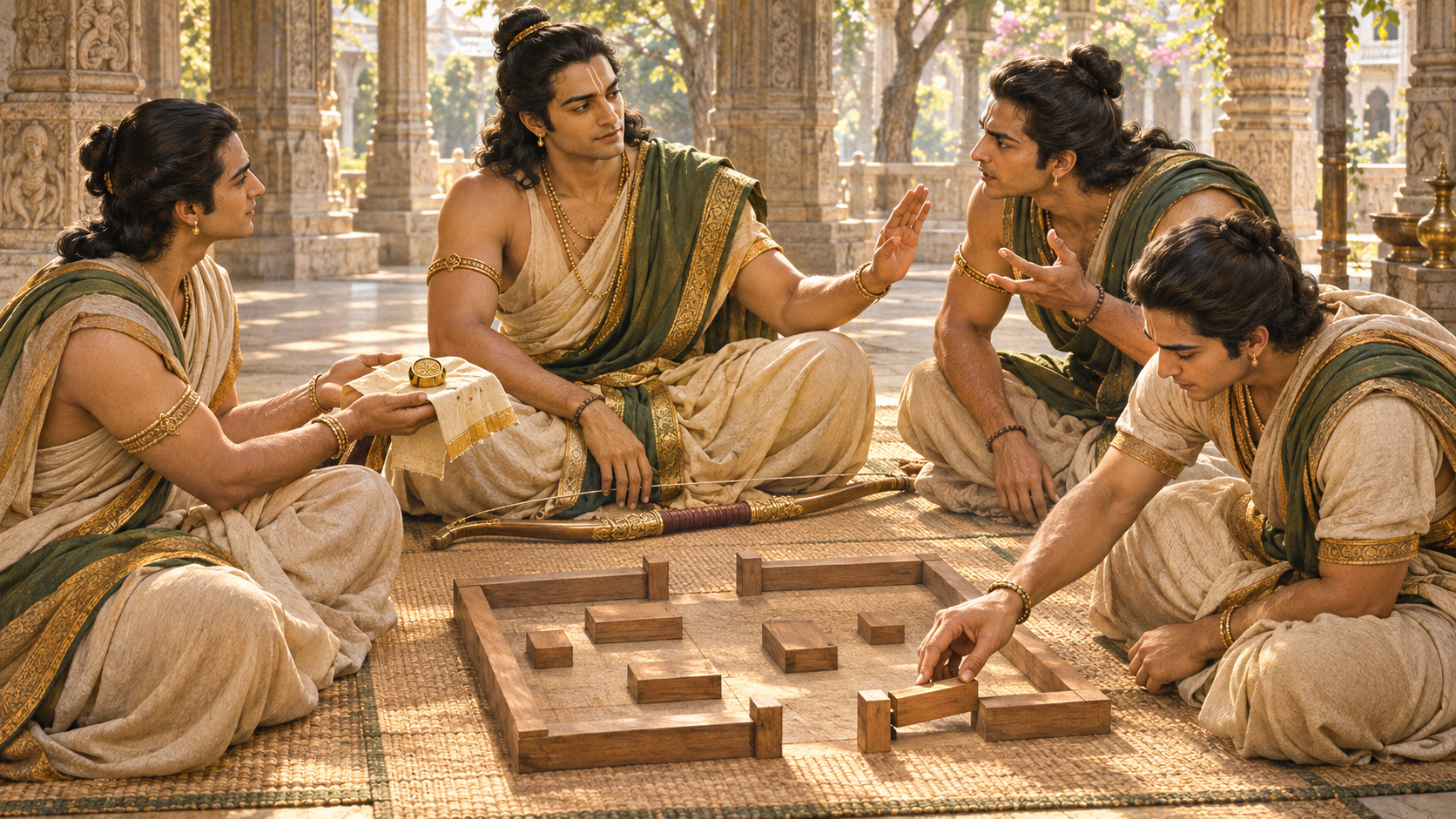
The symbolism becomes deeper when you examine the relationships among the brothers instead of isolating them as personality types. Their virtues are mutually corrective.
Rama without Lakshmana would leave dharma admired but unexecuted. Lakshmana without Rama would leave tremendous energy without a governing measure. Bharata without the willingness to administer would turn non-attachment into withdrawal. Shatrughna without a purpose greater than combat would reduce strength to hostility.
Rama and Bharata also reveal two directions of renunciation. Rama relinquishes the immediate enjoyment of kingship to honour duty. Bharata relinquishes the temptation to possess kingship while still accepting the work required by the kingdom. One walks into the forest; the other remains near the throne without making it his own. Both refuse to let circumstance redefine what is right.
Lakshmana and Shatrughna illuminate two modes of service. One is visible, immediate and close to the principal struggle. The other is quieter and easier to overlook. A healthy community needs both. If it honours only the people at the front, maintenance work becomes invisible. If it values only quiet compliance, courageous action is suppressed. The brothers prevent either mistake.
This is why choosing a favourite brother is less useful than asking which capacity a situation requires from you. You may need Rama’s clarity when defining an obligation, Bharata’s restraint when receiving a title, Lakshmana’s stamina during execution and Shatrughna’s self-mastery when frustration appears. Mature conduct can call for all four in the same decision.
Do not reduce the brothers to a personality quiz
The quickest way to weaken this symbolism is to decide that you simply are one brother. That turns a moral practice into a fixed identity. It can also excuse imbalance: an energetic person claims Lakshmana while avoiding discernment, a reluctant leader claims Bharata while evading responsibility, or a forceful person invokes Shatrughna while refusing to examine anger.
A sound interpretation should pass three tests. It should respect the character’s place in the Ramayana, deepen rather than bypass the question of dharma, and change something about your conduct. If an interpretation merely flatters your existing temperament, it has probably stopped being spiritually useful.
It is equally important not to weaponize the brothers against other people. Rama’s commitment to duty does not authorize you to demand unquestioning obedience. Bharata’s non-possession does not require someone to surrender every legitimate claim. Lakshmana’s service does not sanctify exhaustion or the erasure of necessary boundaries. Shatrughna’s strength does not turn disagreement into enmity.
Begin with yourself. The inner reading is most honest when it reveals your neglected responsibility, hidden attachment, inconsistent effort or recurring obstruction. Applied only to the faults of others, it becomes another instrument of the ego it was meant to discipline.
Use the four-brother test before a difficult decision
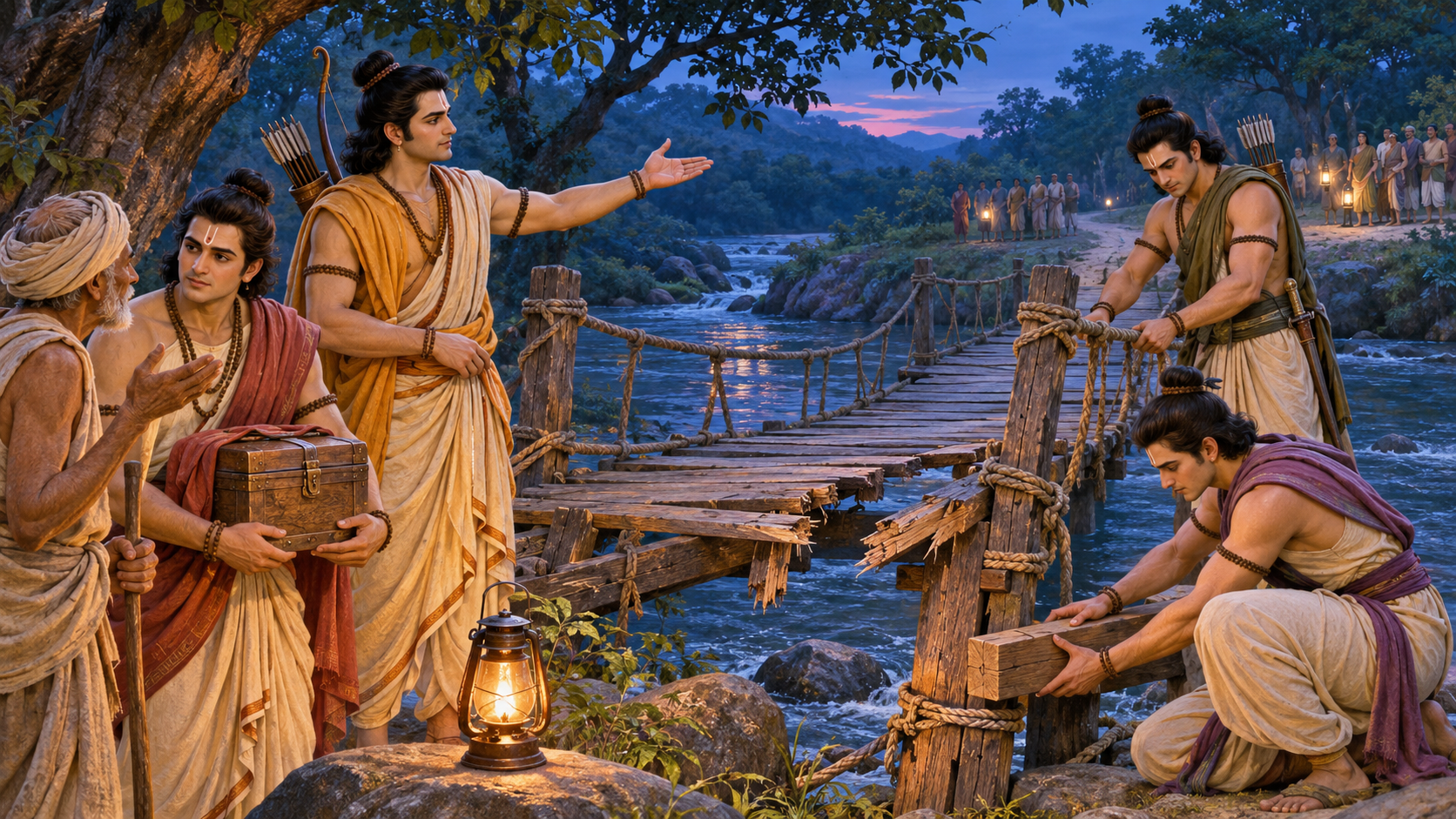
When a choice involves duty, authority or loyalty, write a short answer to each of the following questions. Keep the answers separate at first. Combining them too early makes it easy for one attractive virtue to conceal a failure elsewhere.
- Rama – What is the governing dharma? Name the promise, relationship or responsibility that should direct the decision. Then distinguish it from what would merely preserve your comfort or reputation.
- Bharata – What am I trying to possess? Identify the title, credit, control, approval or outcome that you are treating as yours. Ask whether you could perform the duty faithfully while holding that reward more lightly.
- Lakshmana – What service does the right course require? Convert principle into the next concrete act. Name the preparation, conversation, protection or repeated effort without which your good intention will remain inert.
- Shatrughna – What inner adversary could defeat the decision? Name the tendency rather than blaming a person. It may be anger, vanity, fear, resentment, procrastination or the need to be noticed. Decide how you will recognize it when it appears.
Suppose you are asked to lead a temple or community initiative. The Rama question asks whether accepting the role serves a genuine need and fits your obligations. The Bharata question tests whether service has become a search for position. The Lakshmana question identifies the actual work required rather than the honour attached to the title. The Shatrughna question exposes the habit most likely to damage cooperation once difficulties begin.
The same test works when declining a role. Refusal may be dharmic because another obligation has priority, or it may be avoidance dressed as humility. You find the difference by moving through all four questions. Clear duty without attachment, followed by concrete service and honest self-scrutiny, is harder to counterfeit than any single virtue by itself.
You can also use the test after an action. If the result went poorly, do not ask only whether your intention was good. Check whether the duty was correctly understood, whether possessiveness distorted the choice, whether execution was adequate and whether an inner obstacle was ignored. This turns regret into a precise correction instead of vague self-condemnation.
Key takeaways
- Rama symbolizes the governing clarity that places dharma above convenience.
- Bharata shows that non-attachment can coexist with responsible administration; stewardship is not abandonment.
- Lakshmana represents the disciplined energy that turns a right principle into protective action.
- Shatrughna directs strength toward hidden obstacles, beginning with the tendencies within oneself.
- The brothers are most useful as a coordinated discipline, not as labels for four fixed personality types.
The next time duty and self-interest become difficult to separate, do not ask only, “What would Rama do?” Let the whole brotherhood examine the choice. Clarify the dharma, loosen your claim on the reward, do the work the decision demands and confront the habit that could undo it. That is how sacred symbolism moves from admiration into practice.
References

Leave a Reply
You must be logged in to post a comment.