
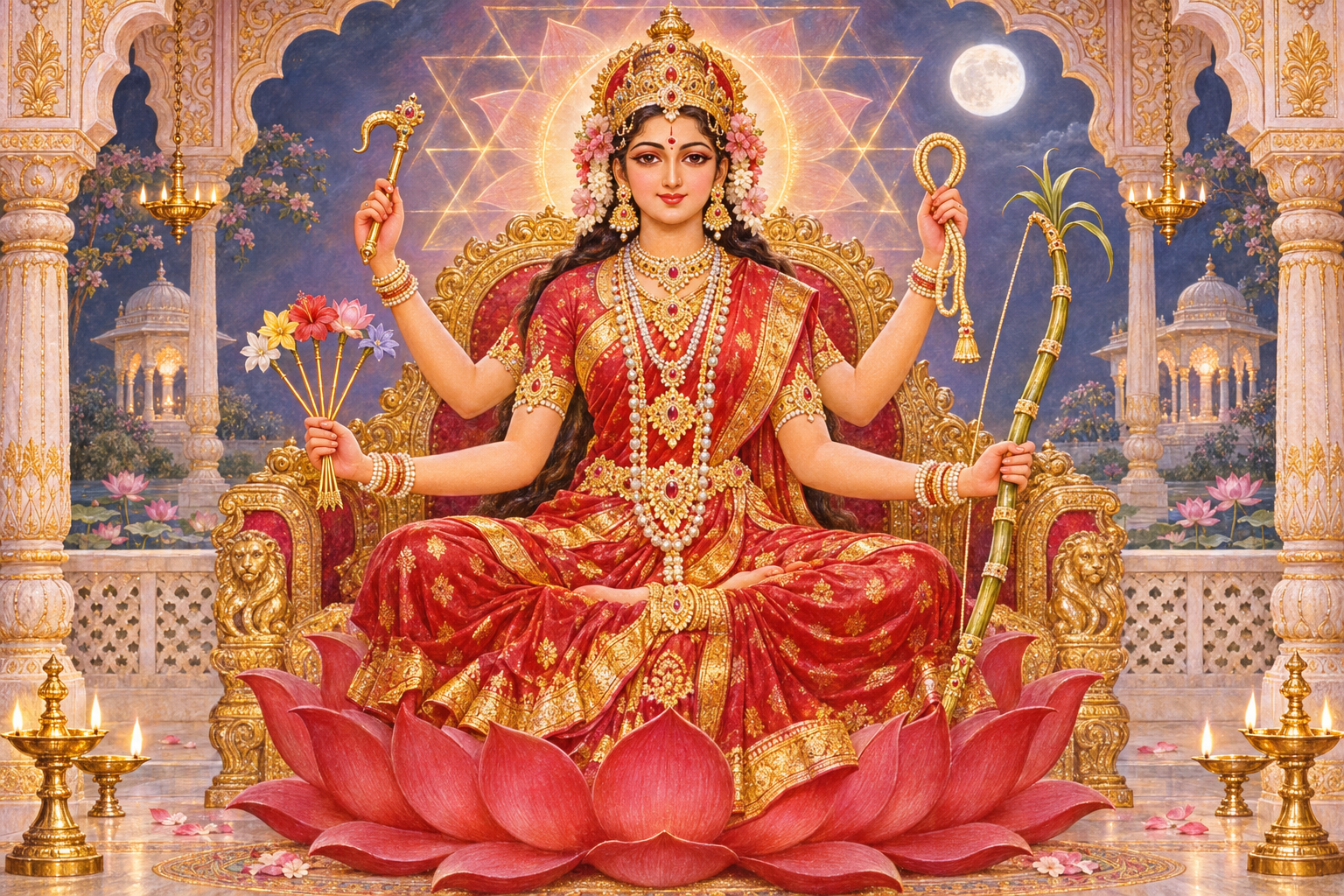
You are looking at a Devi murti labelled Shodashi, Tripurasundari, Lalita, Rajarajeshwari or Bala. The figure is beautiful, but beauty alone cannot tell you which form of Devi you are seeing. What should you actually notice?
Begin with identity, context and theological emphasis before trying to decode individual ornaments. Shodashi iconography is meant to disclose consciousness, beauty and sovereignty as a unified perfection. Reading the image well therefore requires more than matching one visible object to a name.
Begin with the Devi’s identity, not a single attribute
Shodashi belongs to the Dasa Mahavidyas, the ten great wisdom forms of Devi. That setting matters. You are not merely looking at an attractive divine figure; you are encountering a form through which wisdom itself is contemplated.
A common mistake is to identify a murti from one memorable feature while ignoring its label, shrine and compositional setting. Individual attributes can be shared across Devi traditions, and sculptural conventions can vary. A responsible identification brings several kinds of evidence together: the name used by the temple, the figure’s place in the shrine, the complete arrangement of the image and the interpretation preserved by that worshipping community.
This distinction is especially useful when viewing an old sculpture in a museum or an uncaptioned photograph online. You may be able to describe the image precisely without yet being able to identify it securely. Say what is visible first. Treat the name as confirmed only when the context supports it.
Her names tell you what kind of presence to notice
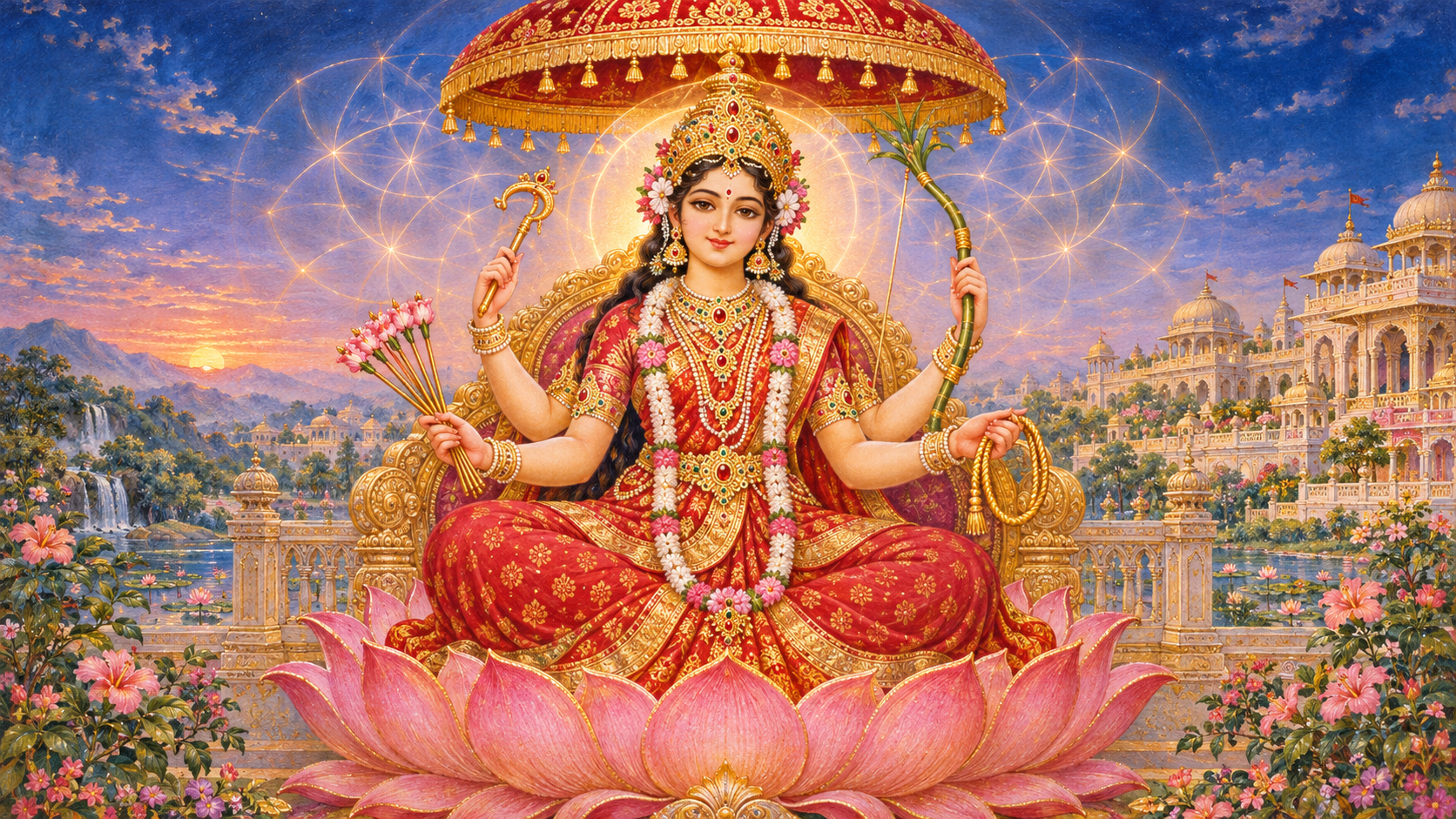
Shodashi is worshipped through several closely related names, including Tripurasundari, Rajarajeshwari, Lalita and Bala. These names should not be handled as disposable synonyms. Each can direct your attention toward a particular dimension of the Devi, while the local tradition determines how that dimension is expressed.
- Shodashi places the symbolism of sixteen and completeness at the centre of interpretation.
- Tripurasundari directs attention to supreme beauty. Here beauty is not superficial decoration; it belongs to the sacred order manifested by the Devi.
- Rajarajeshwari brings sovereignty forward. When the composition gives her commanding centrality, dignity or an enthroned presence, notice how those features serve that theological idea.
- Lalita draws attention to grace and divine ease. Power need not be depicted as strain, aggression or disorder.
- Bala can foreground youthful presence. Youthfulness in this setting should not be mistaken for spiritual incompleteness or subordinate status.
Use these names as interpretive lenses, not as five independent visual tests. A temple may favour one name because of its lineage, ritual life or regional usage. Record the exact title that the community uses before replacing it with a term that happens to be more familiar to you.
Sixteen is a theological key, not a counting game

The name Shodashi carries the significance of sixteen, and the Devi represents a sixteen-fold perfection of consciousness, beauty and sovereignty. This gives you a sound starting point, but it does not authorize you to gather any sixteen visible details and declare the image decoded.
If a shrine, inscription or established explanation identifies a particular group of sixteen, follow that tradition. If it does not, do not manufacture one by counting petals, ornaments, attendants and architectural details until the total fits. The number first tells you how the Devi is understood: as completeness rather than deficiency, fragmentation or unfinished potential.
That changes how you look. Ask whether the image presents beauty, awareness and authority as competing qualities or as one integrated reality. Shodashi’s beauty does not diminish her sovereignty. Her sovereign character does not cancel grace. Her perfection is not an isolated physical trait but the governing meaning of the form.
A practical method for viewing a Shodashi image
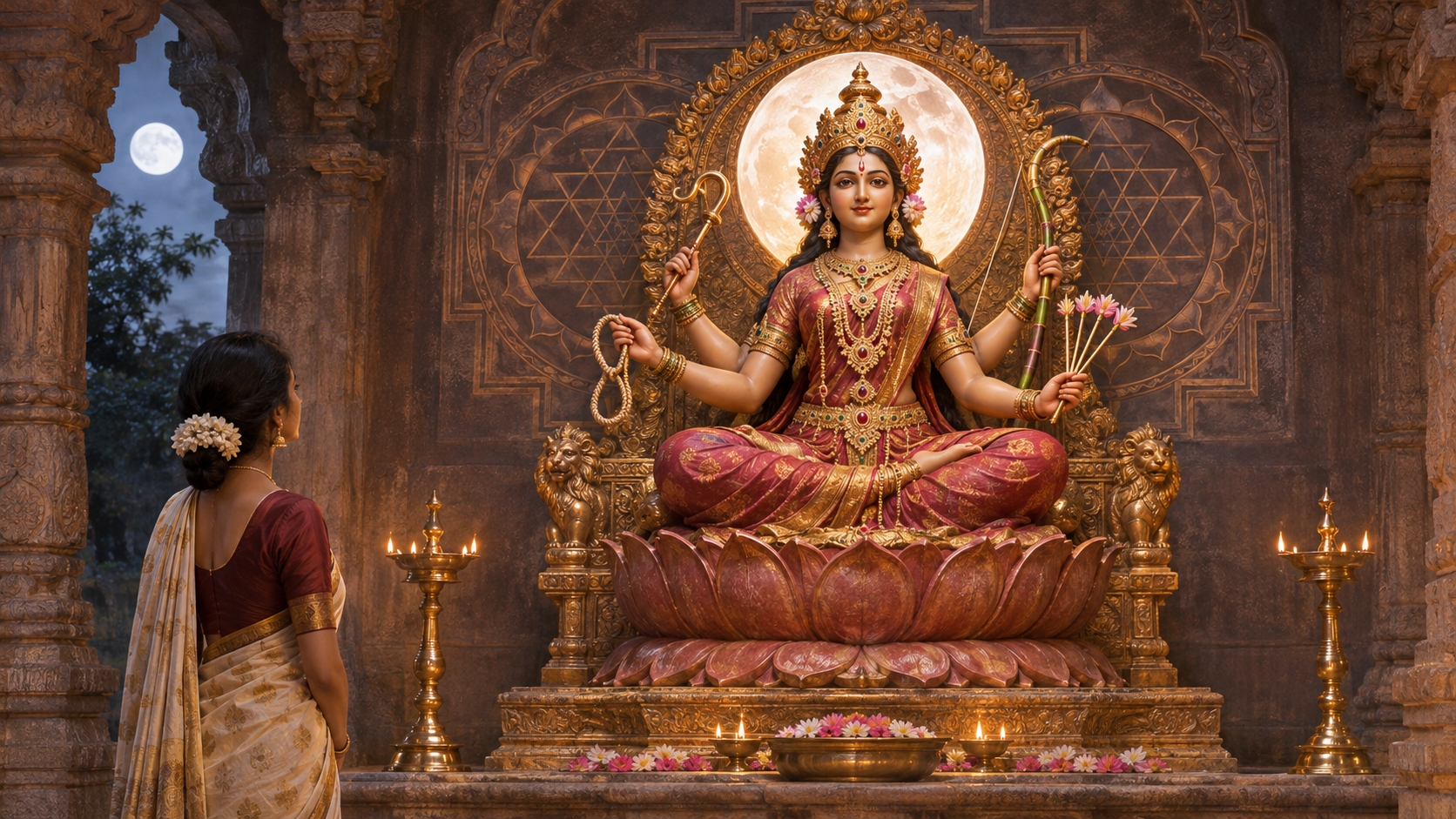
Use the following sequence at a temple, in a museum or while examining a photograph. It keeps observation separate from assumption and gives you notes that can be checked later.
- Transcribe the exact name. Record whether the label says Shodashi, Tripurasundari, Rajarajeshwari, Lalita or Bala. If the name appears in an Indian script, preserve the original wording as well as any translation.
- Record the setting. Note whether the figure occupies the central shrine, a subsidiary niche, a Mahavidya sequence or another arrangement. Neighbouring figures and the image’s position can be more informative than an isolated ornament.
- Describe before interpreting. Write down posture, hands, gestures, held objects, seat, ornaments, facial expression and surrounding figures. Do not yet decide what every feature means.
- Test the name against the composition. Ask how the complete arrangement communicates wisdom, supreme beauty, sovereignty, grace or youthful presence. Use only features that you can actually see.
- Handle sixteen carefully. Count a set of sixteen only when the grouping is visually deliberate or confirmed by the relevant tradition. Otherwise, understand sixteen as the form’s governing symbolism of perfection.
- Verify locally. Prefer the temple’s own identification, an inscription, a reliable catalogue or lineage-specific teaching over an anonymous caption. If two traditions use the names or forms differently, preserve that difference instead of forcing them into a single formula.
This method also protects you from the reverse error: rejecting a genuine Shodashi murti because it does not reproduce the one version you already know. Sacred iconography follows recognizable principles, but living traditions do not always express them through an identical sculptural formula.
Key takeaways
- Shodashi is one of the ten Mahavidyas, so her beauty must be read as a manifestation of wisdom, not as decoration alone.
- Tripurasundari, Rajarajeshwari, Lalita and Bala bring different dimensions of the same sacred presence into focus.
- The symbolism of sixteen concerns perfection and completeness; it does not justify inventing a set of sixteen objects in every image.
- No isolated attribute should overrule a clear temple identification, inscription or established worshipping context.
- Good iconographic reading begins with an exact description and proceeds to interpretation only after the setting has been considered.
The next time you encounter Shodashi, pause before searching for a decisive emblem. Record her name, observe her place in the composition and ask how the whole form joins beauty, consciousness and sovereignty. That disciplined attention will take you further than a hurried checklist.
References

Leave a Reply
You must be logged in to post a comment.