
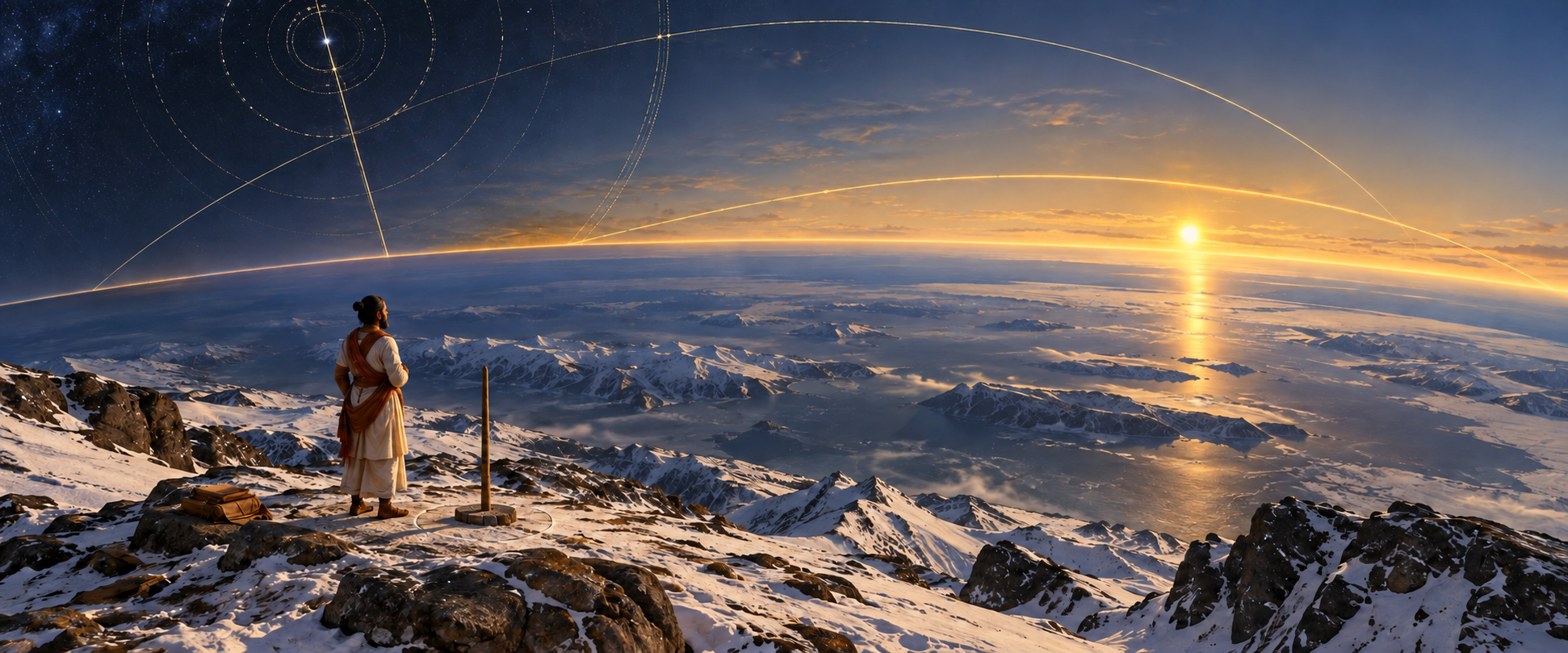
You are reading that the devas experience six human months of daylight followed by six months of night. Is this physical astronomy, sacred symbolism, or a cosmological claim that cannot be tested? The usual choice between literalism and dismissal is too crude.
The more defensible reading begins with a precise distinction: in this context, a day is an uninterrupted interval of light at an observer’s horizon, not a claim that the Earth’s rotation takes a year. Once you separate the observer, the horizon, and the annual motion of the Sun, the six-month day becomes a consequence of spherical geometry. That lets you recognize the astronomical knowledge without making historical claims the mathematics cannot prove.
Puranic timekeeping starts with the observer
Puranic cosmography places the devas at Meru and assigns one human year to their complete light-dark cycle: six months with the Sun visible and six months without it. Read carelessly, this can sound as though time itself runs at a different mechanical speed. Read from the observer’s position, it describes something more concrete. The Sun rises once, remains above the horizon through one half of its annual course, sets once, and remains below the horizon through the other half.
The distinction matters because a 24-hour rotation continues even when there is no daily sunrise or sunset. During a midnight sun, the Sun still traces a diurnal circle as the Earth rotates. The unusual feature is that the entire circle stays above the local horizon. During the corresponding polar night, the whole circle remains below it.
Meru therefore performs two related but distinguishable roles. In Puranic cosmography, it is a sacred world-axis and the abode of the devas. In the astronomical interpretation developed by the jyotisins, it serves as the northern polar observing station. You need not reduce the sacred Meru to an ordinary mountain on a modern map to understand the second role. Nor must you strip away its cosmological meaning before testing the geometry.
Varahamihira describes the Sun as visible at Meru while it passes through the six zodiacal signs beginning with Mesa. The complementary half of the annual course belongs to the opposite polar realm. The theological language identifies the observers; the astronomical content describes which half of the Sun’s path lies above each observer’s horizon.
When you meet a statement about a divine day, ask whose horizon? before asking whose clock? That one question prevents the most common misreading.
The six-month day follows from spherical geometry
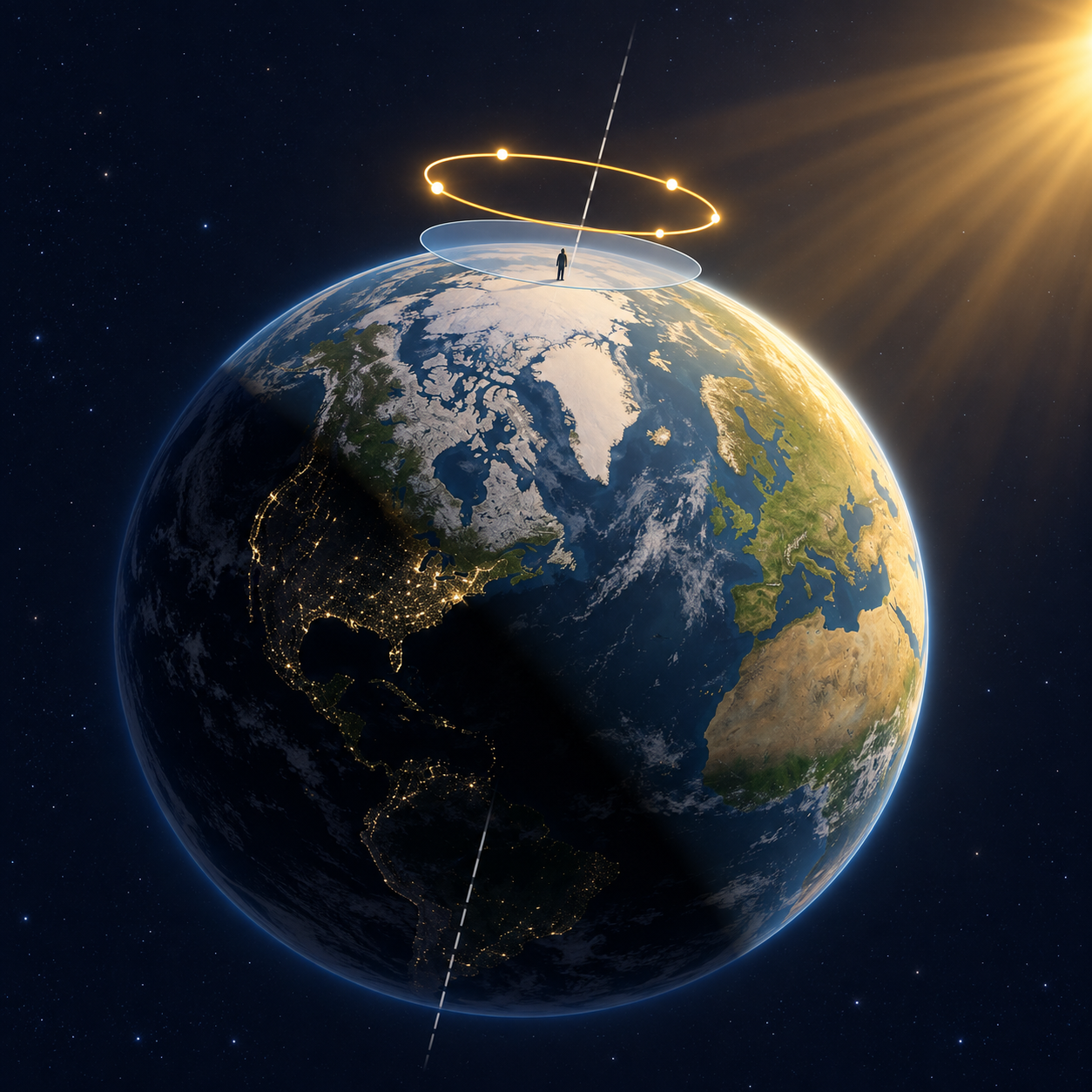
The calculation begins with bhugola, the spherical Earth, placed within bhagola, the celestial sphere. In the approximately fifth-century Aryabhatiya, Aryabhata describes the Earth as a globe in space. Once the Earth is treated as a sphere, observers at different latitudes must have differently tilted horizons.
The pole star supplies an immediate geometrical check. An observer at the equator sees the north celestial pole on the horizon. An observer at the North Pole sees it at the zenith. Between those positions, it appears at an intermediate height. Moving north does not change the celestial axis; it changes the observer’s orientation to it.
The Sun moves along the apamandala, or ecliptic. Its kranti, solar declination, measures how far north or south of the celestial equator it lies. The observer’s co-latitude is the complement of latitude: 90 degrees minus the latitude. Bhaskara II states the decisive rule in the Siddhantasiromani: at a northern site, uninterrupted daylight lasts for as long as the Sun’s northern declination exceeds that site’s co-latitude. He identifies latitudes greater than 66 degrees as the region where this exceptional condition can occur.
You can test any polar-day claim with four steps:
- Identify the observer’s latitude rather than treating the sky as identical everywhere.
- Find the co-latitude by subtracting that latitude from 90 degrees.
- Compare the Sun’s northern declination with the co-latitude.
- If the declination is greater, the Sun’s daily circle does not cross below the horizon, so there is no sunset during that rotation.
At the North Pole, the co-latitude is zero. Whenever the Sun is north of the celestial equator, its declination is greater than zero and its complete diurnal circle remains above the horizon. When the Sun enters the southern half of its annual path, the complete circle lies below the horizon. In the ideal spherical model, this divides the solar year into one continuous daylight interval and one continuous interval of darkness.
Notice what the rule does not say. Crossing 66 degrees north does not immediately give every observer a six-month day. It makes some period of uninterrupted daylight possible. The duration grows as the observer moves closer to the pole because the co-latitude becomes smaller and the Sun satisfies the declination condition for more of its annual course. The full half-year case belongs to the pole itself.
The strongest evidence is the changing duration by latitude
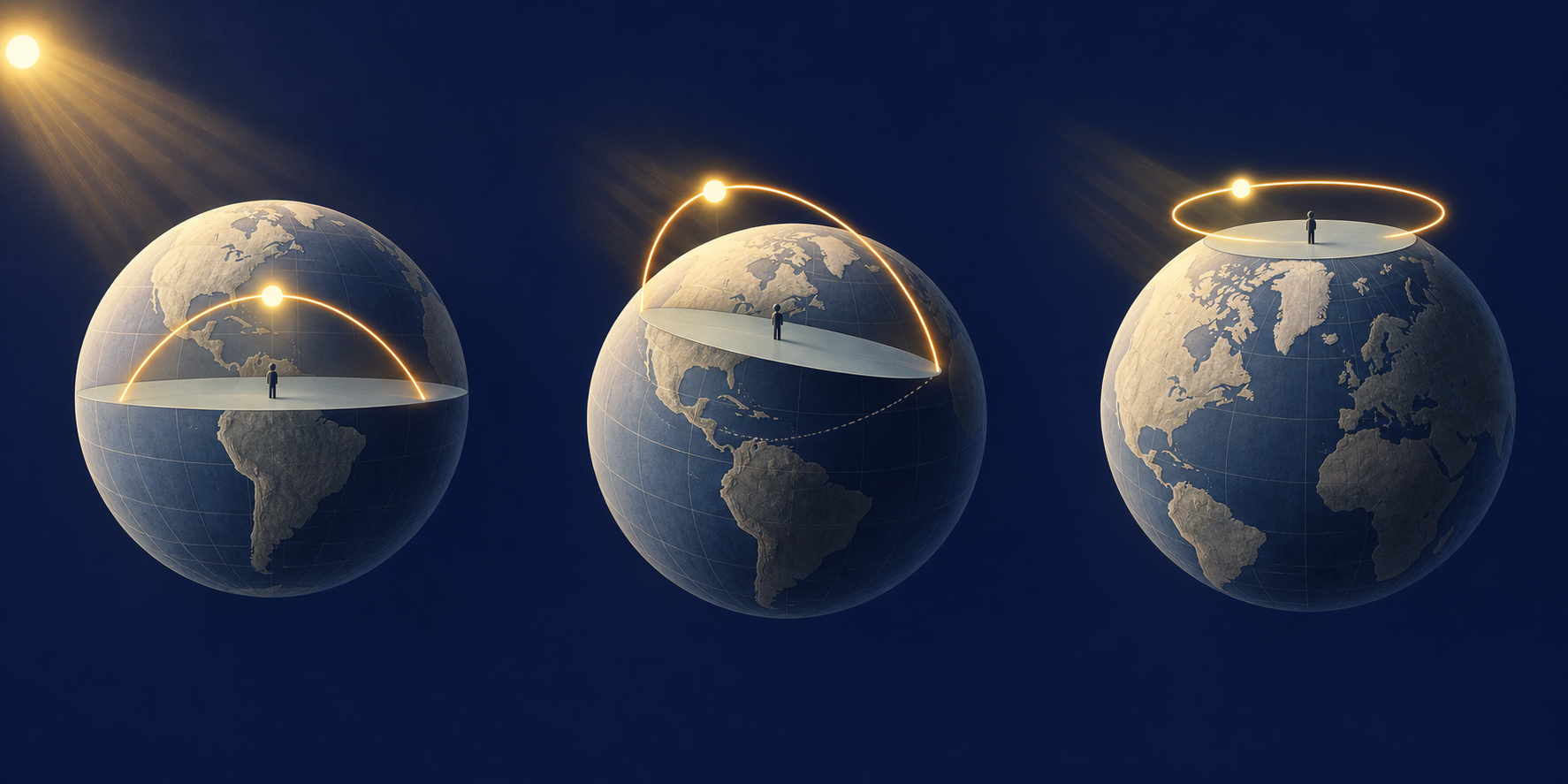
A six-month polar day is the memorable case, but the more demanding achievement is predicting what happens south of the pole. A spherical model must explain not only the extreme endpoint but also the transition toward it. At the boundary, the Sun first remains visible for a complete daily rotation. Farther north, the uninterrupted interval lengthens until it reaches six months at Meru.
Varahamihira’s sixth-century Pancasiddhantika works through this changing sky from locations north of Ujjayini. It identifies regions where particular zodiacal signs never rise and regions where other signs never set. That is a latitude-dependent prediction: changing the observer’s position systematically changes which portions of the celestial sphere can cross the horizon.
The calculations also distinguish intermediate spans of continuous daylight, including two-month and four-month cases. The use of these intervals may reflect the Indian division of the year into rtus, or seasons, but that calendar connection should remain a possibility rather than be promoted to a demonstrated historical motive.
For the two-month case, Varahamihira’s distance calculation converts to about 69 degrees 24 minutes north, close to the stated modern value of approximately 69 degrees 22.5 minutes north. The significant point is not merely that two numbers are close. His method predicts a graded relationship among latitude, the horizon, and the duration of continuous sunlight.
That gradient should carry more weight in your evaluation than a general resemblance between a mythic image and a natural phenomenon. A broad image can coincide with nature by chance. A rule that predicts how the phenomenon changes as the observer moves north is much harder to dismiss as an accidental likeness.
The claim is strongest when kept within its limits

What the astronomical evidence supports
- A spherical Earth was part of the siddhanta framework. Aryabhata’s bhugola and bhagola provide the geometry needed to reason about latitude and the celestial sphere.
- Indian astronomers understood polar daylight as a lawful phenomenon. The Sun’s diurnal circle can remain wholly above or below the horizon, depending on latitude and declination.
- The tradition went beyond the six-month endpoint. Varahamihira calculated intermediate regions, while Bhaskara II expressed the governing condition as a general relationship between declination and co-latitude.
- The Puranic day of the devas is physically intelligible. A full human solar year can correspond to one polar light-dark cycle without changing the Earth’s rotational period.
- Direct observation is not required for the calculation. Once the spherical model is established, polar conditions can be deduced from geometry.
What the calculation does not establish
- It does not prove an ancient Arctic expedition. The surviving mathematical result shows that travel was unnecessary, not that travel occurred.
- It does not identify Meru with one ordinary modern mountain. A polar function within spherical astronomy is not automatically a cartographic address for every feature of Puranic Meru.
- It does not prove a direction of borrowing. Astronomical compatibility alone cannot tell you whether a Puranic formulation produced a later calculation, a calculation shaped a textual interpretation, or both drew on a longer shared tradition.
- It does not turn every cosmological statement into modern geography. Each claim still needs its own textual context and, where applicable, its own mathematical test.
- It does not cancel symbolic meaning. A description can carry theological significance while remaining compatible with a physical phenomenon.
The careful conclusion is therefore substantial but bounded: the six-month day at Meru corresponds coherently to polar astronomy, and siddhanta mathematicians could derive the phenomenon from a spherical Earth. Compatibility is not identity, mathematical deduction is not a travel record, and correspondence is not proof of literary genealogy. Keeping those distinctions visible makes the case more credible, not less Dharmic.
Key takeaways for reading the passage responsibly
- Read the divine day first as an uninterrupted daylight interval measured at an observer’s horizon, not as a year-long rotation of the Earth.
- Keep three layers distinct: Meru’s sacred role, its polar function in astronomical interpretation, and the geometry used to calculate visible sunlight.
- Use the operational rule: continuous daylight occurs while northern solar declination exceeds the observer’s co-latitude.
- Remember that locations just beyond 66 degrees can have shorter periods of continuous light; the duration increases toward the six-month polar case.
- Give special weight to latitude-dependent predictions. Two-month, four-month, and six-month cases demonstrate a working model rather than a single suggestive resemblance.
- State the historical conclusion precisely: mathematical competence is demonstrated; polar travel, a modern address for Meru, and a particular direction of textual influence are not.
The next time you encounter a Puranic measure of divine time, mark three things in the margin: the observer, the horizon, and the celestial cycle being measured. If the interpretation accounts for all three and survives the relevant geometry, you have a reasoned reading rather than either an embarrassed dismissal or an inflated claim.
References
