
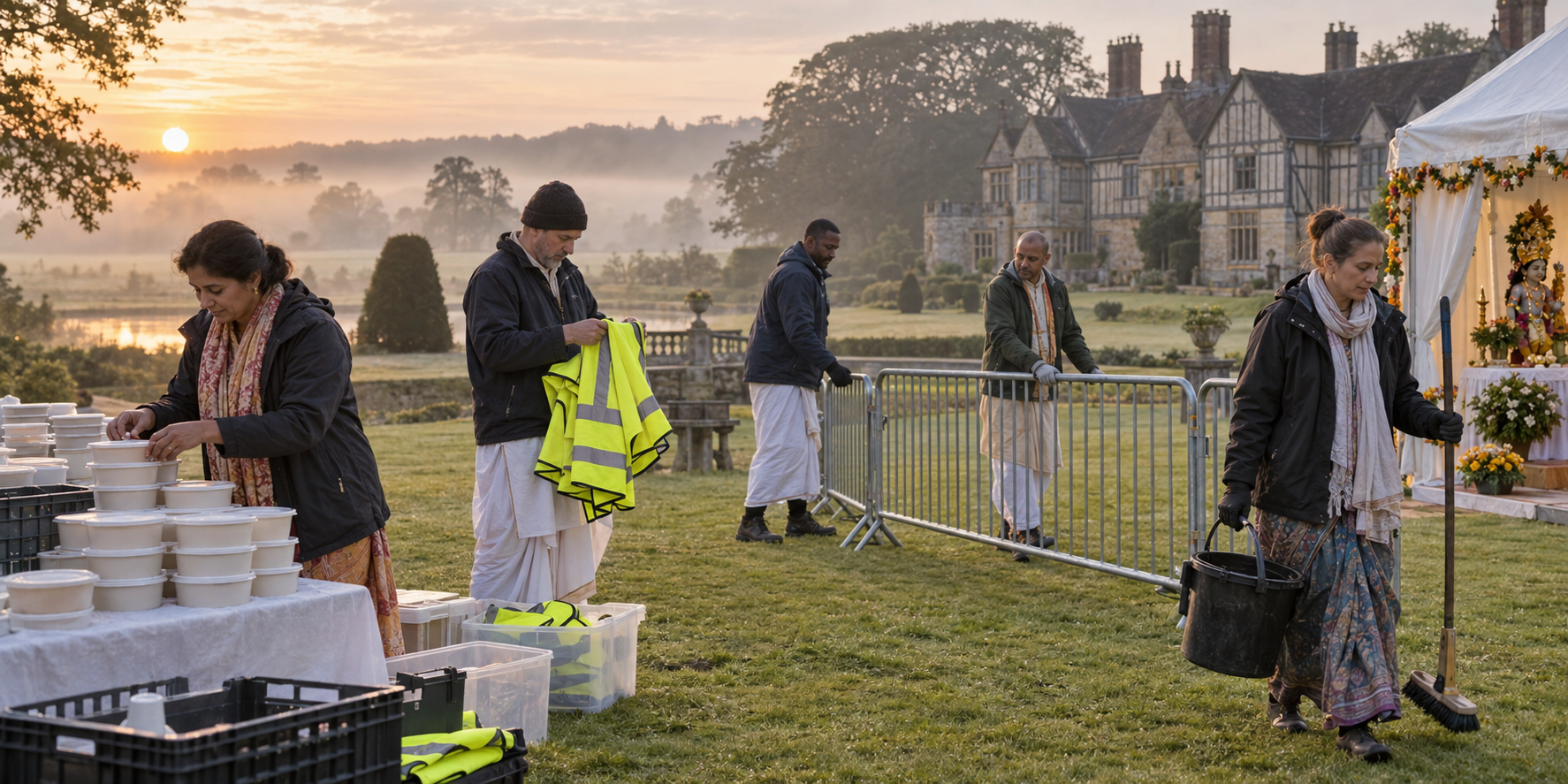
You want to serve at Bhaktivedanta Manor’s Janmashtami celebration, but volunteering can mean anything from guiding cars to preparing prasadam or clearing the grounds after the last pilgrims leave. The right question is not simply, “How can I help?” It is, “Where can I be dependable?”
At the Manor’s 2026 celebration, hundreds of local volunteers handled hundreds of roles across a two-day festival. That scale rewards clear commitments. If you choose a suitable role, state your availability precisely, and treat the final cleanup as part of the seva, you make yourself far more useful to the festival team.
Choose the service you can complete reliably
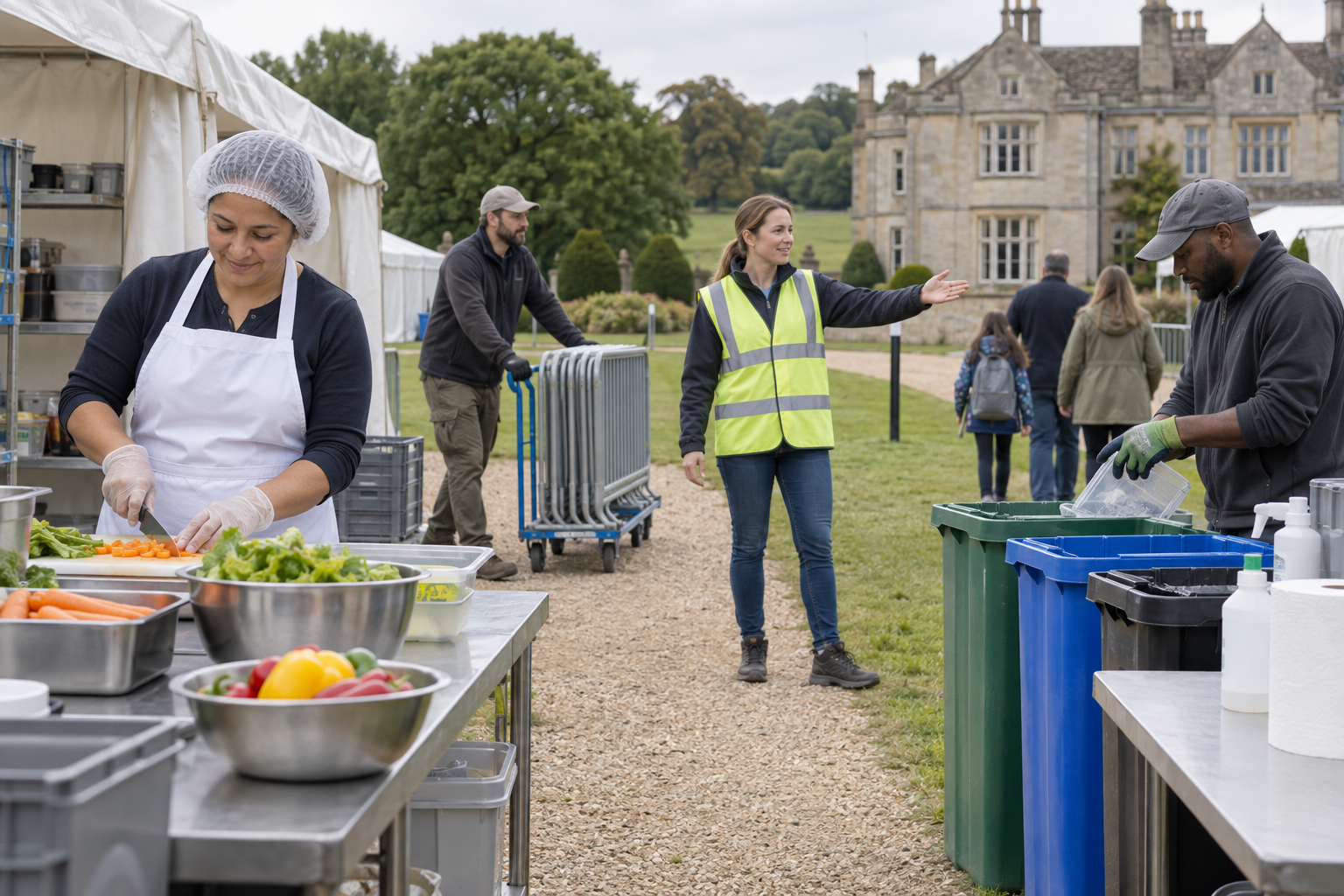
Seva is not made more valuable by being visible. A parking volunteer who remains at the assigned point, gives calm directions, and completes the shift may contribute more to the pilgrims’ day than someone who chooses a prominent role but cannot sustain it.
Start by matching your temperament, abilities, and practical limits to the kinds of work a large Janmashtami celebration requires:
- Choose parking or guest-direction work if you can communicate briefly and courteously, remain attentive in a busy environment, and repeat the same instructions without becoming impatient.
- Choose event-space setup if you prefer concrete tasks behind the scenes and are comfortable following a layout or team leader’s sequence.
- Choose family activities if you can give children and parents consistent attention while keeping the activity orderly.
- Choose prasadam service or preparation if you work carefully, follow the kitchen team’s instructions, and understand that speed cannot come at the expense of cleanliness or coordination. Volunteers helped provide free vegetarian prasadam for every guest at the 2026 celebration.
- Offer specialist skills when they are genuinely relevant. The Manor’s seamstresses spent months hand-stitching detailed new outfits for the deities, showing that some of the most important Janmashtami seva happens long before the public festival.
- Choose clearing and restoration if you are available after the celebration and do not need your contribution to be seen by the crowd.
When you express a preference, give the coordinator an alternative as well. For example: your first choice may be family activities, while your second could be guest direction. A preference helps with placement; a demand makes placement harder.
Be equally clear about constraints. If you cannot stand for long periods, lift equipment, work outdoors, manage crowds, or stay beyond a fixed time, say so before receiving an assignment. This is not a failure of devotion. An accurate limit allows the team to give you work you can finish and prevents another volunteer from having to abandon a post to cover yours.
Plan for an operation, not only a celebration

Visitors encounter art, drama, traditional and contemporary dance, stories from Krishna’s life, and kirtan across the grounds. Volunteers encounter the operating structure that makes those experiences possible. Your shift may involve access, food, equipment, queues, families, or restoration rather than watching the main-stage programme.
Decide in advance whether you are primarily coming to serve or primarily coming to attend. Both are legitimate, but confusing them creates avoidable tension. If seeing a particular programme matters to you, disclose that scheduling limit rather than leaving your assignment without cover. Do not assume that serving near the celebration guarantees an uninterrupted view of it.
Access also needs deliberate planning. Both days in 2026 used strict ticketed entry to manage visitor capacity and community access. That fact does not establish what credential a future volunteer will need. Confirm the current arrangement with the festival team instead of assuming that a guest ticket is a volunteer pass, or that volunteering automatically admits accompanying friends and relatives.
Before accepting a role, obtain answers to four practical questions:
- Where exactly do you report, and to whom?
- What are the required arrival and release times?
- Does your assignment involve standing, lifting, outdoor work, food handling, or sustained contact with the public?
- What ticket, pass, identification, clothing, or equipment does the team instruct you to bring?
Do not fill gaps with assumptions. A public programme time is not necessarily a volunteer reporting time, and the place where guests enter is not necessarily the volunteer check-in point. Save the instructions and the coordinator’s contact details before travelling.
Give the coordinator information they can use immediately
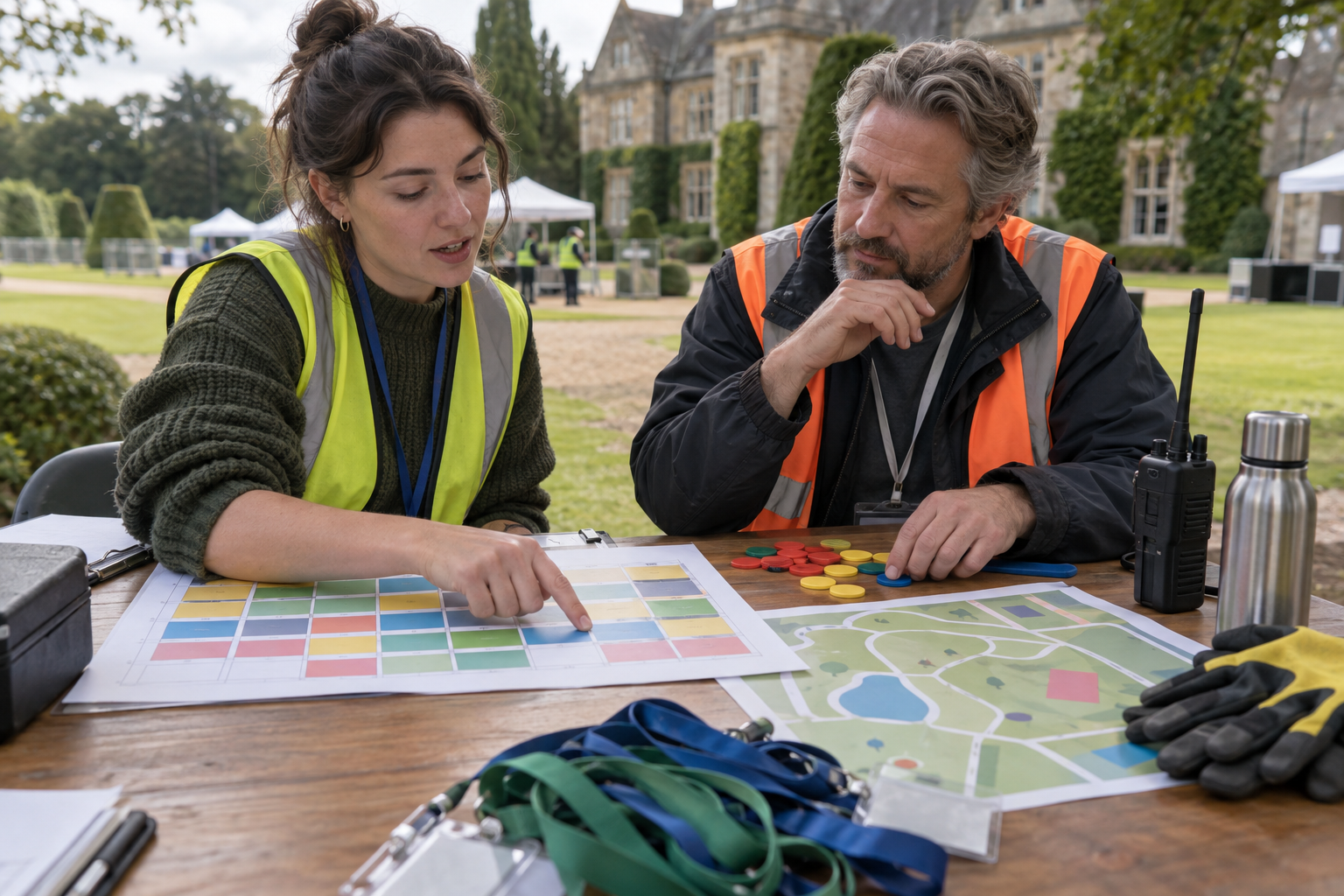
A message saying only that you are happy to help expresses goodwill but still leaves the organising team with every practical question unanswered. Make your first contact easy to act upon.
Include these details in whatever registration or contact channel Bhaktivedanta Manor provides for the festival:
- Your name and the best way to reach you.
- The festival day or days for which you are available.
- Your exact available time window, including the latest time you must leave.
- Your preferred service area and one acceptable alternative.
- Relevant experience, such as stewarding, cooking, sewing, performance production, children’s activities, logistics, or site restoration.
- Any mobility, lifting, sensory, medical, dietary, or accessibility constraint that affects safe placement.
- Whether you are applying alone or as part of a family, youth, workplace, or community group.
- If a young person wishes to serve, their age and the accompanying adult arrangement, so the Manor can explain its current requirements rather than your family guessing them.
A useful request is concise: available days and hours first, suitable work second, constraints third. The coordinator should be able to read it once and see where you might fit.
Once assigned, treat the role as a commitment to a team rather than a loose expression of interest. Arrive at the instructed point, check in with the named lead, and ask before changing positions. At a festival with hundreds of interdependent duties, an apparently empty post may be waiting for the person who promised to cover it.
Prepare for redirection as well. Crowd flow, food service, weather, late arrivals, or an unfinished setup can change what is most useful. Flexibility is valuable when it remains coordinated. Moving yourself to another task without telling your lead is not flexibility; it simply creates a new gap.
Look beyond the hours when pilgrims are present
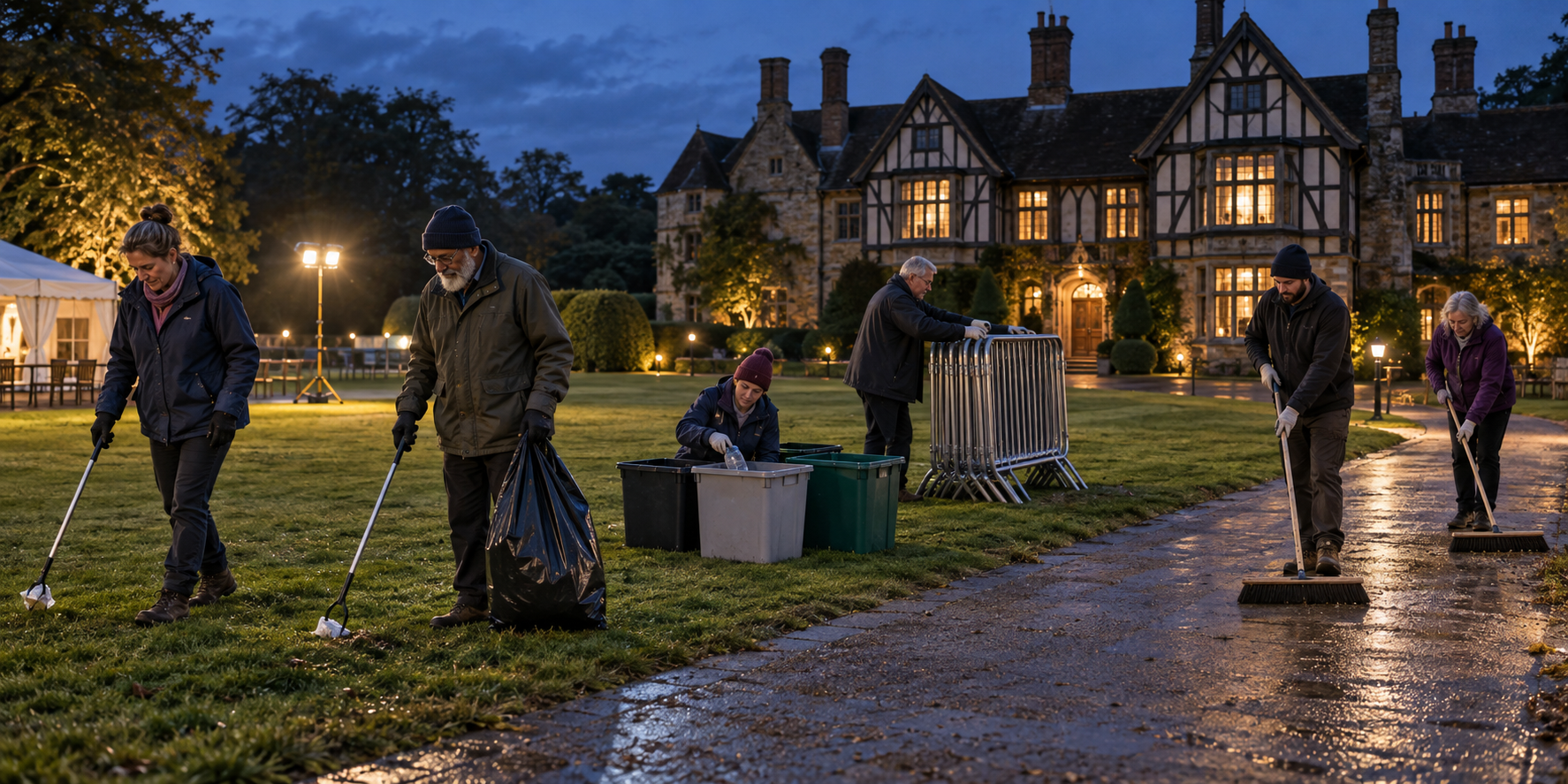
The public celebration is only the most visible layer of Janmashtami seva. The full cycle includes preparation, setup, service during the festival, and restoration afterward. If crowds are difficult for you, or the main festival shifts are already filled, ask whether your skills suit work before or after the public programme.
Advance service can demand a longer horizon than a single shift. The deity outfits prepared for the Manor’s celebration required months of detailed hand-stitching. That is a useful correction to the idea that volunteering begins when the gates open. Skilled, patient preparation can be central to the offering even when most pilgrims never meet the people responsible.
The same principle applies at the other end. Once the festivities had finished and pilgrims had gone home, more than 200 volunteers from corporate and professional backgrounds took time away from their usual work to help clear and restore the site. Their contribution was not an afterthought. A large festival cannot be considered complete while its grounds still require substantial restoration.
If you can help with cleanup, offer it as a definite commitment: state the day, the hours available, whether you can do physical work, and any relevant logistics or site-management experience. Do not overstate your capacity. Follow the team lead’s safety instructions, use the equipment provided, and decline lifting that exceeds your ability. Selfless service does not require unsafe handling or an avoidable injury.
Cleanup is also a practical option for a workplace or professional group seeking to serve together. The documented 2026 effort shows that such volunteers can make a substantial contribution after the public-facing roles have ended. A group organiser should still seek approval and assignment from the Manor rather than arriving with an unannounced team.
Key takeaways for a dependable Janmashtami volunteer
- Choose a role you can complete, not merely the role you would most like to be seen doing.
- Give exact availability, one preferred assignment, one alternative, relevant skills, and honest physical or accessibility limits.
- Confirm reporting instructions and volunteer-entry requirements separately from the public ticketing system.
- Expect service to occupy your attention; arrange any must-see programme time with the coordinator instead of leaving a position uncovered.
- Ask about advance preparation or post-festival restoration if event-day crowds or schedules do not suit you.
- Stay flexible within the chain of coordination. Accept redirection, but never abandon or swap an assigned post without informing the responsible lead.
Your most useful next step is simple: decide your real availability, select two suitable kinds of seva, note any constraints, and send that complete information through the Manor’s current volunteer channel. A clear promise that you can keep is already the beginning of service.
References
