

You are looking at a temple image of two deities and wondering what the relationship is meant to teach. Is this a divine marriage, a statement about masculine and feminine powers, a model for human relationships, or something else? The safest answer is not to choose one explanation for every pair.
Hindu divine partnerships use relationship as a theological language. Some illuminate creation, preservation, knowledge, prosperity, consciousness, power, devotion, or karmic forces. If you identify the kind of relationship before interpreting its symbolism, the image becomes much clearer.
Key takeaways
- A consort is not merely a secondary deity standing beside a more important one. The relationship itself carries meaning.
- Divine pairs do not all represent the same kind of union. Marital, devotional, cosmic, and iconographic relationships must not be flattened into one category.
- Ask what each figure contributes, what connects them, and what becomes distorted when either is interpreted alone.
- Radha and Krishna are best approached through bhakti and divine love, not forced into an ordinary domestic template.
- Rahu and Simhika show that consort imagery can organize cosmic and karmic symbolism without presenting an ideal human marriage.
- A sacred partnership may inspire human conduct, but it does not justify hierarchy, coercion, dependence, or the erasure of individuality.
A consort is a relationship, not a supporting role

The English word consort can sound like an assistant, spouse, or decorative companion. That is often the first mistake. In Hindu iconography, the accompanying deity may reveal the power, field of action, or relational dimension through which the central deity becomes intelligible.
The recurring pairings of Brahma and Saraswati, Vishnu and Lakshmi, and Shiva and his divine counterpart invite you to read divinity relationally. Creation is not meaningful without knowledge and articulation. Preservation is not complete if the world being preserved cannot flourish. Transcendent stillness and active power are distinguishable, yet neither explains lived reality by itself.
This does not mean that every deity shown alone is deficient. A single murti can present a complete object of worship. The paired form places emphasis elsewhere: it asks you to contemplate how divine qualities meet, cooperate, disclose one another, or become active.
Use a simple test. If you can remove one member of the pair and your explanation remains unchanged, you probably have not interpreted the partnership. Do not begin by deciding who is superior. Begin by asking what the relationship allows you to see that either figure, considered in isolation, would leave unstated.
One visual grammar can perform several theological jobs
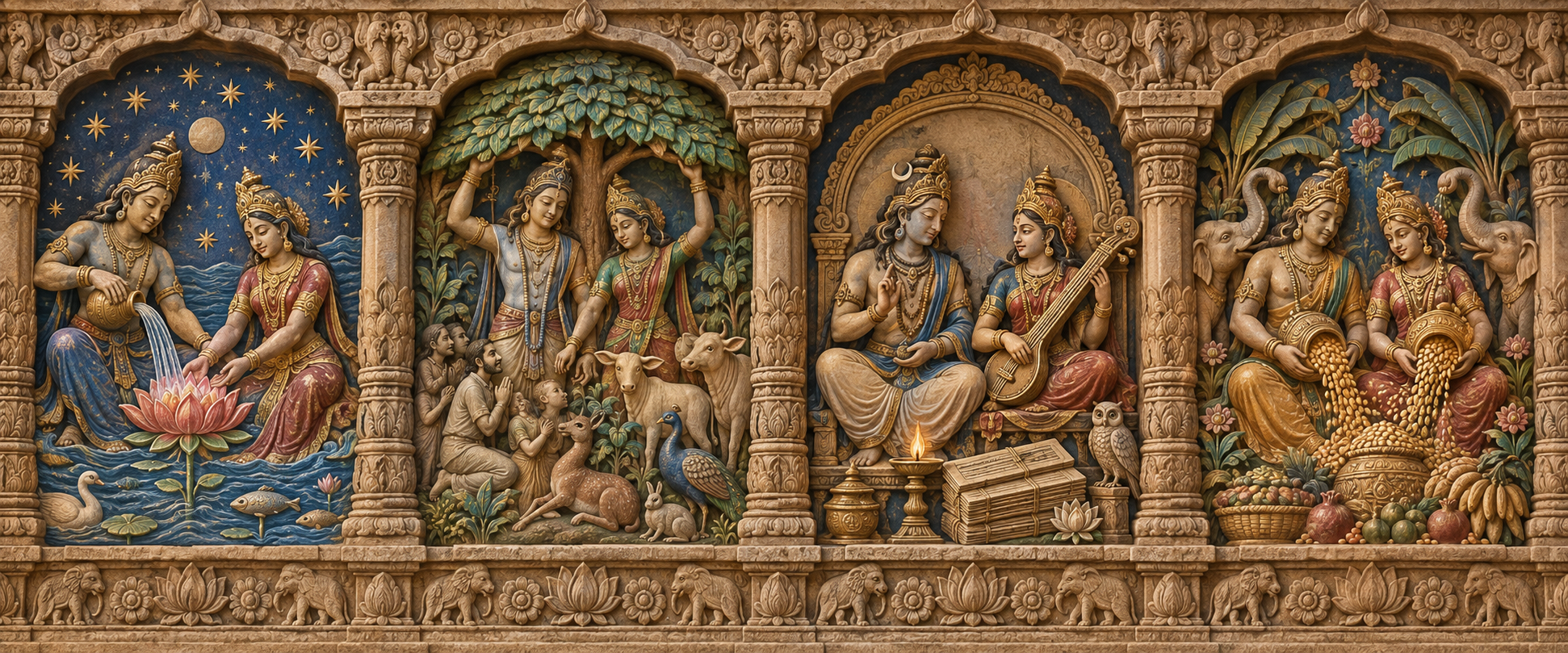
Two figures placed together may look like the same visual formula, but the relationship can be doing very different work. The following lenses are starting points, not universal definitions imposed on every sampradaya.
| Divine pair | A useful first lens | A reading to avoid |
|---|---|---|
| Brahma and Saraswati | Creative activity joined to knowledge, expression, and intelligibility | A male creator accompanied by an ornamental wife |
| Vishnu and Lakshmi | Sustaining order joined to prosperity and flourishing | Wealth detached from responsibility, order, or preservation |
| Shiva and Shakti | Transcendent stillness or consciousness related to active divine power | A social claim that men possess authority while women merely assist |
| Radha and Krishna | Devotion, love, intimacy, and the relation between devotee and Bhagavan | Reducing the pair to ordinary marital biography |
| Rahu and Simhika | Relational symbolism within a cosmic and karmic framework | Assuming every consort pair depicts romance or ideal domestic life |
With Brahma and Saraswati, try turning the symbolism into a sentence: creation must be guided by knowledge if it is to become ordered and communicable. That reading gives you something practical to notice. Before beginning a project, building an institution, or teaching an idea, ask whether enthusiasm has outrun understanding. The pair ceases to be a static family portrait and becomes a discipline of informed creation.
With Vishnu and Lakshmi, resist reducing Lakshmi to cash or private accumulation. Read prosperity beside preservation. Then ask whether what you call success actually sustains a household, community, duty, or inherited good. The pairing challenges prosperity without stewardship as much as it challenges order without well-being.
With Shiva and Shakti, read the polarity functionally before reading it socially. Stillness and action, transcendence and manifestation, or consciousness and power can illuminate one another without becoming a crude ranking of men and women. The practical question is whether your spiritual life has become all contemplation and no action, or all activity and no inward orientation.
Radha and Krishna require a different lens. Radha is revered as a devoted friend of Krishna, foremost among the gopikas, and a goddess of love and affection. Those features direct attention toward bhakti: the quality of loving devotion, the devotee’s orientation toward Bhagavan, and a love not exhausted by social classification.
If you begin with the question of whether Radha fits a modern civil category of spouse, you can miss what the relationship is revealing. Watch instead for attention, remembrance, longing, surrender, and delight in Krishna. For your own practice, the relevant test is not whether you can imitate a divine biography. It is whether devotion is becoming less transactional: less concerned with what you will receive and more capable of sustained, loving attention.
Rahu and Simhika widen the frame again. Rahu is understood in the Navagraha system as a shadow graha associated with the ascending lunar node, while Simhika appears as his consort in Hindu sculpture. This is not the same symbolic task as Radha-Krishna bhakti or Vishnu-Lakshmi preservation. Here the partnership belongs first to celestial, karmic, and iconographic thought.
That distinction matters whenever you meet a less familiar divine pair. Do not import the meaning of a famous household form merely because the image contains two related figures. First identify the deity’s domain. A relationship situated among the Navagrahas should initially be interpreted through that cosmic setting, not treated as advice about romance or family organization.
Use five questions during darshan or study
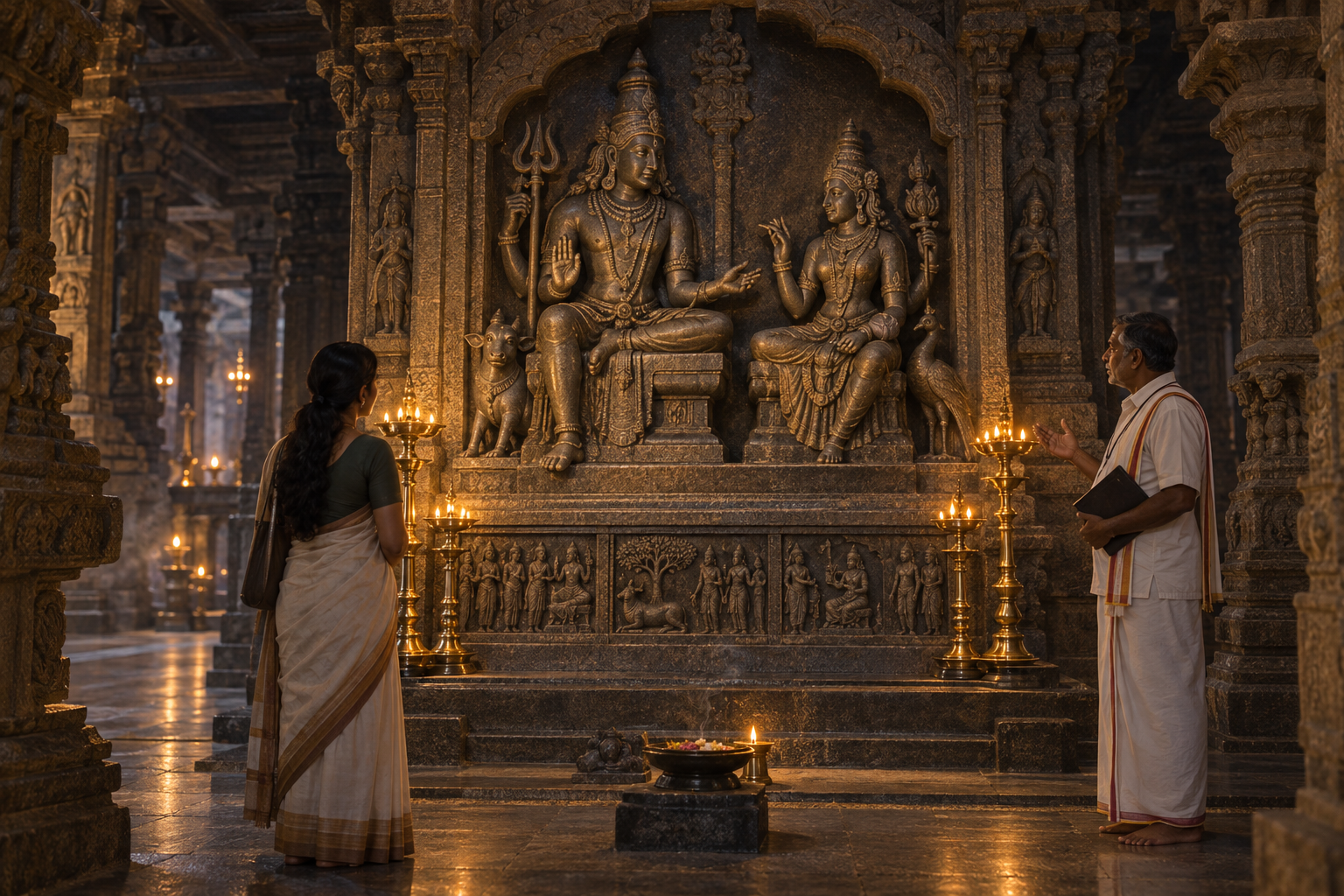
You do not need an elaborate theory before approaching a paired murti. Work through these questions in order. They prevent the most common interpretive shortcuts while leaving room for the temple’s own tradition.
- Where does the pair appear? Note whether you are seeing a temple’s principal deities, an attendant figure, a festival arrangement, a narrative scene, or a graha sculpture. Placement narrows the range of plausible meanings.
- What does each figure signify in this tradition? Use the deity’s name, the temple’s liturgy, the local account, and the relevant sampradaya. Do not infer function from gender or posture alone.
- What kind of relation connects them? Ask whether the image emphasizes marriage, devotion, manifestation, complementary power, cosmic association, or another relation. More than one may be present, but one usually supplies the clearest starting point.
- What goes wrong when the qualities are separated? Creation without knowledge becomes disorderly. Prosperity without preservation becomes extraction. Contemplation without active power becomes inert, while action without orientation becomes restless. This question turns symbolism into discernment.
- What practice follows from the image? Choose one concrete response. Study before creating. Steward what you acquire. Join contemplation to responsible action. Offer devotion without bargaining. A sound application should express the relationship rather than imitate the surface details of divine life.
When a mantra, vrata, initiation, or ritual procedure is involved, interpretation is not enough. Follow the relevant lineage or temple instruction rather than constructing a practice from visual symbolism alone. Iconography can tell you what to contemplate; it does not automatically supply the authorized ritual method.
Four mistakes that flatten divine partnership
- Treating every pair as literal biography. Sacred narratives matter, but a divine relationship may simultaneously carry devotional, metaphysical, ritual, and cosmic meanings. Historical or domestic questions cannot exhaust it.
- Turning complementarity into hierarchy. Distinct qualities do not automatically establish that one deity, one sex, or one human social role exists merely to serve another. If an interpretation makes one member dispensable, it has failed to explain the pair.
- Forcing every tradition into one formula. Hindu traditions may emphasize different names, forms, moods, and theological relations. When readings differ, begin with the named deity, sampradaya, liturgy, and temple context instead of declaring one slogan to be the meaning of every image.
- Using divine symbolism to control human relationships. A sacred partnership does not command every devotee to marry, erase personal boundaries, tolerate coercion, or remain in a destructive relationship. Divine complementarity is a lens for contemplating reality and dharma, not permission to sanctify domination.
The next time you encounter a divine couple, pause before naming it a marriage scene. Identify each presence, name the relation, and complete one sentence: together, these deities show that this divine quality cannot be understood apart from that one. Then carry one consequence of that sentence into your conduct. That is where consort symbolism moves from something you recognize to something that changes how you see and act.
References
- Hindu Pad — Ma Radha Rani | Greatest Devotee of Lord Krishna
- Hindu Blog — Why Are Hindu Gods Married? The Symbolism of Divine Couples
- Hindu Blog — Simhika Consort Of Navagraha Rahu In Hindu Sculptures
