

You encounter the word Puranasamhita and face an immediate problem: does it name one particular book, the Puranas collectively, or the process by which Puranic knowledge was organized? If you choose an answer too quickly, you can misread everything that follows.
The soundest starting point is to keep three things distinct: inherited Puranic lore, its compilation into a transmissible body of knowledge, and the particular text or passage in front of you. That distinction lets you read traditionally without claiming more historical certainty than the term itself provides.
Begin with the word, not a guessed book
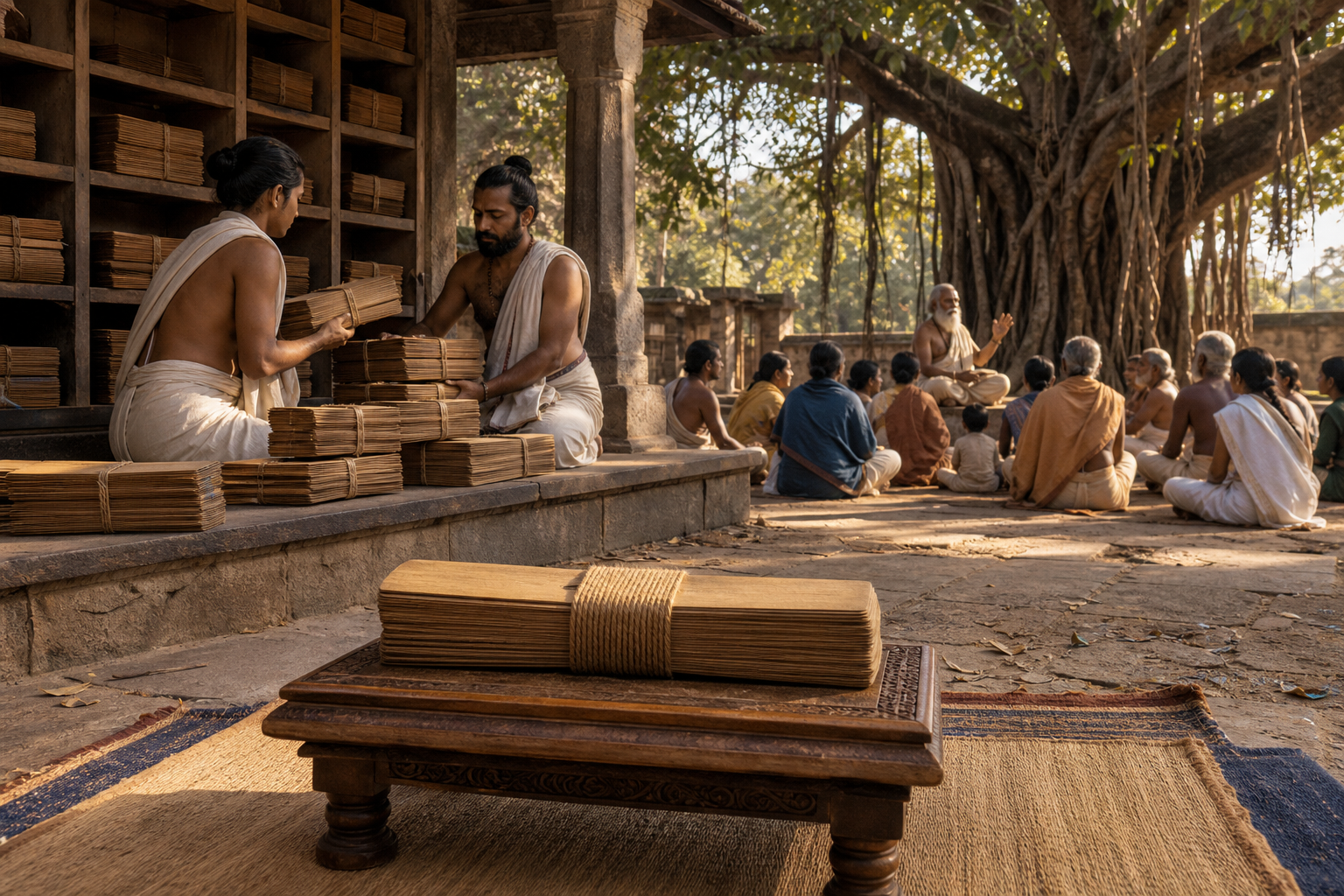
Puranasamhita, also written as Purana Samhita, joins two ideas. Purana points to inherited or ancient lore. Samhita emphasizes gathering, arranging, or composing material into an ordered whole. In its most direct sense, the compound refers to the composition of Puranic lore.
The word collection is helpful, but it can sound too passive. A heap of stories is merely an accumulation. A samhita presents material in a form that can be preserved, taught, recalled, interpreted, and passed onward. Order and relationship therefore matter alongside content.
This is why the singular form should not be treated as automatic proof of one uniform volume comparable to a modern single-author book. Depending on context, Puranasamhita may direct your attention to an organized body of lore, the work of compilation, or a textual form associated with that work. The surrounding passage must decide how narrowly you should read it.
- Puranic lore: the narratives, memories, teachings, genealogies, cosmological accounts, sacred places, observances, and devotional understandings being transmitted.
- Puranasamhita: the gathering and ordering that gives such lore a transmissible structure.
- A received Purana or passage: the concrete textual form you can actually read, cite, translate, or compare.
When you meet the term, inspect its grammatical neighbours. References to gathering, arranging, teaching, preserving, or transmitting usually foreground compilation. References to chapters, wording, manuscripts, or editions point toward a more specific textual object. References to stories or teachings may foreground the lore itself. If the context does not settle the matter, retain the ambiguity instead of inventing certainty.
Compilation does more than store old stories

Oral transmission and systematized knowledge are not opposites. Oral tradition carries memory through recitation, explanation, repetition, and renewed narration. Compilation gives that inheritance an organized form. Puranasamhita is important precisely because it stands at this meeting point between living memory and structured religious knowledge.
That process is not religiously neutral. Arrangement affects understanding. A cosmological account placed beside a genealogy, a devotional teaching, or the praise of a sacred place can establish relationships that an isolated quotation conceals. The compilation does not merely preserve individual units; it helps form a world in which those units make sense together.
This gives you a practical reading rule: never extract a Puranic statement before checking its frame. Note what comes immediately before it, what follows it, who is speaking, who is listening, and what question or occasion prompted the teaching. A sentence may be memorable on its own while performing a more precise function within its narrative setting.
The same rule applies when Puranic material is used in a sermon, social-media graphic, or debate. Before accepting a detached line as a universal proposition, locate the passage and ask what the compilation is doing with it. It may be praising, instructing, remembering, explaining, warning, or situating a practice. Those functions can overlap, but they are not interchangeable.
Read Puranic diversity without mistaking it for disorder

Puranic literature does not always speak in the voice of a modern textbook or chronological history. Its modes include sacred narrative, cosmology, genealogy, devotion, moral instruction, ritual explanation, and the religious interpretation of place. One passage can operate in more than one mode.
If you ask only, “Did this happen exactly like a modern report?”, you may miss the passage’s theological or ethical work. If you declare everything symbolic, you commit the opposite error by stripping the tradition of claims it may intend to make. A disciplined reading first asks what kind of claim appears in the passage and how that claim functions in its setting.
Variation should be handled with equal care. Two tellings can differ because they address different audiences, emphasize different deities or places, serve different teaching purposes, or preserve different lines of transmission. Difference is not automatically contradiction. Yet respect for tradition does not require you to pretend that every formulation says exactly the same thing.
- Check the question: are the passages actually answering the same question?
- Check the frame: do they belong to comparable narrative, devotional, ritual, or cosmological settings?
- Check the scope: is each statement presented as a general principle, a teaching for a particular setting, or praise directed toward a deity or sacred place?
- Check the wording: are you comparing the underlying texts, or merely two translators’ choices?
Only after those checks should you decide whether the passages complement one another, preserve distinct perspectives, or genuinely disagree. Hindu tradition does not gain dignity from forced uniformity. It is better served by patient attention to how sacred memory has been ordered and transmitted.
A seven-step method for studying Puranasamhita

You do not need to solve the entire history of Puranic literature before studying one occurrence of the term. Use the following method whenever Puranasamhita appears in a translation, commentary, lecture, or discussion.
- Capture the exact occurrence. Copy the term, its translation, and the complete sentence around it. Record whether it appears as Puranasamhita or Purana Samhita, but do not assume that English word spacing creates two different concepts.
- Identify what the term denotes locally. Does the passage emphasize lore, the act of compilation, an organized corpus, or a particular textual object? State the answer provisionally if the context remains unclear.
- Map the teaching frame. Note the speaker, listener, setting, and immediate question where these are supplied. This prevents a framed teaching from being mistaken for an unqualified declaration.
- Classify the passage’s work. Ask whether it preserves memory, praises a deity or place, explains the cosmos, relates a lineage, recommends conduct, or interprets an observance. More than one function may apply.
- Inspect the arrangement. Summarize the material immediately before and after the passage. Then write one sentence explaining why the compiler or transmitter may have placed these elements together. Mark that explanation as an interpretation, not a proven intention.
- Compare like with like. Compare passages only after checking that their subject, scope, narrative setting, and translation level are genuinely comparable. If edition or manuscript information is unavailable, do not make confident claims about exact wording.
- Write a two-sentence finding. In the first sentence, state what the passage communicates within its own frame. In the second, state how its placement contributes to the larger body of Puranic knowledge. This keeps content and compilation connected without confusing them.
A compact notebook entry can use the fields “Term | Location | Local meaning | Speaker and listener | Function | Neighbouring material | Uncertainty.” That is enough structure to reveal where your interpretation rests on the text and where it rests on inference.
This method also protects you from a common historical mistake. The concept of Puranasamhita, by itself, does not establish a precise date, a single compiler, fixed contents, or an unbroken wording for every passage. Those conclusions require evidence beyond the compound’s meaning. Where that evidence is absent, write “not established here” and continue with what the context can support.
Key takeaways
- Puranasamhita is best approached as the ordered composition of Puranic lore, not automatically as the title of one modern-style book.
- Keep inherited lore, the process or result of compilation, and the received text in front of you conceptually distinct.
- Read arrangement as part of meaning: the narrative frame and neighbouring material can change how an isolated sentence should be understood.
- Do not treat every variation as corruption or force every difference into artificial agreement. Compare purpose, scope, setting, and wording first.
- Use the term to understand sacred transmission, but do not make it prove a date, author, or fixed textual history that the context does not supply.
On your next encounter with Puranasamhita, begin with one small discipline: write down whether the discussion concerns lore, compilation, or a received text. That single distinction will sharpen every question you ask afterward and help you approach the Puranic inheritance as both living memory and carefully organized sacred knowledge.
References
