

You may hear a Vedic yajna in which a major recitation pauses, a priest speaks a brief formula, an offering follows, and the rite immediately moves on. If you listen only for hymns or translations, that short utterance can seem incidental. It may actually be doing essential coordinating work.
The useful question is not simply, What does this sentence mean? Ask what it makes possible at that exact moment. Nigada becomes intelligible when you follow the relationship among voice, priest, movement, offering, and the recitation that comes next.
Do not hear nigada as a fourth kind of hymn
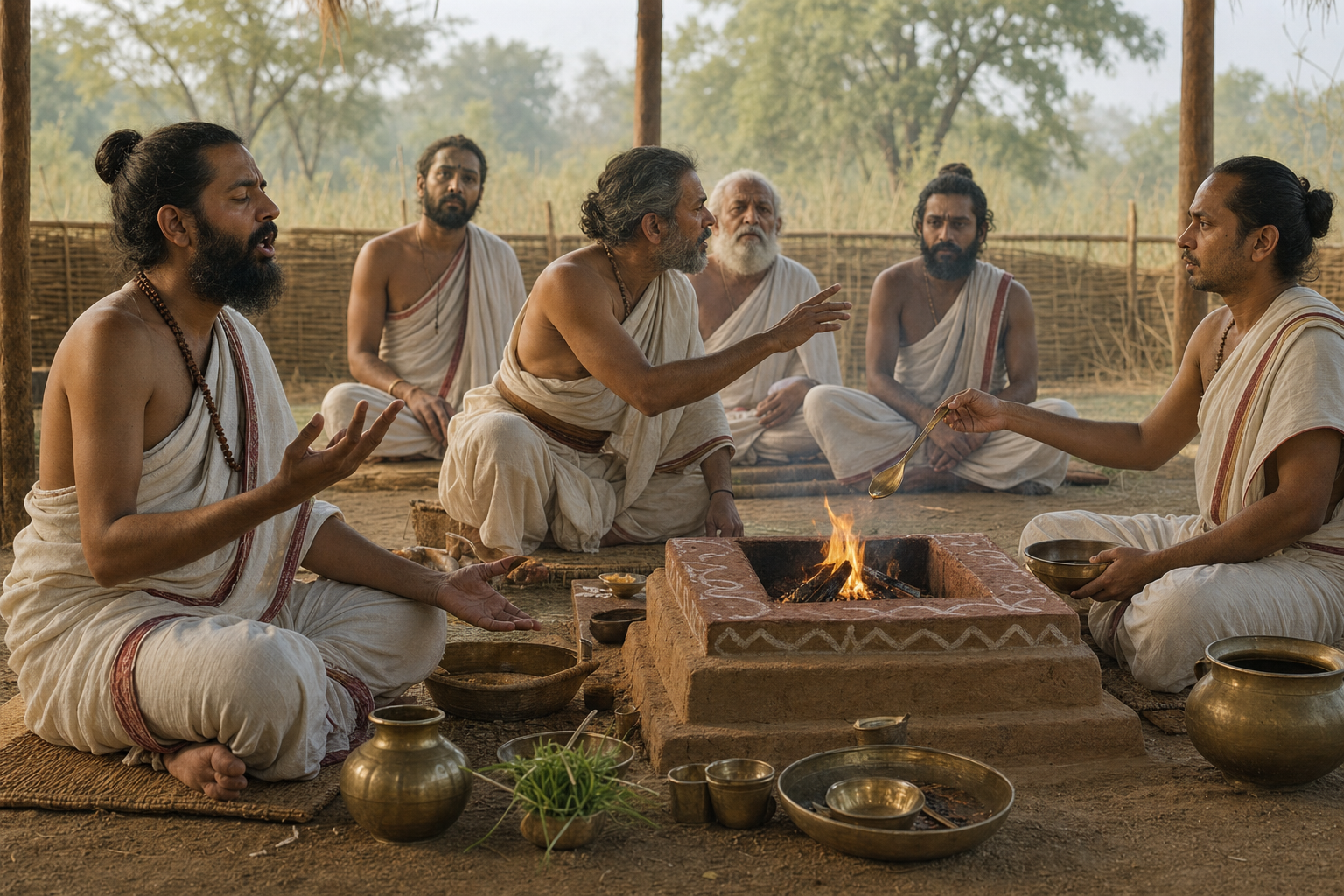
A Vedic sacrifice is not one uninterrupted stream of chanting. It is an ensemble performance in which distinct forms of sacred speech are entrusted to priests with distinct responsibilities. Begin with the familiar triad of rik, yajus, and saman.
| Verbal form | Typical character | Priestly role | Work within the yajna |
|---|---|---|---|
| Rik | Metrical verse | Hotr | Recitation shaped as prayer, invocation, or praise |
| Yajus | Primarily prose formula | Adhvaryu | Sacrificial speech closely joined to actions and offerings |
| Saman | Melodically developed verse | Udgatr | Sung performance governed by a disciplined musical pattern |
The Brahman priest supervises the performance for textual and procedural correctness. Nigada should be placed within this multivocal structure, but not treated as a competing fourth member of the triad. It is better understood as a coordinating layer: a compact, context-bound utterance that helps the different ritual lanes meet at the right instant.
This distinction changes how you study it. A rik can be recognized as a metrical verse outside the immediate act in which it is recited. A nigada loses much more when detached from performance. Its identity may depend on who voices it, who hears or answers it, the required voice level, the offering or movement beside it, and what immediately precedes and follows it.
Length alone is therefore a poor test. Not every short expression is nigada, and a fragment does not become nigada merely because it sounds like a cue. Function and placement are decisive. A nigada may stand beside a yajus, help prepare the transition to a rik, or signal movement after a saman cadence without becoming identical to any of those forms.
Read nigada at the ritual junction

The most revealing place to look for nigada is a junction: the point where spoken sound and sacrificial action must coincide. Its brevity is not evidence of lesser importance. Brevity allows a cue or affirmation to do its work without displacing the principal recitation.
A well-placed nigada can support three kinds of alignment:
- Procedural alignment: the appropriate person begins the appropriate act at the prescribed point rather than acting from memory or visual guesswork.
- Semantic alignment: the offering or movement remains joined to the mantra and intention proper to that ritual moment.
- Acoustic alignment: the supporting utterance is audible in the manner required for its function but does not compete with the principal chant.
These three alignments explain why translating the words is not enough. You can know a formula’s lexical meaning and still misunderstand its ritual work. Conversely, a trained participant can respond correctly to a familiar cue because its place in the sequence has been learned together with its sound.
Watch one junction instead of chasing every word
If you are observing a yajna, choose one offering sequence and follow it closely. Trying to identify every sound across the entire ceremony usually produces a list of fragments without relationships. For the chosen sequence, notice:
- which priest carries the principal recitation;
- whether a shorter utterance occurs before, during, or immediately after a movement;
- whether an assistant or group gives a response;
- what happens to the ladle, vessel, offering, or priestly position at that instant;
- whether the utterance confirms the present act or opens the next phase.
This observational method does not authorize you to label every brief sound as nigada. It gives you the right evidence to ask a competent teacher a precise question: What is the utterance at this particular junction, and what rule governs it in this performance?
Voice level is part of that rule. Nigada can be delivered with acoustic restraint, including softly in an upamshu mode; some contexts may assign a collective response to assisting priests. Neither feature should be universalized. A quiet utterance is not casual speech, and a group response is not proof that the same arrangement belongs in another ritual or recension.
Softness also does not relax phonetic discipline. The accents udatta, anudatta, and svarita, together with correct sandhi, remain relevant when the utterance is subdued. If a cue is too soft for you to catch, do not reconstruct it from a loosely similar recording. Record its position in the sequence and seek the wording, accent, and voice level from the lineage responsible for that rite.
Distinguish nigada from its ritual neighbors
Vedic ritual contains several kinds of short or specialized speech. Confusion arises when every directive, insertion, invocation, and offering cry is placed under one label. The categories can occur close together, so classify the utterance by the work it performs rather than by brevity or dramatic effect.
| Form | Primary ritual work | Question that helps identify it |
|---|---|---|
| Nigada | Coordinates, confirms, or helps time a context-bound ritual junction | What action, response, or transition does this utterance synchronize? |
| Praisha | Directs a ritual agent to undertake an act | Is one participant being instructed to proceed? |
| Nivid | Provides an insertion that enumerates or supplies context within the stotra system | Is this an inserted textual unit with an enumerative or contextual role? |
| Anuvakya and yajyā | Frame the prelude and principal invocation associated with an offering | Does the expression belong to the invocatory framing of the offering? |
| Svaha and vashat | Punctuate the offering at a ritually marked point | Is this the offering exclamation itself rather than a coordinating cue around it? |
These are functional distinctions, not isolated boxes. More than one form may contribute to the same ritual episode. A directive can lead to an act, a coordinating utterance can keep the participants aligned, and an offering exclamation can mark the decisive instant. Calling all three nigada erases the architecture you are trying to understand.
Use four checks whenever a label is uncertain:
- Agent: Who speaks, and is anyone specifically expected to answer or act?
- Position: Does the expression come before, during, or after the offering?
- Function: Does it direct, invoke, enumerate, punctuate, confirm, or coordinate?
- Lineage: Which shakha and ritual procedure determine its wording and delivery?
This test is more reliable than searching a transcript for an isolated word. The same performance can place several verbal forms within a narrow span of time, while a transcript may conceal changes of speaker, volume, gesture, and ritual station.
Learn nigada as sound joined to action

Do not begin by collecting detached formulas. That approach may give you vocabulary while leaving the ritual grammar invisible. Build from the general structure toward one exact performance context.
- Establish the three main verbal modes. Be able to distinguish metrical rik, action-oriented yajus, and melodic saman, and know the corresponding functions of Hotr, Adhvaryu, and Udgatr.
- Select one manageable ritual segment. Identify the offering or transition being studied instead of attempting to map a complete yajna at once.
- Create an event map. For each utterance, write down the speaker, listener or respondent, immediately adjacent mantra, associated movement, object or vessel, ritual station, and timing.
- Add the phonetic layer. Mark accent, sandhi, pace, and whether the required delivery is full-voiced, subdued, collective, individual, or silent at a particular point.
- Practise the event, not merely the sentence. Use hearing and repetition under competent guidance so that the utterance is learned with its cue, response, and action.
- Compare recensions only after one usage is clear. Treat differences in wording, voice, and placement as possible shakha-specific rules before treating them as errors.
The familiar recitational disciplines of samhita, pada, krama, jata, and ghanapatha preserve and test verbal memory in different ways. Nigada requires an additional practical layer: placement within live ritual choreography. Accurate recall does not by itself guarantee accurate timing. A formula spoken too early, too late, by the wrong participant, or at the wrong voice level can fail in its coordinating role even when every syllable is remembered.
Before you practise a particular nigada, your notes should answer seven questions:
- Which yajna and which precise segment is this?
- Which shakha or recensional lineage is being followed?
- Who utters the formula?
- Who acts, listens, or responds?
- What offering, vessel, movement, or station is linked to it?
- What comes immediately before and after it?
- What voice level, accent, and sandhi have been taught?
If any of these remain unknown, mark the gap instead of filling it with a generalized rule. Wording, placement, and delivery can vary legitimately by shakha. A formula learned from one recensional setting should not be transplanted into another simply because the surrounding offering appears similar.
This also gives you a fair way to handle apparent disagreement between teachers. First establish whether they are describing the same shakha, the same yajna, the same ritual phase, and the same priestly role. Variation at any of those levels can explain a difference that would otherwise look like contradiction.
Key takeaways for listeners and students
- Nigada is best recognized as brief, targeted ritual speech whose full identity depends on context.
- Its principal value lies in coordinating priest, mantra, action, offering, and transition at a particular junction.
- It is not a fourth peer of rik, yajus, and saman, and it should not be confused with a directive, textual insertion, invocatory formula, or offering exclamation.
- Voice level, accent, speaker, response, and placement are parts of the practice, not optional performance details.
- Shakha variation is real; learn one lineage’s rule before comparing or generalizing.
- The safest study unit is not an isolated sentence but a complete sound-and-action event taught by a competent guide.
At your next yajna, follow one offering rather than trying to capture the whole soundscape. Note who speaks, what moves, where the short utterance falls, and how the next phase begins. Then take that event map to someone trained in the relevant lineage. Moving from a word list to a timed ritual map is the practical step that makes nigada visible.