
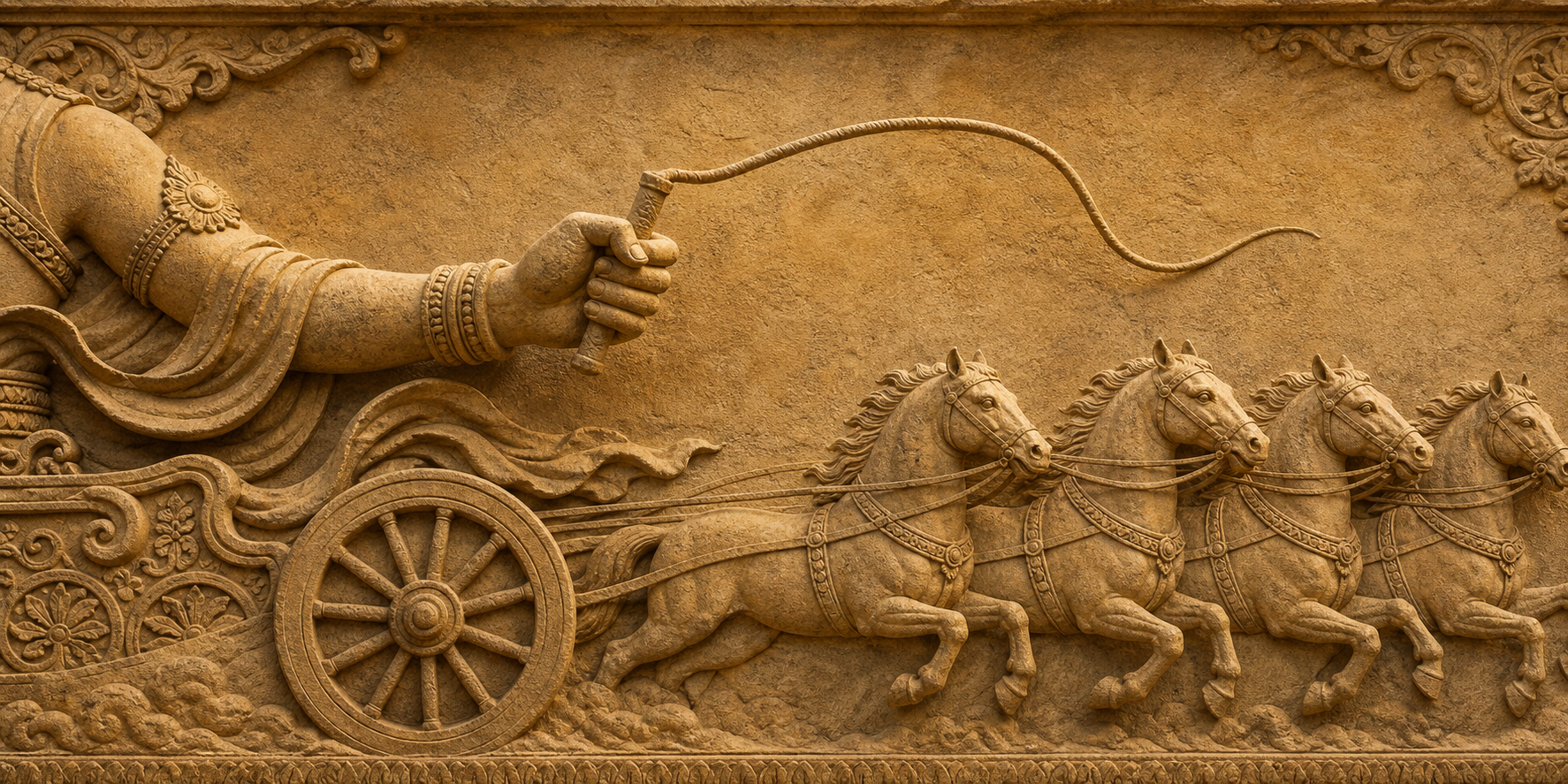
You are looking at a temple sculpture when a small object catches your eye: a short handle with a narrow line curling, falling, or sweeping away from the hand. Is it a noose, a rein, a staff, a weapon, or simply damaged ornament?
If it is Kasha or Pratoda, the object is doing more than identifying its bearer. It tells you how the image understands authority: energy must move, but it must move in the right direction, at the right pace, under disciplined guidance. You can recover that meaning by reading the form, the bearer, and the surrounding scene in the correct order.
First identify the object, not the symbolism
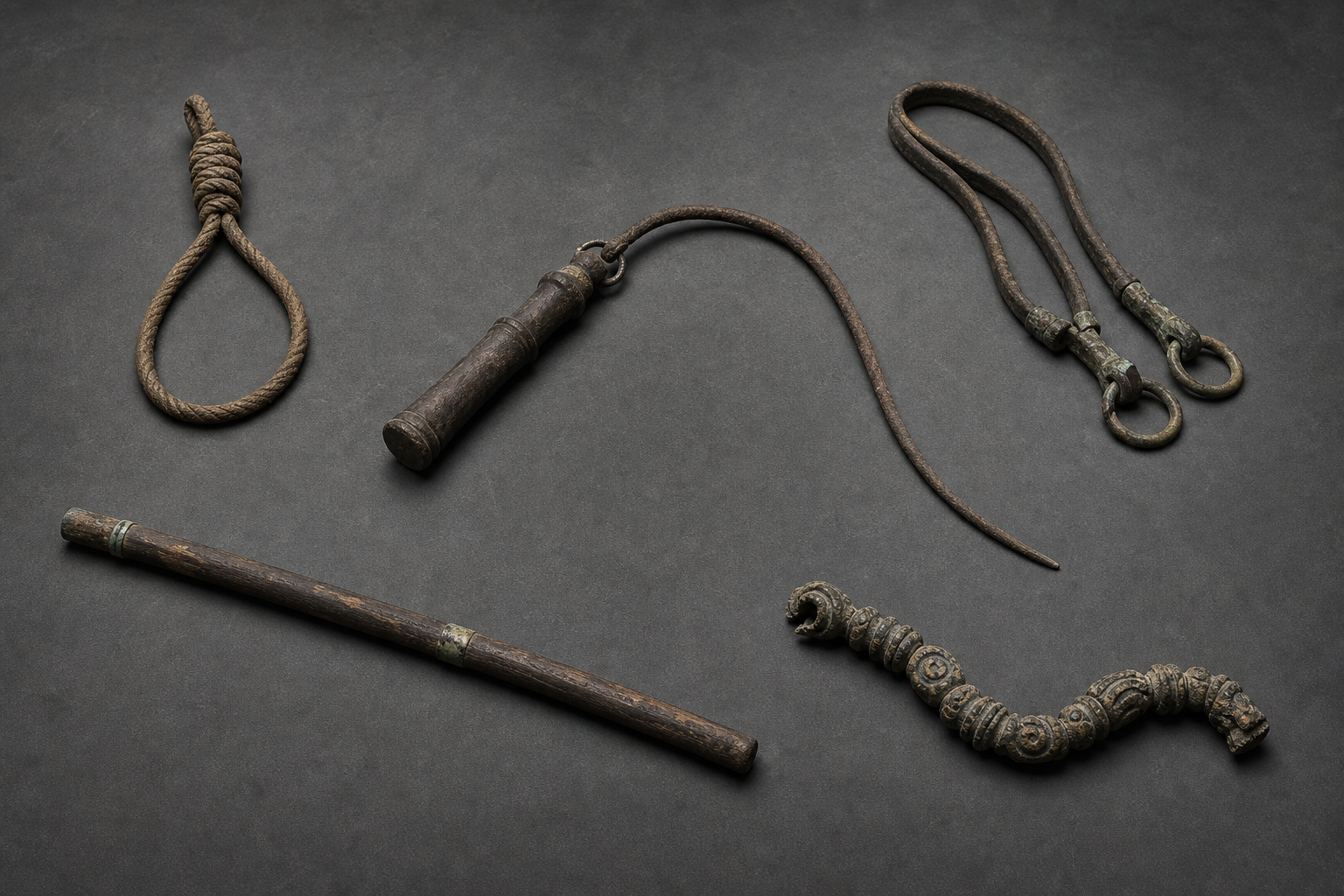
Kasha and Pratoda name a whip or goad-like implement within Hindu iconographic vocabulary. Pratoda belongs to the same broad family of regulating implements as the ankusha, pasha, and danda. It may be classified as an ayudha, but here that word should not make you imagine a battlefield weapon. An ayudha in an iconographic inventory can be a held implement whose function is guidance, authority, protection, or identification.
The first clue is scale. Kasha is ordinarily a secondary, relatively modest attribute. It supports the figure’s role without competing with the face, principal mudras, or defining emblems. A large discus, trident, lotus, or staff may establish identity immediately; a whip usually explains what the figure is doing.
- Find the grip. Look for a short or medium-length handle. It may be plain, faceted, ringed, or finished with a small knob.
- Trace the line from the grip. A whip has a thong or lash that narrows, bends, coils, or flares at its end. A rigid shaft that keeps the same width is more likely to be a staff.
- Check for a hook or loop. A clear hook points toward an ankusha, while a conspicuous loop is more likely to indicate a pasha. Kasha is defined by a flexible, directional line rather than a hook or closed noose.
- Separate it from the reins. In a chariot scene, reins lead from the hand toward the horses. The whip may begin near the same hand, but it functions as a separate implement of impetus.
- Follow the implied motion. A whip often creates a diagonal that leads your eye from the bearer’s face to the hand and onward toward a horse, mount, animal, procession, or guarded space.
Stone loss can complicate the identification. A broken lash may leave only a handle, while a shallow carved line can disappear into weathering or shadow. Do not decide from the surviving fragment alone. Change your viewing angle, inspect the hand position, and look for the action implied by the surrounding figures.
Key takeaways
- Kasha or Pratoda is usually a handle joined to a flexible, tapering lash.
- It is normally a secondary attribute, so it explains function more often than it establishes a deity’s identity.
- The bearer and narrative setting matter more than resemblance alone.
- Its usual iconographic message is disciplined direction: gathering energy, regulating movement, and sustaining order.
The bearer and setting determine the reading
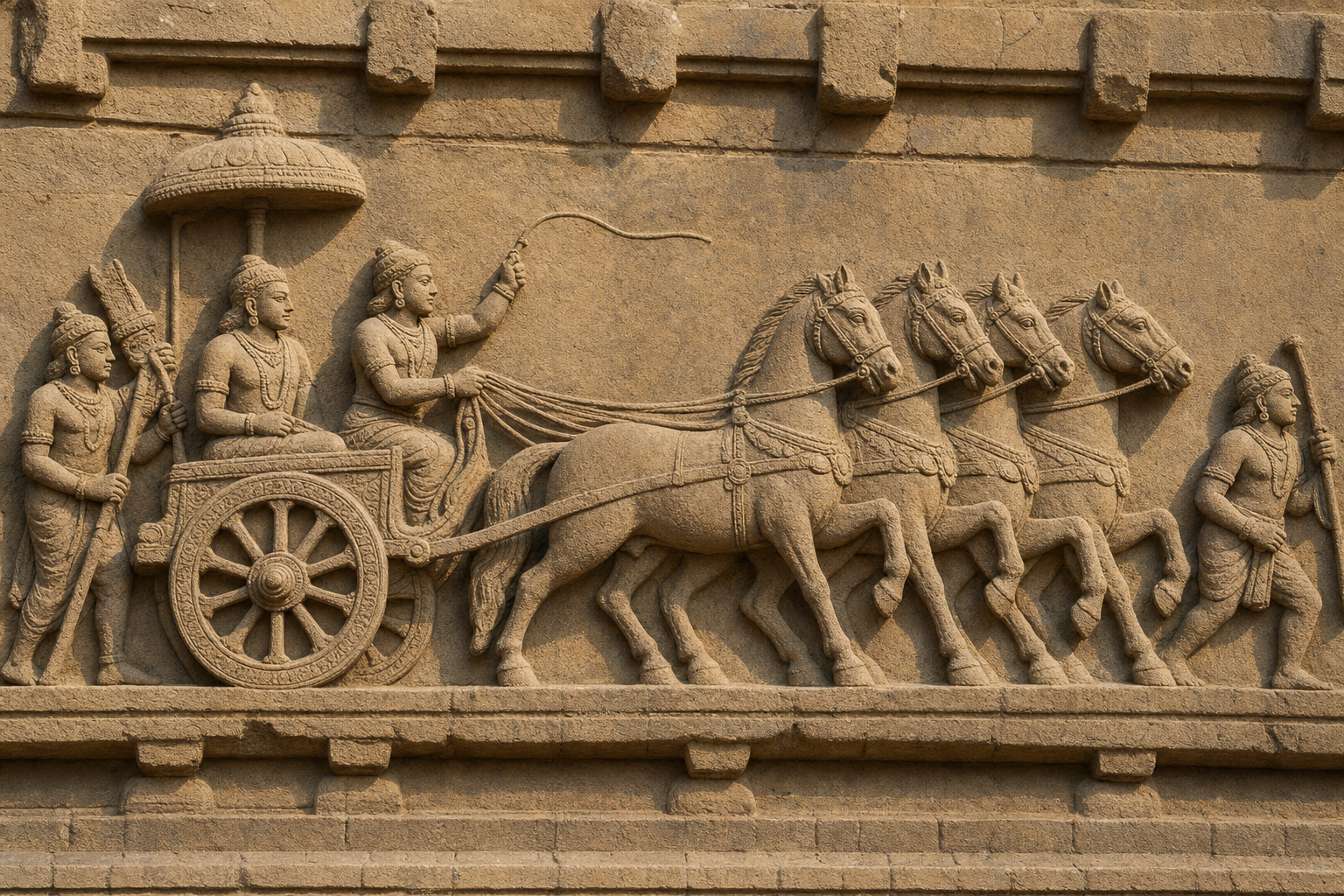
A whip does not carry one isolated meaning everywhere it appears. Start with a concrete question: who holds it, and what must that figure direct, guard, or regulate? Several contexts give you especially strong clues.
- Aruna and the solar chariot: This is the clearest setting. Surya is commonly marked by his lotuses, while the charioteer Aruna appears before him with reins and Pratoda, directing the seven horses. The whip belongs to the governance of the chariot’s movement and therefore to the ordered passage of light and time. Chariot imagery at the Konark Sun Temple makes this kinetic logic particularly easy to recognize.
- Threshold guardians and attendants: A dvarapala, pratihara, or gana may carry a coiled or extended whip near a doorway or within a mandapa. At a threshold, its meaning shifts from locomotion to vigilance. Entry into sacred space requires attention, protocol, and restraint.
- Shaiva and Shakta figures: Pratoda can appear among the multiple implements held by fierce, protective, or guardian manifestations. It may accompany pasha, ankusha, damaru, or other attributes. The combination presents shakti as directed force rather than uncontrolled intensity. A lash-like implement in some Yogini ensembles can similarly emphasize mastery of instinct and motion.
- Vaishnava narrative scenes: Kasha is not a primary attribute of Vishnu, but it belongs naturally in pastoral, vehicular, and processional reliefs. A gopa may direct cattle, or an attendant may manage a mount. Here the implement clarifies the action taking place within the narrative.
- Yama and his retinue: Yama is more characteristically associated with pasha and danda. A whip is therefore safer to read as part of an ancillary program of discipline or accountability unless the full composition establishes otherwise. Do not turn an occasional accessory into a universal identifying emblem.
- Buddhist and Jaina narrative art: Reins and whips can also appear with guardians, charioteers, attendants, and vehicular scenes beyond Hindu traditions. Their presence reveals a shared Dharmic visual language of directed movement and self-mastery, not proof that every bearer has the same theological identity.
This context-first method prevents a common error: identifying the central deity from an attendant’s implement. In a solar panel, for example, the lotuses help establish Surya, while the charioteer’s reins and whip establish Aruna’s task. Read the whole relationship before naming any single figure.
Pratoda belongs to a family of instruments of guidance
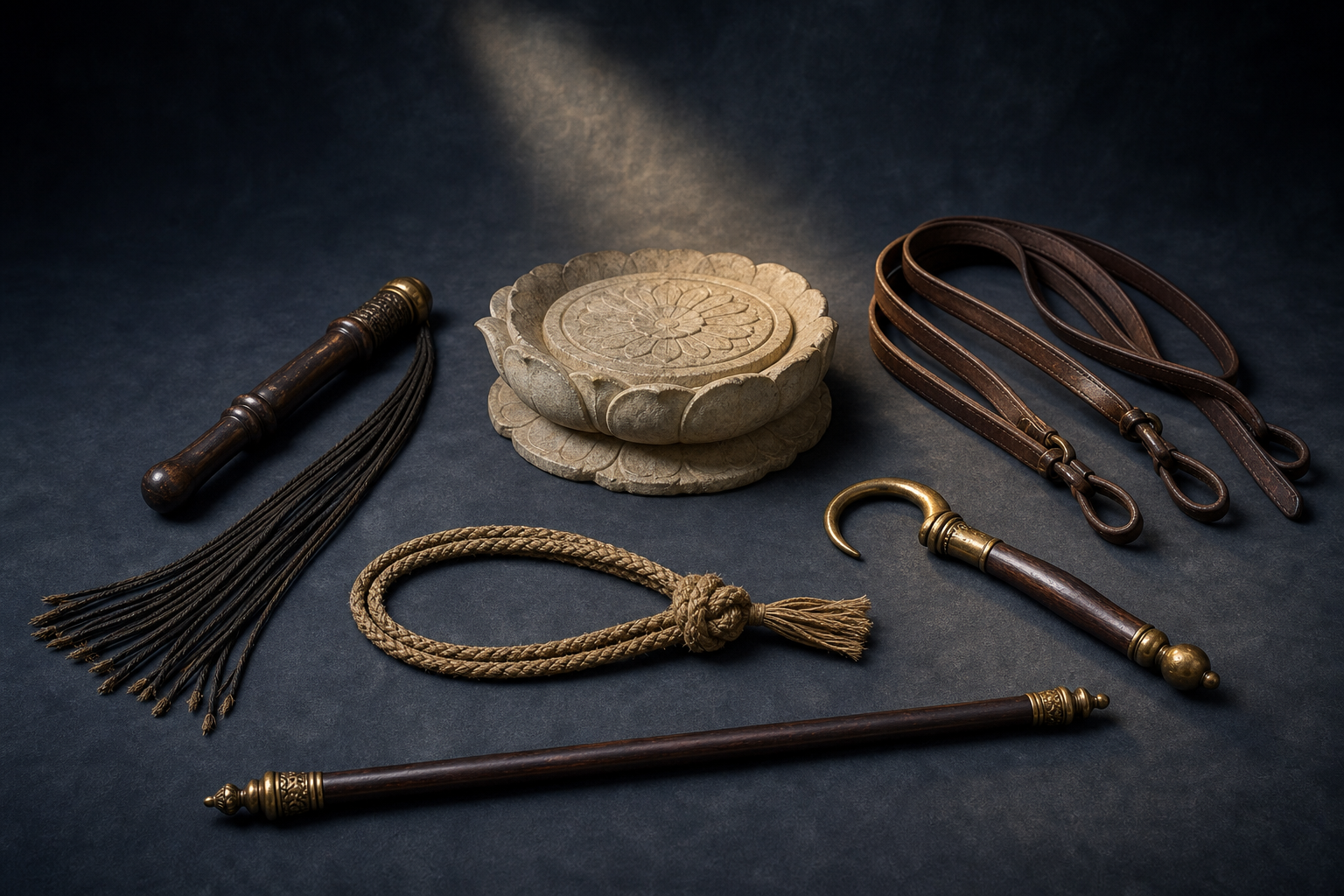
Kasha becomes clearer when you compare it with the nearby visual vocabulary. Pasha, ankusha, Pratoda, and danda all regulate movement or conduct, but they do so through different actions. Those differences are precisely why a sculptor may place more than one of them in a complex image.
| Implement | Visible form | Immediate action | Iconographic emphasis |
|---|---|---|---|
| Pasha | Cord, loop, or noose | Gathers, holds, or binds | Restraint, relationship, containment |
| Ankusha | Short handle with a hook | Steers through a precise cue | Correction, discrimination, directed control |
| Kasha or Pratoda | Handle with a flexible lash | Urges movement and maintains momentum | Cadence, impetus, disciplined energy |
| Danda | Rigid rod or staff | Supports, bars, or enforces | Authority, rule, firm consequence |
The distinctions give you a practical interpretive vocabulary. The noose gathers what is straying. The goad corrects direction at a particular point. The whip supplies repeated impetus. The staff represents settled authority. None of these meanings is mechanically fixed, but each begins with the physical action of the object rather than an arbitrary symbolic association.
This is why Pratoda should not be reduced to cruelty. The image does not deny that a literal whip can inflict pain; it assigns the implement a particular role within a sacred composition. The whip is generally small, functional, and subordinate. It is not displayed as a trophy. Its visual work is to show that force becomes legitimate only when it is proportionate, purposeful, and yoked to duty.
That principle connects Kasha with rita and dharma. Rita concerns ordered pattern, while dharma carries that order into right conduct, obligation, and social life. The whip therefore asks an ethical question of whoever holds authority: can vitality be guided without being crushed, and can correction be exercised without becoming domination?
The same distinction matters in dandanitic thought. Discipline is not justified merely because a ruler, guardian, teacher, or institution possesses power. Its purpose is to protect order through measured correction. An oversized or triumphant whip would communicate something different. The customary modesty of Pratoda is part of its message.
Form, material, and composition preserve the clue
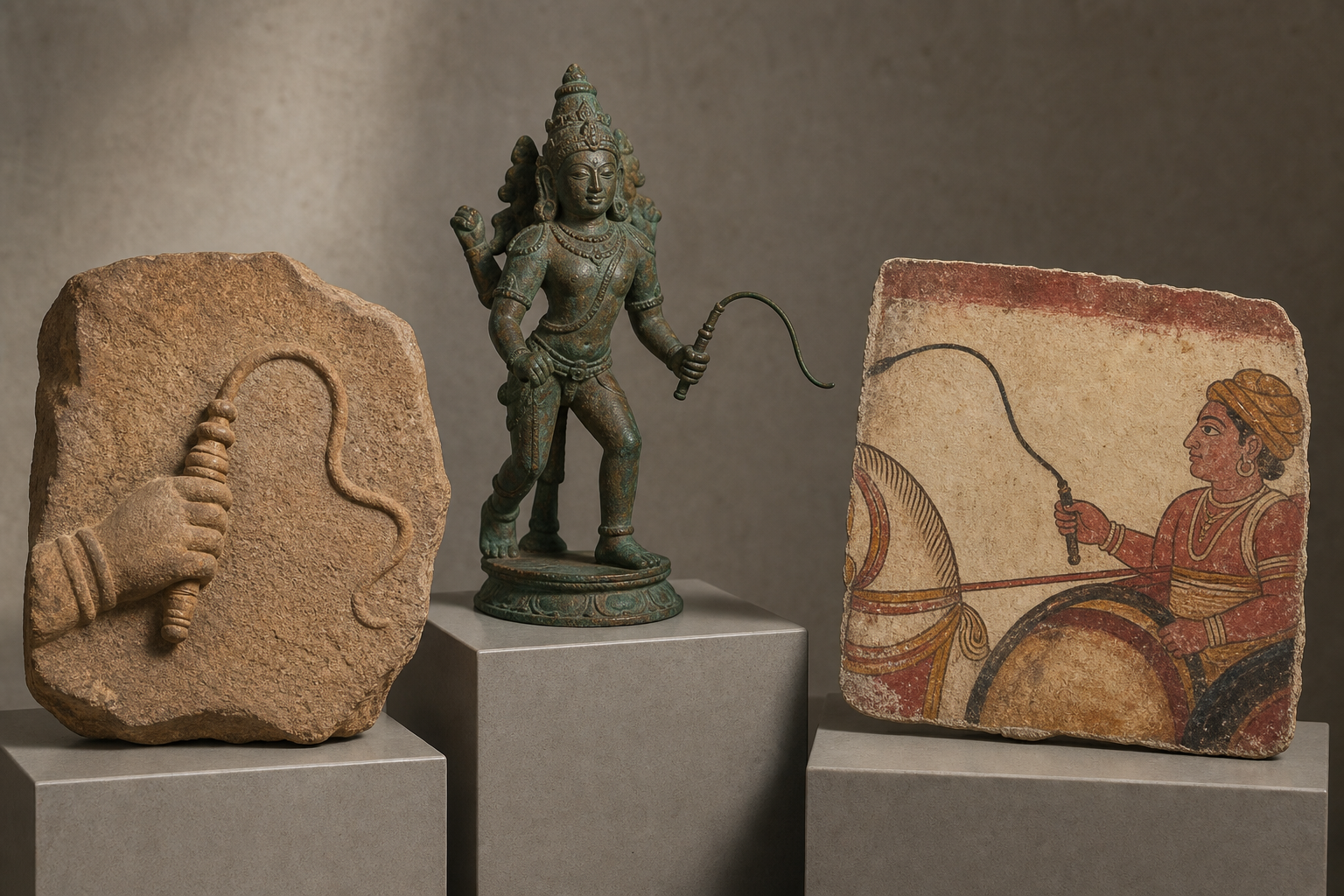
Once you know what to seek, the sculptor’s craft becomes evidence. A readable Pratoda normally has two primary components: a graspable handle and a lash whose curve indicates flexibility. Small details such as rings, facets, ribs, braiding, a terminal flare, or a slight hand guard may reinforce the identification.
Material changes the solution. A freely hanging stone cord would be vulnerable, so a stone lash may survive as a shallow relief line or a gently raised band supported by the background. A metal icon can give the implement a firmer ribbon-like profile that remains structurally durable while preserving the impression of movement. What looks too solid to be a real thong may therefore be the sculptor’s practical translation of flexibility into a lasting material.
Regional style refines the treatment without changing the basic visual logic. Odishan work may use deeper undercutting to heighten motion; Hoysala soapstone can carry fine ribbing or jewel-like handle detail; and a Chola bronze may reduce the object to a spare curve integrated with the larger rhythm of the figure. Use these features as supporting evidence, never as the sole basis of identification.
Composition supplies another test. The Manasara, Mayamata, and Aparajitaprccha belong to the shilpa-shastra world in which attributes are not random additions. They must remain legible, proportionate, and consistent with the figure’s nature and role. Pratoda consequently tends to occupy a diagonal or outer arc where it can activate the image without covering the face, primary mudras, or principal emblems.
Follow that diagonal with your eyes. It may carry you from the bearer’s gaze to the hand, from the hand to the lash, and from the lash to the beings or space under direction. The line itself teaches you how to read the scene. Motion is present, but it has been given a measure and a destination.
A five-step reading method for your next temple visit
You do not need to memorize every possible bearer before entering a temple or museum. Use a repeatable sequence that keeps visual evidence ahead of interpretation.
- Locate the bearer within the hierarchy. Decide whether you are looking at the central deity, a charioteer, a guardian, an attendant, a gana, a pastoral figure, or part of a procession.
- Inventory the unmistakable attributes first. Lotuses, a discus, a trident, a vehicle, a crown, a mudra, or a threshold position may identify the larger context more securely than the suspected whip.
- Trace the complete object. Look for the transition from handle to flexible lash. Compare it directly with any nearby reins, cords, hooks, staffs, serpents, or garlands.
- Name its action with one verb. Is it gathering, steering, propelling, guarding, or enforcing? If the best verb is propelling or maintaining momentum, Pratoda becomes a stronger identification.
- Only then ask what the action means. In a solar chariot it may express ordered cosmic movement; at a doorway, vigilance; beside a fierce figure, mastery of energy; in a contemplative reading, regular self-correction.
Keep the final step proportionate to the evidence. A catalog identification and a spiritual meditation are not the same claim. The handle, lash, bearer, and narrative establish what the object probably is. A yogic reading then lets you consider what its action can disclose about your own discipline.
In that contemplative register, Pratoda can represent steady redirection of the mind. Restless rajas needs direction; inert tamas needs impetus; sattva grows through measured, repeated effort. Pasha, ankusha, and Pratoda can then be read as three moments of practice: contain what is wandering, correct the course, and maintain a sustainable rhythm. This complements disciplines of restraint and attention associated with yama, niyama, pratyahara, and dama.
That reading does not turn severity toward yourself. A whip driven by anger is evidence of lost mastery, not its attainment. The iconographic lesson is cadence: make the necessary correction, repeat it without drama, and keep energy serving a worthy direction.
The next time you encounter a slender lash in sacred art, resist the quick label of weapon. Trace the line, identify what is being guided, and ask which form of discipline the scene requires. That small act of attention allows an easily overlooked attribute to reveal the image’s larger teaching about power under dharma.