
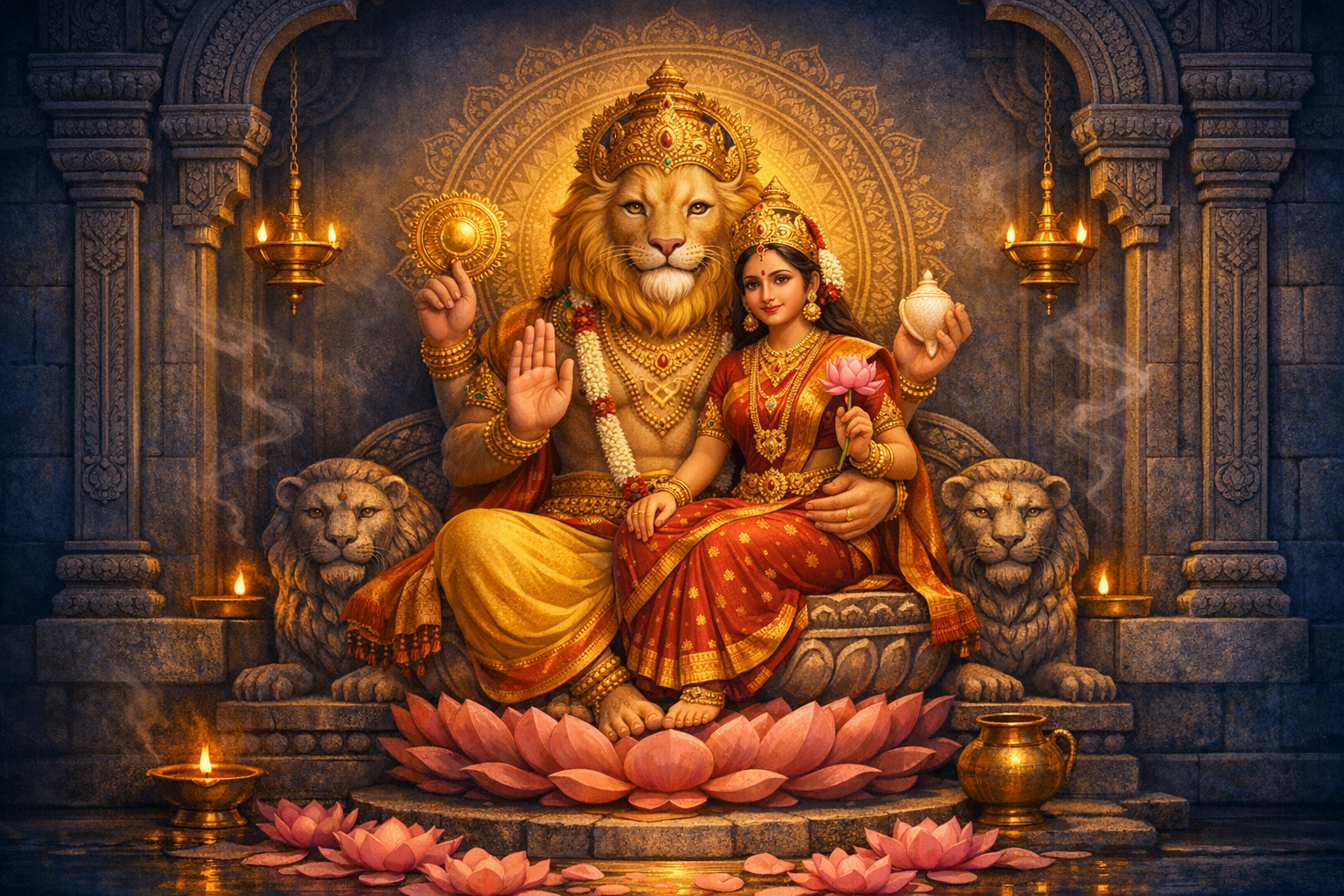
The moment that shook the three worlds is described with luminous brevity in the Vishnu Purana and more fully in the Bhagavata Purana (Bhagavata Purana, Canto 7): when Narasimha, the leonine avatar of Vishnu, burst forth at twilight to vanquish Hiranyakashipu, the very fabric of the cosmos trembled before a justice that was absolute. Even the devas hesitated to draw near. What followed in sacred memory is equally decisive: the same power that razed adharma opened a path of refuge and tenderness for the devotee. This pivotfrom raudra (terrible) to shanta (pacified)is what Lakshmi’s presence on Narasimha’s lap makes enduringly visible.
Iconography within Vaishnava traditions calls this composite form Lakshmi-Narasimha or Lakshminarasimha. The depiction is simple and profound: Lakshmi, embodiment of Srigrace, auspiciousness, and ordersits upon the left lap of Narasimha. He often holds the shankha and chakra and offers Abhaya (fearlessness) and Varada (boon-bestowing) mudras. Together, they articulate a theology of irresistible protection tempered by compassionate accessibility. The pose itself announces the meaning: justice has achieved its end and now turns, through Lakshmi’s karuna, toward anugraha (benediction) for all who seek refuge.
Scriptural threads converge to sustain this image. The Bhagavata Purana recounts the purifying ferocity of the avatara and the unique sharanagati (surrender) of Prahlada, whose bhakti can approach even the most blazing form. Agamic sources in the Vaikhanasa and Pancharatra traditions elaborate the worship and iconography of Lakshmi-Narasimha, noting how Sri’s inseparability from Vishnu ensures that divine power remains oriented toward lokasangraha (the upholding of the world). In this sense, Lakshmi on the lap is not a narrative snapshot but a theological resolution: cosmic wrath, having righted injustice, settles into protective stillness.
Why specifically the lap? In classical Indian aesthetics and ritual symbolism, the lap (uru) signifies intimacy, acceptance, and unguarded nearness. It is the seat where fear dissolves; the threshold of the heart made explicit. Placing Lakshmi there states in the language of form what theology teaches in the language of doctrine: Narasimha is no longer addressed as an impersonal force of retribution but as the ever-approachable Lord whose fierce grace now serves the devotee’s ascent.
Vaishnava iconography preserves important variations. In shanta representations, Narasimha is seated, often in lalitasana, with two or four arms; Lakshmi holds a lotus and may lightly embrace His torso. In ugra representations (Ugra Narasimha), the energy surges outwardfangs bared, mane aflame, weapons radiant. The Lakshmi-Narasimha murtis intentionally emphasize the pacified continuum: with Lakshmi present, the same energy that shattered tyranny now steadies minds, stabilizes societies, and bestows fearlessness.
Mudras refine the message. The Abhaya mudra, a universal Hindu symbol, communicates “do not fear”; the Varada mudra conveys generosity and prosperity. Positioned alongside shankha and chakra, the mudras align prosperity (Lakshmi), protection (chakra), purity of resolve (shankha), and refuge (Abhaya). For the devotee, the synthesis is practical: the Lord protects, the Goddess prospers, and together they confer inner stability and outer well-being.
Underlying this synthesis is the metaphysical identity of Sri. Lakshmi is not merely wealth in a narrow material sense; she is the principle of order, beauty, and flourishing that makes dharma livable. In the cosmology of the Puranas and the Pancharatra Agamas, Vishnu without Sri does not appear; the sign of Sri (srivatsa) rests on His chest. The lap-seated Lakshmi externalizes this inseparability in a form that is relational and pastoralDivinity that meets the devotee at eye level.
Rasa theory illumines the transition. Narasimha’s emergence is suffused with raudra rasa (the aesthetic mood of fury against adharma). Lakshmi’s advent introduces karuna (compassion) and shringara (harmonizing love), culminating in shanta (tranquil plenitude). The continuity among these rasas is not a contradiction but a culmination: righteous force that does not melt into compassion remains incomplete; compassion that does not ground itself in justice remains ineffectual. Lakshmi on the lap completes the arc.
A well-known devotional trajectory follows from this. When ordinary minds face injustice or fear, they often oscillate between rage and retreat. The Lakshmi-Narasimha synthesis teaches a steadier path: courage anchored in compassion. The icon does not invite passivity; it invites fearless clarity without losing the tenderness to heal what violence (even righteous) can unsettle in the heart.
The Bhagavata Purana’s account of Prahlada makes this structurally plain. The devas fear to approach; Prahlada, absorbed in bhakti, prostrates fearlessly. His prayer transforms the atmosphere; wrath dissolves into grace. Lakshmi seated upon Narasimha’s lap converts that moment into a lasting grammar of devotion: sharanagati is always met not by annihilating judgment but by protective embrace.
Agamic liturgies reinforce the pastoral dimension. Pancharatra manuals describe Lakshmi-Narasimha as a form suitable for household shrines precisely because the energy is auspiciously pacified. Vaikhanasa texts detail alankara and upacharas that bathe the deity in sandal, camphor, and fragrant watersrituals that mirror the theological cooling implied by Lakshmi’s presence.
Temple traditions extend these insights through place and time. At Simhachalam (Varaha Lakshmi Narasimha), the moolavar is kept under sandal paste through the year, revealed uncovered only during Chandana Yatra. The practice encodes a hermeneutic: raw, unmediated power is made accessible by cooling, nurturing graceLakshmi’s very work. At Ahobilam (Nava Narasimha), one encounters a spectrum from ugra to shanta forms, culminating in shrines where Lakshmi’s nearness signals rest and refuge.
Other famed kshetrasYadadri (Yadagirigutta), Mangalagiri, Melkote’s Yoga Narasimha, and numerous South and East Indian templesoffer variations that keep the core constant: with Sri upon His lap, the Lord’s gaze softens and the devotee’s fear lifts. Even the celebrated Ugra Narasimha at Hampi, whose Lakshmi image was lost to time, is remembered in local lore as originally Lakshmi-Narasimhaanother sign that communities intuitively prize the completed harmony over the isolated intensity.
Mantra and stotra traditions draw the devotee into this harmony. The widely recited protective verse “Ugram viram mahavishnum jvalantam sarvato mukham” affirms the Lord’s invincible guardianship. Devotees of Lakshmi-Narasimha often pair such mantras with the plea of the Karavalamba Stotram, “Lakshmi nrisimha mam dehi karavalambam,” seeking the Lord’s hand of rescue through the mediating grace of Sri. The synergy is deliberate: there is no fearlessness without refuge, no refuge without fearlessness.
Contemplative practice makes the icon personally transformative. A simple dhyana: visualize Narasimha seated, Lakshmi upon His left lap; note His Abhaya mudra and her serene lotus; breathe steadily, reciting softly “Om Nrisimhaaya Namah” or “Lakshmi Nrisimha mam dehi karavalambam.” Observe how the body releases tension when courage is framed by kindness. For many, this becomes an effective sadhana for anxiety, anger, and moral exhaustion.
The social ethic embedded here is equally clear. Dharma requires resolve; households and communities also require warmth, stability, and abundance. Lakshmi’s presence signals that prosperity is not an afterthought to justice but a co-principle of sustained well-being. The form thus becomes a charter for ethical leadership: protect fearlessly, nurture generously.
Across the broader dharmic family, analogous insights abound, underscoring a civilizational unity. In Buddhist iconography, wrathful deities guard the path precisely to clear it for karuna; the union of upaya (skillful means) and prajna (wisdom) echoes the balance Lakshmi-Narasimha provides. In Jain symbolism, the lion associates with Mahavira, and the pervasive Abhaya gesture embodies a fearless ahimsacourage without cruelty. Sikh thought unites Miri and Piri, the saint-soldier ideal, harmonizing valor with compassion. These resonances affirm a shared grammar: fierce protection must serve gentle upliftment.
The theological coherence deepens when viewed through the Purusha–Shakti lens. Vishnu as Purusha is the stable ground of being; Lakshmi as Shakti is the dynamic principle of order and fruitfulness. Their inseparability ensures that power is ethical and grace is effective. On the lap, Shakti is not subordinate but co-intimate; the scene encodes complementarity, not hierarchy.
Even the placement on the left (vama-bhaga) holds significance. Vama, associated with the heart’s side, gestures to tenderness and interiority. Seated there, Lakshmi makes Narasimha’s heart visible; devotees learn to read divine might through the register of empathy.
From an art-historical perspective, the form travels widely. Southeast Asian Vishnu iconographies (including the Khmer repertoire) present Narasimha with regional stylizations while preserving the essential grammar of assurance and accessibility. Such diffusion underlines how human communities everywhere long to see justice completed by mercy.
Philosophically, Lakshmi on Narasimha’s lap answers an abiding question: what contains righteous fury after its work is done? The answer is not suppression but transfigurationraudra resolves into shanta by the touch of Sri. This is neither a retreat from strength nor an indulgence in sentiment; it is a higher integration in which courage becomes calm and calm remains courageous.
For the devotee’s inner life, the implications are concrete. When facing injustice, one meets it; when the moment passes, one returns to stillness. The image of Lakshmi-Narasimha trains this alternation into a habit of mind. Over time, the nervous system entrains to Abhaya: the world feels safer not because it is naive, but because protection and providence are consciously invoked.
In household ritual, the form gently resets priorities. Offerings to Lakshmi-Narasimhalamp, water, flowers, foodbecome rehearsals of an integrated life: clarity first (light), purity of intent (water), beauty (flowers), and shared nourishment (food). The blessing then is not only personal prosperity but communal steadiness.
Ethically, Lakshmi’s presence curbs the two common distortions of strength: cruelty and pride. Narasimha’s Abhaya, mediated by Sri, denies cruelty any mandate and returns the devotee to humilitystrength in service, not strength for display.
In Sri Vaishnava theology, this is the heart of sharanagati. One surrenders not to impersonal fate but to a personal presence whose justice is trustworthy and whose compassion is inexhaustible. Lakshmi’s lap-seat makes the welcome unmistakable; the devotee approaches without dread.
Community memory sustains the message through festival and story. Narasimha Jayanti recalls the moment of deliverance; temple utsavas enact the cooling and adorning of the Lord, sometimes with explicit invocations to Sri to “soften the gaze.” Such practices are not embellishments; they are theological pedagogy rendered in rhythm and fragrance.
The icon also serves as corrective to polarizations of our time. Some valorize severity without solace; others seek solace without spine. Lakshmi-Narasimha refuses the split. In this, the form offers a shared resource to all dharmic communities seeking to build societies that are safe, fair, prosperous, and compassionate.
Summarized in keywords familiar to devotees and scholars alikeBhagavata Purana, Vishnu Purana, Vaikhanasa, Pancharatra Agama, Abhaya mudra, Varada mudra, Ugra Narasimha, Shanta Narasimha, Prahlada, dharma, anugrahathe meaning is consistent: Lakshmi on Narasimha’s lap is the visual theology of fierce grace. It tells seekers what the devas discovered and Prahlada lived: approach is possible, welcome is real, and fear melts where justice meets compassion.
In lived devotion, this culminates as trust. Daily darshan before Lakshmi-Narasimha cultivates an inner vow: to protect what is good, to nurture what is fragile, and to rest in a courage that harms none. When the mind needs strength, one looks to Narasimha; when the heart needs warmth, one looks to Lakshmi; when life needs wholeness, one looks to bothtogether.
Thus the lap of the Lord, bearing Sri, becomes more than an image: it becomes a way of seeing and a way of being. In that way, the devotee finds not only protection from the world’s storms but a compass to walk through them with clarity, compassion, and unshakable peace.
Inspired by this post on Hindu Blog.
