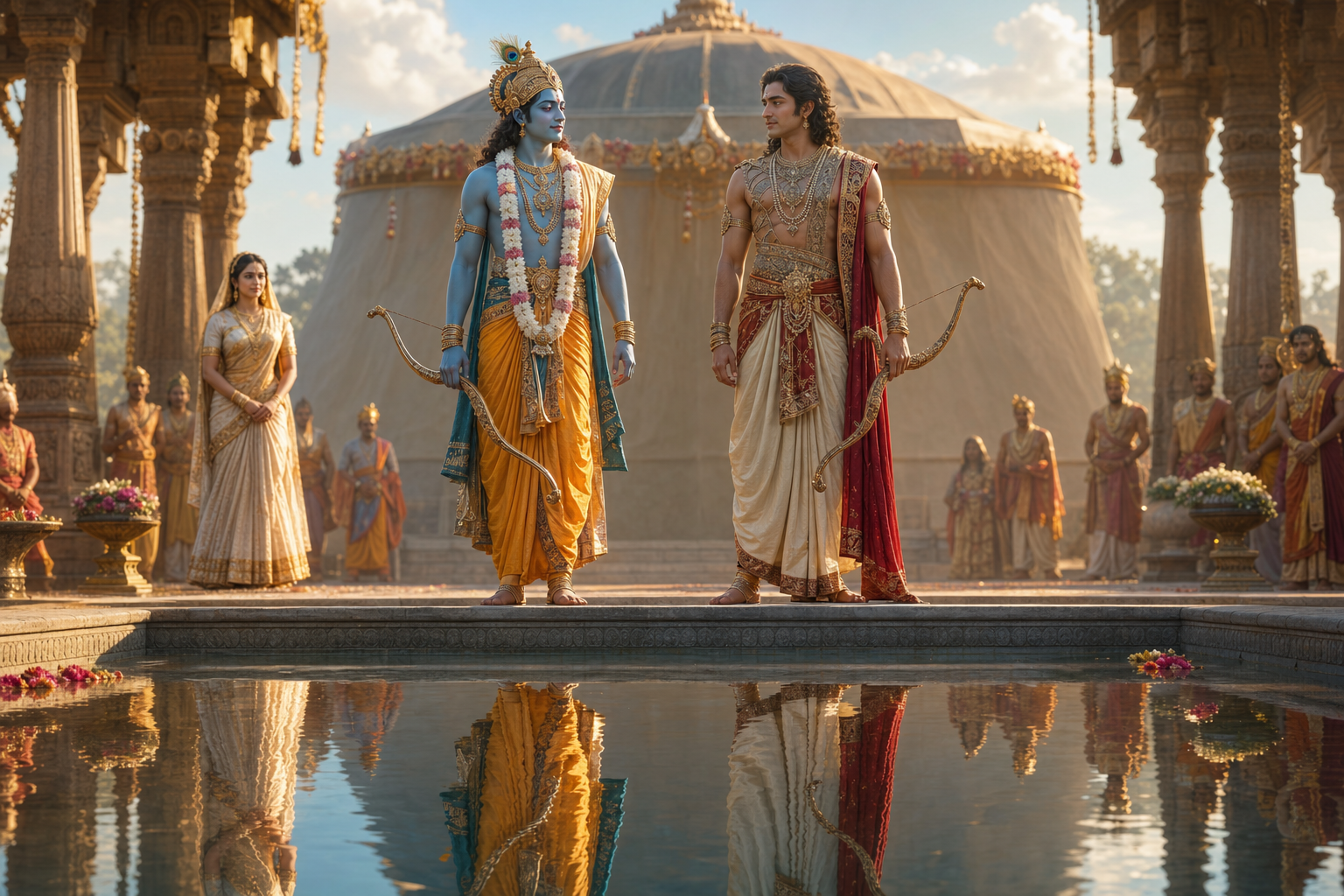
The archery trial associated with Lakshmana’s swayamvara is often presented as a direct comparison between Krishna and Arjuna. Its real interest, however, lies in the sequence of demands imposed on every contestant: control a formidable bow, infer the position of an invisible target from its reflection, and convert that inference into a decisive shot.
Only one source article was supplied for this synthesis, so its account cannot be treated as independently corroborated reporting. A careful reading can nevertheless distinguish the episode it reports, the interpretation it advances, and the narrower conclusion the contest supports.
The contest belongs to Lakshmana’s remembered story
The supplied DharmaRenaissance article places the episode in the Bhagavata Purana, Canto 10, Chapter 83. It reports that Draupadi asks Krishna’s queens to relate how their marriages occurred, and that Lakshmana’s response extends through verses 17-39, with the archery contest described principally in verses 19-26.
This narrative setting changes how the competition should be read. The source identifies Lakshmana as King Brihatsena’s daughter and cautions that she is not Lakshmana, Sri Rama’s brother. It also notes that she is conventionally counted among Krishna’s eight principal queens, although the designation Ashta Bharya is a later classificatory expression rather than the focus of the passage itself.
According to the article, Lakshmana had heard Narada recount the deeds and manifestations of Acyuta, a name of Krishna, and had consequently fixed her mind on Mukunda. Brihatsena understood her preference and arranged the swayamvara. The trial thus serves more than one purpose within the account: it is a public contest of ability, a royal marriage custom, a father’s response to his daughter’s choice, and the means through which that choice becomes visible to the assembly.
Why the concealed fish tested more than accuracy
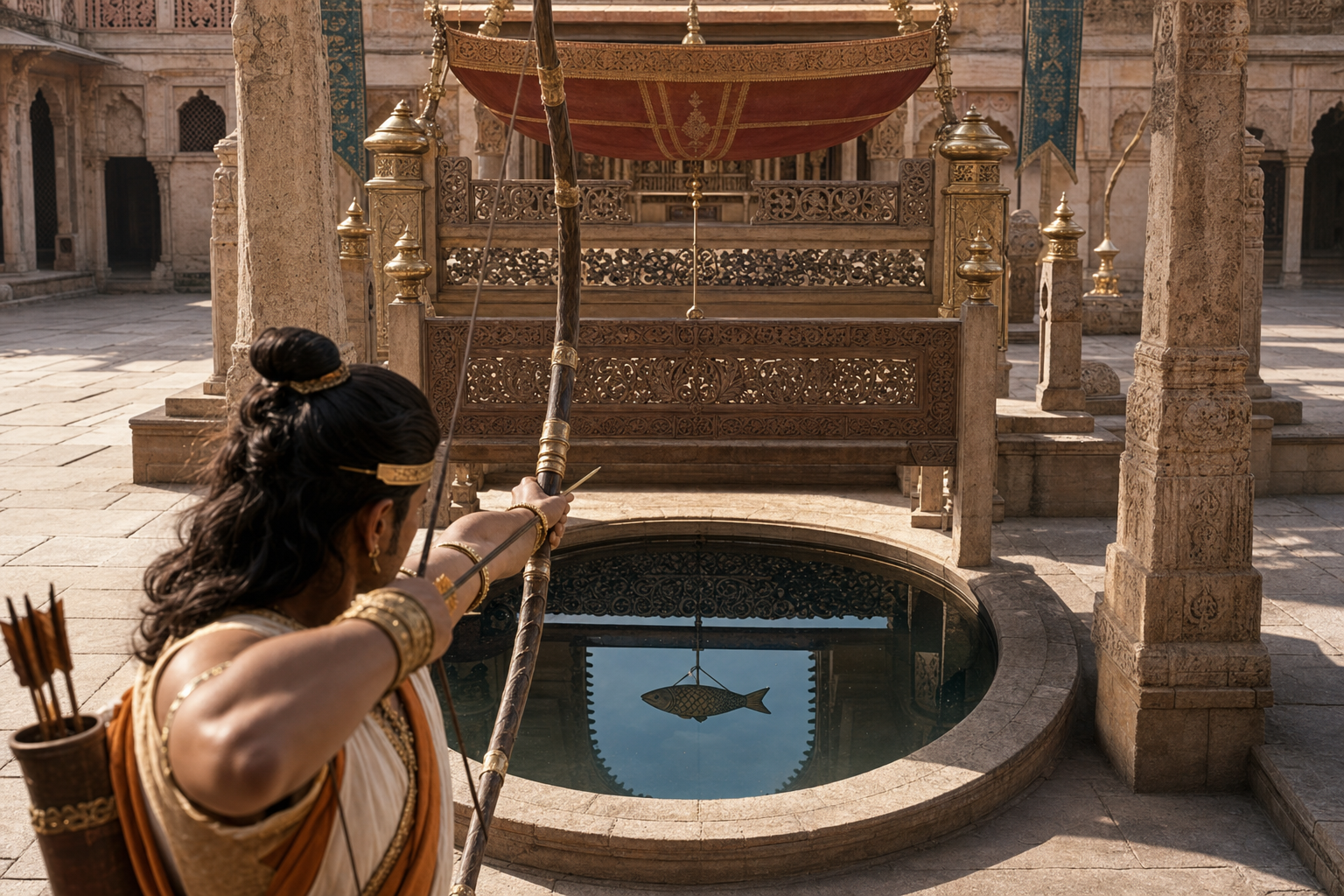
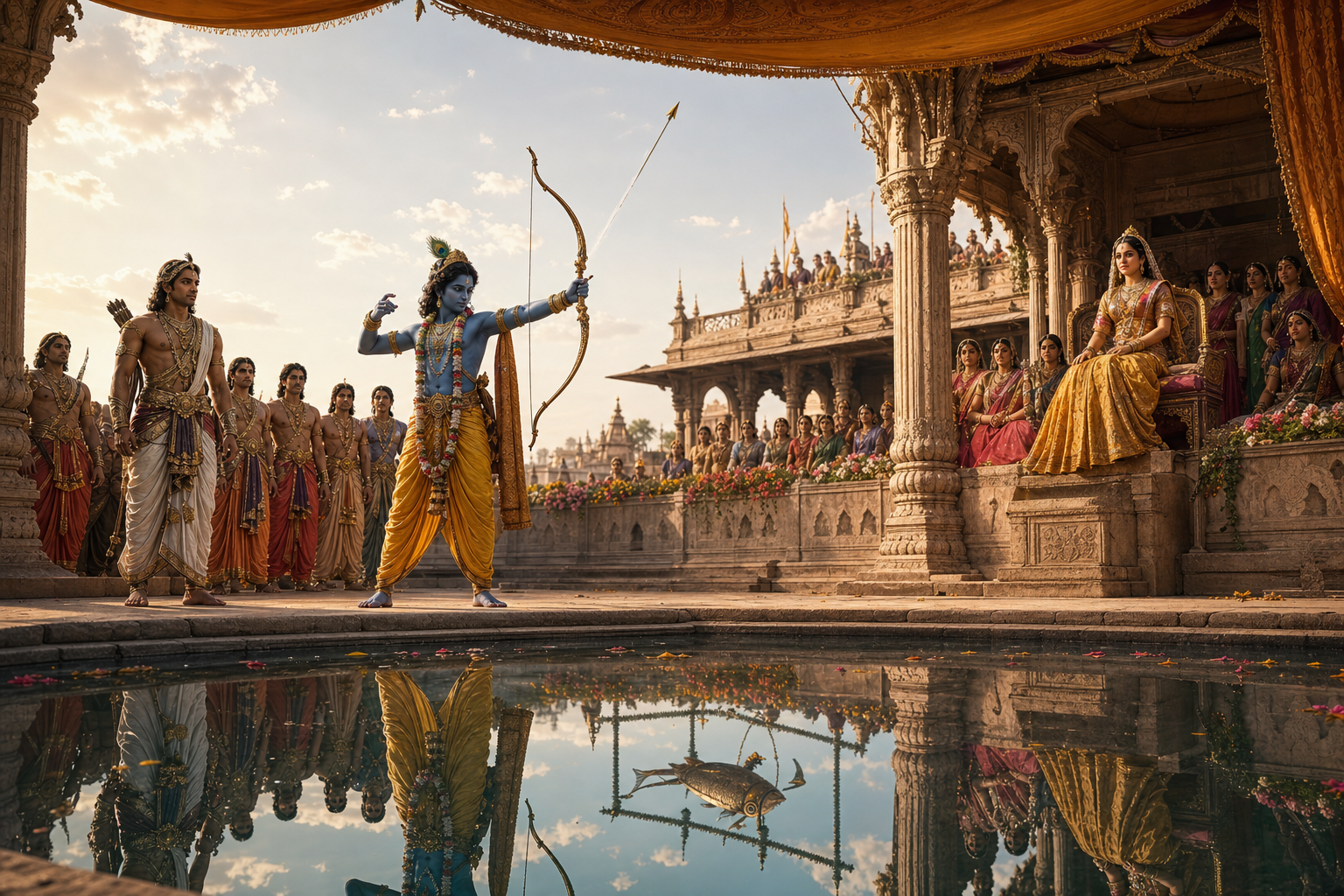
The source says Lakshmana herself compares this challenge with the fish target at Draupadi’s swayamvara. In Lakshmana’s contest, however, the fish was covered on every side. Contestants could not inspect it directly and had to use its image in water below them to determine where to aim above.
As a general matter of optics, a reflection provides visual information about an object without occupying the object’s physical location. An archer facing such an arrangement must translate an indirect, directionally displaced image into an upward shot at the real target. Any movement of the reflecting surface can further complicate perception. The supplied source does not give dimensions or construction details, so attempts to reconstruct the apparatus precisely would go beyond the available evidence.
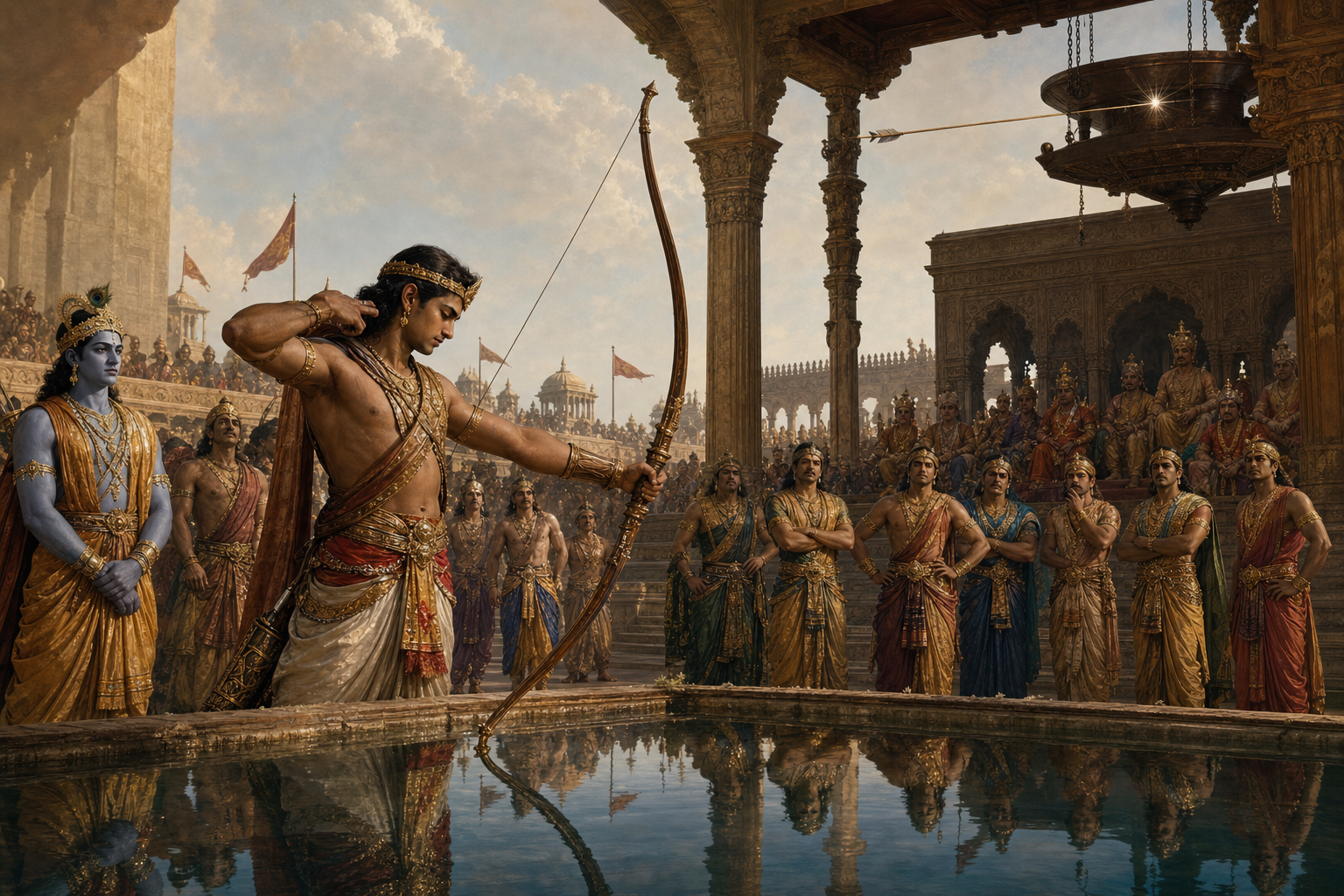
The bow created a separate threshold. The article reports that some participants could lift it but not string it, while others lost control when it recoiled and were knocked down. Jarasandha, Shishupala, Bhima, Duryodhana, Karna, and the king of Ambashtha are among the named contestants. Several were reportedly able to string the weapon yet could not locate the hidden target.
The challenge therefore separated martial performance into distinct stages. Strength was required to manage the bow, stability to keep it aligned, perception to interpret the reflection, and precision to make the inferred trajectory coincide with an object that could not be seen directly. Reputation or success at one stage could not substitute for completing the whole chain.
Arjuna’s near miss establishes the trial’s severity
The source associates Arjuna’s attempt with Bhagavata Purana 10.83.24. Its account says that he examined the reflection, determined the fish’s position, aimed, and released an arrow that made contact but did not pierce the target. This placed him substantially ahead of contestants who could not infer the fish’s location at all.
The result is important precisely because it was so close. Arjuna reportedly solved the central perceptual problem and sent his arrow to the concealed object. Yet the trial had a binary completion condition: touching the fish was not equivalent to piercing and bringing it down. The distinction between an excellent attempt and a successful attempt remained narrow but decisive.
Reading the scene as Arjuna’s humiliation would therefore obscure the evidence used to establish the contest’s difficulty. The other failures demonstrate how demanding the preliminary stages were; Arjuna’s contact with the target shows that his combination of strength, inference, and aim was exceptional. His near success makes Krishna’s subsequent performance more meaningful than it would have been in a field consisting only of obvious failures.
What Krishna’s victory supports—and what it does not
The article reports that Krishna took up and strung the bow without difficulty, looked at the reflection once, and brought down the target with one arrow. Within the conditions described, this is a clear comparative result: Krishna completed the particular task that Arjuna had nearly completed.
That result does not by itself create a universal ranking of every martial achievement attributed to Krishna and Arjuna. Different narratives employ different weapons, circumstances, purposes, and standards of success. The defensible comparison is limited to this reported contest: both faced the concealed-fish challenge, Arjuna grazed the target, and Krishna fulfilled its winning condition.
The devotional frame also resists reducing the episode to sporting statistics. In Lakshmana’s recollection, the victory completes a story that begins with hearing about Krishna and choosing him inwardly. The extraordinary shot publicly resolves the swayamvara, but it also answers the intention around which her testimony is organized. Technical excellence and sacred narrative function together rather than competing as explanations.
Key takeaways for a careful reading
- The supplied source locates the contest in Lakshmana’s first-person marriage account in Bhagavata Purana 10.83.
- The fully concealed fish reportedly made indirect perception essential; merely possessing the strength to string the bow was insufficient.
- Arjuna’s arrow reached and grazed the fish, making his attempt a near success rather than evidence of poor archery.
- Krishna’s victory establishes superiority in this defined trial, not an all-purpose judgment on every feat associated with either figure.
- The contest advances Lakshmana’s devotional and marital narrative as well as displaying martial ability.
Future discussion of the episode will be strongest when it preserves these boundaries and compares the primary passage, its translations, and related swayamvara narratives without turning one precisely framed feat into a claim broader than the text can bear.