

Reading darśana responsibly requires more than translating Sanskrit propositions into familiar philosophical language. It requires attention to the kind of vision a tradition cultivates, the means of knowledge it accepts, the practices it prescribes, and the textual institutions through which its arguments became intelligible.
Vedic hermeneutics offers a disciplined way to undertake that reading. Its central contribution is not a ban on comparison or criticism, but an order of interpretation: reconstruct a discourse within its own conceptual grammar before judging it through categories developed elsewhere.
Darśana is an orientation, not merely a set of propositions
The source article notes that darśana is commonly rendered as philosophy, worldview, doctrine, or school of thought. Each translation identifies part of its meaning, but each can also narrow it. Derived from a verbal field associated with seeing and experiencing, the term can indicate vision, perspective, encounter, or a systematic account of reality and knowledge. Its intellectual and devotional uses should not be collapsed into one another, yet both retain the sense that seeing can alter the position of the observer.
This makes darśana more practically demanding than an abstract theory. A classical system ordinarily connects its account of what exists with an account of how knowledge becomes valid, why error or bondage persists, what conduct and discipline are appropriate, and how the highest human end is understood. Metaphysics, epistemology, ethics, practice, and liberation consequently illuminate one another. Removing any one of these dimensions can make the remaining arguments appear more isolated than they are within the tradition.
The distinction also changes the reader’s central question. Instead of asking only what a text claims, interpretation must ask what mode of discernment the text seeks to form. A doctrine may function as an argument, a guide to practice, a diagnosis of error, and a means of reorienting the practitioner. Reading it exclusively as speculative philosophy risks overlooking this integrated purpose.
Interpretation begins before the first word is translated

No translation is conceptually empty. When dharma becomes religion, law, morality, duty, or social order, the chosen English term highlights one relation while importing associations of its own. Similar difficulties arise when ātman is rendered as soul, brahman as God or absolute, yajña as sacrifice, or śraddhā as belief or faith. Such glosses can orient a beginning reader, but the source article cautions that none should be treated as a complete equivalence.
The difficulty is hermeneutic rather than merely lexical. Words take meaning from grammar, established usage, genre, surrounding argument, interpretive history, and the expectations of a community. A passage is read through the larger work, while the larger work is reconstructed from its passages. A technical term is explained through a tradition, but knowledge of that tradition also depends on the texts in which the term appears. This movement between part and whole is productive when the reader’s assumptions remain visible and open to revision.
Comparison is therefore most reliable after reconstruction. An interpreter should first determine how a term operates among neighboring concepts, what problem the author is addressing, which means of knowledge carry authority, and what kind of transformation or conclusion the discourse seeks. Only then can an external comparison reveal genuine similarities and differences instead of similarities manufactured by translation.
This sequence does not grant inherited interpretations immunity from examination. It simply prevents criticism from replacing the object it intends to study. Philology, historical criticism, manuscript research, archaeology, sociology, and philosophy may disclose features unavailable to a strictly confessional reading. Conversely, Sanskrit competence, ritual knowledge, commentarial training, and engagement with living communities can expose assumptions that an external analysis has overlooked. The source article describes the needed balance as accountability both to evidence and to the conceptual integrity of the tradition.
Vedic authority does not erase disagreement among darśanas
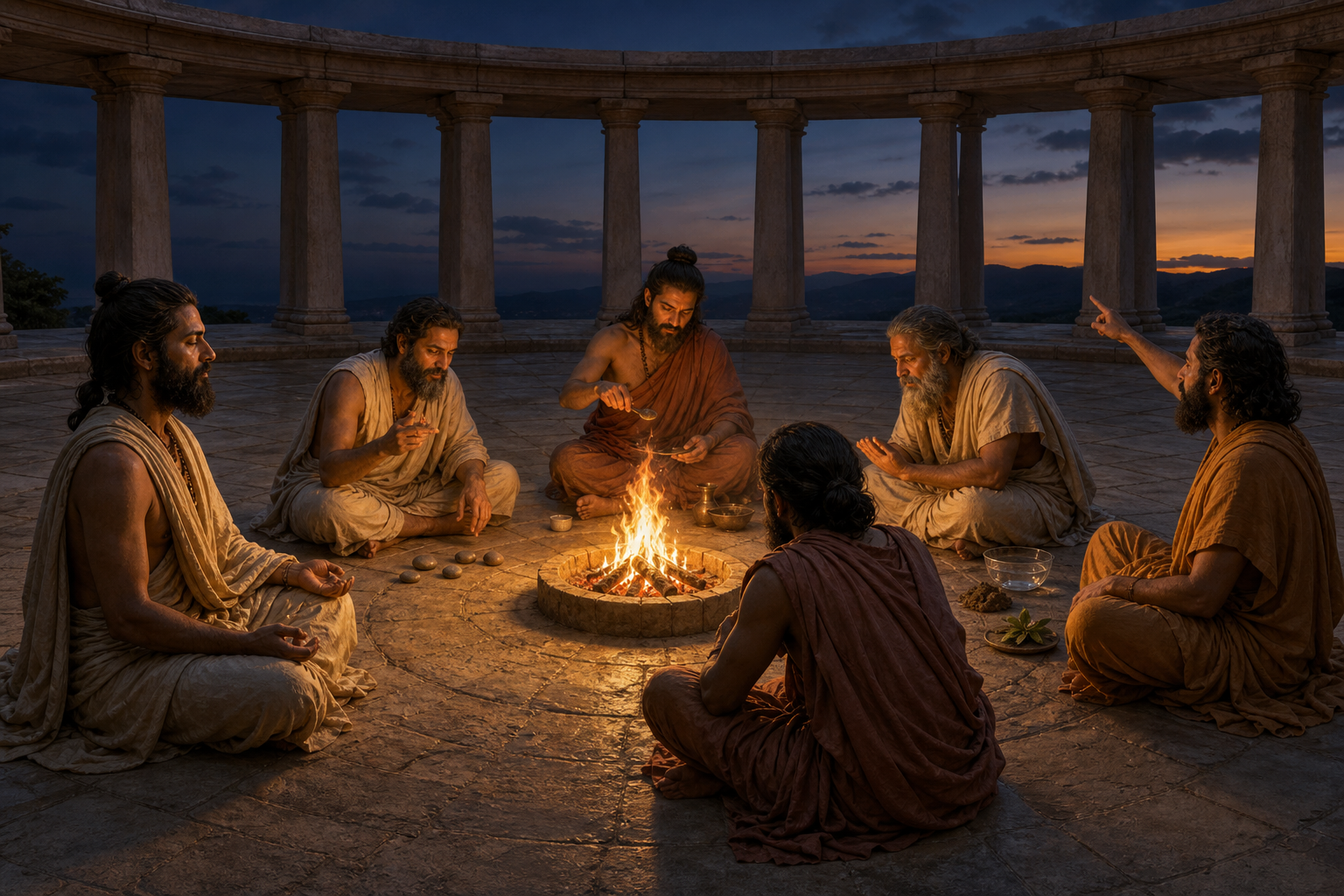
The designation āstika illustrates why inherited categories need contextual definition. In classifications of classical Hindu schools, the source article explains, the term generally concerns recognition of Vedic authority rather than simple belief in a creator God. Mīmāṃsā could defend that authority without requiring divine authorship as its foundation. Translating āstika merely as theistic would therefore misdescribe both the classification and some of the positions it contains.
The familiar grouping of Sāṅkhya, Yoga, Nyāya, Vaiśeṣika, Mīmāṃsā, and Vedānta is useful as a map, not as evidence of a uniform creed. According to the source, these darśanas differ over ontology, valid means of knowledge, causation, selfhood, and liberation. They also developed through commentaries, subcommentaries, teaching, and debate with Hindu and non-Hindu interlocutors, including Buddhist, Jain, materialist, grammatical, ritual, and theological traditions.
A darśana is consequently better approached as a historically extended practice of reasoning than as a sealed doctrinal package. Continuity need not mean the absence of change. It can instead reside in the disciplined methods by which new claims are argued, connected to authoritative sources, challenged through objections, and situated within an interpretive lineage.
The same care applies to the idea of a Hindu canon. The source distinguishes among śruti, smṛti, Itihāsa, Purāṇa, Dharmaśāstra, Āgama, Tantra, sūtra, bhāṣya, ṭīkā, devotional poetry, ritual manuals, and regional retellings. These forms do not possess identical authority, and their standing can vary among sampradāyas. Treating them as a flat collection called Hindu scripture obscures both hierarchy and interpretive diversity.
Genre governs what counts as an adequate reading. An injunction, hymn, metaphysical dialogue, genealogy, legal digest, devotional lyric, and epic narrative do not perform the same work. A Purāṇic narrative may combine theological, ritual, genealogical, pedagogical, and sacred-geographical purposes. An episode in an Itihāsa may preserve moral ambiguity because it cultivates judgment rather than issuing a context-free rule. Apparent contradiction can thus result from asking one genre to behave like another.
Texts depend on practices and institutions of understanding
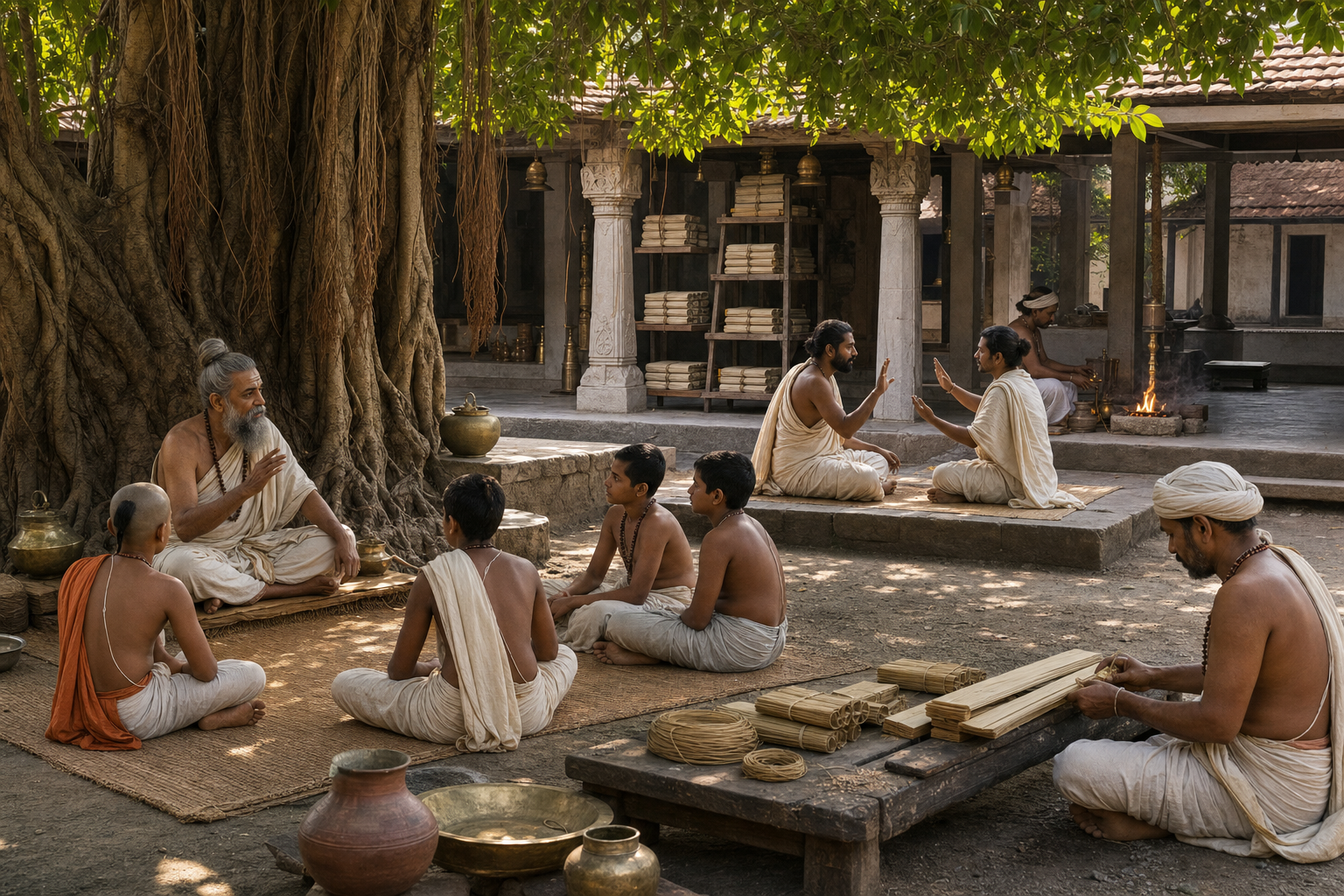
Vedic hermeneutics cannot be reduced to solitary reading because many texts presuppose forms of training outside the written page. The source article points to teachers and students, recitation lineages, memorization, grammar, debate conventions, ritual competence, and extensive commentary. A compressed sūtra may require oral explanation; a mantra may depend on sound, accent, sequence, and performance; a philosophical conclusion may become intelligible only after the progression from objection to response and established position has been reconstructed.
This institutional ecology explains a modern paradox described by the source: texts can become more accessible in print or digital form even as the training assumed by them becomes unevenly available. Changes in patronage, education, scholarly language, and academic specialization affected older systems of transmission, although traditional lineages and institutions did not simply disappear. Availability of a text should therefore not be confused with mastery of its interpretive conditions.
Neither romantic restoration nor academic self-sufficiency resolves that difficulty. Traditional institutions may carry exclusions, local limitations, sectarian premises, or historically conditioned judgments. Universities can contribute critical editions, linguistic comparison, material history, and transparent review. At the same time, academic methods can misread texts when living practice, oral discipline, or inherited technical vocabulary is treated as incidental. A stronger ecology of interpretation would allow these forms of competence to correct one another.
A rigorous reading moves from reconstruction to evaluation

A practical reading method begins by identifying the text’s location: its genre, claimed authority, audience, and relation to a lineage or debate. It then reconstructs the key vocabulary without assuming that a single English equivalent exhausts any technical term. The argument must be followed as an organized whole, including objections, replies, accepted means of knowledge, practical disciplines, and the human end toward which the discourse is directed.
Historical and comparative questions can then be introduced without allowing them to dictate the initial description. Evidence from manuscripts, institutions, social history, or competing philosophies may revise an inherited account. Traditional commentary and practice may likewise reveal that a seemingly obvious modern interpretation depends on foreign assumptions. The aim is neither to protect a text from criticism nor to make it resemble a modern theory, but to ensure that evaluation addresses the text and tradition that actually exist.
Key takeaways
- Darśana integrates a way of seeing with reasoning, practice, conduct, and an account of liberation.
- Technical Sanskrit terms should be reconstructed through context, genre, and interpretive history before being reduced to English equivalents.
- Recognition of Vedic authority does not make the āstika darśanas doctrinally uniform or necessarily theistic.
- Different textual classes and genres require different interpretive expectations.
- Responsible criticism is answerable both to evidence and to the conceptual world of the tradition under examination.
The future of darśana studies depends on rebuilding interpretive competence across boundaries: philological precision joined to philosophical patience, historical scrutiny joined to genre awareness, and textual access joined to sustained engagement with the practices that make the texts legible.