
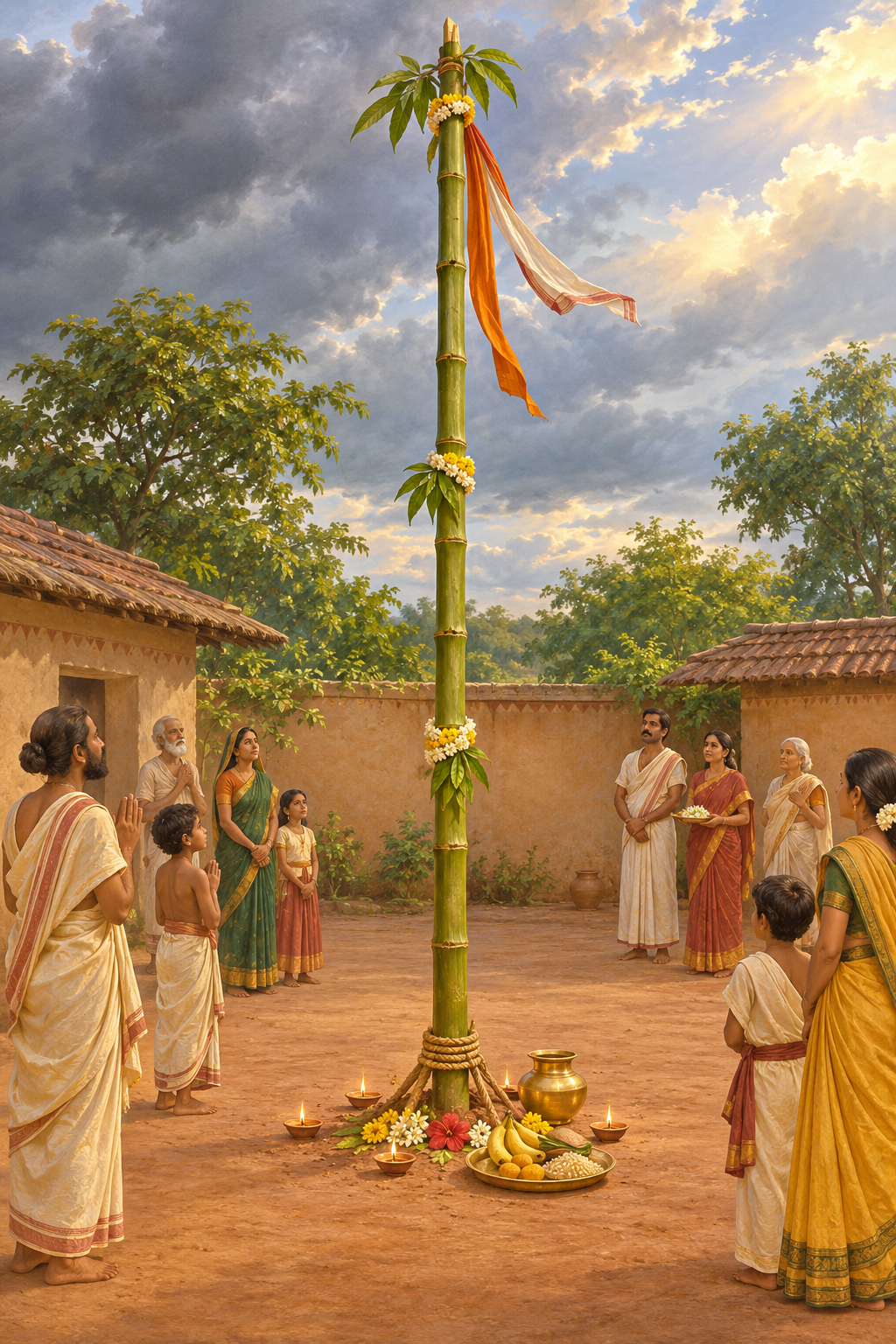
If you have seen a bamboo pole planted before a Hindu festival and wondered whether it is decoration, a flagstaff, or something sacred, the timing gives you the first clue. In this tradition, the bamboo is raised deliberately as a staff associated with Indra.
Knowing the Mahabharata setting helps you understand the symbol without inventing a universal ritual procedure. It also gives you a sound way to ask about the custom when you encounter it in a temple, village, or family celebration.
Begin with Uparichara Vasu, not with the pole alone
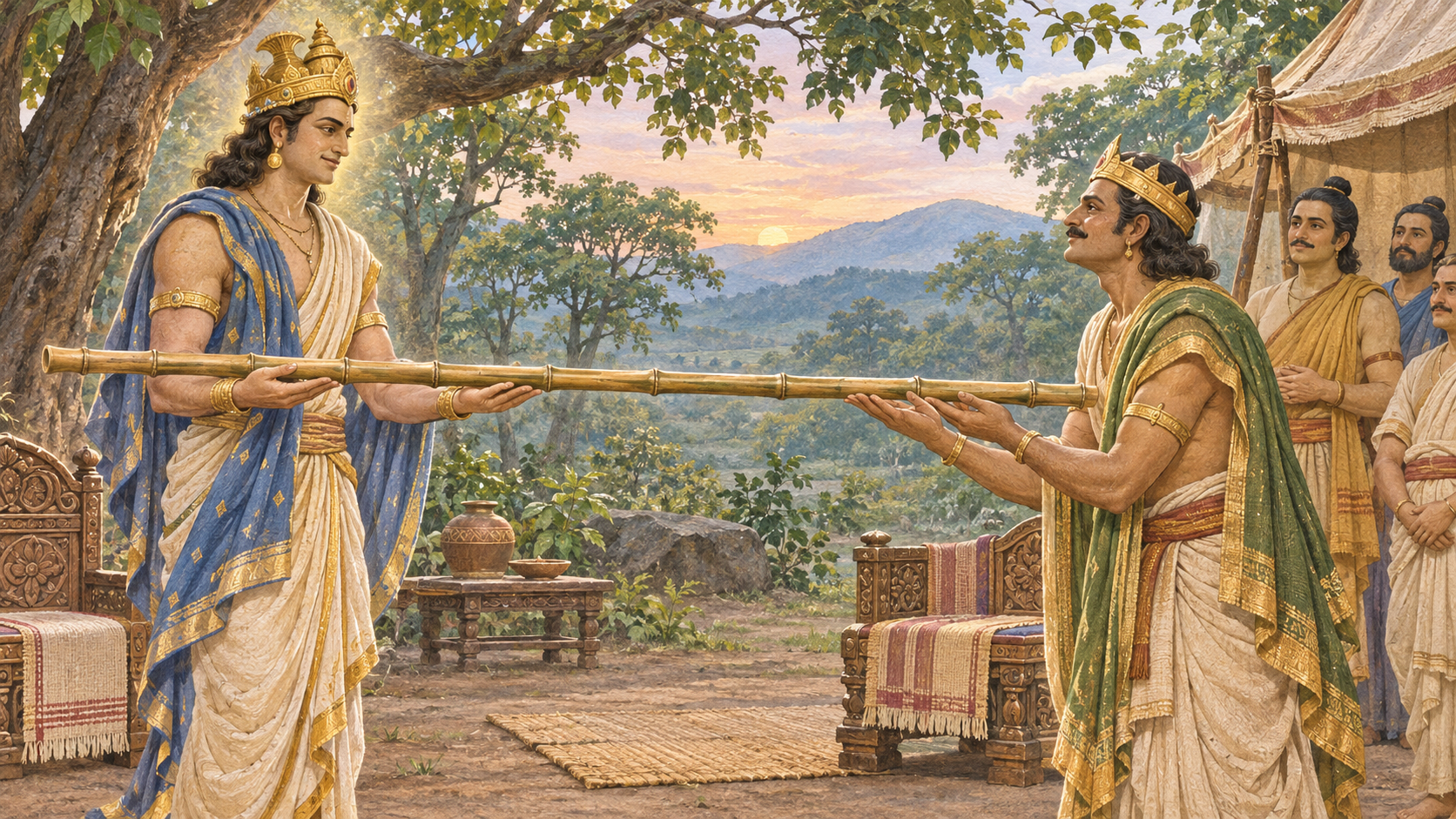
The Mahabharata places a conversation between Indra and Uparichara Vasu in the Adi Vamshavatarana Parva of the Adi Parva. Uparichara Vasu is the king of Chedi. He has lost interest in worldly life and has turned toward tapas, withdrawing into a quiet setting.
That setting changes how you read the sacred staff. The narrative does not begin with spectacle. It begins with a ruler confronting the limits of worldly authority. Indra’s encounter with such a king places royal duty, spiritual discipline, and divine order in the same frame.
The bamboo should therefore not be treated as an isolated object with a vague promise of good fortune. It carries an epic memory. A community that plants it before a festival is bringing that memory into a visible, public form.
What the planted staff can signify
It is useful to distinguish the tradition’s textual anchor from our interpretation of its symbolism. The Mahabharata supplies the narrative setting. The physical act of planting the staff allows several connected meanings to be read from that setting.
Authority made answerable to dharma
Uparichara Vasu is both a king and a practitioner of tapas. His position prevents a shallow opposition between governance and spirituality. Read in that light, Indra’s staff can represent authority that stands upright only when it remains aligned with dharma.
Epic memory made present
A story heard in recitation can seem distant. A bamboo planted in the festival ground gives that story a place in the community’s shared space. The pole is not the whole teaching; it is a prompt that directs attention back to the teaching.
Preparation before celebration
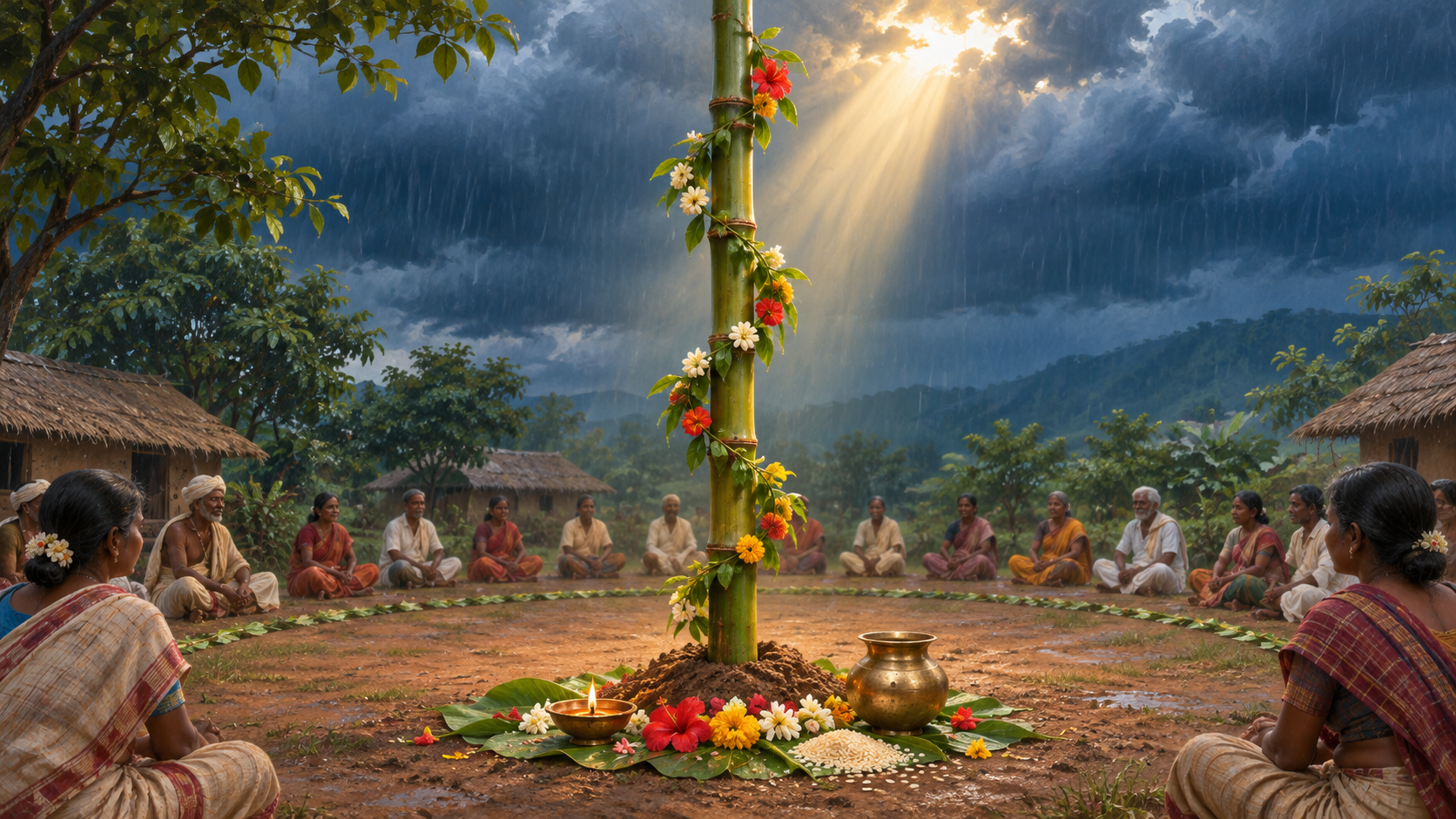
The bamboo is associated with preparation before the festival. That sequence matters. Sacred celebration does not begin only when music, worship, or public gathering starts. It begins when the community prepares the ground and establishes the symbol around which the observance will be understood.
When you see the staff, notice the action as well as the object. A bamboo lying nearby is material. A bamboo intentionally selected, planted, and identified with Indra has entered a ritual relationship with the community.
Do not turn an origin narrative into a universal manual
The epic connection tells you why the staff deserves attention. It does not, by itself, settle every practical question about how a particular community observes the custom. The height of the bamboo, its placement, the words spoken, any accompanying offerings, and the manner of removal belong to local procedure unless a community can identify a more specific textual rule.
This distinction protects the tradition in two directions. It prevents local details from being advertised as rules for every Hindu. It also prevents a living regional practice from being dismissed merely because every operational detail is not contained in a brief retelling of the Mahabharata episode.
If you are helping to organise an observance, do not construct a ceremony from symbolism alone. Use this sequence:
- Ask what the staff is called in the local language and whether the community explicitly identifies it with Indra.
- Consult the priest, customary organiser, or family elder who actually maintains the observance.
- Confirm when the bamboo is planted, where it is placed, who performs the act, and when it is removed.
- Ask whether a mantra, offering, procession, or other act accompanies it. Do not add one merely because another festival uses it.
- Record the Mahabharata connection separately from the local instructions so future participants can tell inherited procedure from later explanation.
If the answers differ between two communities, that difference does not automatically make one practice false. First determine whether they preserve the same epic association through different customary forms. Precision is more respectful than forcing uniformity.
How to observe and explain the custom responsibly
You can learn a great deal by watching the sequence around the staff. Start with four questions: Is it planted before the main celebration? What local name is used? Is the story of Indra and Uparichara Vasu told? What actions take place when the pole is established and removed?
Write down the answers in the vocabulary used by the practitioners. Translating every term immediately into a generic phrase such as “festival pole” can erase the very distinction you are trying to preserve. Record the original word, its pronunciation if possible, and the explanation given by the people responsible for the rite.
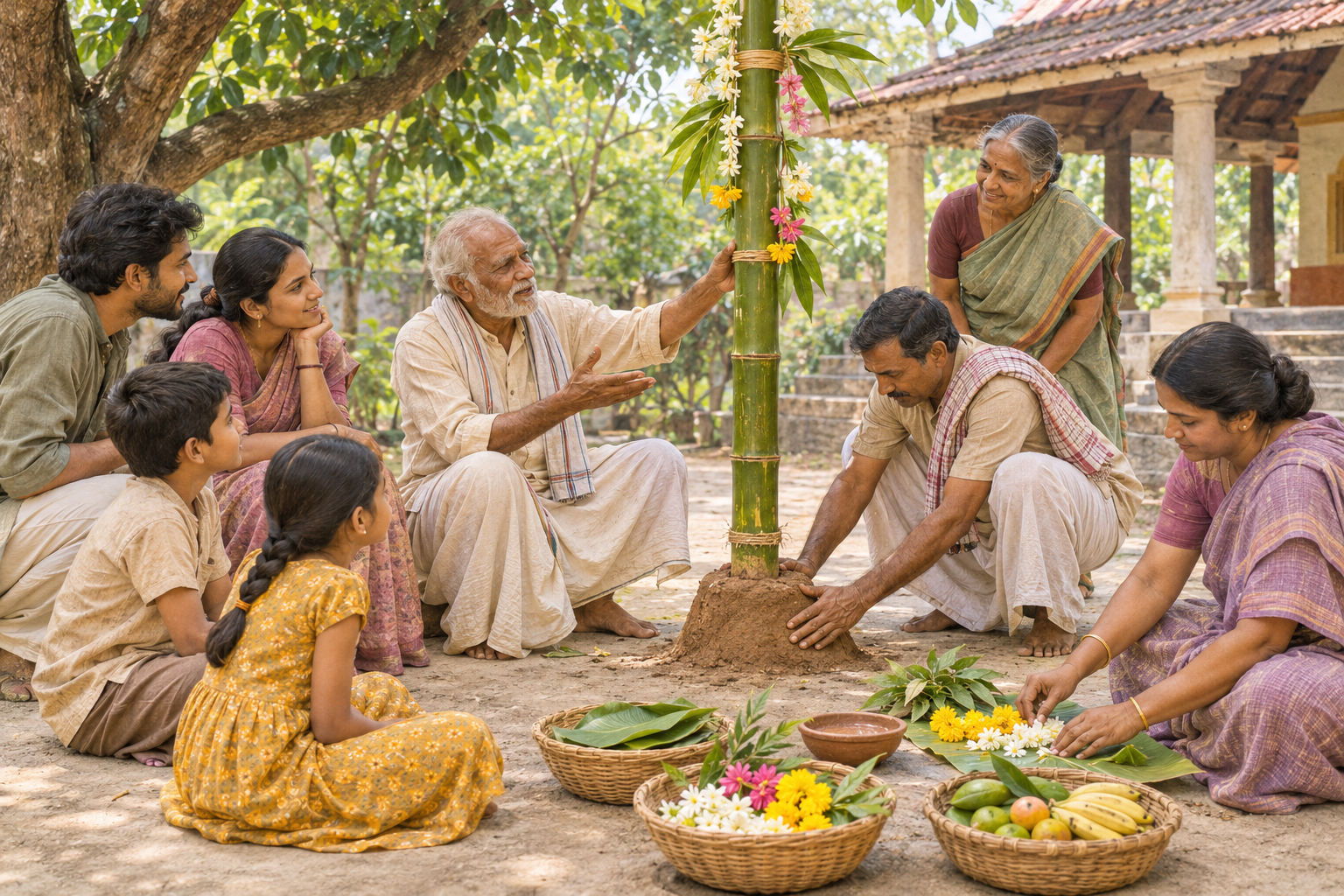
When explaining the tradition to a child, visitor, or younger family member, three sentences are enough to begin:
- This bamboo is being planted as a sacred staff associated with Indra.
- Its background is connected with Indra and Uparichara Vasu, the king of Chedi, in the Adi Parva of the Mahabharata.
- This community follows its own inherited procedure, so we ask its practitioners about the details instead of assuming that every Hindu observance is identical.
That explanation gives the object a scriptural context without pretending that a short account resolves every ritual question. It also invites the next generation to investigate rather than merely imitate.
Key takeaways
- Indra’s bamboo staff is connected with the Mahabharata encounter between Indra and Uparichara Vasu, king of Chedi.
- Uparichara Vasu’s movement away from worldly life toward tapas is essential context, not a disposable preface.
- The planted staff can be read as a public reminder that authority, discipline, and celebration must remain aligned with dharma.
- The origin narrative and the local ritual procedure answer different questions; do not confuse one with the other.
- Before reproducing the custom, learn its name, timing, placement, accompanying acts, and method of removal from the community that preserves it.
The next time you encounter such a bamboo, pause before calling it decoration or assuming you already know the rite. Ask for its local name, listen for the memory of Uparichara Vasu, and help preserve both the epic connection and the community’s actual practice.
References

Leave a Reply
You must be logged in to post a comment.