
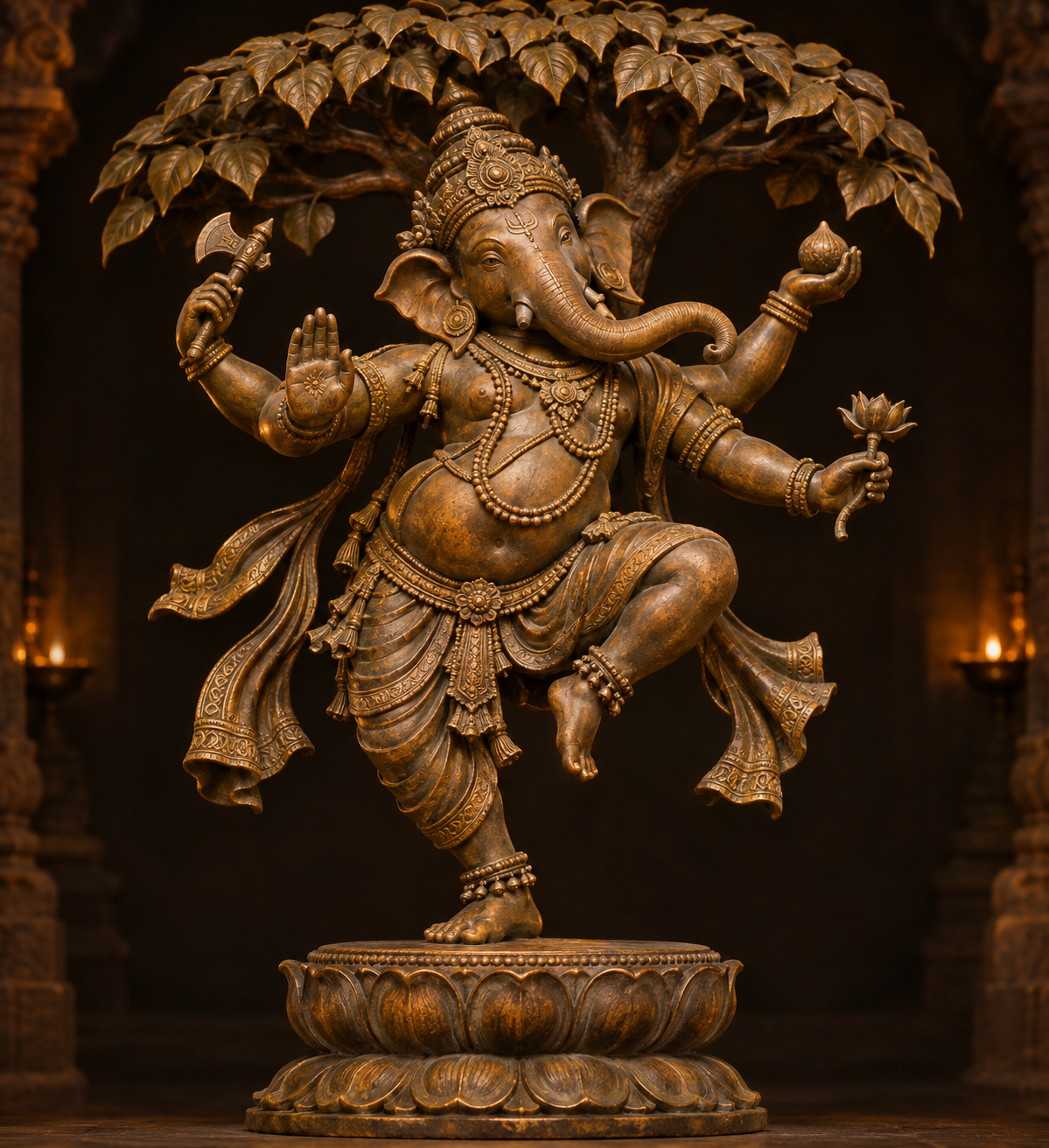
If you have seen a Ganesha sculpture whose body seems to turn, lift, or keep rhythm, you may wonder whether the pose is simply an artistic flourish or the mark of a particular form. With Nritya Ganapati, movement is the identifying idea. You understand the image by beginning with the dance and allowing the other details to refine that recognition.
This order matters. A viewer who immediately tries to decode every hand or object can miss what the whole body is saying. The method below will help you identify the form, understand its central symbolism, and avoid attaching meanings that the image cannot support.
Recognize movement before decoding attributes
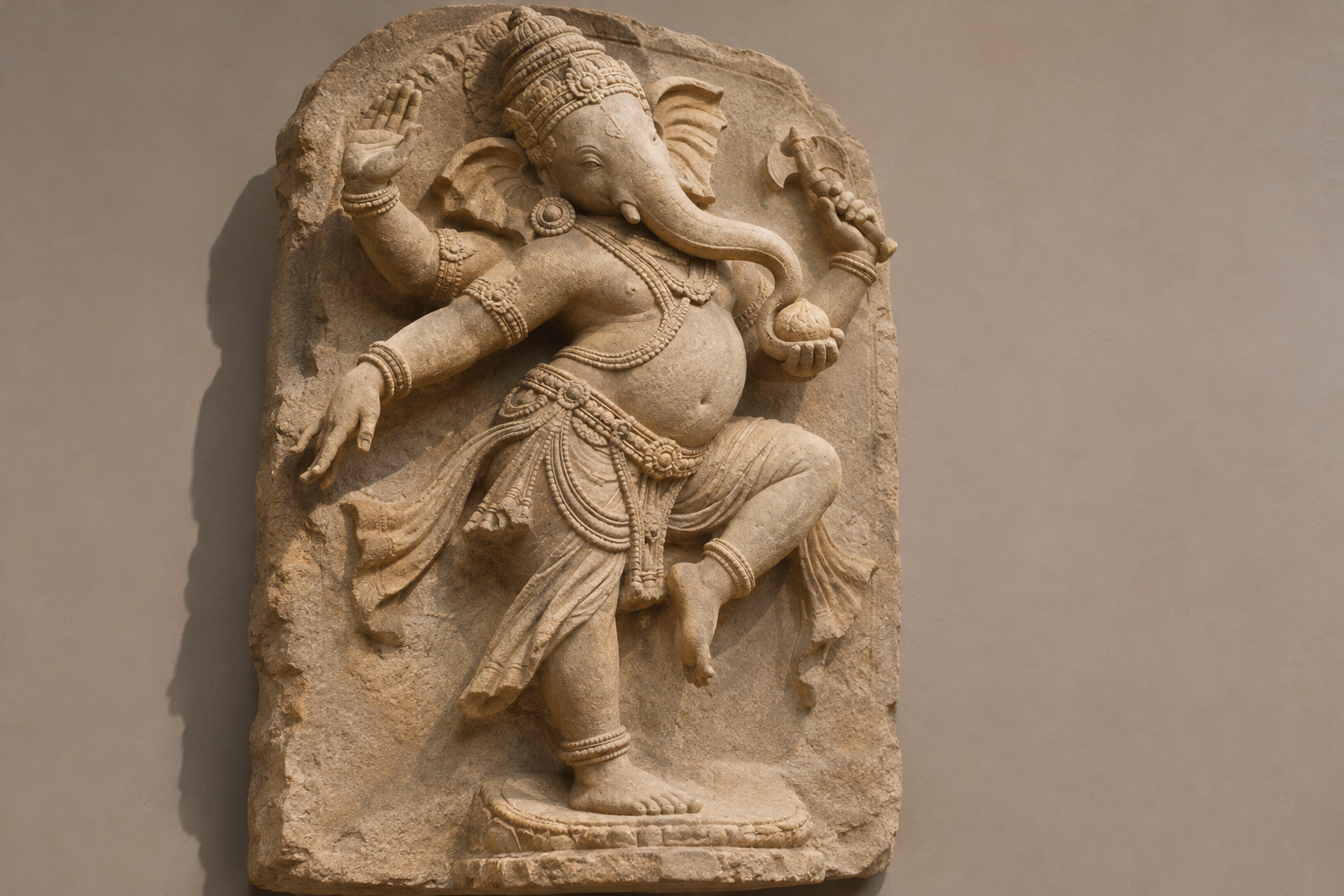
Nritya means dance. Nritya Ganapati therefore presents Ganapati in an active state rather than in a motionless seated posture. It is one of the traditional thirty-two forms of Ganapati associated with the Mudgala Purana. The dance is not a minor embellishment added to an otherwise generic image; it is what gives the form its name and devotional emphasis.
Begin with the sculpture’s complete silhouette. Ask whether the body communicates repose or continuing motion. Notice the transfer of visual weight, the direction in which the limbs carry your eye, and whether the composition appears to pause in the middle of an action. A dancing image ordinarily creates a sense that the posture has a before and an after.
Do not decide from one bent limb alone. A limb may be positioned unusually because of the sculptor’s style, the available stone, later damage, or the needs of the composition. Look for several mutually supporting signs of rhythm and animation. These are viewing tests, not a replacement for a temple identification, an inscription, a catalogue entry, or reliable provenance.
This distinction is especially useful when examining an old or damaged murti. A missing hand may prevent you from identifying an attribute, but it does not necessarily erase the movement expressed by the surviving body. Record what remains visible before attempting to reconstruct what is absent.
Why the place among thirty-two forms matters
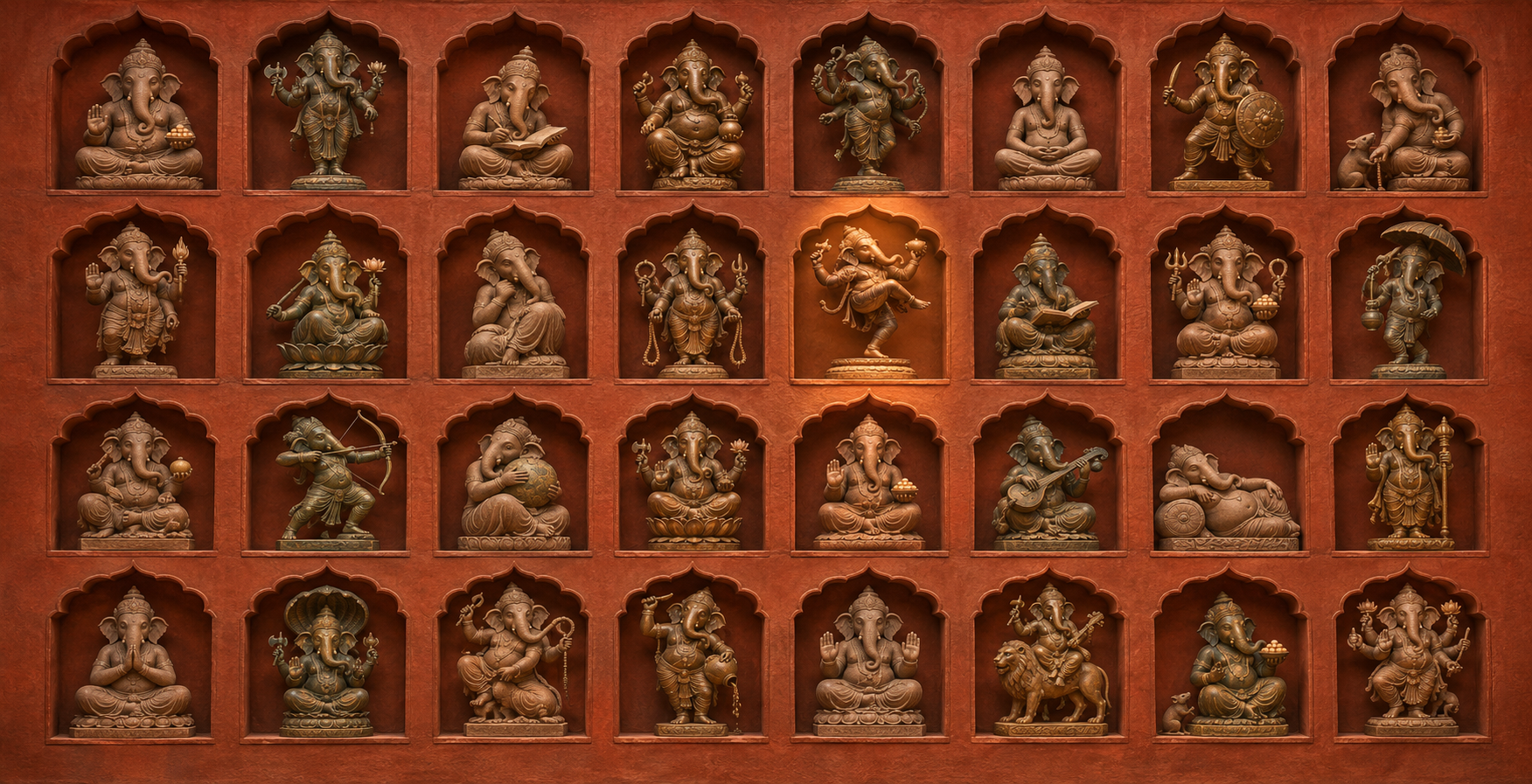
The thirty-two-form tradition gives you a vocabulary for recognizing different presentations of Ganapati. It does not ask you to treat each named form as an unrelated deity. The name directs attention toward a particular action, mood, or theological emphasis within the worship of Ganapati.
For Nritya Ganapati, that emphasis is movement. Once you know this, you can avoid two common mistakes. The first is flattening every representation into a generic image of Ganesha, as though posture made no difference. The second is the opposite error: treating every artistic variation as proof of a separate canonical form.
Use a three-stage reading instead:
- Recognition: determine whether the image is intended to show Ganapati dancing.
- Attention: examine how the sculptor or painter makes movement perceptible.
- Interpretation: relate that movement to the form’s central meanings of joy and creative energy.
This sequence keeps the interpretation anchored in the visible image. It also leaves room for regional, historical, and artistic variation without pretending that every variation has the same theological weight.
The dance makes joy and creative energy visible
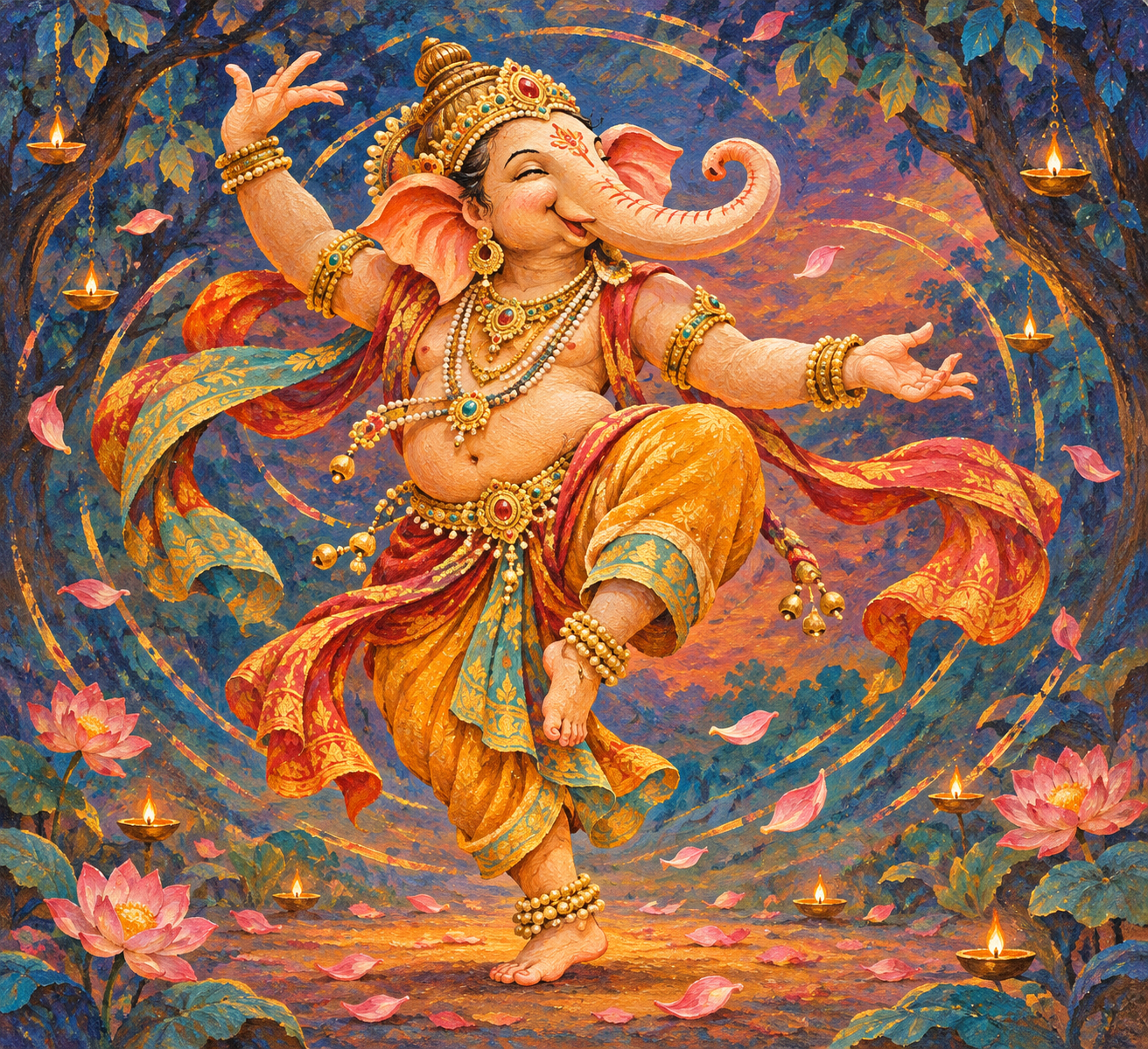
Nritya Ganapati expresses divine joy and creative energy through dance. Both ideas need to be read carefully. Joy here is not merely a cheerful facial expression, and energy is not frantic or uncontrolled activity. The ordered movement of dance holds vitality and form together.
That union is the key to the image. Dance requires motion, but meaningful dance is not random motion. Rhythm gives movement coherence. The body becomes a vehicle of expression, so theology is communicated through posture rather than through a written proposition. Nritya Ganapati allows you to see sacred activity as expressive, disciplined, and joyful at once.
If you usually approach Ganapati chiefly as the remover of obstacles, the dancing form adds an important practical dimension. An obstacle is not always answered by waiting for circumstances to change. Some difficulties require intelligent movement: beginning the neglected work, changing an ineffective pattern, or giving creative form to energy that has remained scattered. That is a devotional application of the image, not an extra iconographic rule.
Avoid expanding the symbolism beyond what the form can carry. It is reasonable to read the dance through joy, creativity, rhythm, and active expression. It is less responsible to assign a fixed meaning to every curve, ornament, or unidentified object merely because it appears in a sacred image. Reverence does not require speculation.
A five-pass method for reading a particular image
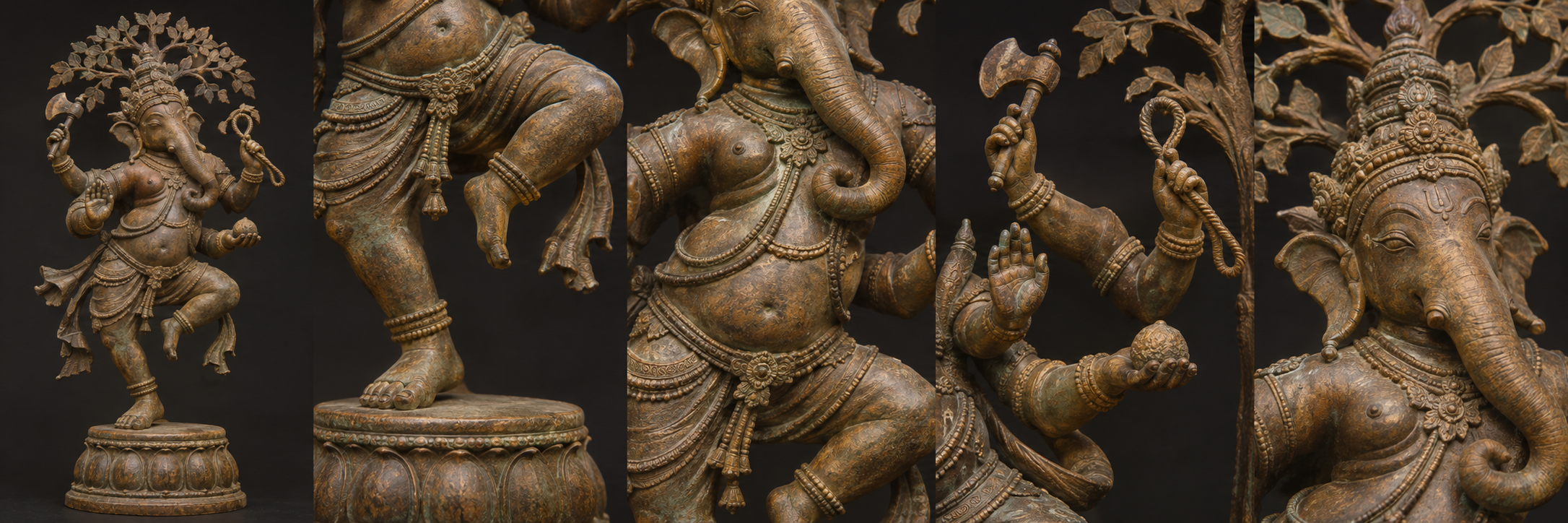
You can use the following method in a temple, museum, book, or home shrine. It separates observation from interpretation while keeping both parts of the encounter alive.
- See the whole posture. Before counting hands or naming objects, follow the body’s direction. Decide whether the composition primarily communicates stillness, procession, combat, blessing, or dance.
- Confirm the identification. Check the name supplied by the temple, collection, inscription, or trustworthy catalogue. If no identification is available, describe it provisionally as a dancing form of Ganapati rather than claiming certainty.
- Inventory only what you can see. Record the number of visible limbs, recognizable objects, ornaments, supports, and signs of damage. If an object is unclear, mark it as unclear. Do not force it into a familiar category.
- Separate observation from inference. A shifted posture is an observation. Joy and creative energy are interpretive meanings associated with Nritya Ganapati. Keeping those levels distinct makes the final reading stronger, not colder.
- Return to the governing action. Ask how every securely identified detail supports, balances, or frames the dance. If a proposed interpretation makes the defining movement irrelevant, reconsider it.
A careful note on an unfamiliar sculpture might read: The limbs and distribution of weight create a rhythmic, active silhouette. The image is identified as dancing Ganapati. Its movement can therefore be read as an expression of divine joy and creative energy. Several damaged or indistinct attributes remain unidentified.
That short description is more useful than a long catalogue of guessed meanings. It tells another reader what is visible, what is traditionally associated with the form, and where certainty ends.
Key takeaways
- Nritya Ganapati is the dancing form of Ganapati and belongs to the traditional group of thirty-two forms associated with the Mudgala Purana.
- The dance is the primary iconographic clue; read the whole posture before concentrating on individual attributes.
- Its central symbolic language is divine joy joined with creative energy.
- Joy should not be reduced to cheerfulness, and energy should not be confused with disorder; dance presents movement shaped by rhythm.
- Separate what you observe from what you infer, and leave damaged or unclear features unidentified rather than inventing meanings.
- Use the image devotionally by asking where purposeful, well-directed action is needed in your own life.
The next time you encounter Nritya Ganapati, give the silhouette one uninterrupted minute before reading a label or searching for attributes. Follow the movement, notice where the composition carries your attention, and then ask what creative action the image places before you. That small discipline turns looking into a more honest form of darshana.
References

Leave a Reply
You must be logged in to post a comment.