
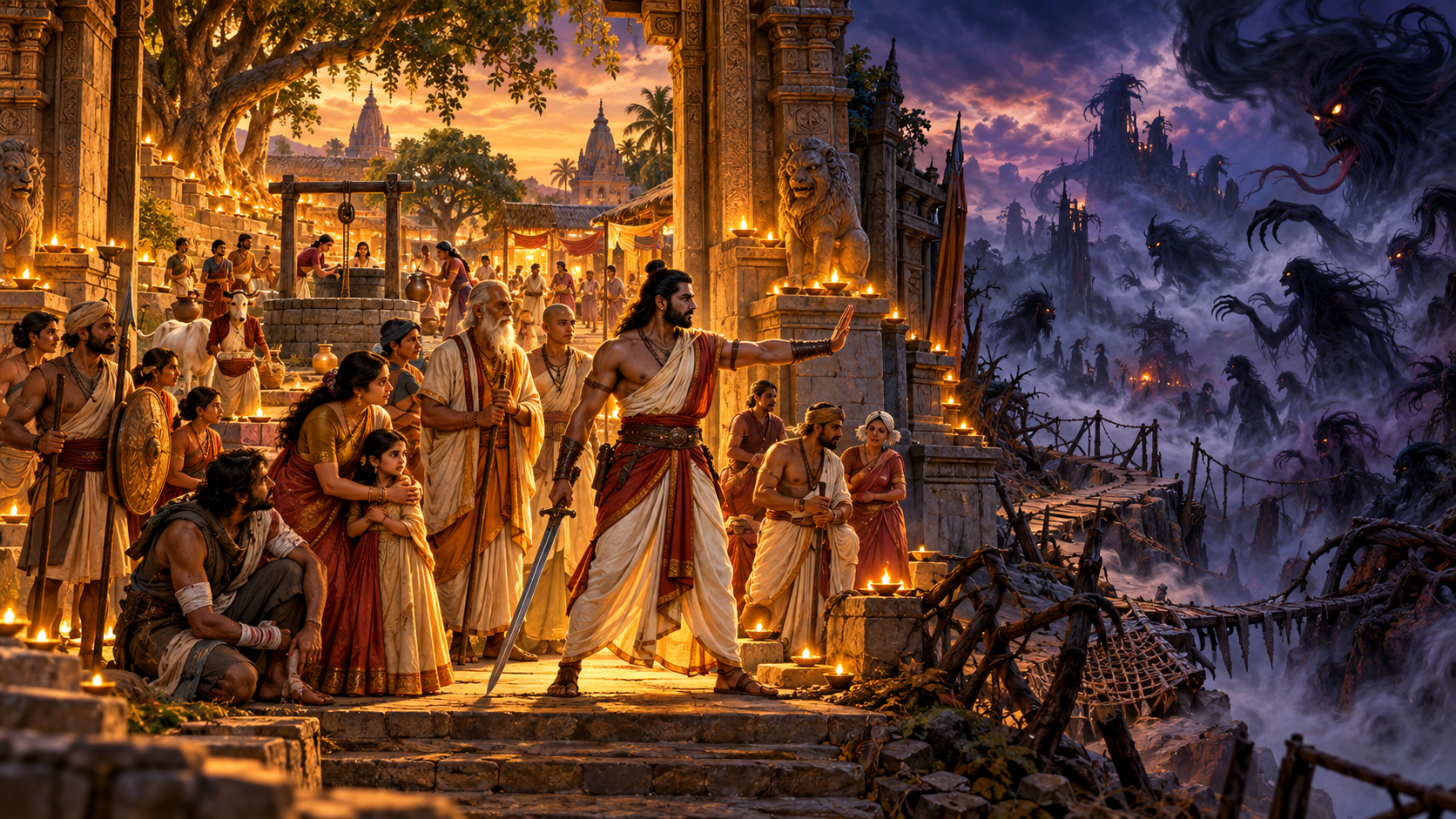
If the battles between humans and Rakshasas leave you with nothing more than a contest between heroes and monsters, the stories can feel distant from ordinary life. A more demanding reading asks a question you can use now: what turns a shared world into a place where the strongest appetite becomes law?
Seen this way, the human-demon conflict is a map of social breakdown and moral recovery. Dharma places limits on power, binds people to duties, and creates refuge for those who cannot defend themselves alone. Chaos dissolves those limits until deception, fear, and force decide what is permitted. The first practical lesson is crucial: do not begin by deciding who looks demonic. Begin by examining what kind of order a person’s conduct creates.
The real boundary runs through conduct, not appearance
The recurring human-Rakshasa battles in the Ramayana, Mahabharata, and Puranas become morally useful when they are read as a conflict between ways of living, not merely as warfare between two kinds of beings. A biological reading makes virtue automatic and evil hereditary. A dharmic reading keeps moral agency at the centre.
Being human does not by itself make every desire righteous. Nor does the word Rakshasa give you permission to stop judging actions carefully. The relevant boundary appears wherever restraint confronts appetite, obligation confronts entitlement, and protection confronts predation.
You can test that boundary through four concrete questions:
- How is power understood? Dharmic power carries duties and limits. Chaotic power treats capacity as permission: if something can be seized, silenced, or consumed, the powerful assume they may do it.
- How are the vulnerable treated? A dharmic order gives the weak a claim upon the strong. A predatory order regards weakness as an opportunity.
- What happens when someone speaks an unwelcome truth? An ordered community can correct itself. A chaotic one protects the offender, punishes the witness, or changes the rules after the fact.
- Are limits reciprocal? Dharma cannot mean strict restraint for outsiders and unlimited exemption for one’s own side. A rule that binds only an opponent is an instrument of domination, not a shared norm.
This is also why casually calling modern communities, castes, religions, or political opponents demons is a serious misreading. It shifts attention from conduct to identity and prepares the mind to excuse cruelty. The symbol should sharpen moral discrimination, not cancel it. Name the harmful act, identify the violated duty, and show the consequence. If you cannot do those three things, the label is doing the work that judgment should do.
Matsya Nyaya explains how disorder becomes predation

Matsya Nyaya, often expressed through the image of larger fish consuming smaller fish, describes more than visible lawlessness. It names a condition in which protective order has failed and unequal strength becomes the final court of appeal. The problem is not that people have different abilities or positions. The problem is that power is no longer answerable to anything beyond itself.
This condition can exist beneath a calm surface. A household may look orderly because one person is afraid to speak. An institution may have elaborate procedures that protect insiders while exhausting complainants. A ruler may suppress public disorder while using fear as the basis of obedience. Silence, hierarchy, and predictability are not sufficient evidence of dharma. Predation can be highly organised.
The slide into Matsya Nyaya usually follows a recognisable moral sequence:
- An appetite claims an exception. Someone treats desire, anger, status, or advantage as a reason not to observe a common limit.
- The exception survives because resistance is costly. Others remain silent, excuse the conduct, or decide that confronting it is more dangerous than enduring it.
- Repetition becomes an expectation. What began as a violation becomes the way things are done. The burden shifts from the offender to the person asking for the rule to be honoured.
- Truth loses protective force. Evidence matters less than influence. Witnesses anticipate retaliation, and the weaker party learns that being correct is not the same as being safe.
- Private strength replaces shared order. People seek patrons, factions, weapons, money, or numbers because no dependable norm stands between them and the powerful.
The point at which to intervene is therefore earlier than open violence. Watch for selective exemptions, retaliatory rule changes, the humiliation of truthful witnesses, and the claim that strength proves legitimacy. Those are not minor defects that will necessarily correct themselves. They are the mechanisms by which an ordered relationship becomes a feeding ground.
When you assess a conflict, ask who can appeal, who must remain silent, and whether the same evidence would be accepted if the parties exchanged places. These questions reveal more than the volume of the quarrel. Ordinary disagreement can be loud while remaining reciprocal. Predation may be quiet because only one side is allowed to speak.
Dharma is disciplined order, not passivity or control

Dharma is sometimes reduced to keeping the peace. That reduction benefits the aggressor whenever peace means that the injured party must absorb harm without protest. A quiet arrangement in which the powerful act without restraint is not the opposite of Matsya Nyaya. It is Matsya Nyaya with good manners.
Yet resistance does not become dharmic merely because its target is unjust. Rage can imitate the appetite it opposes. Collective punishment can reproduce the same disregard for innocence. Humiliation can turn protection into revenge. The human-demon conflict therefore places two demands on the defender: stop predation, and do not let the methods of resistance establish another predatory order.
A response remains oriented toward dharma when it observes four restraints:
- Name the violation precisely. Identify the broken promise, abused authority, threatened person, or destroyed boundary. Vague claims of evil invite vague punishment.
- Protect before seeking satisfaction. The immediate task is to stop ongoing harm and create safety for those at risk. The defender’s anger is not the measure of what protection requires.
- Keep the response tied to its purpose. Censure, exclusion, restraint, or force should address the actual danger. Once the danger has ended, continued cruelty no longer serves the stated duty.
- Restore a rule that can outlive the conflict. Victory is incomplete if the vulnerable will face the same danger under a different powerful actor. The repaired order must make truth speakable, duties visible, and appeal possible.
This distinction prevents two opposite errors. The first is sentimental passivity: refusing to confront exploitation because confrontation feels impure. The second is righteous licence: assuming that a good cause purifies every tactic. Dharma permits neither helplessness nor unlimited retaliation. It asks what must be defended, what limit governs the defence, and what kind of life will remain afterward.
Whenever someone invokes dharma to justify an action, ask for the corresponding obligation. What must the powerful person refrain from doing? What protection is owed to the weaker party? What rule will bind the victor? If the answer contains privileges but no duties, the language of dharma is being used to conceal appetite.
Read the conflict at personal, institutional, and civilisational scales
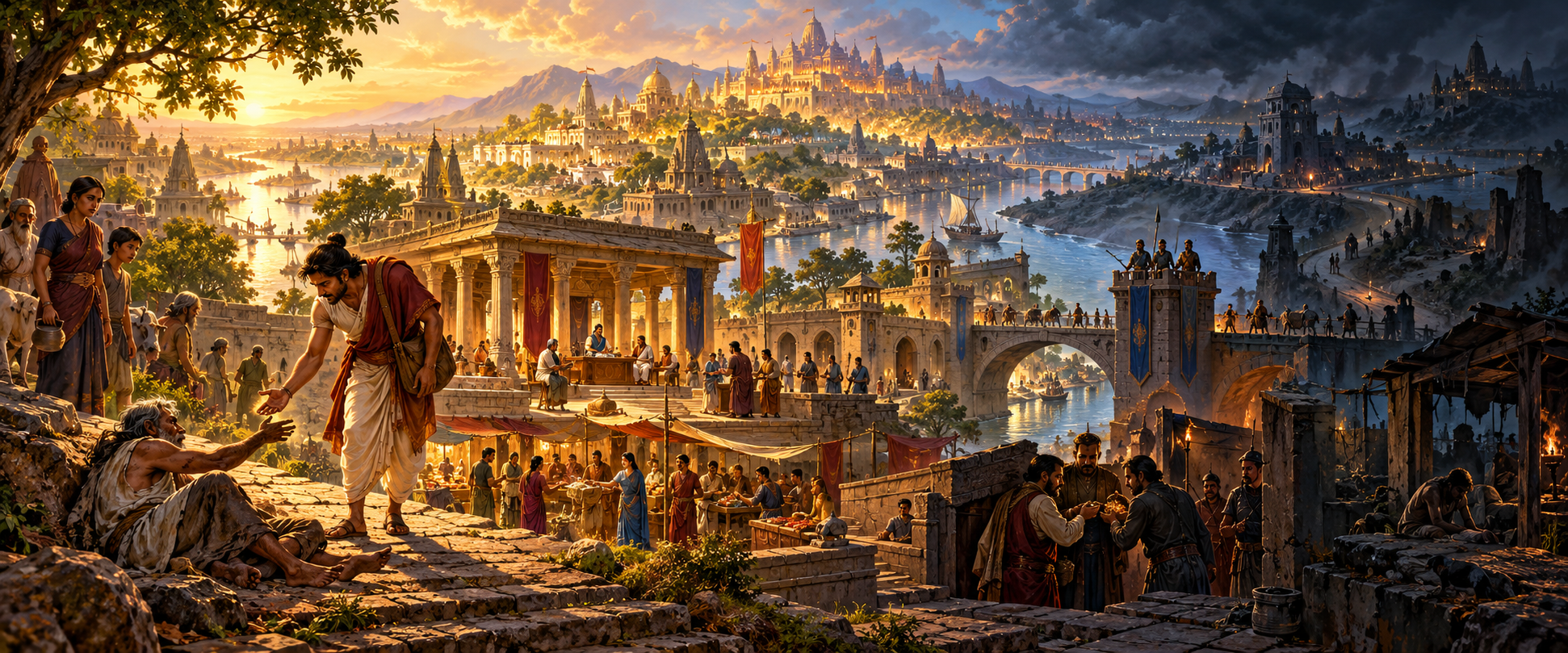
The symbolism becomes most useful when you apply it at more than one scale. The same struggle can occur within a person, inside a community, or across a civilisation. These levels influence one another, but they should not be collapsed. A private impulse is not automatically a public enemy, and a political disagreement is not automatically an epic war.
At the personal scale, look for the appetite that seeks exemption
Chaos begins internally when desire presents itself as necessity: because you are angry, you must strike; because you are afraid, you may deceive; because you have been wronged, every response is permitted. The dharmic counter-move is not to deny the feeling. It is to refuse the conclusion that feeling grants unlimited authority.
Before acting in a heated conflict, write down three answers: what concrete good are you protecting, what limit will you not cross, and what rule would you accept if your opponent held more power than you? If the third answer differs from the rule you want now, self-interest may be disguising itself as principle.
At the institutional scale, inspect the path available to the weak
A family, temple, school, workplace, or association should not be judged only by the virtues it praises. Examine what happens after a person with little status reports misconduct. Can the complaint be stated without public humiliation? Is evidence preserved? Is the decision-maker independent of the accused? Are consequences consistent? Can a mistaken judgment be corrected?
These procedures may appear less dramatic than defeating a monster, but they perform the same civilising work: they prevent superior strength from becoming the sole determinant of justice. If an institution depends entirely on the personal goodness of its leader, it has not yet built a durable protection against chaos. Good character matters, but clear boundaries and credible review make that character transmissible beyond one person’s tenure.
At the civilisational scale, defend the conditions that sustain memory
A civilisation does not preserve dharma only by defeating visible threats. It must keep open the channels through which people learn duties, remember inherited wisdom, practise worship, debate meaning, and form communities of trust. Temples, families, teachers, literature, ritual, and public memory matter because they give moral order a life beyond coercion.
This changes what cultural defence should prioritise. Reacting to insults may sometimes be necessary, but reaction alone leaves the culture dependent on its adversaries for direction. Teaching a child a tradition, supporting a functioning institution, preserving a text, correcting a falsehood with evidence, and creating a trustworthy place of refuge all build the order that chaos cannot supply.
The civilisational test is not simply whether our side can win a confrontation. It is whether people under our protection can live truthfully without becoming prey, and whether the means of protection remain answerable to dharma. A society that defeats an external aggressor but normalises internal impunity has preserved power, not necessarily order.
Key takeaways
- Read the human-Rakshasa battle as a struggle between moral orders, not as permission to treat inherited identities as good or evil.
- Recognise Matsya Nyaya by its mechanism: strength replaces shared rules, witnesses fear retaliation, and the vulnerable lose a credible path of appeal.
- Do not confuse silence with harmony. An orderly appearance can conceal highly organised predation.
- Do not confuse resistance with revenge. A dharmic response protects the vulnerable, names the violation, limits its means, and rebuilds a reciprocal rule.
- Test every claim of righteous power by asking what duty restrains the powerful and what protection reaches the weak.
- After confronting a threat, invest in the institutions, teaching, worship, memory, and relationships that make dharmic order durable.
The next time you face a conflict, resist the urge to begin with the identity of the supposed demon. Start with one violated duty, one person exposed to predation, and one reciprocal boundary that must be restored. That small act of clarity is how the language of dharma becomes a discipline rather than a slogan.
References

Leave a Reply
You must be logged in to post a comment.