
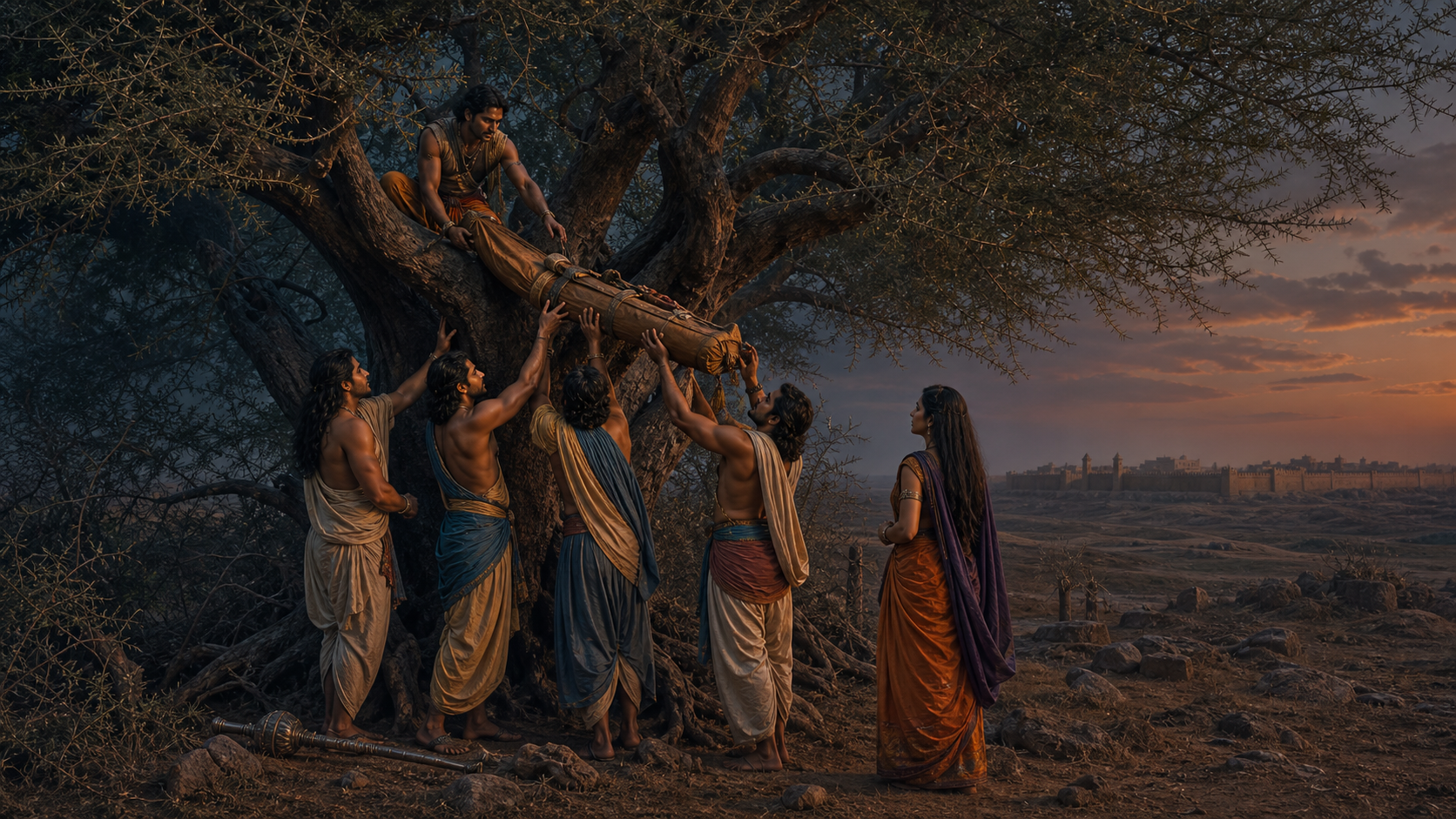
You may know that the Pandavas entered Virata in disguise, but that raises a practical question: what could they do with the weapons that might reveal who they were? They could neither display those weapons nor simply abandon them.
Their solution was a carefully layered concealment plan. Arjuna chose a remote shami tree, its natural defenses hid the weapons, and a corpse discouraged anyone curious enough to approach. Once you see how these elements worked together, the episode becomes more than an unusual detail from the Mahabharata. It becomes a lesson in disciplined preparation during Ajñātavāsa.
The exact place chosen for the weapons
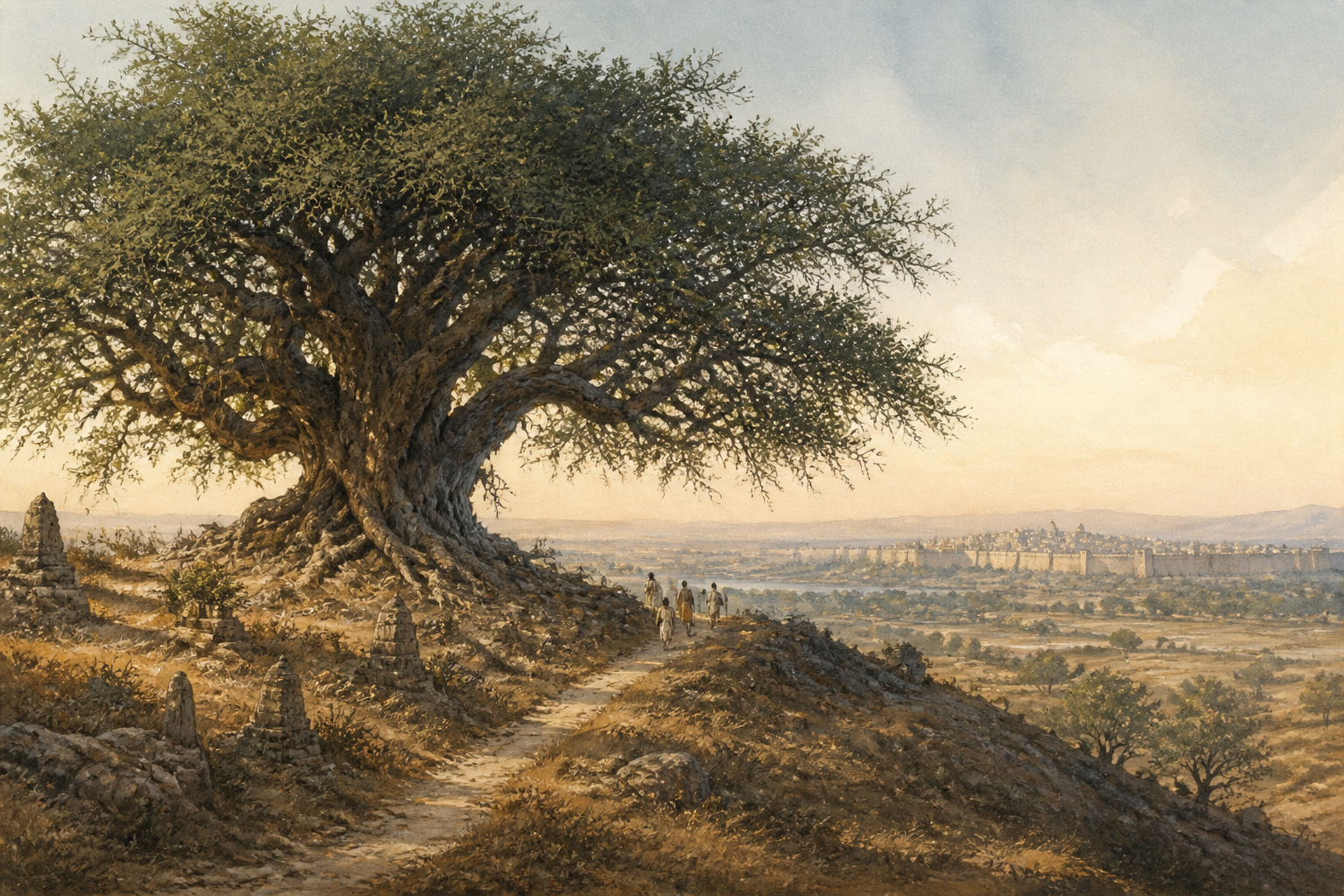
As the Pandavas entered the kingdom of Virata for their incognito exile, Arjuna identified a gigantic shami tree on a mountain peak near a cremation ground. Its formidable branches made it exceptionally difficult to climb, while its dense foliage prevented an observer from easily seeing what had been placed within it.
Each part of that location mattered. The mountain setting separated the cache from ordinary activity. The cremation ground made casual exploration less likely. The tree itself provided height, physical obstruction, and visual cover. This was not merely an isolated tree that happened to be convenient; Arjuna selected a place whose surroundings already resisted unwanted attention.
The choice also solved a problem that is easy to overlook. A hidden object must remain retrievable to its owner. Throwing the weapons away would have protected the disguises but destroyed the Pandavas’ ability to recover their martial capacity. The shami tree let them place the weapons beyond casual reach without losing the location themselves.
So the short answer to where the Pandavas hid their weapons is precise: in a huge, densely covered, difficult-to-climb shami tree near the cremation ground outside the ordinary life of Virata.
The concealment worked because it had several layers
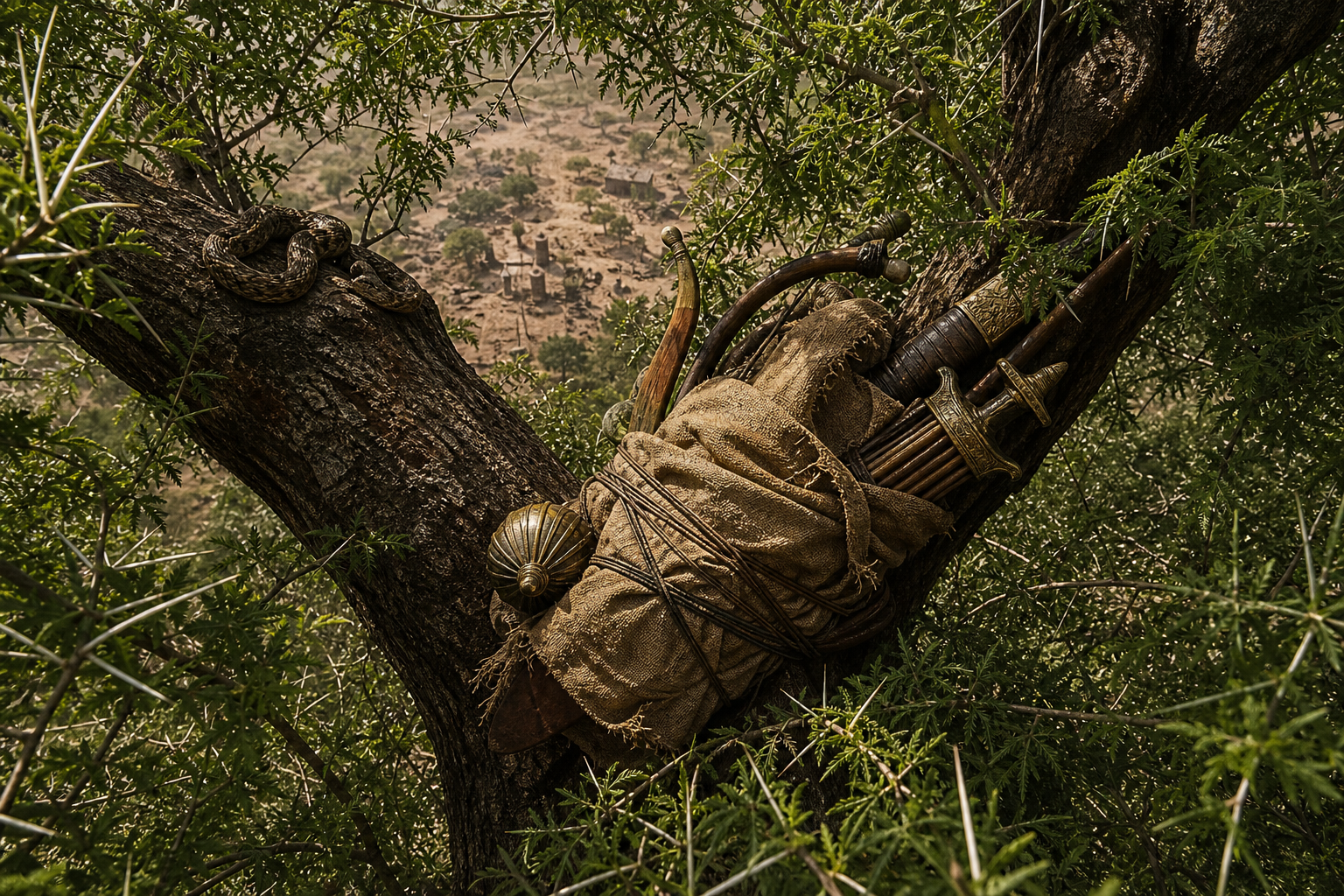
The weapons were not protected by a single clever trick. The entire arrangement formed a sequence of barriers.
First came distance. A person had to leave the places where people normally lived and worked, climb toward an elevated and forbidding location, and enter the vicinity of a cremation ground. That removed the merely idle passerby.
Then came access. Anyone who reached the tree still faced its intimidating branches and the difficulty of climbing it. The hiding place demanded effort before a search could even begin.
Next came concealment. Dense leaves and branches broke the observer’s line of sight. A person standing below would not necessarily know that the tree contained anything worth seeking.
Finally came aversion. The presence of a dead body supplied a human deterrent. A stranger who had overcome the inconvenience of the location and the difficulty of the tree still needed the willingness to investigate a corpse.
Notice how the plan narrows the number of possible discoverers at each stage. Someone needs a reason to visit the area, a willingness to approach the tree, the ability to climb it, and prior knowledge of where among the thick branches to search. Curiosity alone is unlikely to carry a person through every barrier.
This is why the tree and the corpse should not be treated as competing explanations. The tree supplied the physical defenses; the corpse strengthened the psychological defense. Remove the tree, and the body provides fear without reliable concealment. Remove the body, and the tree remains difficult but may still attract a determined explorer. Together they made discovery much less likely.
What it means to say that a corpse guarded the weapons
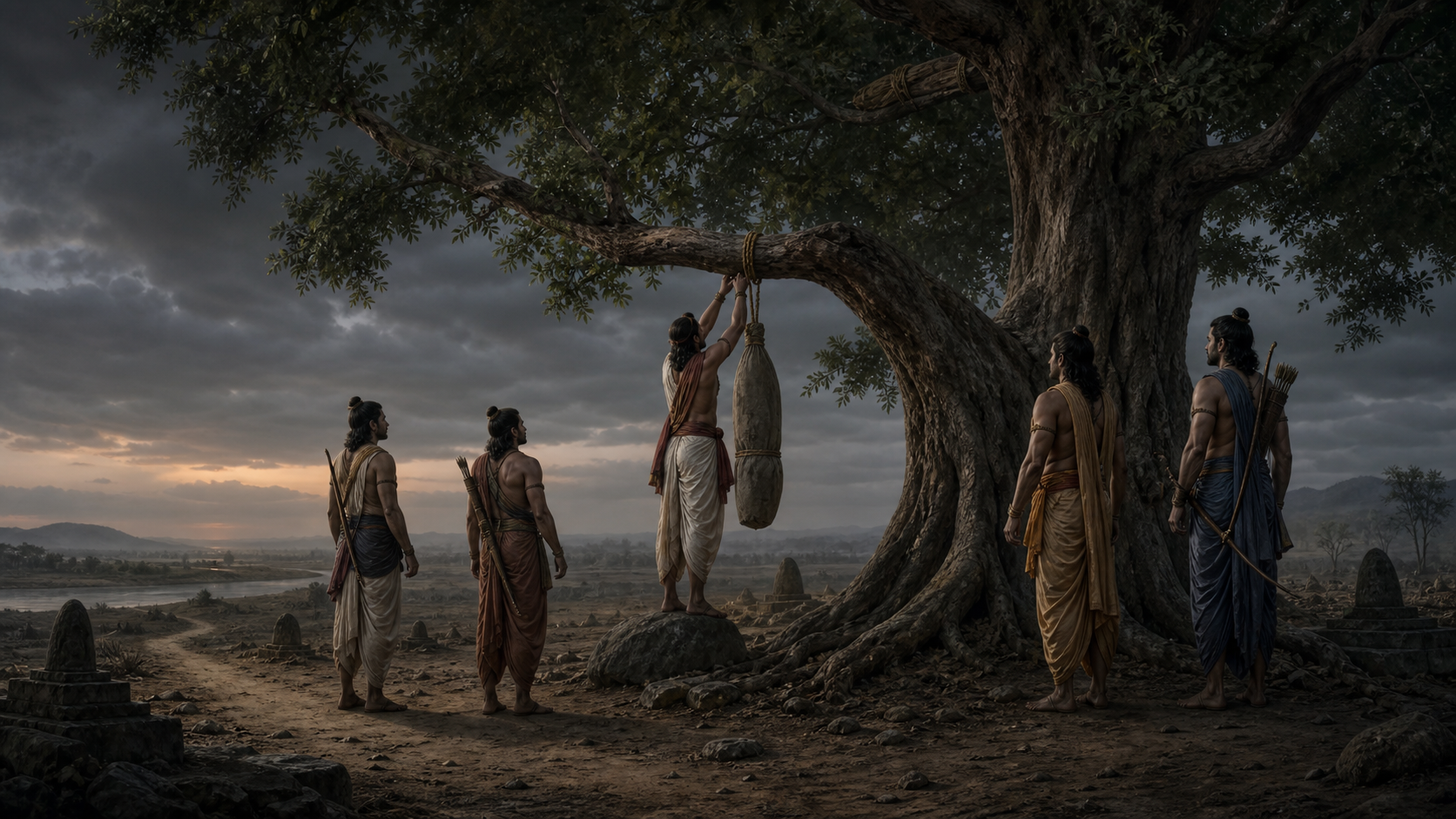
The statement that a corpse guarded the Pandavas’ weapons is metaphorical, not supernatural. The body did not stand sentry or exercise magical power. It guarded the cache by changing how other people would respond to the place.
A corpse near a cremation ground belonged to the unsettling character of the setting. At the same time, direct contact with it was something most people would avoid without a compelling reason. The deception therefore depended on ordinary human expectations. It did not need to make the weapons invisible; it needed to make close inspection seem undesirable.
That distinction matters because the memorable corpse can overshadow the more disciplined parts of the plan. Fear alone was not the strategy. Fear was placed inside a location already protected by remoteness, height, difficult branches, and dense foliage. The body was the final discouragement, not the whole arrangement.
The episode should not be turned into a general prescription concerning the treatment of the dead. It describes an exceptional stratagem used under the pressure of concealment. Its enduring value lies in the discernment behind the arrangement: Arjuna considered the surroundings, anticipated how strangers would behave, and selected defenses that did not require a visible guard.
Ajñātavāsa required restraint without surrender
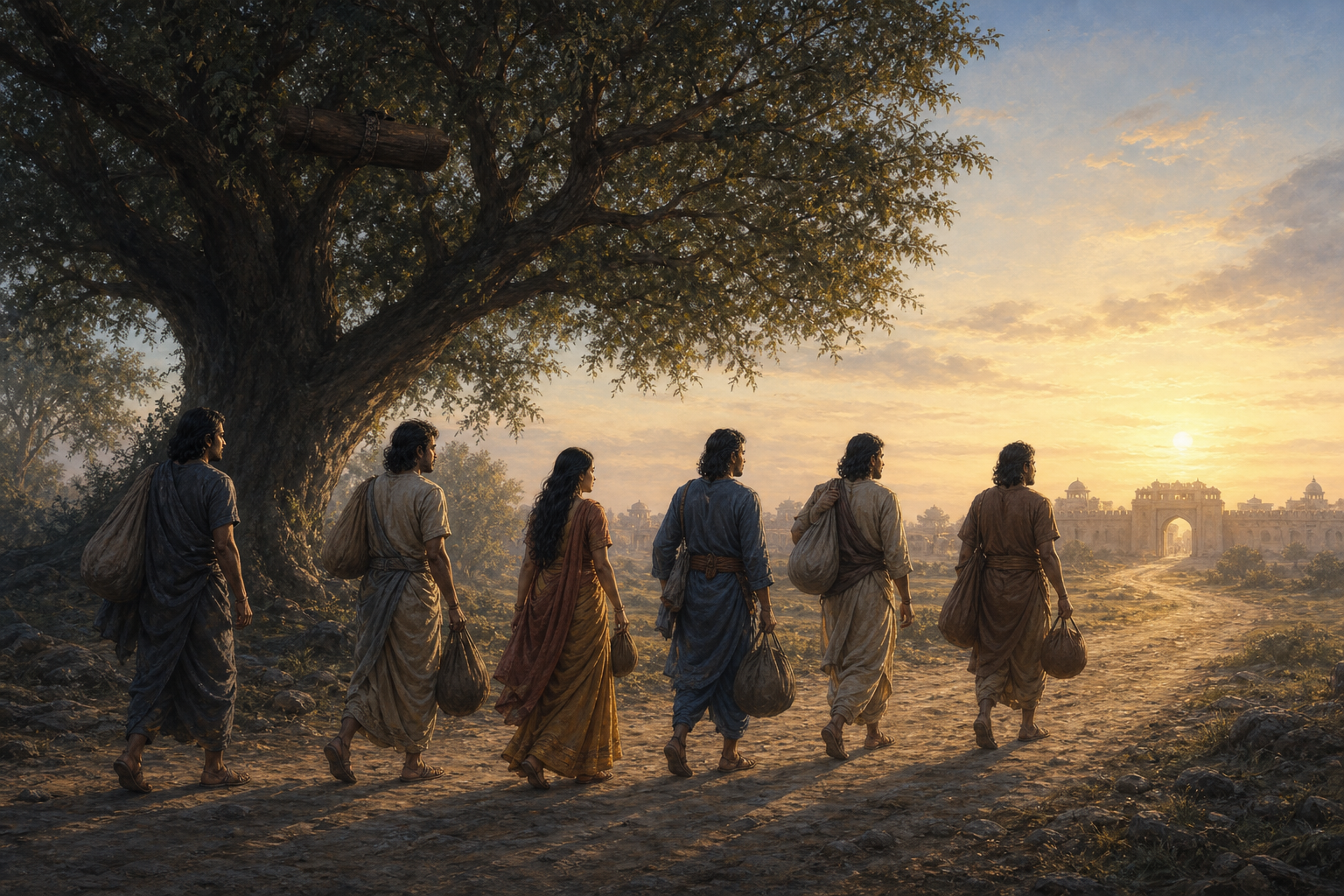
The Pandavas’ problem was not a lack of strength. Their problem was that visible signs of strength could defeat the purpose of Ajñātavāsa. Weapons connected to accomplished warriors could attract questions, while the success of life in Virata depended upon remaining unrecognized.
Arjuna’s decision therefore draws three useful distinctions. Concealment is not necessarily cowardice. Temporary non-use is not the same as renunciation. An assumed identity does not erase the capacity and duties being held in reserve.
The weapons remained available, but they did not dictate the Pandavas’ conduct at every moment. That is the deeper discipline in the scene. A warrior may possess the means to act and still understand that the correct action now is to wait, prepare, and avoid unnecessary exposure.
This also gives you a sound way to explain the episode to a younger reader. Do not present it only as a macabre trick. Begin with the conflict: the Pandavas had to protect their anonymity without destroying what they would later need. Then show how Arjuna solved both sides of the problem at once. The weapons were removed from sight but not lost; the disguises were protected but the Pandavas were not rendered helpless.
It is equally important not to force every feature into a mystical explanation. Within this episode, the narrated advantages of the shami tree are concrete. It is gigantic, difficult to climb, thickly covered, and situated in an inhospitable place. Later devotional associations may deserve their own treatment, but they should not replace the practical logic that makes this particular scene coherent.
Key takeaways
- Where were the weapons hidden? In a gigantic shami tree on a mountain peak near the cremation ground in the kingdom of Virata.
- Why was that tree suitable? Its intimidating branches were extremely difficult to climb, and its dense foliage concealed what had been placed within them.
- What did the corpse do? It acted as a psychological deterrent, making an already forbidding hiding place even less attractive to investigate.
- Why not abandon the weapons? The Pandavas needed to preserve their capacity to recover them while preventing those weapons from compromising their incognito identities.
- What makes the plan notable? It combined terrain, access difficulty, visual concealment, and predictable human behavior instead of depending upon one defense.
When you next encounter this episode in a retelling, look for all four elements: the elevated location, the cremation ground, the natural defenses of the shami tree, and the deterrent effect of the corpse. Keeping those details together preserves the intelligence of Arjuna’s plan and the disciplined purpose of Ajñātavāsa.
References
