
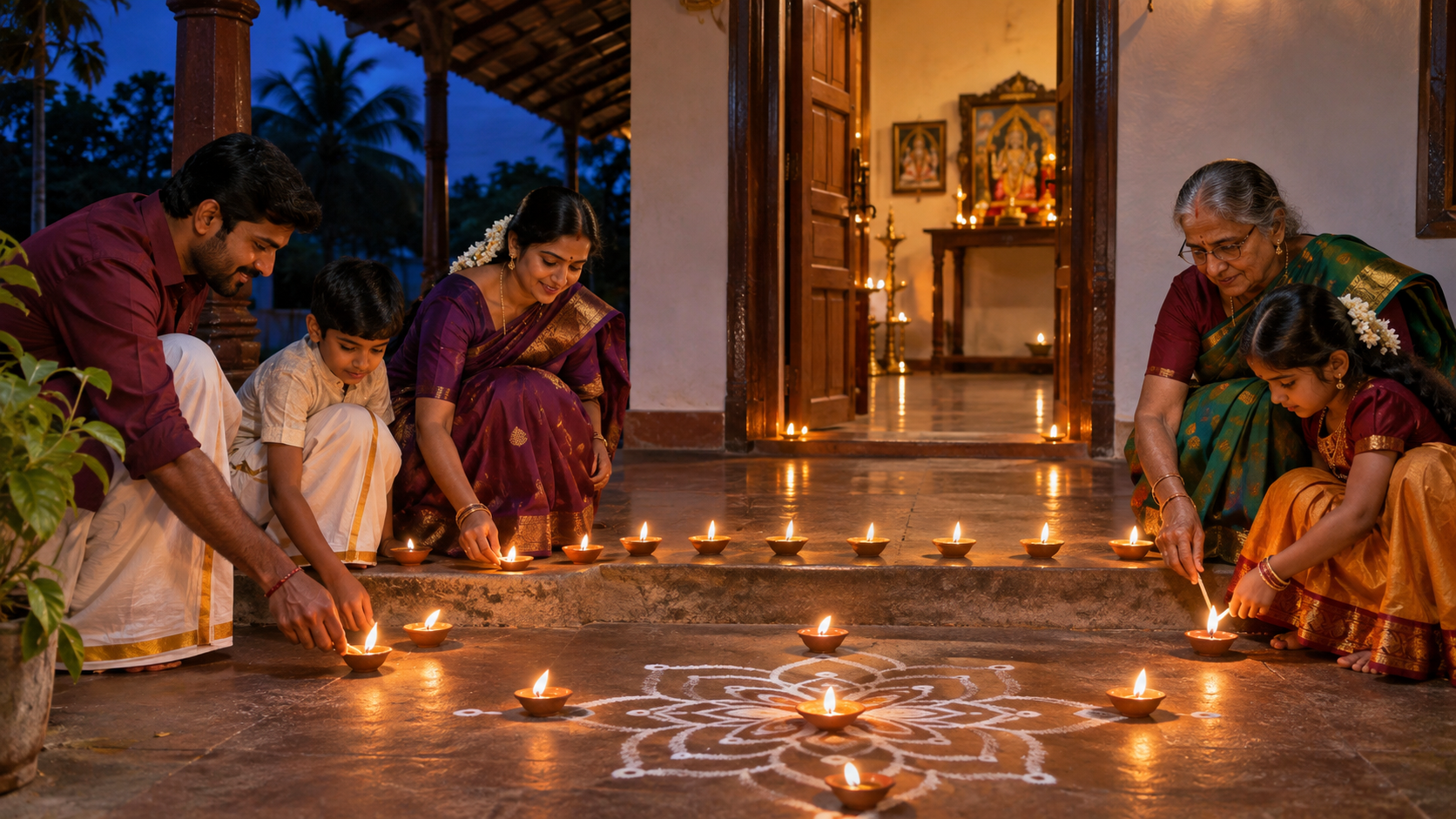
You may know that Karthigai Deepam is a festival of lamps but still be unsure about the date, the order of worship, or which temple customs belong in your home. The sound approach is simple: get the calendar right, preserve the shared act of lighting deepams, and let your family’s sampradaya determine the details.
You do not need an elaborate display or a collection of unfamiliar rituals. A clean worship space, safely placed lamps, sincere prayer, and attention to your inherited tradition form a coherent observance.
The common observance and its distinct devotional forms
Karthigai Deepam makes sacred light visible. Lamps illuminate the shrine and extend outward into the home, turning an ordinary domestic space into a place of collective worship. Cleaning, preparing the lamps, lighting them, praying, and sharing an offering are not unrelated tasks; together, they move the household from preparation to worship.
The festival should not be reduced to one sectarian form. The same occasion is observed as Vishnu Deepam by Vaishnava devotees, while the celebrated Tiruvannamalai observance is centered on Arunachaleshwara. These are not competing versions that you must combine. They are devotional expressions shaped by different lineages and sacred places.
If your family has an established procedure, begin there. If it does not, keep the home observance modest rather than assembling a new ritual from disconnected online instructions. The shared lamp-lighting is the stable core; names, hymns, offerings, lamp counts, and temple customs can follow the tradition you actually practise.
Choose the date by the Tamil calendar, not by guesswork
Karthigai Deepam is observed on Pournami, the full-moon observance in the Tamil month of Karthigai. At Tiruvannamalai, the festival is associated with the concurrence of Karthigai Pournami and Krithikai nakshatram. In 2026, Karthikai Maha Deepam falls on November 24.
Put November 24, 2026, on your calendar now, but do not treat a Gregorian date as the complete ritual timetable. A tithi and nakshatra are calculated calendrically, and their local timings do not necessarily match the civil day’s midnight-to-midnight boundaries. If you live outside Tamil Nadu or will attend a particular temple, check the local Tamil panchangam and the temple’s own announcement before fixing your puja time.
If a household calendar and a temple program appear to differ, first check whether they are answering different questions. Your calendar may identify the appropriate tithi for home worship, while the temple notice may give the time of a public ceremony. Follow the temple’s current instructions for temple participation and your family’s established practice for the home observance.
A simple and safe order for observing at home
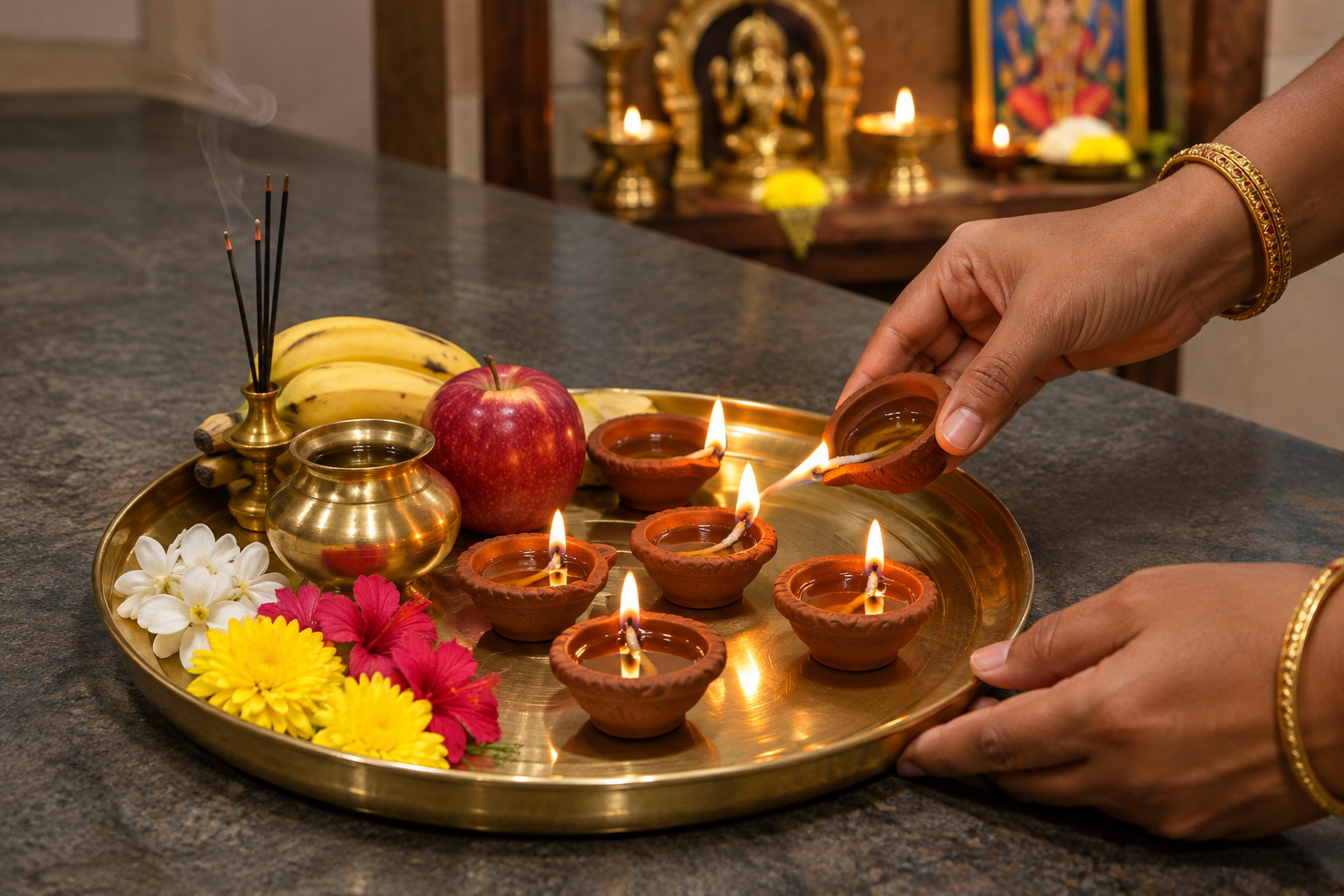
Preparation matters because rows of lamps are harder to manage after worship has begun. Do the practical work before the evening rather than placing and filling lamps while other family members are already praying.
- Confirm the day and local timing. Use the Tamil panchangam followed by your family or temple. For 2026, begin with November 24 and then confirm the local observance time.
- Clean the home and shrine. Cleaning houses and temples is part of the observance associated with Vishnu Deepam and Karthigai Deepam. Clear the shrine before arranging lamps so worship does not become a last-minute housekeeping exercise.
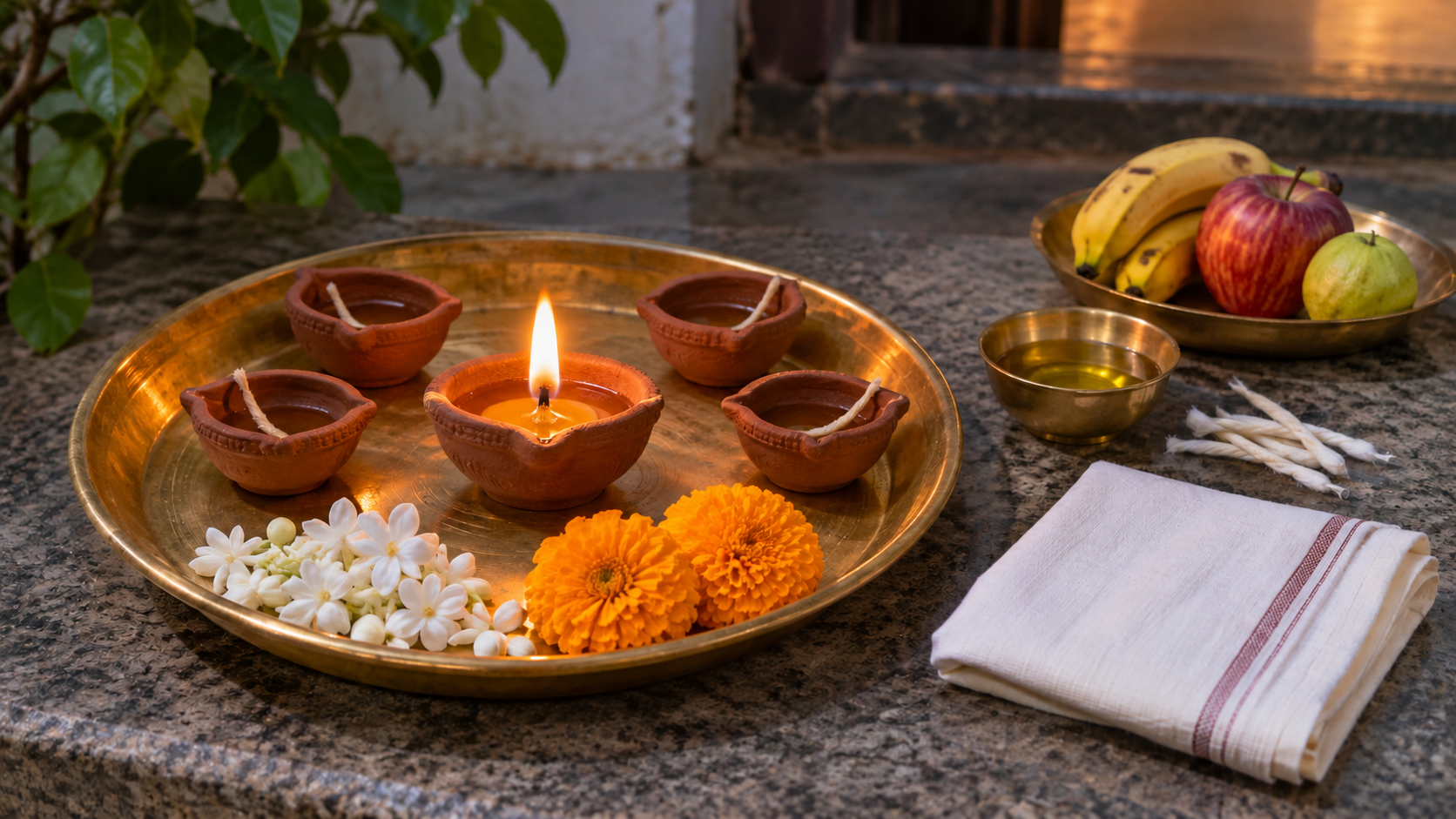
- Prepare every lamp before lighting the first one. Set out the lamps, wicks, fuel, matches or taper, offerings, and a safe way to handle a spent wick. Use the lamp material and fuel customary in your household rather than treating one online recommendation as universal.
- Choose stable locations. A shrine, entrance, courtyard, or protected balcony can carry the visual rhythm of the festival, but every flame needs a level, heat-resistant base. Keep lamps away from curtains, paper decorations, dry leaves, pets, children, and walking routes.
- Begin at the shrine. Light the principal worship lamp and offer prayer according to your lineage. A Vaishnava household may center Vishnu Deepam; a Shaiva household may direct worship toward Shiva or Arunachaleshwara. If your family has prescribed hymns or names, use them. If it does not, a short, attentive prayer is better than an inaccurately copied liturgy.
- Extend the light through the home. Light the remaining lamps in an orderly sequence. There is no need to invent a supposedly mandatory number. Follow a family count when one exists; otherwise, use the number you can place and supervise safely.
- Offer and share naivedya. Prepare the food customary in your household, offer it during worship, and share it as prasada. The point is continuity of worship, not an improvised menu presented as a universal rule.
- Supervise the flames until the observance ends. Never leave oil or ghee lamps unattended. If a placement becomes unsafe, move or extinguish the lamp carefully. Fire safety is not disrespect; preventable danger does not make an offering more authentic.
Families with limited space can light fewer real lamps in carefully supervised places. Electric lights may support the visual decoration where an open flame is unsafe, but you need not make a theological claim that every kind of light is ritually identical. Keep the actual offering clear and the rest practical.
Let temple tradition guide temple participation
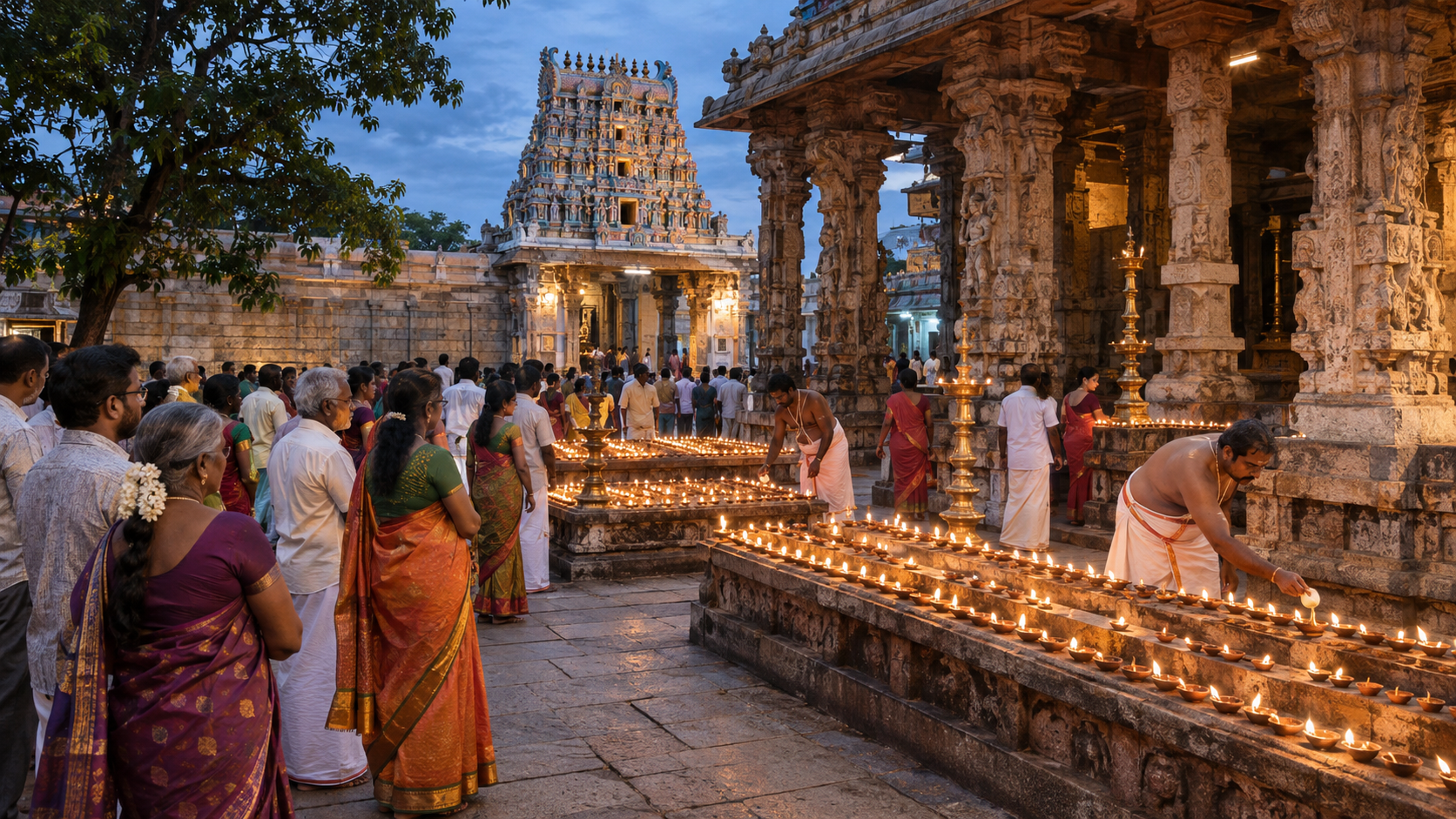
Tiruvannamalai is not merely a larger version of a domestic lamp arrangement. Karthikai Maha Deepam there belongs to the sacred life of the Arunachaleshwara temple and has its own public program. If you plan to attend in 2026, November 24 establishes the festival date, but it does not establish every ceremony, entry arrangement, or event time.
Before travelling, confirm four things with the temple or your pilgrimage organiser: the current day’s program, the time by which you must arrive, any entry or crowd instructions, and what worship materials may be brought. Do not plan transport around an unverified event time merely because the festival date is known.
Vishnu Deepam likewise deserves to be observed within its Vaishnava setting rather than treated as a decorative label for the day. If your household follows that tradition, ask your family priest or temple which names, hymns, offerings, and sequence are customary. This preserves the living practice without pretending that one short checklist can replace sampradaya.
You may also encounter the name Sokkappanai in connection with Tamil Nadu’s Karthigai observances. When a local temple announces it, ask what that temple expects from participants and follow the organisers’ directions. Do not recreate a large public fire practice at home from a name or a photograph; any substantial flame requires an appropriate site, supervision, and local safety compliance.
Key takeaways
- Karthigai Deepam falls on Karthigai Pournami; in 2026, the identified festival date is November 24.
- Confirm local tithi timing and the current temple program instead of relying on the Gregorian date alone.
- Clean the home and shrine before arranging lamps, offerings, and worship materials.
- Place only as many lamps as you can safely supervise; a larger count is not automatically a more authentic observance.
- Keep Vaishnava Vishnu Deepam, Shaiva worship, Tiruvannamalai Maha Deepam, and local Sokkappanai customs rooted in their respective traditions.
- For a first home observance, choose a coherent sequence from your family or temple rather than combining unfamiliar practices from several lineages.
Your useful next step is small: record November 24, 2026, ask which form your family or temple follows, inspect the places where lamps will stand, and gather the materials in advance. When the day comes, you can give your attention to the deepam and the prayer instead of solving avoidable practical problems.
References
- Hindu Pad – Vishnu Deepam, Sokkappanai: Karthigai Deepam Festival in Tamil Nadu
- Hindu Pad – Thiruvannamalai Karthikai Maha Deepam 2026 Schedule | Arunachaleshwara Karthigai Deepam

Leave a Reply
You must be logged in to post a comment.