
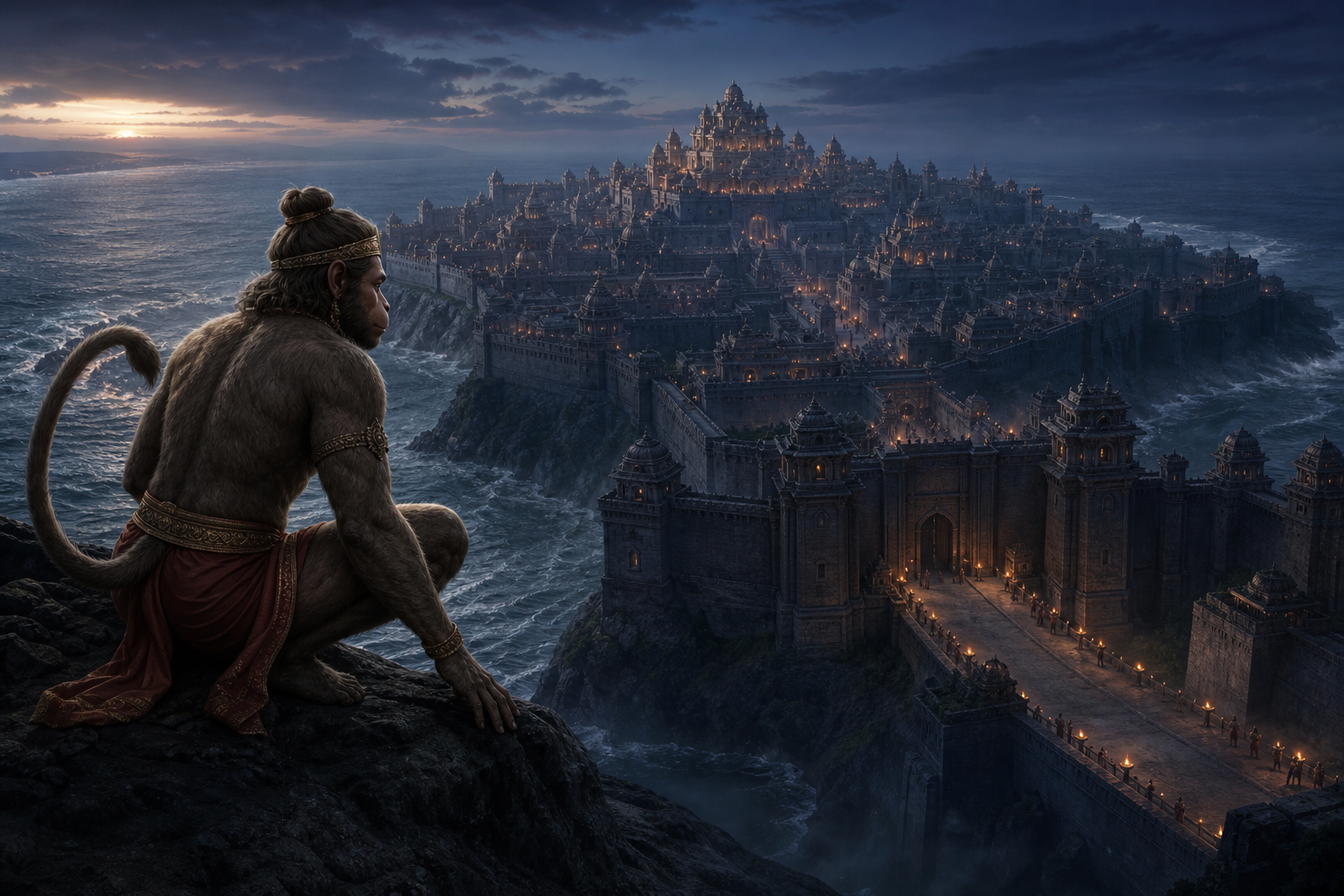
If your memory of Hanuman in Lanka jumps from the discovery of Sita to the burning of the city, you may be skipping the achievement that makes Rama’s campaign possible. Hanuman does not return with courage alone. He returns with a usable picture of the objective, the terrain, the defenses, the garrison and the enemy’s response under pressure.
Read the mission as military reconnaissance and a different Hanuman comes into view: not only the mighty devotee who crosses the sea, but the disciplined scout who turns an apparently impregnable capital into a problem that can be analyzed. That distinction helps you understand why the bridge, the alliance with Vibhishana and the restraint of dharma-yuddha belong to the same strategic sequence.
The mission changes once Sita is found

Before locating Sita, Hanuman has one overriding obligation: confirm that she is alive and identify where Ravana is holding her. Everything else is subordinate. A scout who exposes himself too early may learn a great deal about the enemy and still fail the mission because he cannot verify the person he was sent to find.
Once Sita is found, the intelligence problem widens. Rama does not merely need to know that she is in Lanka. He needs to know whether an army can reach the island, where it can enter, what will resist it, how quickly the defenders can react and what must remain protected during an assault. Hanuman therefore observes more than a destination. He studies a system.
This is the first useful distinction to carry into your reading: target confirmation and campaign reconnaissance are related, but they are not identical. The first answers, Where is Sita? The second asks, What must Rama’s forces overcome without losing sight of Sita’s safety?
Hanuman’s value lies in preserving that order. He infiltrates, observes patterns of activity, confirms the objective, maps relevant routes and learns how the city responds. Only then does his mission become openly disruptive. Intelligence remains tied to purpose rather than becoming a search for spectacle.
The distinction also explains his sober report after a seemingly miraculous adventure. A reliable scout does not ask the commander to imitate his personal feat. Hanuman’s agility and stealth allowed one exceptional operative to penetrate Lanka. They did not allow an entire vanara force, with its need for movement, resupply, rotation and evacuation, to cross the same way. His success proves that the perimeter is penetrable; his observations explain why penetration alone will not win the campaign.
Lanka’s first and strongest wall is the sea

Begin with the water, not the gold. Lanka is a jala-durga, a water fort whose surrounding sea performs the work of an immense moat. Reefs, headlands, surf and restricted landing areas can narrow an approach before a defender fires a weapon. The attacker must solve two problems at once: how to reach the island and how to keep an army functioning after the first crossing.
That second problem is easy to miss. A daring party may reach a beach, yet an invasion fails if reinforcements, food, weapons and the wounded cannot move across the water reliably. Lanka’s geography therefore attacks the campaign’s continuity. It can separate the troops already ashore from everything they still require.
Behind the maritime barrier, Hanuman encounters golden ramparts, iron gates and defenses arranged in depth. You can read the defensive system as five connected layers:
- The sea restricts the direction, speed and scale of approach.
- Waterfront outworks contest the vulnerable transition from sea to land.
- High outer walls create distance, elevation and protected positions for missile troops.
- Iron-bound gates and massive bars turn necessary entrances into chokepoints.
- Inner defenses around the royal complex force an attacker to survive more than one breach.
The hema-prakara, or golden rampart, works in more than one register. A high, bright wall is a physical obstacle that hampers climbing and gives defenders an elevated platform. It is also psychological architecture. The display of wealth and order tells an approaching enemy that the ruler possesses resources, labor and confidence. Lanka tries to deter before it has to fight.
The ayasa-dvara, or iron gate, concentrates the opposite message: hard resistance at the point where movement is already constrained. A barred gate does not need to defeat an entire army by itself. It needs to delay the leading formations while defenders above and around it can mass their attacks. Narrow routes inside the city can continue that channeling even after an outer entrance is forced.
Architecture is only half the defense. Rakshasa doctrine adds darkness, surprise and maya. If the defenders operate effectively at night, darkness is not automatically cover for the attacker; it may reverse the expected advantage. Illusion and deception make identification harder, while arrows, javelins, heavy missiles and sorties can disrupt formations already compressed by walls and gates.
References to the sataghni reinforce the impression of prepared anti-assault weapons. Commentarial explanations vary, including spiked beams and iron-studded devices used against dense groups. That variation matters. You need not force the description into one exact mechanical blueprint to understand its military function: clustered attackers near a fortification face specialized weapons designed to punish concentration.
Cross-reading Lanka with Kautilya’s Arthashastra is useful as strategic vocabulary, not as proof that every feature of the city follows a surviving manual. The categories help you notice the water fort, layered obstacles, intelligence, deception, negotiation and siege engineering. They should sharpen the reading, not flatten epic poetry into a technical inventory.
Hanuman gathers relationships, not just facts
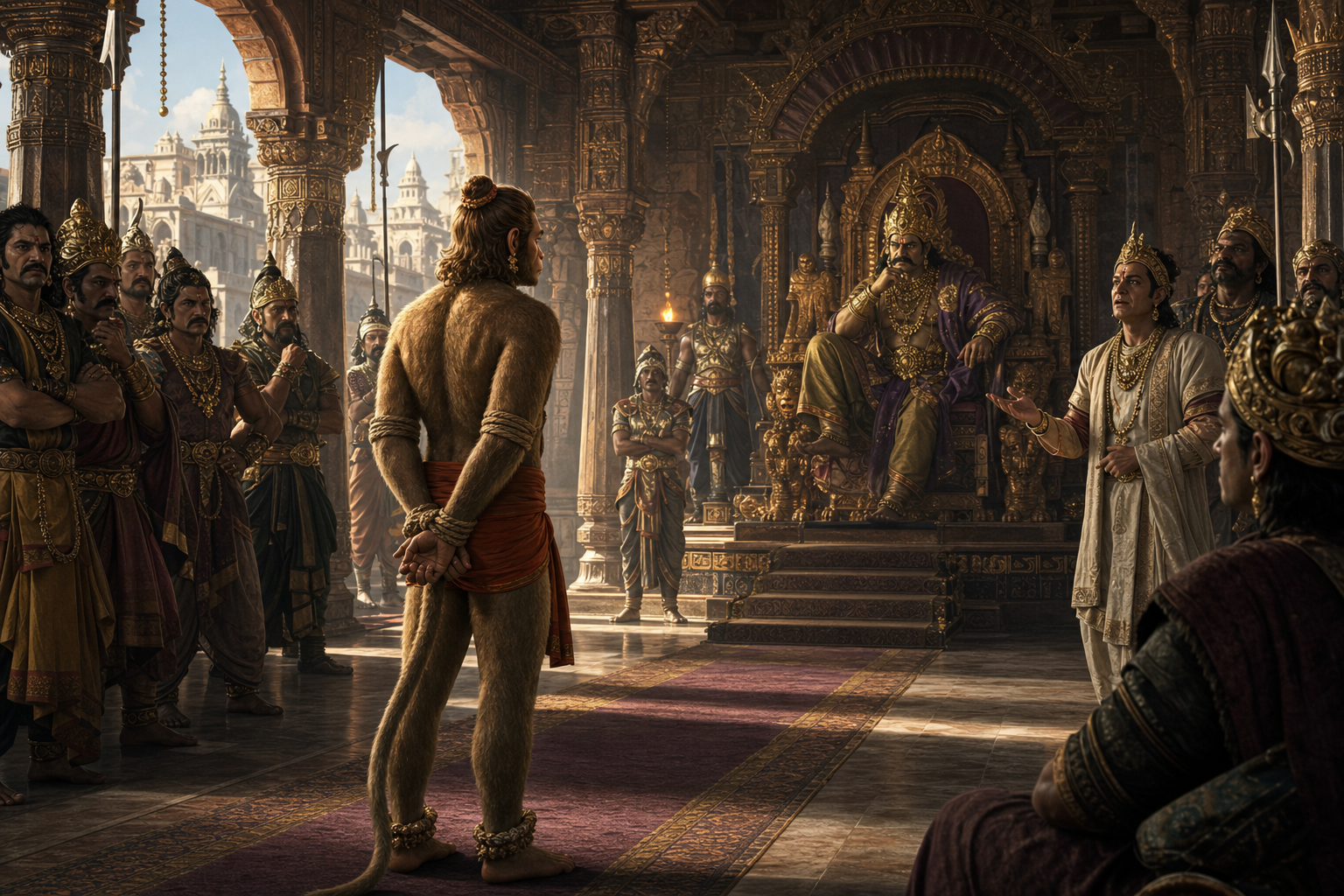
A troop count would not be enough. Military intelligence becomes useful when it shows how terrain, structures, routines and morale affect one another. Hanuman needs to understand not merely what Lanka possesses, but how its parts behave as a defensive organism.
You can follow his reconnaissance through six practical questions:
- Where can a force approach? The sea, coastline and limited landing corridors determine where mass movement is possible.
- What will slow or channel it? Outworks, walls, gates, bars and internal routes create successive points of delay.
- How will the city detect an intrusion? Pickets, watch rotations, beacons, horns and drums connect observation to warning.
- How does the garrison prefer to fight? Night operations, deception, projectiles, heavy weapons and sudden sorties reveal doctrine as well as equipment.
- Where are the protected objectives? Sita’s location and the royal complex must be distinguished from the city as a whole.
- What happens when the system is shocked? The spread of fire, the speed of response and the limits of coordination expose vulnerabilities hidden by the city’s imposing appearance.
These questions prevent a common misreading: equating a successful infiltration with an easy invasion. A perimeter can be strong and still admit an exceptional intruder. Hanuman’s entry reveals that Lanka is not sealed perfectly, but the difficulty of moving an army remains. Strategic planning must account for the scale of the force, not only the ability of its finest scout.
His disruption of Lanka carries a similarly limited meaning. Read militarily, the burning functions as a stress test of urban fire response, command links and morale. Flames can reveal which areas are vulnerable, how quickly orders travel and whether an aura of invincibility survives a sudden shock.
That interpretation should not become a timeless license for indiscriminate destruction. The action is ethically difficult when viewed through modern concerns about urban warfare, and even within the epic it does not define the final campaign’s whole moral character. Its intelligence value is narrower: the golden city can be disrupted, its defenders can be surprised and its psychological defenses are not as solid as its walls.
The disciplined conclusion is therefore neither Lanka is invincible nor Lanka is easy to conquer. It is more precise: Lanka has formidable defenses, but those defenses depend on identifiable terrain, procedures, assumptions and command responses. Once those dependencies are visible, Rama’s forces can design an operation around them.
Intelligence becomes a bridge, an alliance and restraint
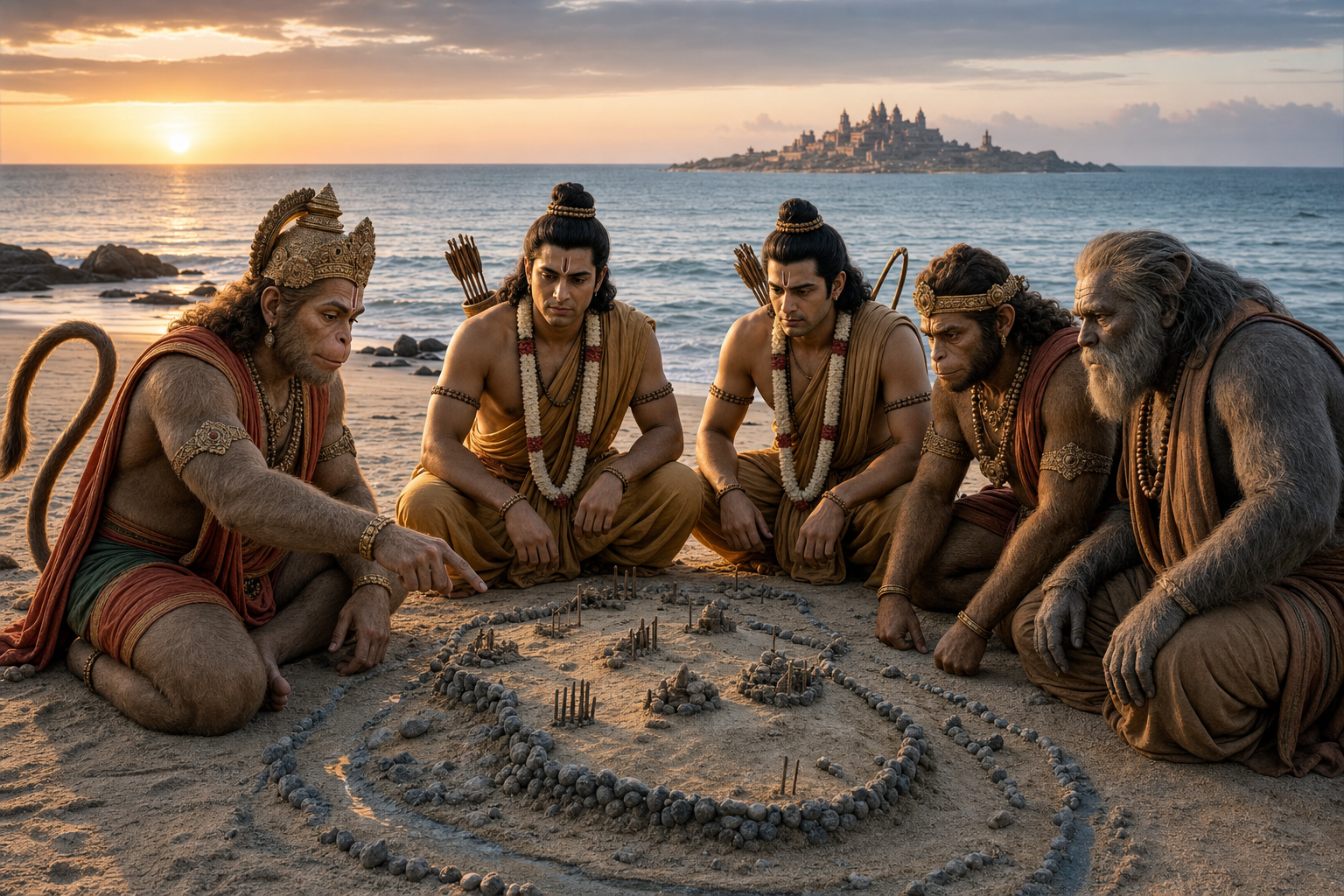
Reconnaissance matters only when it changes decisions. Hanuman’s findings do not produce a single clever tactic. They shape an entire campaign design in which engineering solves access, alliance reduces uncertainty and dharma limits the purpose and use of force.
| Reconnaissance finding | Military meaning | Campaign response |
|---|---|---|
| The sea is Lanka’s outer defense | A one-time crossing cannot sustain a mass army | Build the setu to establish dependable movement |
| Walls, gates and inner defenses create depth | One breach will not end resistance | Plan for successive obstacles rather than one decisive entrance |
| Night fighting and maya favor the rakshasas | Timing and perception can become weapons | Maintain vigilance, flexibility and morale under deception |
| Sita is a protected objective inside the enemy capital | Destruction of the city is not the mission | Keep rescue and rightful restoration central to operational choices |
| Vibhishana rejects Ravana’s course | The enemy polity is not morally or politically uniform | Accept righteous refuge and cultivate informed alliance |
The setu solves continuity, not merely distance
The causeway led by Nala and Nila is the direct answer to the sea’s strategic veto. Without it, crossings remain exceptional and vulnerable. With it, the campaign gains a line of communication capable of supporting mass movement, resupply, rotation and evacuation.
This is why the setu should not be treated as a decorative miracle between reconnaissance and battle. It is the operational consequence of recognizing Lanka as a water fort. Hanuman demonstrates that the ocean can be crossed; Nala and Nila turn crossing into infrastructure. One feat establishes possibility. The other makes sustained action possible.
Vibhishana changes the intelligence environment
Vibhishana’s departure from Ravana exposes another weakness: a fortified state is not necessarily a united state. Strategically, his acceptance reduces Lanka’s monopoly over internal knowledge. Morally, his saranagati establishes that justice cannot be reduced to loyalty between opposing camps. A righteous person seeking refuge does not become unworthy of protection merely because he comes from the enemy’s side.
This keeps alliance-building within the grammar of dharma. Vibhishana is not valuable only because he can help defeat Lanka. His counsel matters because he has rejected adharma. The order is important. If usefulness alone determined protection, refuge would become a transaction. In Rama’s camp, the obligation to shelter the righteous carries its own moral weight.
Dharma defines what victory is allowed to mean
Envoys are sent, counsel is offered and opportunities for de-escalation precede the final destruction of Ravana’s power. These are not signs that the campaign lacks resolve. They distinguish the recovery of Sita and the defeat of adharma from conquest for its own sake.
Good intelligence serves that distinction. Knowing the objective, routes, obstacles and likely responses gives a commander more capacity to discriminate. Ignorance pushes an army toward blunt force because every location and movement appears equally uncertain. Reconnaissance creates options, including the option to direct force toward what must be overcome while protecting what must not be treated as expendable.
This is the deeper connection between strategy and dharma-yuddha. Restraint is not an ornament added after the military plan is complete. It determines the legitimate objective of the plan. Lanka’s defenses must be breached, but Lanka’s wealth is not the prize; Sita must be restored, Ravana’s adharma must end and those who seek righteous refuge must be protected.
The broader Dharmic resonance does not require Hindu, Buddhist, Jain and Sikh traditions to possess an identical doctrine of war. The shared moral warning is narrower and more durable: courage without discipline can become violence, and power severed from duty can reproduce the domination it claims to oppose.
Key takeaways
- Separate infiltration from invasion. Hanuman’s entry proves that one skilled scout can penetrate Lanka; it does not solve the movement and sustainment of an army.
- Read the sea as the outer fortification. The setu is necessary because geography threatens supply and continuity, not merely because Lanka is far away.
- Trace the defensive layers as one system. Waterfront approaches, walls, gates, internal routes, warning procedures and night-fighting doctrine reinforce one another.
- Treat the burning as a limited diagnostic, not the whole strategy. It reveals weaknesses in response and morale but does not remove the need for engineering, alliance and disciplined operations.
- Judge each military choice by the objective. Sita’s safety, the defeat of adharma, opportunities for de-escalation and protection for Vibhishana keep force subordinate to dharma.
On your next reading, make five columns in the margin: objective, terrain, defense, response and restraint. Place each of Hanuman’s observations under one of them, then note which later decision answers it. The bridge will stop looking like a sudden solution, Vibhishana will stop looking like a convenient defection, and Hanuman’s report will emerge as the quiet hinge between devotion and victory.