
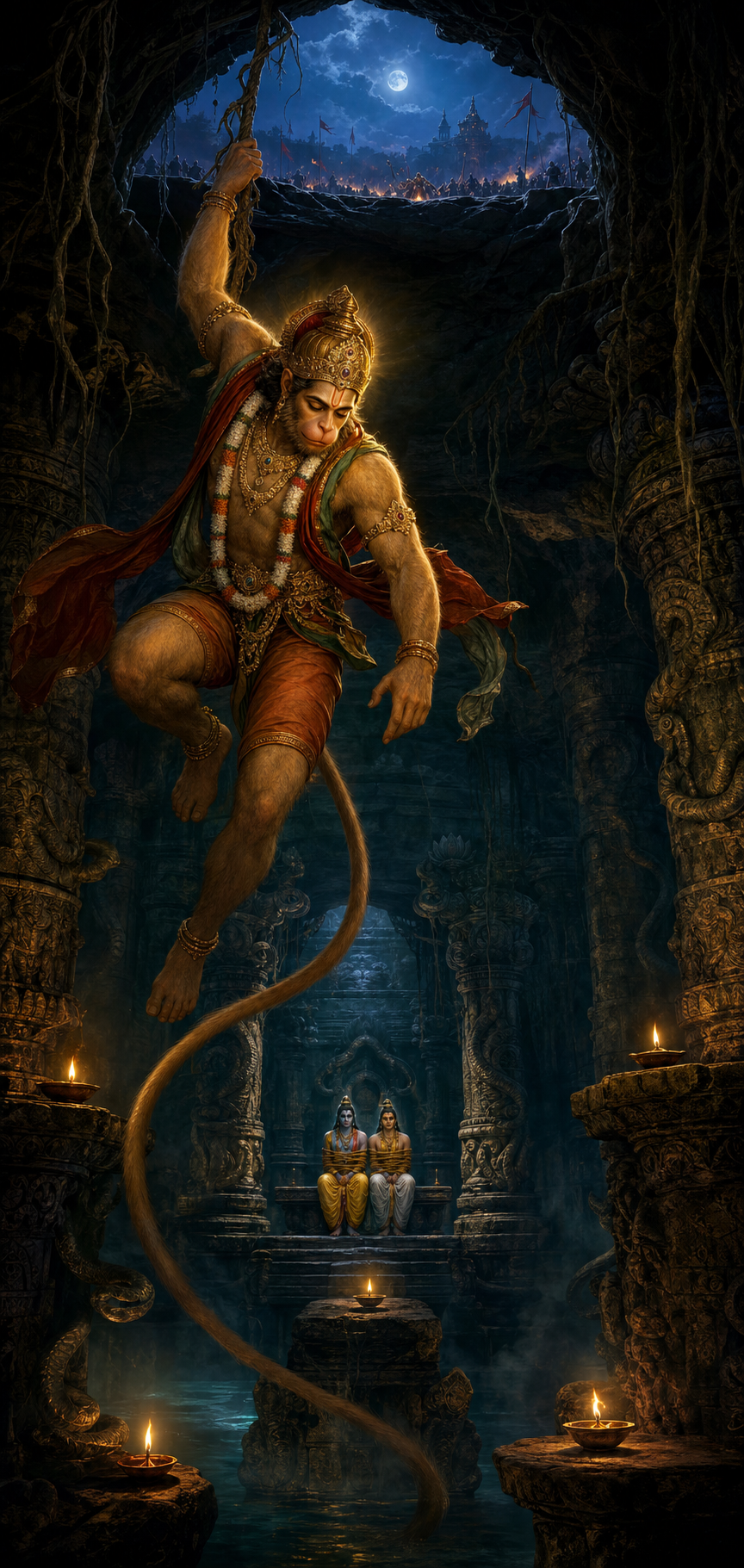
If you first met Panchamukhi Hanuman through a temple murti, a katha, or the rescue of Rama and Lakshmana from Mahiravana, discovering that the episode is absent from the Valmiki Ramayana’s critical edition can feel disorienting. You may wonder whether you must choose between devotion and textual honesty.
You do not. The useful question is not whether the story is simply authentic or inauthentic, but what kind of tradition it represents, which details belong to a particular telling, and what its narrative design teaches. Once those distinctions are clear, the Mahiravana episode becomes easier to discuss without either making an unsupported claim for antiquity or dismissing a living expression of Hindu memory.
Place the episode in the Ramayana tradition accurately
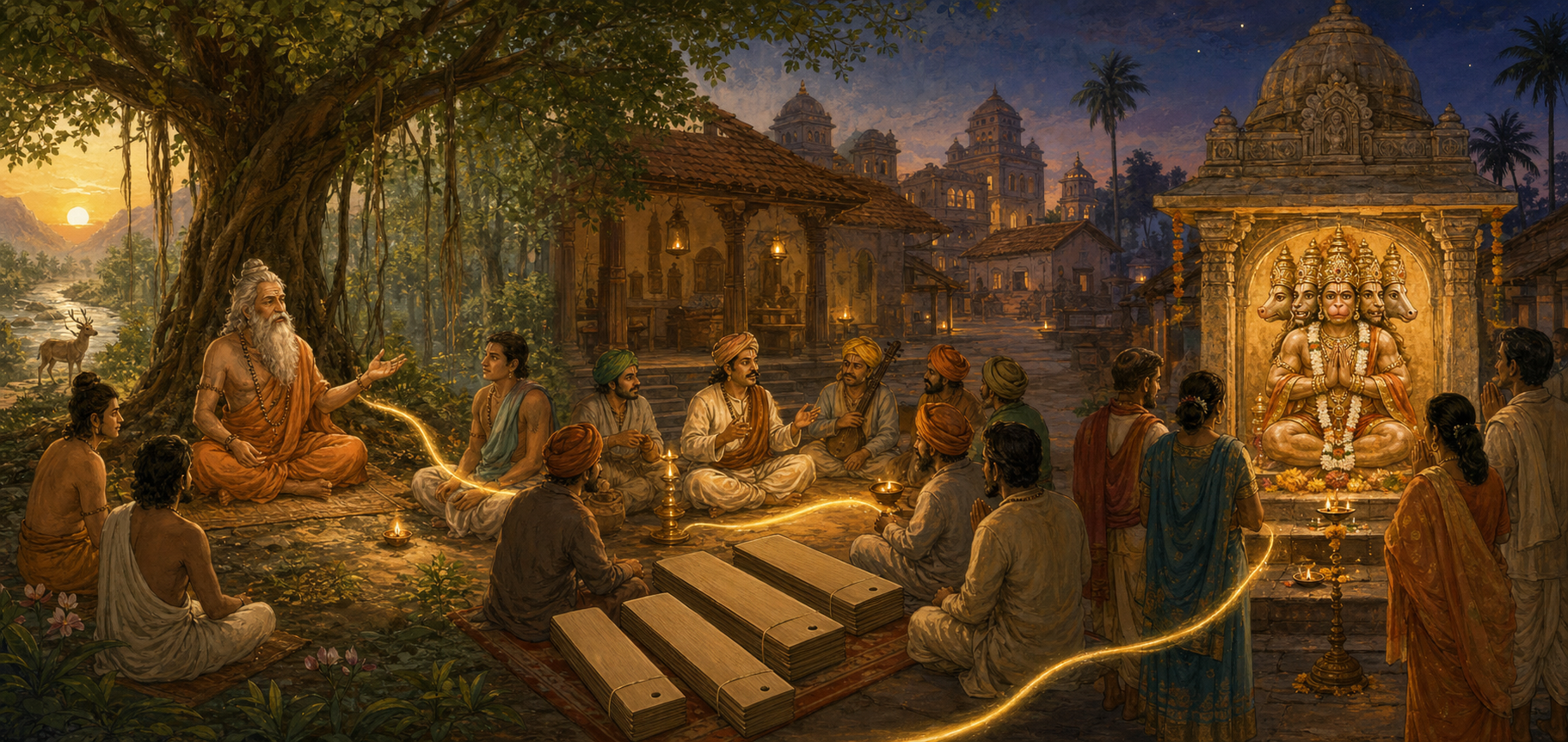
For the narrow question, Did Valmiki narrate this rescue?, the answer is straightforward: the Mahiravana episode is not part of the Valmiki Ramayana’s critical core. That is a statement about textual location. It is not a verdict on the devotional worth of every later Ramayana telling.
The wider Ramayana tradition is not confined to one textual witness. The Mahiravana cycle appears prominently in later and regional works such as the Ananda Ramayana and the Bengali Krittivasi Ramayana. It also lives in Yakshagana, Tolu Bommalata, Ravana Chhaya, local kathas, temple images, stotras, and protective devotional practices. Its authority in these settings comes from transmission, performance, worship, and its ability to communicate dharmic meaning – not from a claim that every detail occurs in Valmiki’s text.
This gives you a clean way to speak about it. Say that the rescue belongs to a later and regional stratum of the Ramayana tradition. Do not say that Valmiki tells it. At the same time, do not use later as a synonym for false or regional as a synonym for insignificant. Textual provenance and cultural vitality answer different questions.
You should also ask which version is being narrated. Some traditions distinguish Mahiravana and Ahiravana as two sorcerer-kings. Others use the names for a single adversary or collapse the figures into one. Details of the abduction, the goddess invoked in the intended sacrifice, the defenses of Patala, and the route to Mahiravana’s death can therefore differ. When teaching or discussing the episode, the precise phrase in this telling is often more honest than the Ramayana says.
Follow the rescue as a change in the kind of battle
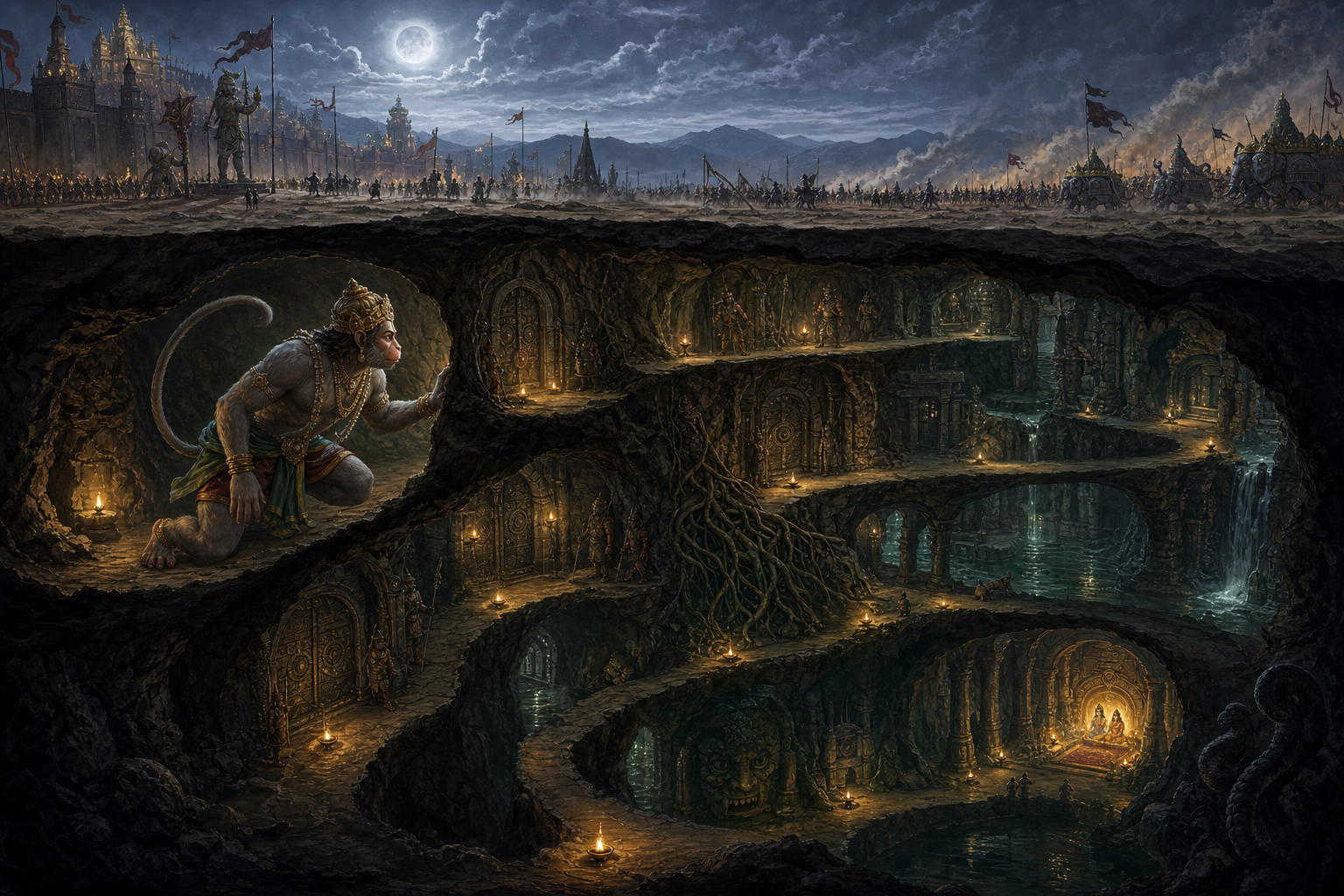
The common narrative spine begins during the war in Lanka. Facing the prospect of defeat, Ravana seeks help from Mahiravana, a sorcerer-king associated with Patala. The conflict then moves away from the visible battlefield into a domain of disguise, hidden passages, mantra, ritual defenses, and deceptive appearances.
- Ravana calls upon Mahiravana when ordinary warfare is no longer securing victory.
- Mahiravana penetrates the camp through deception, often by taking a trusted appearance, and abducts Rama and Lakshmana.
- The brothers are carried into Patala and prepared for sacrifice to a form of Devi, variously named Kali or Chandika.
- Hanuman enters the hostile stronghold through reconnaissance and, in several tellings, assumes the tiny form of a honeybee.
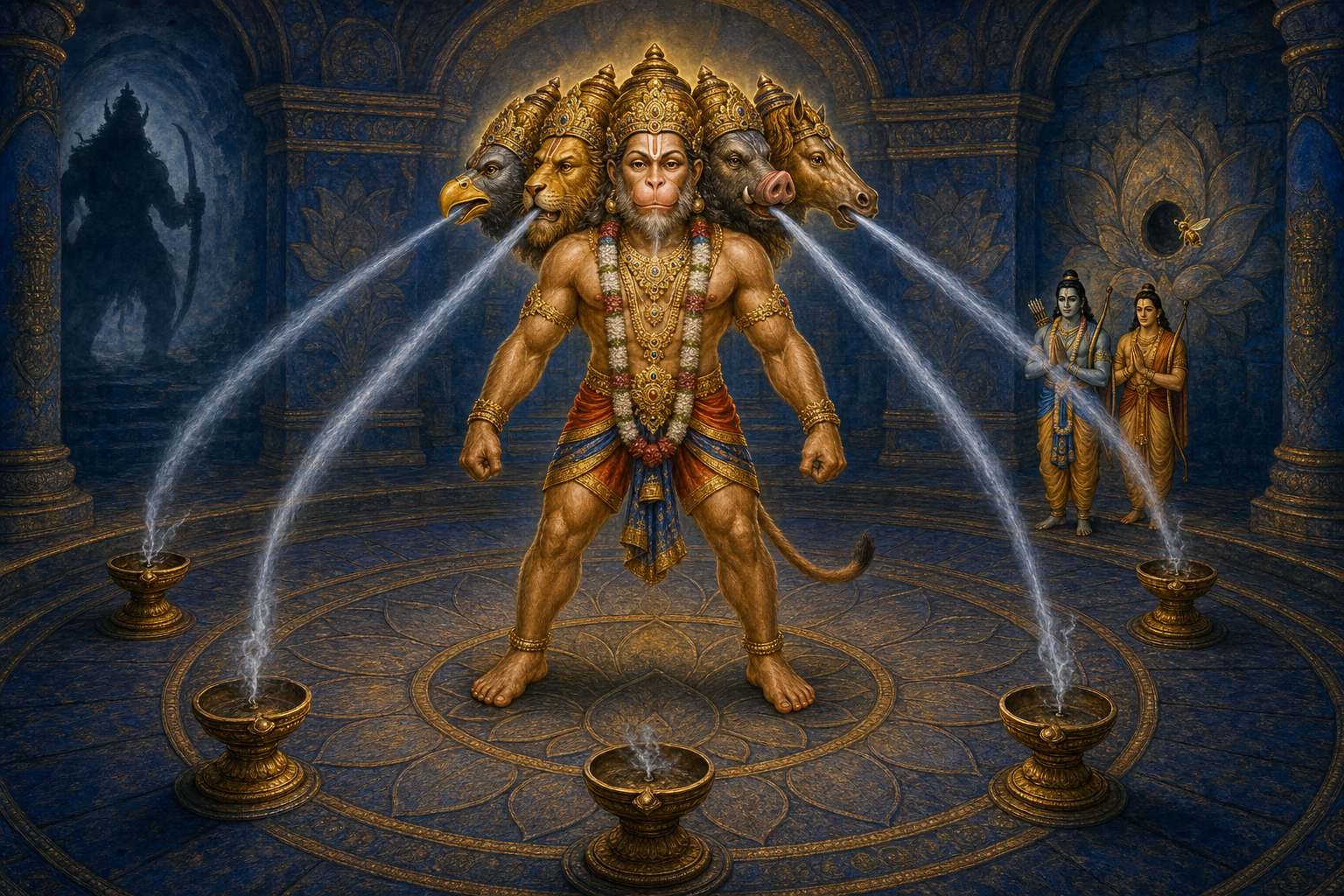
- He discovers that Mahiravana’s protection is joined to five oil lamps oriented in different directions. Extinguishing one lamp at a time will not work; all five must go dark together.
- Hanuman manifests five faces, extinguishes the lamps simultaneously, defeats Mahiravana, releases Rama and Lakshmana, and returns them to the warfront.
Patala here should not be reduced to either a cavern or a simple equivalent of hell. Puranic cosmography imagines a subterranean complex of Atala, Vitala, Sutala, Talatala, Mahatala, Rasatala, and Patala, with naga realms, jeweled cities, formidable beings, and unusual powers. Moving the action there signals that the rules of engagement have changed. Strength remains necessary, but strength by itself cannot identify a concealed dependency or defeat a defense built around several directions at once.
Notice the order of Hanuman’s response. He does not begin by enlarging himself and striking everything in reach. He first determines the nature of the terrain, reduces his visible presence, gathers the decisive information, and only then assumes the form fitted to the problem. The sequence is a practical model of dharmic action: understand before intervening, use no more force than the task requires, and expand your capabilities when the structure of the obstacle becomes clear.
The intended sacrifice must also be read ethically. The villain’s invocation of Kali or Chandika is not a sound basis for condemning Devi worship, mantra, or ritual as such. The adharma lies in abduction, coercion, and the attempt to turn sacred power into an instrument of domination. Hindu narratives regularly distinguish spiritual means from the intention governing their use. A rite does not become righteous merely because it uses a sacred name.
Read the honeybee and the five faces as exact solutions
The honeybee form is disciplined smallness
Hanuman’s honeybee form is not an ornamental transformation. Patala is imagined as a guarded maze whose defenses detect gross movement. A bee can pass through a minute opening, avoid notice, observe a rite without crossing it noisily, and reach a place inaccessible to a warrior-sized body. Where a direct assault would announce Hanuman’s presence, smallness gives him time to learn what must actually be done.
The bee also carries a recognizable Indic symbolism. It seeks nectar with concentrated attention. In this episode, that image becomes a way of understanding a mind gathered around Rama rather than scattered by the spectacle of danger. Hanuman’s attention is devotional, but it is not passive. Rama-bhakti gives it direction; alert observation turns it into effective action.
When you hear or watch this episode, pay attention to the movement from great strength to extreme smallness and then to five-directional expansion. That progression is the teaching. Hanuman does not cling to one display of power as though consistency meant always appearing in the same form. His constancy lies in the purpose of seva. His method changes because the obstacle changes.
Panchamukhi Hanuman solves a problem of simultaneity
Mahiravana’s defense cannot be broken through a rapid sequence. The five lamps must be extinguished at the same moment. Panchamukhi Hanuman therefore represents more than an increase in force: the form supplies simultaneous agency across the directions in which Mahiravana’s life-protection has been distributed.
A widely circulated iconographic arrangement identifies the faces as follows:
| Face | Direction |
|---|---|
| Hanuman | East |
| Narasimha | South |
| Garuda | West |
| Varaha | North |
| Hayagriva | Upward, toward akasha |
The upward face matters. The form is not merely a four-sided guardian with an extra head added for symmetry. It commands the horizontal directions and the vertical opening above. The fivefold solution matches the fivefold defense. Once the lamps are extinguished together, the ritual bond sustaining Mahiravana’s invulnerability is broken.
This is also why Panchamukhi Hanuman should not be read as five competing intentions. The faces act as one presence because all their capacities are aligned toward one act of service. Devotional interpretation sees in the form a convergence of protection, knowledge, courage, spatial command, and the Vaishnava and Shaiva energies gathered around Rama-seva. Unity does not require sameness; it requires a righteous center.
If you encounter a Panchamukhi murti, begin with the directional grammar before trying to decode every weapon or ornament. Identify the frontal face, locate the lateral faces, remember that Hayagriva looks upward, and then relate the whole composition to the five lamps. This turns a visually complex image into a coherent theological statement: comprehensive guardianship is coordinated action, not an accumulation of disconnected powers.
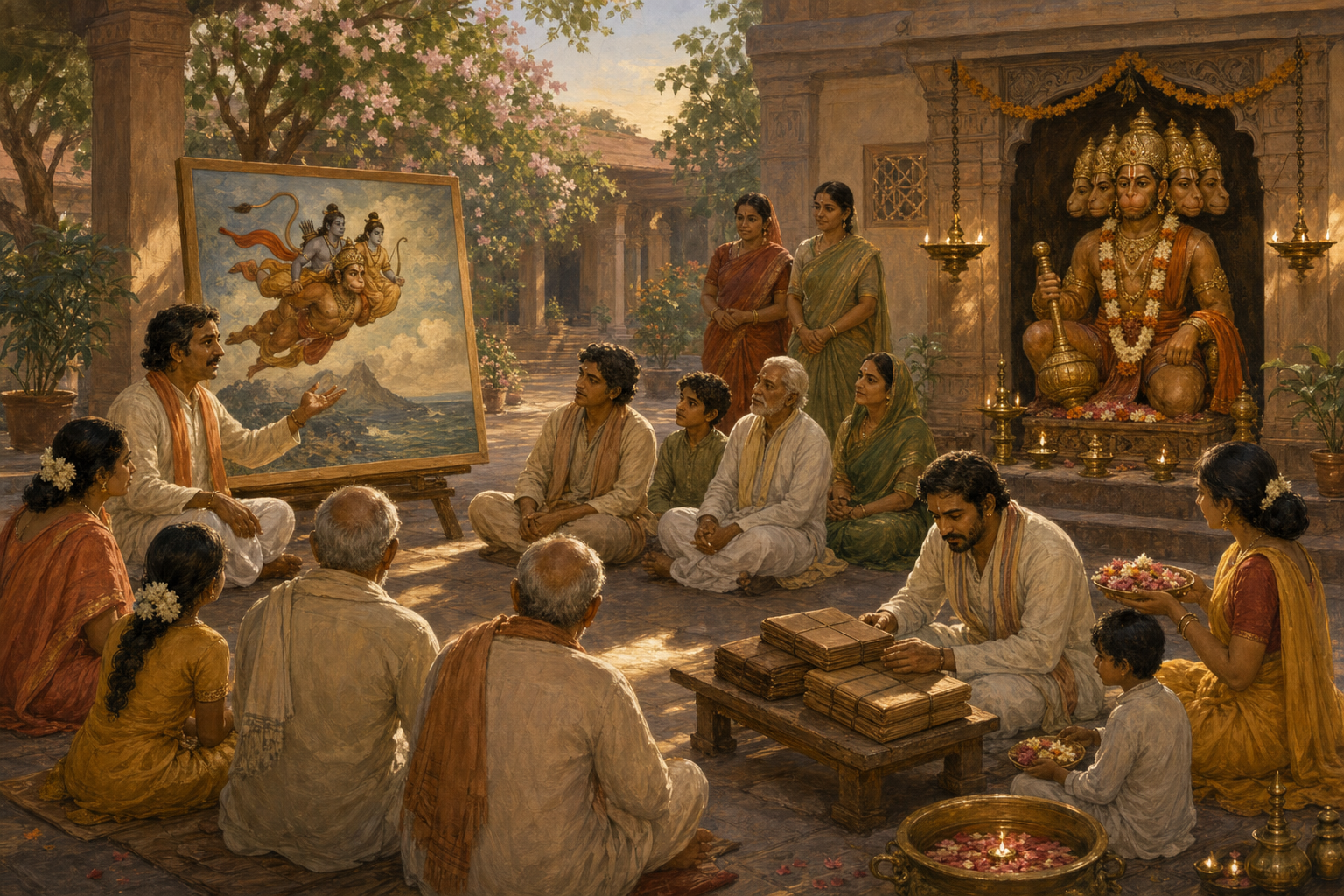
Carry the tradition forward without flattening it
Key takeaways
- Be precise about provenance: the Mahiravana rescue is not in the Valmiki Ramayana’s critical edition, but it is a substantial part of later, regional, performative, and iconographic Ramayana traditions.
- Expect variations: Mahiravana and Ahiravana may be separate figures or names attached to a single adversary, depending on the telling.
- Read the transformations functionally: the bee enables unobtrusive reconnaissance; the five-faced form enables simultaneous action across five directions.
- Keep devotion and discernment together: bhakti fixes Hanuman’s purpose, while buddhi and yukti determine the right method.
- Avoid transactional interpretations: Panchamukhi devotion can discipline attention, conduct, courage, and remembrance, but the story is not a promise that mere repetition mechanically controls events.
For personal practice, the strongest lesson is not that one particular form guarantees protection on demand. It is that protective strength becomes trustworthy when governed by ethical restraint, clear perception, and seva. Recitation of Panchamukhi Hanuman stotras or kavachas belongs naturally with concentrated attention, disciplined conduct, and remembrance of Rama-nama. Separating the words from that orientation would miss the very quality that makes Hanuman’s power dharmic.
For teaching, especially with children or newcomers, use three layers. First tell the rescue as a story with a clear problem and solution. Then explain why a bee succeeds where a large warrior could not, and why five faces are required rather than merely impressive. Finally, name the tradition honestly as a later or regional Ramayana episode. That order preserves wonder without asking a listener to confuse devotional meaning with textual chronology.
Readers formed by other Dharmic paths may also notice genuine family resemblances without claiming that the traditions are identical. Hanuman’s adaptive method recalls Buddhist upaya, or skillful means. The five-angled response can evoke the Jain discipline of anekantavada, which resists reducing a complex reality to one viewpoint. His union of service and courage resembles the Sikh pairing of seva and shaurya. These are illuminating analogies, not claims that one tradition borrowed this episode from another.
The next time you meet Mahiravana in a performance, a retelling, or a temple explanation, ask three questions: Which telling is this? What exact defense must Hanuman overcome? Why does he become smaller before he becomes five-faced? Those questions will let you receive the tradition with both shraddha and discrimination – the same union of unwavering purpose and intelligent means that the story celebrates.
References
