
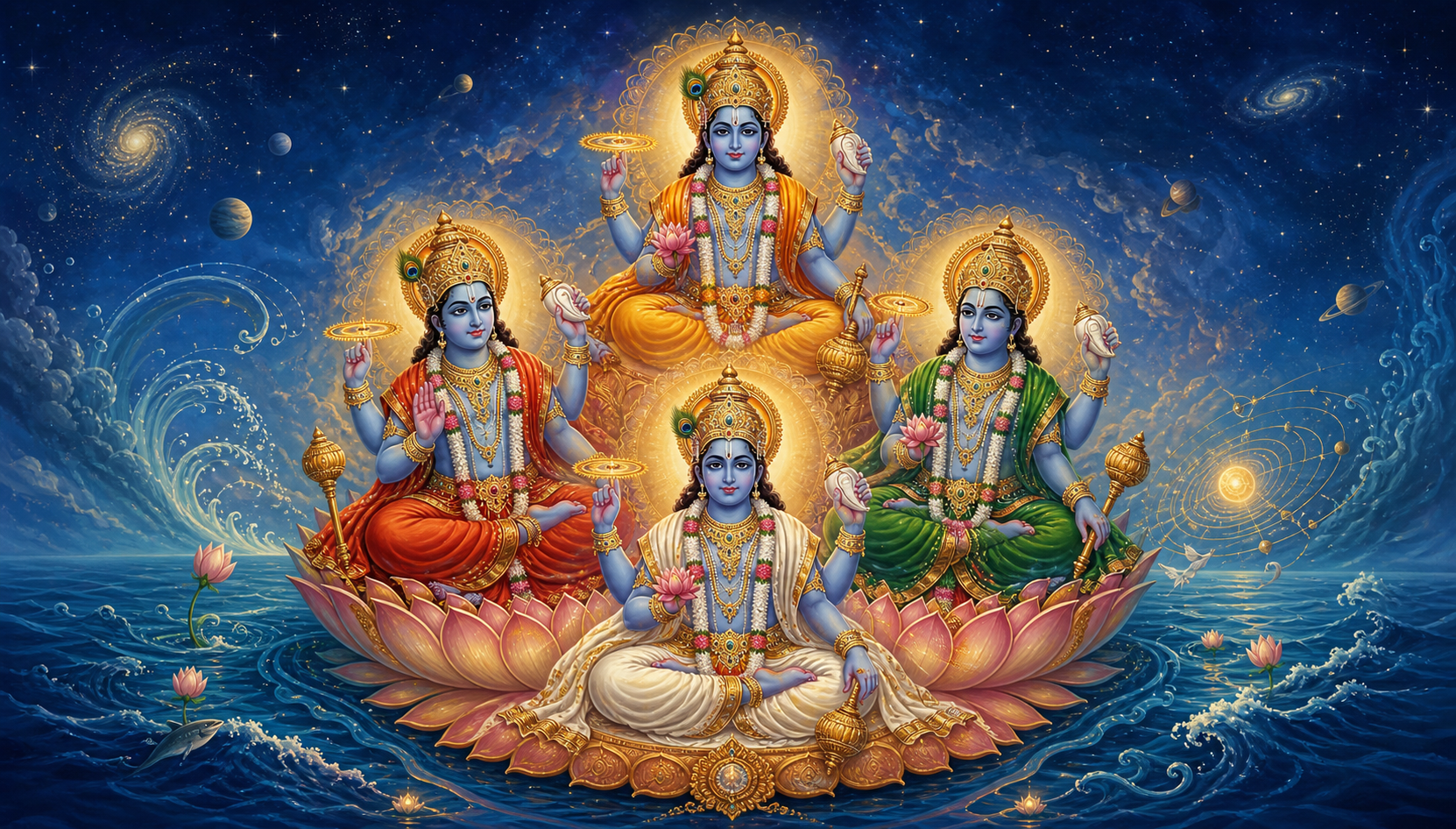
You may have encountered Vasudeva, Sankarshana, Pradyumna and Aniruddha in a temple explanation or Vaishnava teaching and wondered what, exactly, makes them distinct. Treat them as four unrelated deities, four ordinary aliases or another list of avatars, and the doctrine becomes harder than it needs to be.
Keep one sentence in view: the Caturvyuha describes one Vishnu made intelligible through four coordinated manifestations. It explains how the Supreme can remain undivided while becoming present in the creation, withdrawal, governance and preservation of the cosmos.
Key takeaways before you learn the four names
- Vyuha means a purposeful formation or deployment. Here it describes ordered divine manifestation, not the fragmentation of Vishnu.
- Vasudeva holds the primary place; Sankarshana, Pradyumna and Aniruddha express differentiated but inseparable functions.
- The Vyuhas are not simply another avatar list. Avatars belong to the related category of vibhava manifestation.
- The assignment of particular divine excellences varies across texts and lineages, so learn the governing pattern before arguing over a chart.
- A Caturvyuha image is meant to teach relationship and unity through composition, attributes and ritual presence. Counting figures or faces is not enough to identify one.
The distinction between Vyuha and avatar becomes clearer within the fivefold Vaishnava map of divine presence: para is the transcendent Supreme; vyuha is ordered emanation; vibhava comprises incarnations or avatars; antaryamin is the indwelling guide; and arca is the consecrated image. These are related ways in which the one Lord is known, not five competing versions of God.
This framework can also help you approach diversity across the Dharmic family without forcing different traditions into sameness. Jain many-sidedness, Buddhist formulations such as the trikaya and the Sikh affirmation of Ik Onkar offer structural resonances concerning unity and multiplicity. They are not alternate names for the Caturvyuha. Respect begins by noticing the shared question while preserving each tradition’s own answer.
Follow the movement from presence to cosmic order
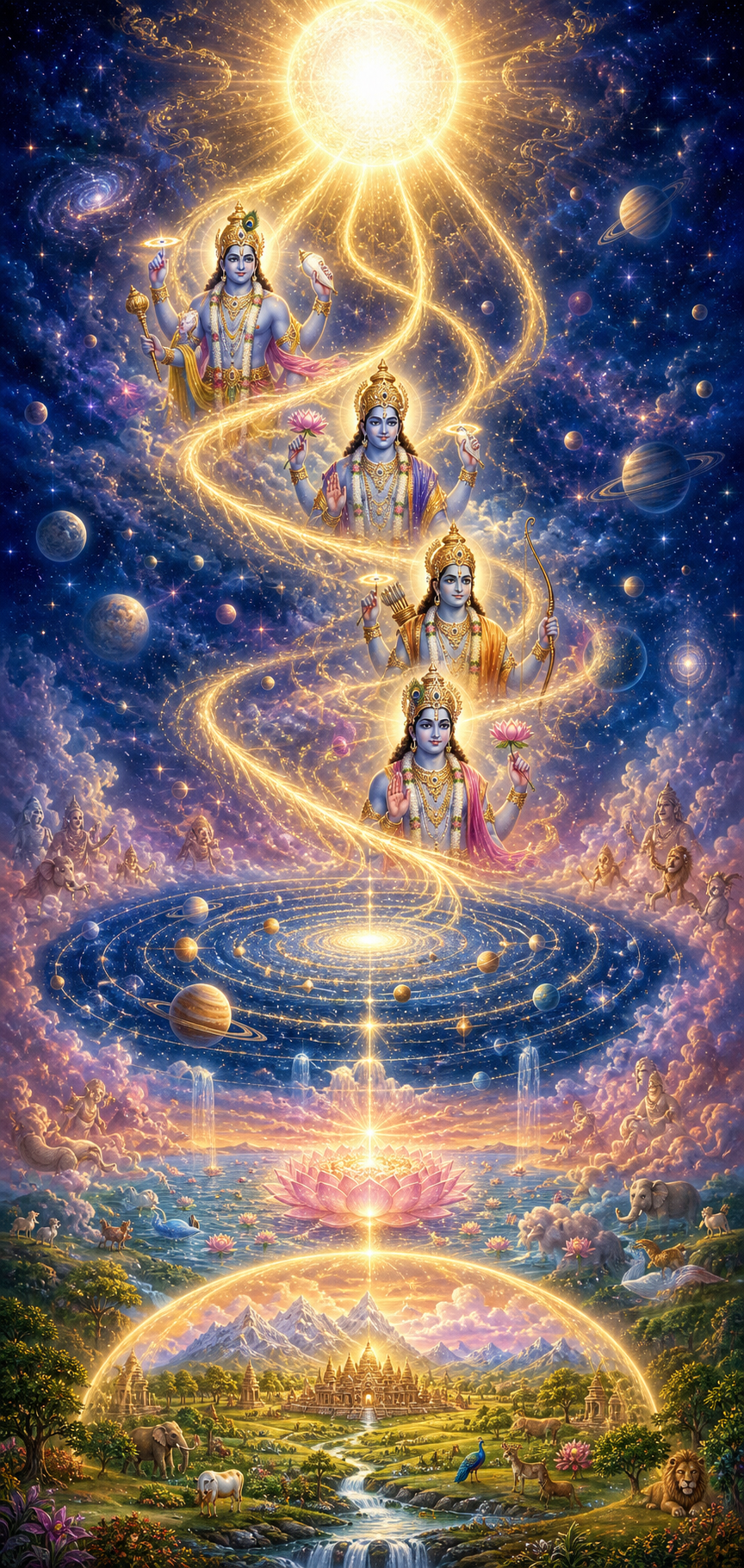
Memorizing four names in isolation invites confusion. Follow their theological movement instead. Vasudeva is the immediate fullness of divine presence. Sankarshana relates that presence to withdrawal and return. Pradyumna expresses creative intention and lordly direction. Aniruddha carries that intention into sustaining regulation and the detailed order of the cosmos.
| Vyuha | Primary emphasis | Question for contemplation |
|---|---|---|
| Vasudeva | The luminous, immediate presence of the Supreme and the plenary ground of the series | What changes when you begin from divine wholeness rather than separation? |
| Sankarshana | Withdrawal, reabsorption and the return of multiplicity toward its source | What must be released, understood or returned rather than grasped indefinitely? |
| Pradyumna | Creative intentionality, purposeful projection and governance | What worthy intention should direct your next action? |
| Aniruddha | Sustaining regulation and the fine-grained maintenance of cosmic order | What requires patient, disciplined preservation after the first impulse has passed? |
A compact memory aid is presence, return, purpose and order. It is not a literal translation of the four names, but it preserves the functional sequence. More importantly, it prevents a common mistake: imagining that the latter manifestations are progressively smaller pieces of Vishnu. The order differentiates divine activity; it does not divide the divine essence.
Do not turn the sequence into a clockwork timeline, either. It is a theological arrangement through which emergence, maintenance and return become intelligible. The functions can be distinguished because the cosmos presents different relations to the divine, while their power remains rooted in one Supreme reality.
Use the six excellences without turning them into four boxes
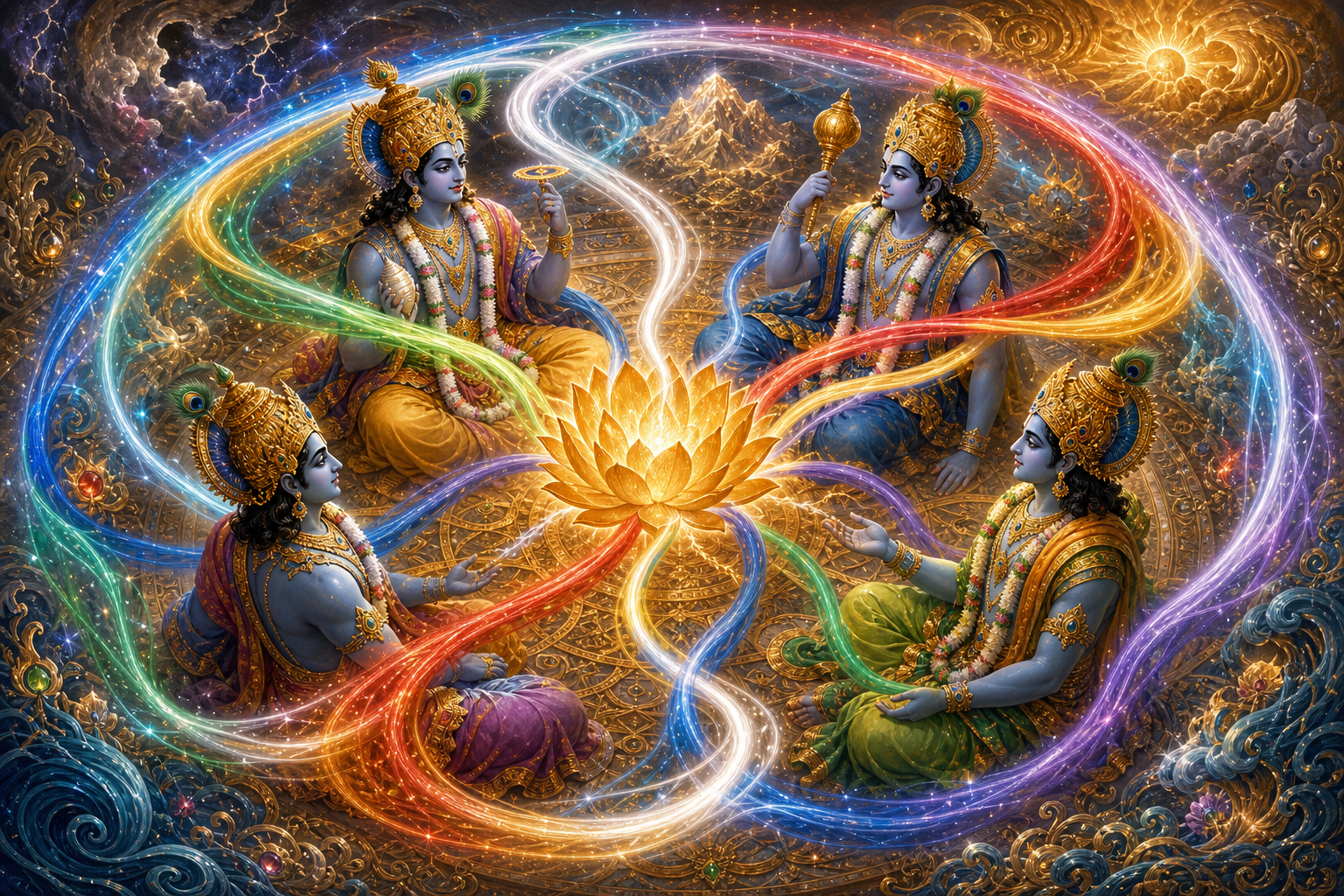
Pancharatra theology often explains the Vyuhas through six excellences, collectively expressing divine fullness:
- Jnana: omniscience or perfect knowledge.
- Aishvarya: sovereign lordship.
- Shakti: divine energy or effective power.
- Bala: strength.
- Virya: valor or unfailing potency.
- Tejas: splendor and radiance.
In one widely transmitted arrangement, Vasudeva possesses all six in plenitude. Sankarshana especially expresses jnana and bala; Pradyumna emphasizes aishvarya and virya; Aniruddha emphasizes shakti and tejas. The word “emphasizes” matters. It does not mean that Sankarshana lacks sovereignty, that Pradyumna lacks knowledge or that Aniruddha lacks strength. The pairings make coordinated functions easier to contemplate; they do not impose limitations upon Vishnu.
You may encounter a different assignment in a class, commentary or temple tradition. That need not signal an error. Particular mappings vary across texts and lineages while the central principle remains stable: differentiated capacities reveal the activity of one undiminished Lord. Before comparing two diagrams, ask which Samhita or Agamic convention each one follows. That question resolves more confusion than trying to force every presentation into a single universal table.
This is also why the Vyuha doctrine answers a serious philosophical problem rather than merely supplying a set of names. If transcendence alone is stressed, Vishnu can seem remote from the world. If manifestation alone is stressed, divine unity can appear to dissolve into plurality. The Vyuhas offer a hierarchy of presence: real distinction of function without competing divine essences.
Read a Caturvyuha image by relationship, not appearance alone
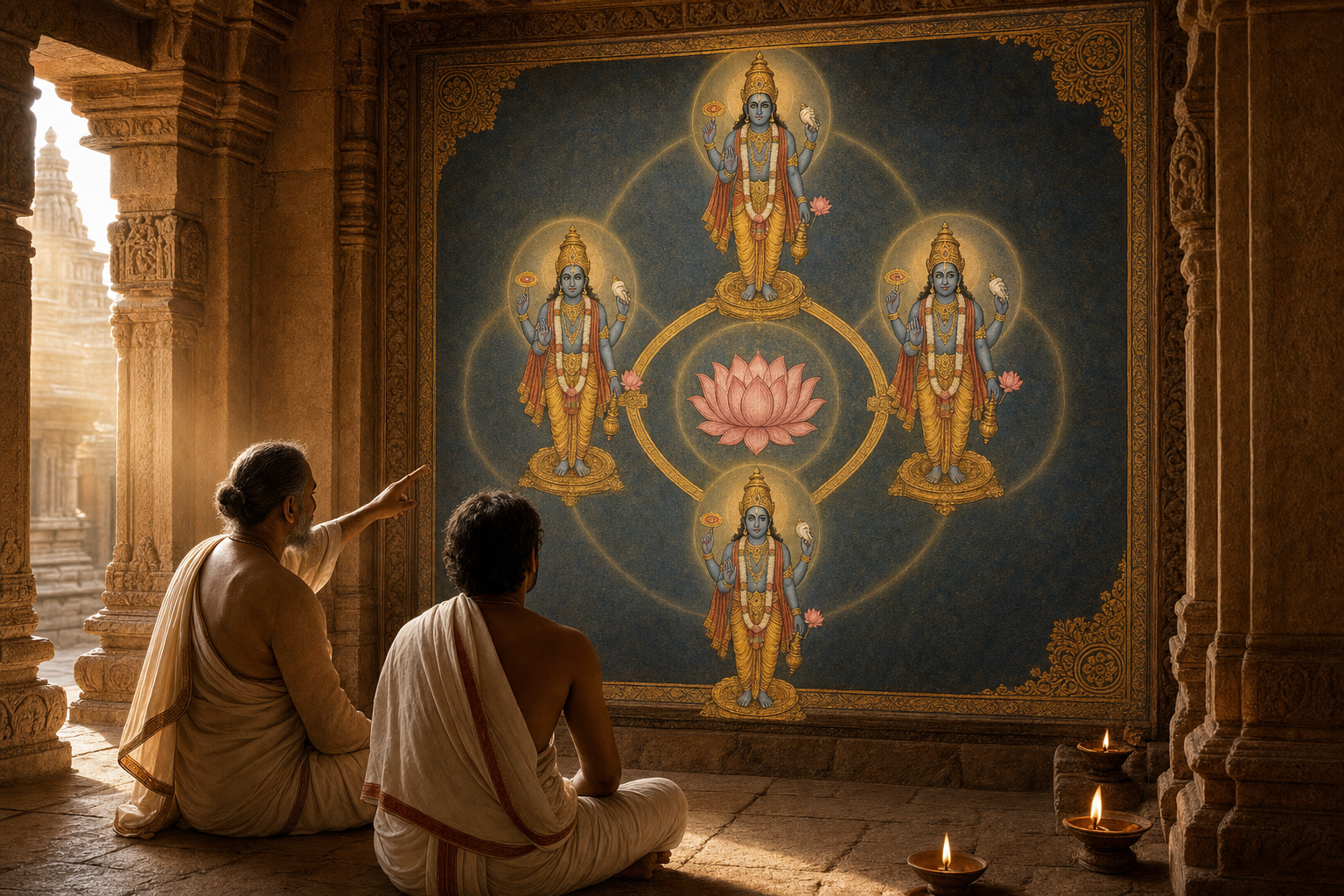
When you stand before a fourfold or multi-aspect Vishnu image, resist the urge to identify it from the number of figures or faces alone. Caturvyuha and related Vaishnava forms developed regional visual languages, so the composition, ritual identity and iconographic program matter together.
- Find the compositional center. Vasudeva commonly receives primacy, while Sankarshana, Pradyumna and Aniruddha appear as associated or flanking presences.
- Notice the total iconographic grammar. Conch, discus, mace and lotus, together with hand gestures and bodily proportions, communicate theological identity within a larger arrangement. A single weapon is rarely enough for a confident reading.
- Ask what relationship the composition presents. A genuine Caturvyuha arrangement should direct your attention from plurality back to a governing unity.
- Confirm the local tradition. Temple liturgy and Agamic convention can tell you more than a resemblance noticed in a photograph.
Systems of tala and angula proportion, prescribed attributes and hasta-mudras in the Murti-khanda and Citra-khanda of the Vishnudharmottara Purana belong to this teaching function. Iconometry is not ornamental bookkeeping. Right proportion, placement and gesture make a metaphysical relationship visible, memorable and suitable for worship.
Do not automatically equate the Caturvyuha with the Vaikuntha Chaturmurti. The multi-faced Vaikuntha form associated with the Kashmir tradition announces Vishnu’s many-aspect sovereignty. The Caturvyuha organizes emanational functions. The two forms share an intuition of one Lord expressed through multiple perfect aspects, but they are not interchangeable labels.
Examples from Mathura and other centers, followed by regional variations, show why you should expect a stable theological idea without demanding one universal silhouette. In a temple, ask the archaka or a knowledgeable guide which form is present and which convention governs it. In a museum, read the provenance and iconographic description before assigning a name. That small discipline turns looking into informed darshana rather than visual guesswork.
The category of arca makes the stakes clearer. A consecrated image is not treated merely as an illustration of an absent deity. Within Vaishnava temple life, iconic presence brings theology into daily worship, festivals and processions. The crafted form therefore has to communicate accurately because devotees meet the doctrine through sight, gesture, mantra and ritual together.
Bring the fourfold teaching into study and sadhana

You do not need to invent four separate devotional routines. Begin with the unity that the doctrine protects. The widely revered twelve-syllabled mantra oṃ namo bhagavate vāsudevāya centers attention on Vasudeva, the plenary presence in whom the complete series is grounded. Mantras associated with the other Vyuhas belong within the particular liturgical and lineage settings that transmit them; follow the practice you have actually received rather than assembling formulas from disconnected charts.
For personal study, use a three-part cycle that joins understanding, seeing and action:
- Study the order. Write Vasudeva, Sankarshana, Pradyumna and Aniruddha in sequence, then place one functional phrase beside each: full presence, return, creative intention and sustaining order.
- Test the map during darshana. At a temple or before a reproduced image, look first for hierarchy and relationship. Only then examine faces, weapons, gestures and accompanying figures.
- Apply one function to the situation before you. Center yourself in Vasudeva when attention is scattered; contemplate Sankarshana when something must be released; turn to Pradyumna when intention needs direction; remember Aniruddha when the difficult work is steady maintenance.
This final step is a contemplative application, not a replacement for lineage-specific ritual. Its value lies in preventing theology from remaining an abstract diagram. Loss can be viewed through the pattern of return, action through purposeful projection, and discipline through sustaining order. Each movement leads back to the same divine center.
At your next encounter with a fourfold Vishnu image, do one thing differently: ask which unity the arrangement is teaching before asking which figure is which. Once that relationship is clear, the names, attributes and ritual roles stop looking like disconnected information and begin to form a coherent path of darshana.
References
