
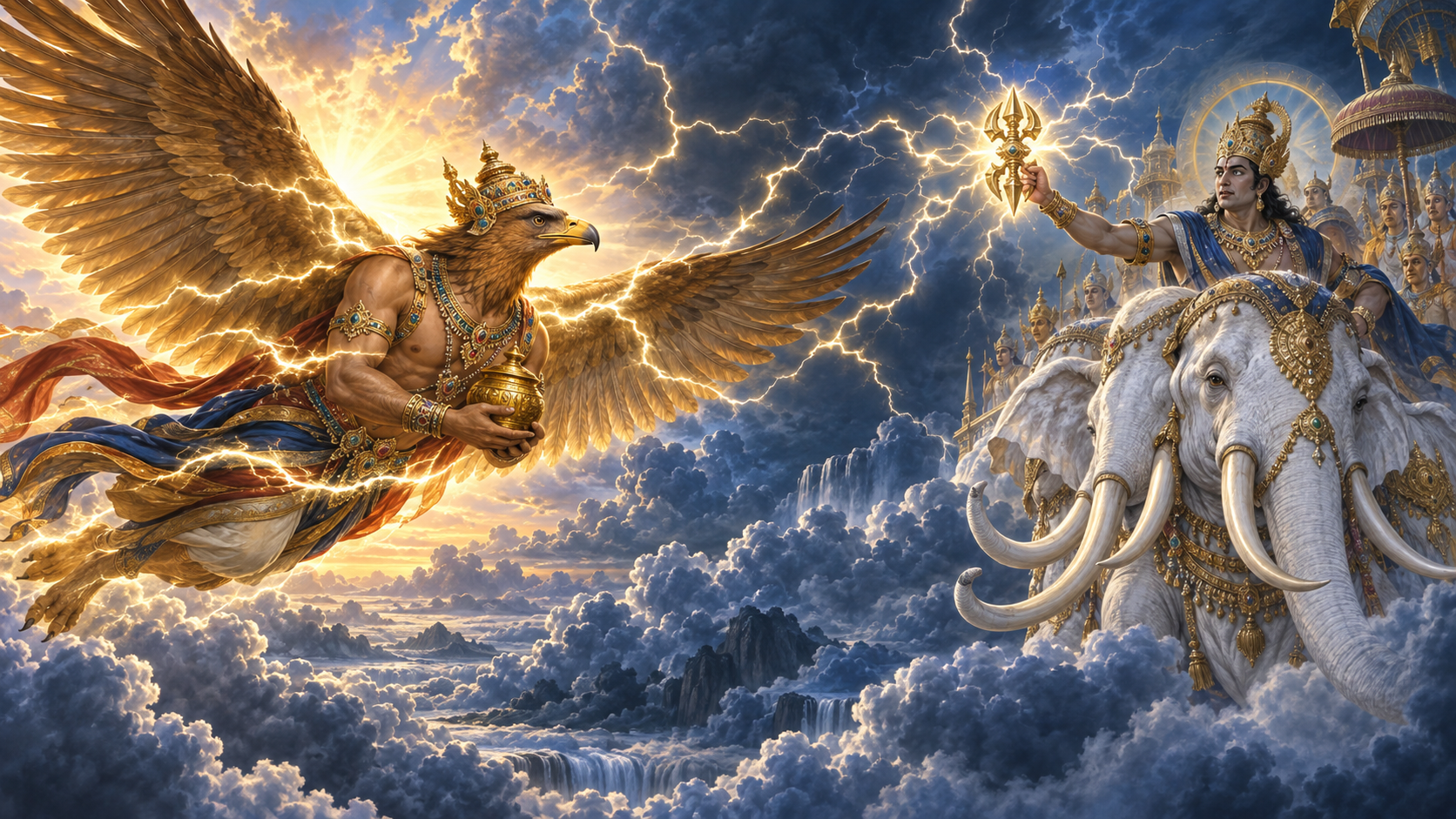
If you read Garuda’s encounter with Indra as a contest over who is the stronger deity, the most useful part of the episode disappears. The real question is sharper: what should you do when you possess enough power to defeat an opponent but still owe respect to something the opponent represents?
Garuda’s answer is neither submission nor triumphalism. He continues his dharmic task, withstands the Vajra, and gives up a single feather. That small gesture explains how strength can remain disciplined after it has proved that it cannot be compelled.
Read the encounter as a test of purpose, not a power ranking
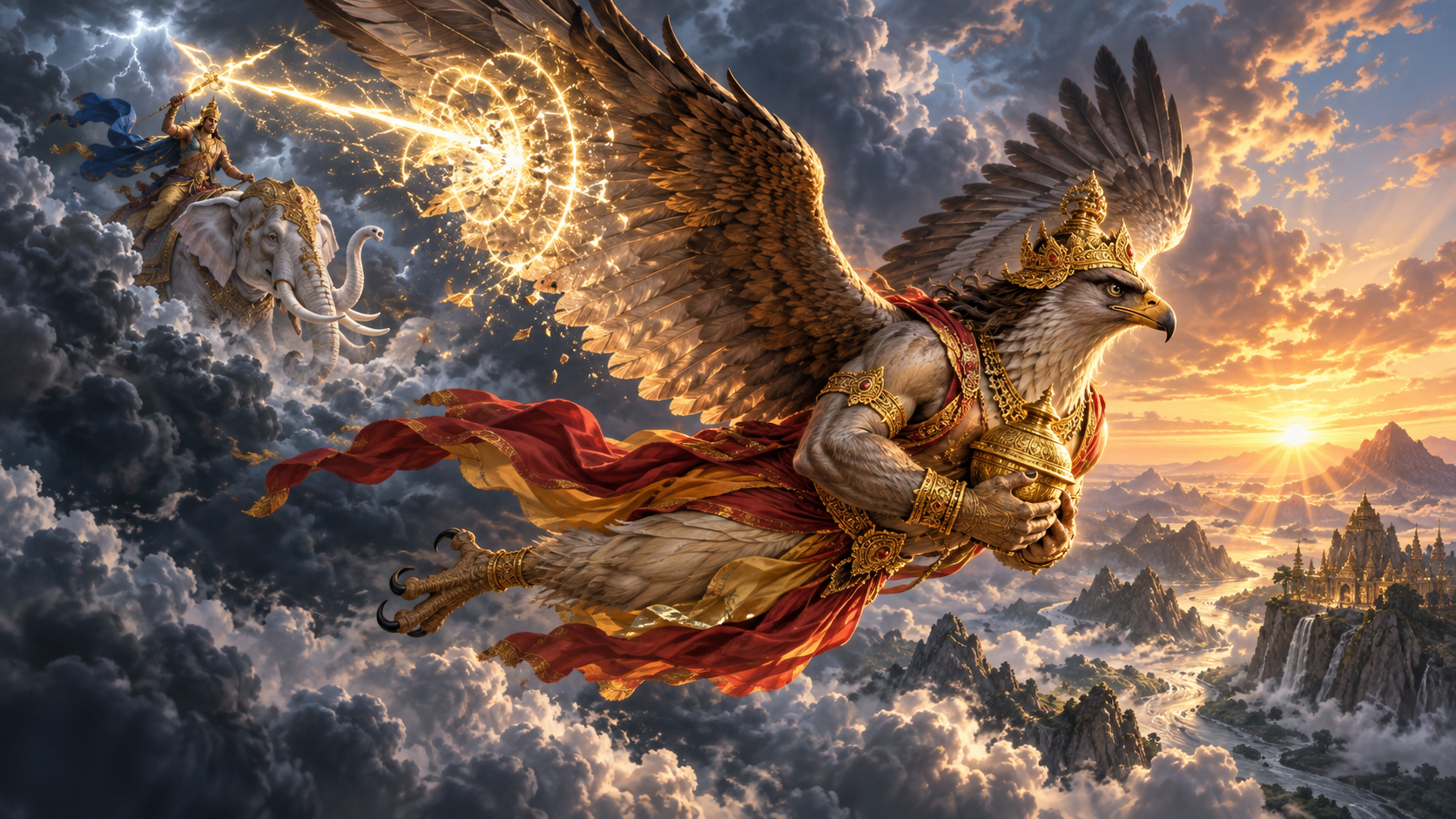
In Chapters 28 and 29 of the Astika Parva in the Adi Parva, Garuda undertakes a formidable journey to obtain Amrita and release his mother Vinata from slavery. He crosses obstacles and defeats the Devas who oppose him. When Indra hurls the Vajra, the weapon does not stop him. Garuda nevertheless allows one feather to fall.
The order of those events matters. Garuda does not set out to humiliate Indra, collect victories, or prove that the king of birds outranks the ruler of the Devas. His strength serves a prior obligation: the freedom of his mother. The conflict occurs because something stands between him and that obligation.
That gives you three layers to notice whenever you revisit the episode:
- Purpose: Garuda’s goal exists before the confrontation. His mission is liberation, not conquest.
- Power: He uses extraordinary strength because the journey places extraordinary resistance in his way.
- Restraint: Once the Vajra proves unable to stop him, he does not turn his superiority into contempt.
This sequence keeps the moral centre of the narrative in view. Strength is not self-justifying. It acquires direction from the duty it serves, and it acquires dignity from the restraint that governs it.
Why the Vajra’s failure does not make Indra powerless
The easiest misreading is to treat the failed strike as a verdict that Indra or the Vajra is insignificant. That conclusion would make Garuda’s feather meaningless. There would be no humility in honouring an object that deserved no honour.
The scene holds two truths together. The Vajra possesses legitimate majesty, yet it cannot subdue Garuda in this encounter. Garuda recognizes the first truth without pretending that the second is false. He neither submits to the weapon nor mocks it.
This is an important Dharmic distinction. A divine office, title, or instrument may carry real authority without carrying unlimited authority. No bearer of power becomes identical with Dharma itself. When authority meets a being, purpose, or obligation beyond its present capacity to command, its limit becomes visible.
That limit does not erase the authority’s proper place. One unsuccessful use of the Vajra does not turn every exercise of Indra’s power into a fraud. It shows that even a mighty instrument cannot settle every question merely by being invoked.
You can apply this distinction whenever someone relies on position instead of judgment. Ask three questions before you either obey automatically or rebel automatically:
- Does this person or institution have legitimate authority in this matter?
- Is that authority being used for the purpose for which it exists?
- Would respecting the office require surrendering a duty that the office cannot rightfully cancel?
A title may deserve recognition while a particular demand deserves refusal. Garuda’s response gives you a way to preserve both conclusions.
The episode should not be turned into a promise that anyone with a righteous intention becomes invulnerable. Garuda is an exceptional being, the mighty Suparna and the vahana of Bhagavan Vishnu. The practical teaching is about the governance of power, not a formula for guaranteed worldly victory.
What the single feather teaches about genuine humility

Garuda’s humility appears only after his strength is unmistakable. That is why the feather matters. It is not the tribute of someone who has been broken. It is a voluntary acknowledgment from someone who could have continued without making it.
Humility here does not mean denying your capacity, shrinking from your responsibility, or calling weakness a virtue. It means seeing your strength accurately and refusing to use more of it than Dharma requires. Garuda does not pretend the Vajra defeated him. He offers honour without falsifying what happened.
That balance is difficult because most conflicts push you toward one of two errors. You may surrender a necessary duty to avoid appearing proud. Or you may treat every sign of respect as weakness and insist that victory must include the other person’s humiliation. The feather refuses both errors.
When you hold the stronger position in a family disagreement, workplace decision, or community dispute, look for your equivalent of the single feather. It should be a truthful sign of regard that does not betray the purpose you are responsible for carrying out. You might acknowledge the other person’s legitimate concern, preserve an established courtesy, credit what they contributed, or accept a limited inconvenience that leaves the essential duty intact.
A useful act of respect has three marks:
- It is truthful. You do not claim that the other side was right when it was not.
- It is proportionate. You yield something limited rather than abandoning the obligation at the centre of the dispute.
- It lowers humiliation, not accountability. The gesture preserves dignity while leaving the facts and consequences visible.
Be careful not to turn this into polished condescension. A symbolic concession offered merely to advertise your superiority is not humility. Garuda’s feather has force because the gesture acknowledges value beyond his ego. Your gesture must do the same.
A five-step Garuda test before you exercise power

The episode becomes practical when you use it before acting, not merely after winning. Run through these five steps whenever you have the power to force an outcome.
- Name your Vinata. State the person, promise, or duty you are responsible for protecting. If you can name only your status, pride, or desire to prevail, you have not yet identified a dharmic purpose.
- Name your Amrita. Define the exact outcome required to fulfil that duty. Keep it narrower than total victory. Garuda needs to complete his mission; he does not need every opposing being to be degraded.
- Identify the Vajra. Notice the power being used against you: a title, rule, threat, reputation, institutional procedure, or social pressure. Decide what legitimate value it represents before deciding whether its present use should control you.
- Choose one feather. Find the smallest sincere concession that honours what is legitimate without surrendering the central duty. If no concession can be made truthfully, do not invent one for appearances.
- Stop when the duty is fulfilled. Once the necessary objective is secure, do not enlarge the conflict to punish opposition or display superiority. Power becomes dangerous when it continues after its purpose has ended.
The first step is the safeguard against self-deception. A strong personal desire does not become Dharma merely because you describe it in sacred language. Test your claimed duty against truthfulness, existing responsibilities, promises you have made, and the harm your action will impose. If your objective requires domination for its own sake, Garuda’s example cannot be used to sanctify it.
The fourth step is equally demanding. Your feather must cost enough to be real, but not so much that it defeats the obligation you began with. That is the difference between humility and capitulation.
Key takeaways for carrying strength without arrogance
- Garuda’s mission begins with a duty to free Vinata, so his power remains subordinate to a purpose beyond personal glory.
- The Vajra can retain majesty even when it fails to stop Garuda; legitimate authority and unlimited authority are not the same thing.
- The single feather is a chosen act of honour, not evidence of forced submission.
- Humility does not require you to deny what is true about your strength or abandon a rightful obligation.
- A dharmic victory ends when the duty is fulfilled. It does not seek an extra reward in the opponent’s humiliation.
The next time a conflict tempts you to reach immediately for your own Vajra, write two sentences first: My duty is… and The recognition I owe is… If you cannot complete both honestly, pause. If you can, protect the duty, offer the feather, and leave the unnecessary victory behind.
References

Leave a Reply
You must be logged in to post a comment.