
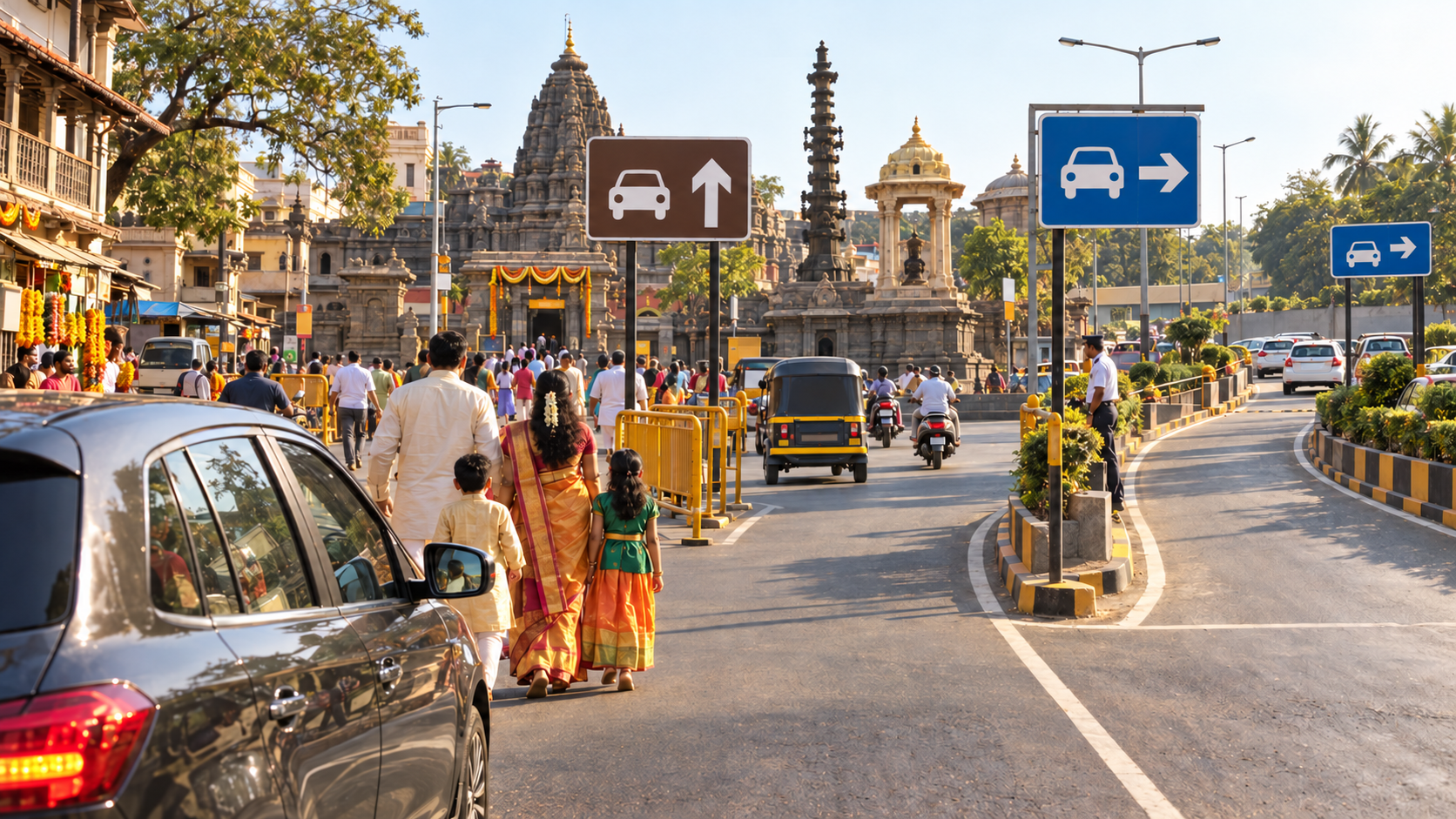
If you are driving to Shri Mahalakshmidevi Temple in Kolhapur during Navratri, finding the temple is only part of the journey. You also need to know which parking area to use, which approach leads to it, and where to turn before you enter the immediate temple area.
A parking facility that an unfamiliar visitor cannot locate is not meaningfully available to that visitor. This is why the call for proper signboards matters. Until their installation and current status are confirmed, plan your arrival around verified parking directions rather than assuming that a navigation app or a temple-location pin will take you to the right place.
The demand concerns wayfinding, not merely parking space
The Maharashtra Mandir Mahasangh has submitted a representation to the Kolhapur district administration seeking parking signboards for out-of-town devotees visiting the temple during Navratri. The specific concern is guidance: a devotee arriving from outside Kolhapur should be able to identify the appropriate parking direction without depending on local knowledge.
That distinction is important. A demand for signboards does not tell you how much parking is available, which parking areas will operate on a particular day, or whether any road restrictions will apply when you visit. It also does not establish that the requested signs have already been approved or installed. Treat the representation as evidence of an identified visitor problem, not as a completed traffic advisory.
Local drivers may know a familiar turn, road, or landmark without consciously thinking about it. An out-of-town devotee does not have that advantage. Useful wayfinding must therefore provide the necessary information before each decision point. A board placed after the required turn, or one that simply says parking without identifying a direction, does not solve the problem.
How to plan your visit while signage remains unconfirmed
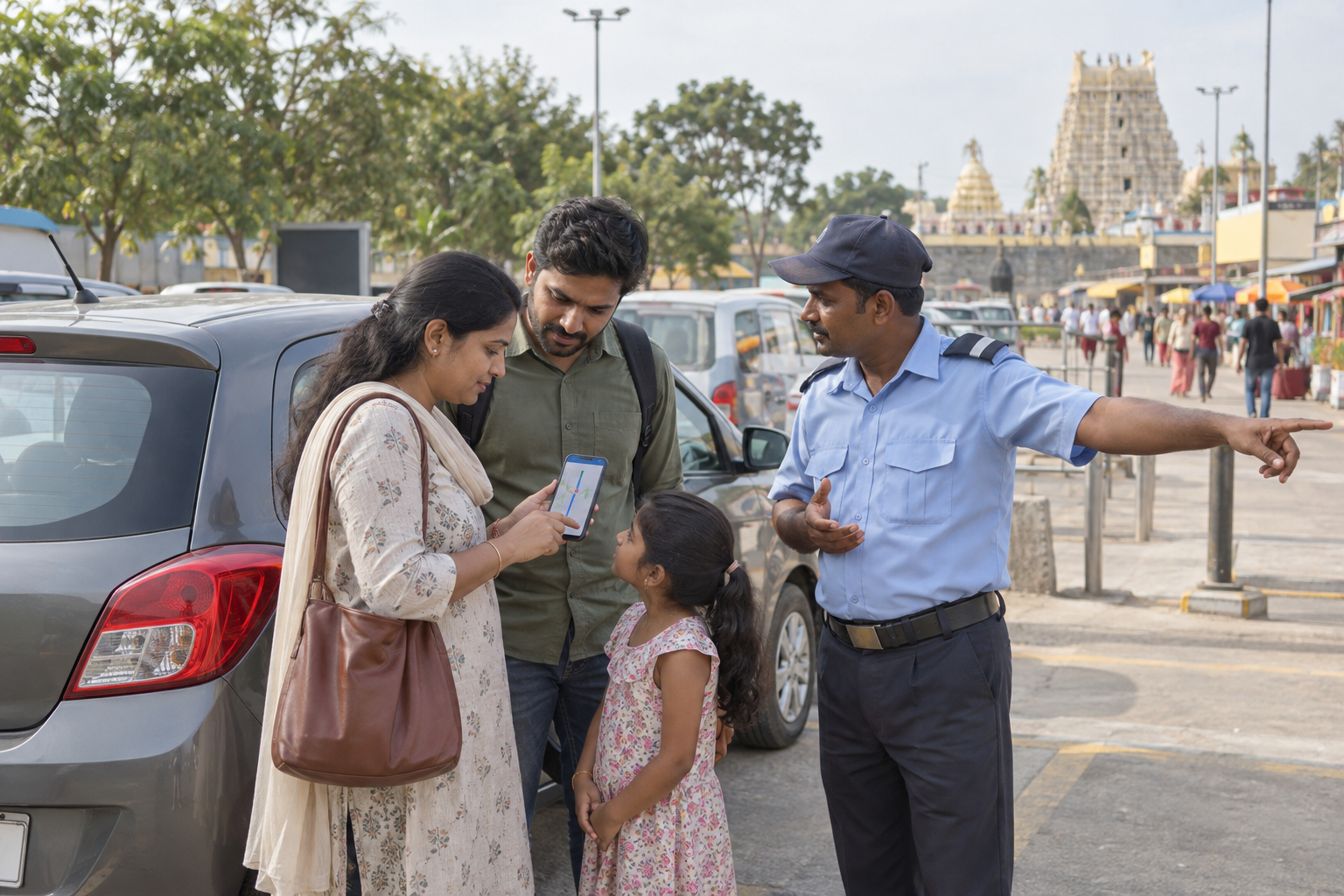
Do not begin the final part of your drive with only the temple address entered in your phone. A temple pin may guide you toward the shrine without identifying the parking approach that authorities expect drivers to use. Verify the last part of the route separately.
- Check close to your travel date. Look for current instructions from the temple administration, district administration, or local traffic authorities. Festival arrangements can be operational details rather than permanent rules.
- Ask for a named parking destination. General advice to park near the temple is not enough. You need the name or identifiable location of the parking area and the approach road leading to it.
- Navigate to the verified parking point. Once you have confirmed the destination, use that location rather than the temple entrance as the final pin in your navigation app.
- Save the directions before setting out. Keep the parking name and route available as a screenshot or written note. This also gives a passenger something precise to compare with on-road instructions.
- Confirm the arrangement at the first official traffic-control point. If police personnel, authorised volunteers, temporary boards, or barricades direct vehicles differently, follow the current on-ground arrangement.
- Keep drop-off and parking questions separate. A place where passengers may be dropped is not necessarily a place where a vehicle may remain. If someone in your group needs assistance, ask about the permitted drop-off arrangement in advance.
If the information you find is incomplete, leave enough flexibility to follow an alternative direction safely. Do not stop in a moving traffic lane to study a map or sign. The passenger can check directions, or the driver can pull over only where stopping is permitted.
What an effective parking sign system must communicate

One board beside a parking entrance is not a wayfinding system. By that stage, the visitor has already chosen an approach. Effective signage forms an unbroken chain from the routes used by arriving devotees to the parking entrance and, ideally, from the parking area toward the pedestrian route to the temple.
- Advance notice: The first sign should appear before a driver must choose a road or lane, not at or after the turn.
- A consistent parking name: Every sign and public notice should use the same name for the same parking area. Changing labels forces visitors to guess whether two names refer to one place or different places.
- Clear arrows: An arrow must correspond unmistakably to the required movement. Decorative wording cannot compensate for an ambiguous direction.
- A recognisable parking symbol: A standard parking symbol helps a driver understand the board quickly, including when the driver is not fluent in every language used on it.
- Distinction between parking and drop-off: Signs should not send vehicles seeking longer parking into a passenger drop-off point, or vice versa.
- Confirmation after each important turn: A repeat sign reassures the driver that the route remains correct. Without confirmation, one missed or obscured board can break the entire chain.
- Current status: If a parking location is closed, full, or replaced by another arrangement, visitors need that information before they reach its entrance.
- A pedestrian continuation: After parking, devotees should be able to identify the walking direction to the temple and the route back to the same parking area.
The wording should be short enough to read while approaching at a safe speed. Marathi can serve local users, while an immediately recognisable symbol, legible arrows, and concise supplementary wording can make the directions usable for devotees arriving from elsewhere. The objective is not to place the largest possible amount of text on a board. It is to let an unfamiliar driver make one correct decision at a time.
How devotees can turn the demand into accountable action
If you live in Kolhapur, belong to a temple organisation, or want to support the demand, ask for an operational answer rather than a general assurance. The most useful questions are concrete:
- Which parking locations are designated for devotees during Navratri?
- From which approach roads will drivers be directed to each location?
- At which junctions or decision points will advance boards be placed?
- How will signs distinguish parking, drop-off points, and restricted approaches?
- Who will update directions if a parking area becomes unavailable?
- When will the complete route be checked from the perspective of an out-of-town driver?
Installation alone is not a sufficient test. A practical field check should begin outside the immediate temple area and follow every board in sequence. Ask someone unfamiliar with the route to trace it without verbal hints. If that person must guess at a junction, the system has a gap even if every planned board is physically present.
When reporting a problem, identify the direction of travel, the exact junction or nearby landmark, and the missing or confusing instruction. A precise report such as a missing left-turn indication before a named junction is easier to investigate than a general complaint that the signs are poor. Photographs can help when taken by a passenger or a safely stationary observer, never by someone actively driving.
Clear directions are a modest civic provision, but they express something larger: respect for devotees should be visible in the practical conditions of their arrival. The test is not how many boards are announced. It is whether a family unfamiliar with Kolhapur can reach the designated parking area without uncertainty or an unsafe last-minute turn.
Key takeaways
- The reported action is a request for parking signboards, not confirmation that a complete sign system has been installed.
- Before travelling, verify a specific parking destination and its approach instead of navigating only to the temple address.
- Effective wayfinding begins before the first important turn and continues through the parking entrance and pedestrian route.
- Devotees and community organisations should ask where signs will stand, what each will communicate, and how the route will be tested.
Before you leave for darshan, obtain two concrete details: the currently designated parking location and the route by which vehicles should approach it. If no current notice answers both questions, direct those questions to the relevant temple, district, or traffic channel. The real measure of progress will be whether an out-of-town devotee can make the correct turn without guesswork.
References

Leave a Reply
You must be logged in to post a comment.