,

Ganesha Theology and the Conquest of Inner Obstacles

7 min read
Ganesha meditates on a lotus pedestal while eight dark knotted forms dissolve in the golden light surrounding him.

Ganesha is commonly invoked at beginnings and approached as the remover of obstacles. Yet two Ganesha-centered texts place the most consequential obstacles inside perception itself: jealousy, pride, delusion, greed, anger, compulsive desire, possessiveness and egoism.

Read together, the incarnation narratives discussed in the Mudgala Purana article and the metaphysical teaching examined through the Ganapati Atharvashirsha reveal a coherent theology. Ganesha represents both the reality larger than the individual and the discerning intelligence through which self-centered habits can lose their authority.

The obstacle remover as the ground of experience

Ganesha sits within a luminous cosmic landscape connected by light to a person holding a mirror in a temple courtyard.

The article Ganesha as the Infinite reports that the Ganapati Atharvashirsha addresses Ganapati as Brahman, the enduring Self and the directly perceptible principle of truth. It identifies him with the creation, preservation and dissolution of the cosmos, the five elements and a range of divine powers. It also describes him as beyond the three gunas, the waking, dreaming and deep-sleep states, the three bodies and the divisions of time.

This presentation holds transcendence and immanence together. Ganesha is not confined to a visible icon, but the icon is not discarded: perceptible form becomes an entrance into contemplation of the underlying principle. The article therefore distinguishes ordinary iconographic form from the wider ontological meaning of form in the Atharvashirsha.

The Mudgala Purana article approaches the same theological breadth through narrative. It reports a scholarly interpretation in which the eight incarnations form a metaphysical sequence, with the later forms related to Shakti, the illuminating principle represented by Surya, Vishnu’s preserving function and Shiva’s dissolving function. This resembles the Atharvashirsha’s inclusive method: diverse divine functions can be gathered into a Ganesha-centered vision without erasing the distinctions maintained by different traditions.

Together, these perspectives change what removal can mean. An obstacle is not always an alien object blocking an otherwise sound intention. It can be a distortion in the person who intends, judges and acts. Removal may consequently require clearer perception or the abandonment of an unwise aim, rather than an easier route toward whatever the individual initially wanted.

Eight demons map the expansion of self-centeredness

Eight shadowy demon figures spiral outward around a small radiant Ganesha, carrying symbols of envy, pride, delusion, greed, anger, desire, possessiveness and egoism.

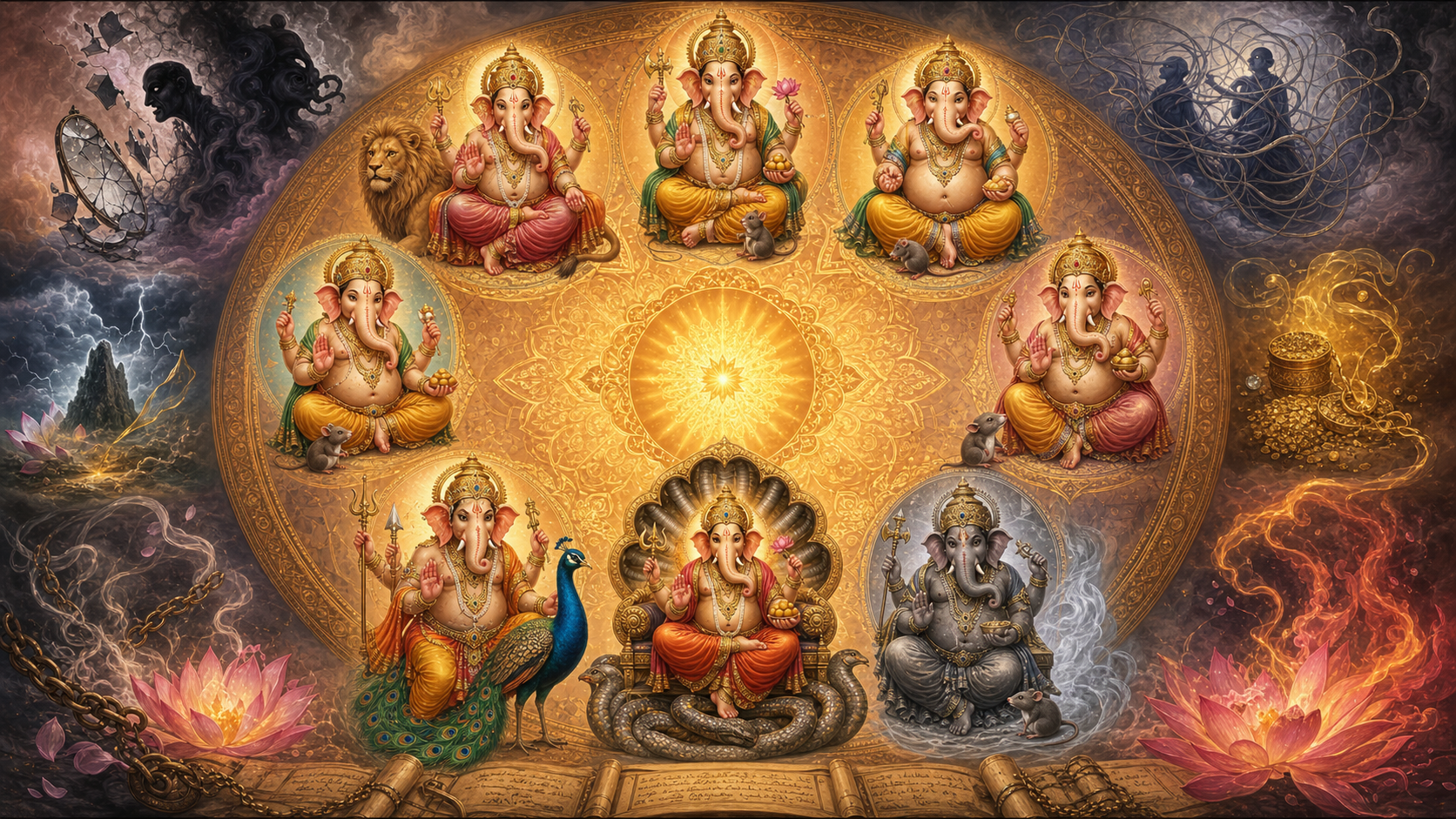
The eight forms belong specifically to the Mudgala Purana, which the source describes as a Ganesha-centered Upapurana associated with Ganapatya traditions. They are not the eight temples of Maharashtra’s Ashtavinayak circuit or the four yuga-related incarnations reported in the Ganesha Purana. The source also cautions that the Mudgala Purana is layered, lacks a universally accepted critical edition and circulates with variations in names, narratives and iconography.

Within that textual caution, the shared pattern is remarkably systematic. Six familiar destabilizing passions are joined by possessive mineness and identity-forming egoism, producing an extended account of how experience becomes organized around the self.

Ganesha formInner obstacleQuestion raised by the pairing
VakratundaJealousy or matsaraDoes another person’s excellence feel like a personal loss?
EkadantaIntoxicated pride or madaHas an advantage become a claim to superiority?
MahodaraDelusion or mohaIs a fragment, impression or immediate feeling being mistaken for the whole?
Gajanana or GajavaktraGreed or lobhaCan acquisition ever reach a meaningful sense of sufficiency?
LambodaraAnger or krodhaIs reaction overruling proportion and discernment?
VikataUncontrolled desire or kamaIs wanting being treated as an unquestionable command?
VighnarajaPossessive mineness or mamaHas care or responsibility hardened into ownership?
DhumravarnaEgoism or ahamkaraIs identity claiming the central place in every action and outcome?

The sequence is useful because the demons are not merely isolated bad feelings. Each represents a disposition that has gained enough influence to govern interpretation and conduct. Jealousy converts comparison into injury; pride makes an advantage intoxicating; delusion mistakes a partial view for reality; and possessiveness converts relationship into a claim of ownership. Egoism supplies the organizing center that can appropriate all the others.

Conquest means restored proportion, not emotional suppression

Ganesha steadies a balanced scale holding symbols of emotion, desire, discernment and generosity as stormy water becomes calm.

Several incarnation episodes reported in the Mudgala Purana article culminate in recognition and surrender rather than annihilation alone. Matsarasura, associated with jealousy, yields after his power is broken. Madasura’s confidence collapses before Ekadanta, and his surrender is accepted. Mohasura is advised to submit to Mahodara and becomes a devotee. These endings make correction and restored order as important as victory.

This narrative pattern discourages a simplistic war against emotion. Desire can direct effort, attachment can accompany commitment, and anger can arise in response to a perceived wrong. The theological problem begins when any such movement claims sovereignty, bends perception around itself and displaces discernment. Conquest is therefore better understood as the loss of a passion’s governing authority.

The forms of Ganesha supply a contemplative grammar for this change. The source interprets Vakratunda’s curved trunk as adaptive wisdom that can meet difference without resentment. Ekadanta’s single tusk suggests centered, one-pointed understanding when success invites self-inflation. Mahodara’s great belly represents the capacity to contain and digest complexity before reaching judgment. Form and ethical meaning reinforce one another.

The Atharvashirsha article deepens this reading by joining devotion to consciousness, knowledge and discriminative understanding. If wisdom belongs to the meaning of Ganesha, divine help need not bypass human judgment. It may operate precisely through the recovery of attention, proportion and responsible choice.

Key takeaways for confronting an inner obstacle

The two textual perspectives support the following framework for reflection. It is an interpretive synthesis, not a ritual sequence claimed by either source.

  • Name the governing disposition. Identifying jealousy, pride, delusion or possessiveness is more precise than treating every difficulty as an external obstruction.
  • Examine the perception beneath the reaction. The central question is not only what happened, but what the agitated mind has made the event mean.
  • Restore the wider field. Ganesha’s metaphysical fullness and Mahodara’s capacity for containment both challenge the habit of treating one feeling or advantage as the whole truth.
  • Use form or sound to gather attention. An image, invocation or measured recitation can provide a stable focus, but it does not substitute for discernment and action.
  • Choose the next step by dharma rather than self-protection. A fitting response should reduce the inner disposition’s authority instead of merely securing its preferred outcome.

Sound provides a notable bridge between the sources. The Mudgala Purana article reports the seed sound Gam within the Vakratunda narrative, while the Atharvashirsha article discusses the sonic construction of Ganapati’s seed syllable and the widely used formula Om Gam Ganapataye Namah. The latter also presents a Gayatri-style invocation that connects contemplation of Ganesha with inspired understanding.

The Atharvashirsha discussion carefully distinguishes traditional claims about mantra’s sacred efficacy from experimentally established outcomes. Its practical observation is more modest: measured recitation can structure attention, mark entry into prayer and return a distracted mind to a meaningful focus. The ethical work remains inseparable from that concentration.

A more demanding meaning of an auspicious beginning

Invoking Ganesha at a threshold need not imply that a worthy beginning will be frictionless. It can instead mark a commitment to discover whether the projected obstacle lies in circumstances, in a poorly chosen aim or in the consciousness interpreting both. Under this reading, auspiciousness includes the willingness to be corrected.

Further study can preserve the distinct settings of the Mudgala Purana and the Ganapati Atharvashirsha while allowing each to clarify the other. Their combined challenge is forward-looking and practical: approach the next threshold with devotion, but also with enough honesty to ask which inner ruler must surrender before a sound beginning becomes possible.

References

FAQs

How do the Mudgala Purana and Ganapati Atharvashirsha deepen the meaning of Ganesha as remover of obstacles?

Read together, the narratives and metaphysical teaching place major obstacles within perception and self-centered habit, not only in external circumstances. Ganesha represents both a reality larger than the individual and the discerning intelligence through which those habits can lose authority.

Which Ganesha forms are paired with the eight inner obstacles?

The article pairs Vakratunda with jealousy, Ekadanta with intoxicated pride, Mahodara with delusion, Gajanana or Gajavaktra with greed, Lambodara with anger, Vikata with uncontrolled desire, Vighnaraja with possessive mineness and Dhumravarna with egoism.

Are the Mudgala Purana's eight Ganesha forms the same as the Ashtavinayak?

No. The article distinguishes the Mudgala Purana’s eight forms from Maharashtra’s eight Ashtavinayak temples and from the four yuga-related incarnations reported in the Ganesha Purana.

Does conquering an inner obstacle mean suppressing emotion?

No. The article treats conquest as restoring proportion and discernment so that desire, attachment, anger or another passion no longer governs perception and conduct.

What framework does the article offer for confronting an inner obstacle?

Name the governing disposition, examine the perception beneath the reaction, restore the wider field, use form or sound to gather attention and choose the next step by dharma rather than self-protection. The article presents this as an interpretive framework for reflection, not a ritual sequence claimed by either text.

What role can mantra or measured recitation play in this practice?

The article says measured recitation can structure attention, mark entry into prayer and return a distracted mind to a meaningful focus. It does not substitute for discernment, responsible action or the ethical work of reducing a passion’s authority.

What does an auspicious beginning mean in this interpretation of Ganesha?

An auspicious beginning need not be frictionless. It can involve asking whether an obstacle lies in circumstances, in a poorly chosen aim or in the consciousness interpreting both, with a willingness to be corrected.

Leave a Reply