
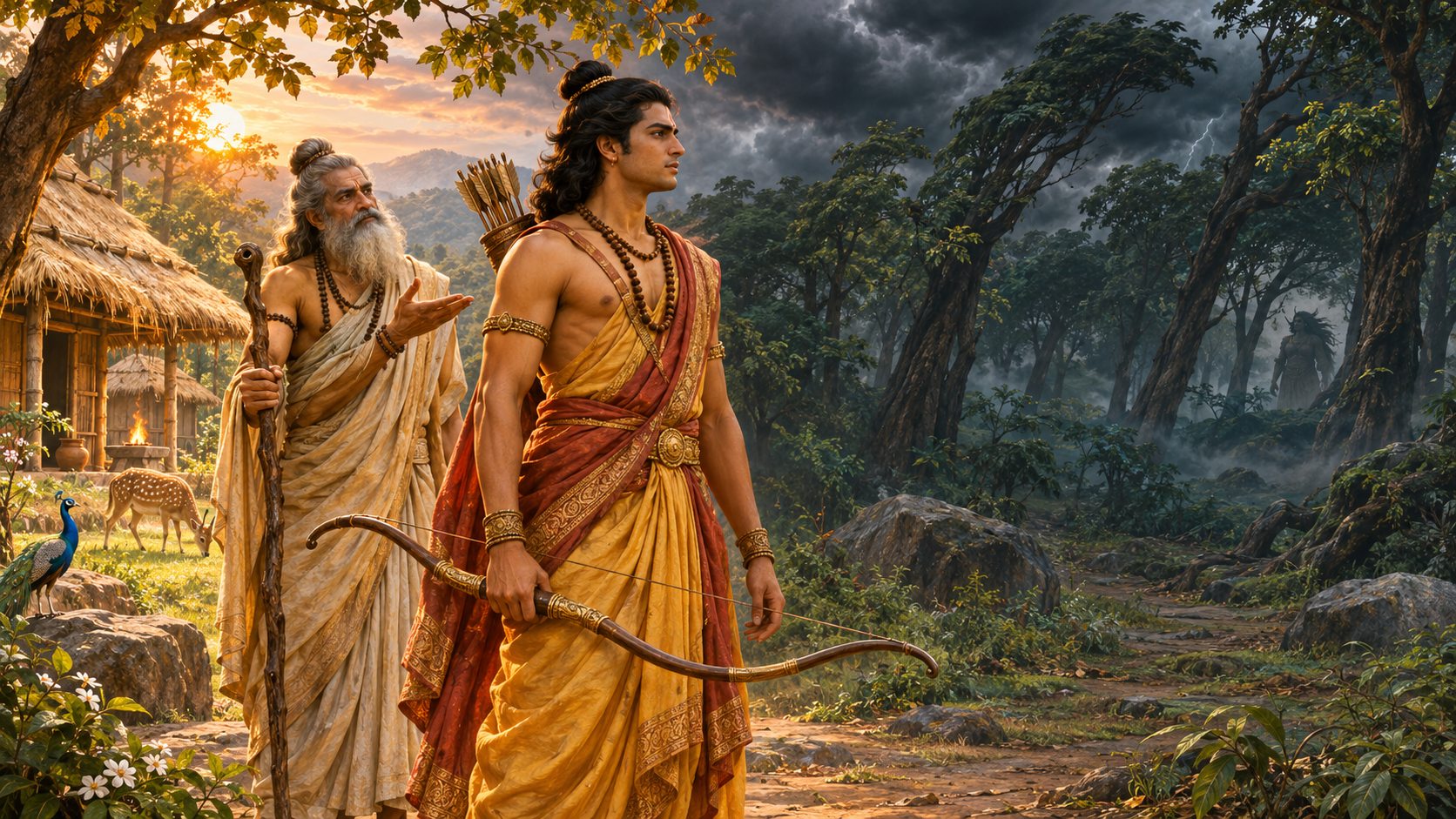
You may be asking a difficult question: does dharma require nonviolence under every condition, or can refusing to stop grave harm become a failure of dharma? The Ramayana’s encounter between Rama and Tataka offers a disciplined way to think about that tension. It neither glorifies force nor treats moral restraint as an excuse for paralysis.
If you are trying to judge whether a use of force can honestly be called dharmic, look beyond who won and which side used sacred language. Ask what was protected, how serious the danger was, who had the duty to act, and whether the action remained bounded by that protective purpose.
Rama’s hesitation is part of dharmic judgment
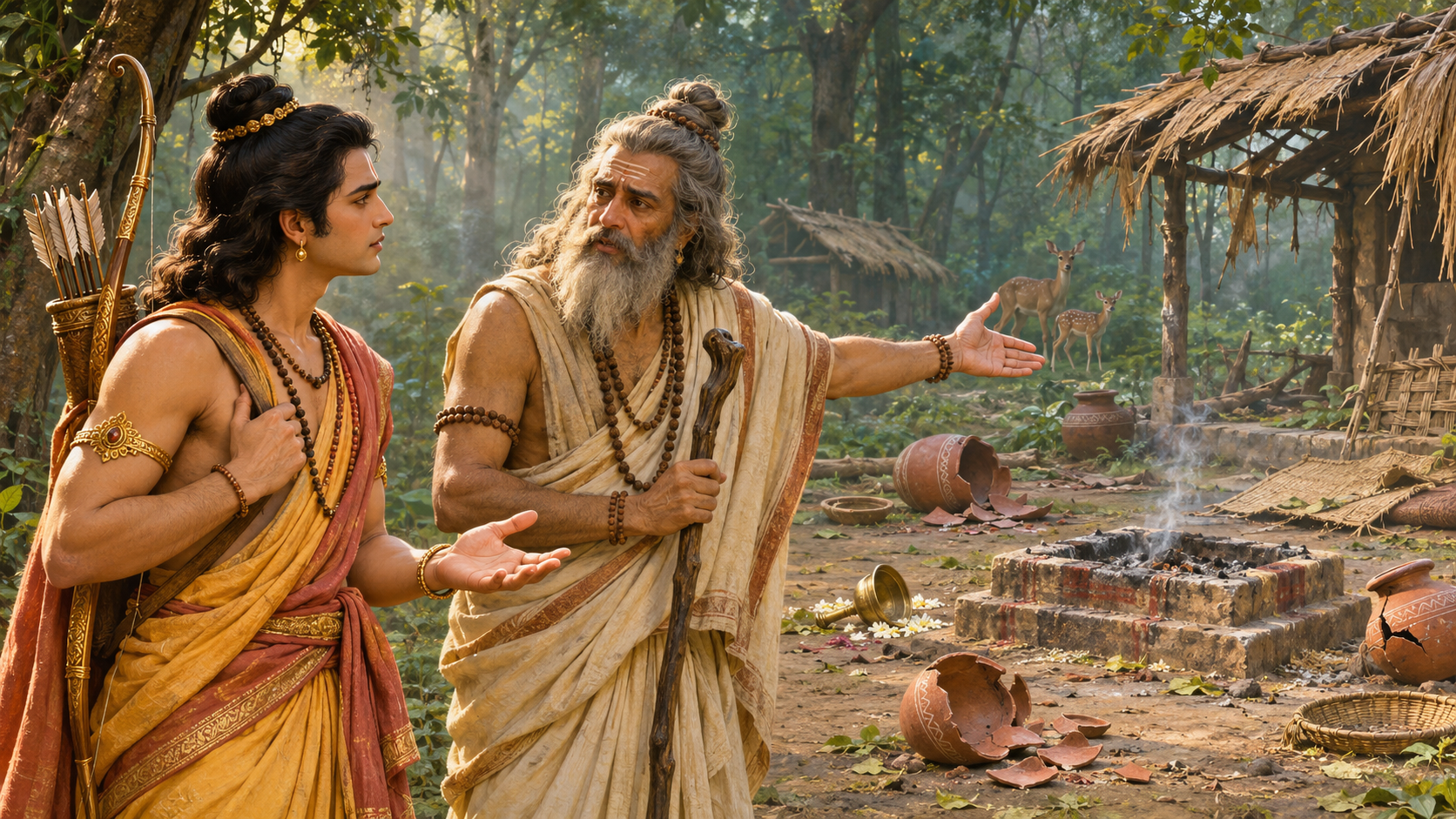
In Balakanda, chapter 24 of the Valmiki Ramayana, Vishwamitra takes the young Rama and Lakshmana into the forest to protect his yajna. When they encounter Tataka, Rama hesitates to kill her because she is a woman. Vishwamitra answers his doubt by recalling earlier cases, including the precedent of Indra and Manthara, in which a woman had become a threat to the world.
Rama’s hesitation matters. He does not meet a morally difficult command with eagerness. A rule against harming women has weight for him, and that weight interrupts action. The pause shows that restraint is not cowardice; it is evidence that force has not become ordinary, pleasurable, or morally invisible.
Yet Vishwamitra does not let a general rule become an absolute immunity for someone who presents grave danger. The moral question therefore moves from category to conduct: not simply, “Who is this person?” but also, “What is this person doing, what is at risk, and what duty arises from that danger?”
This gives you the first practical principle: hesitation should begin moral examination, not end it. Acting without hesitation can reveal cruelty or pride. Refusing to act after the danger and duty have become clear can abandon those who depend on protection. Dharmic judgment has to resist both failures.
Force must remain subordinate to a protective duty
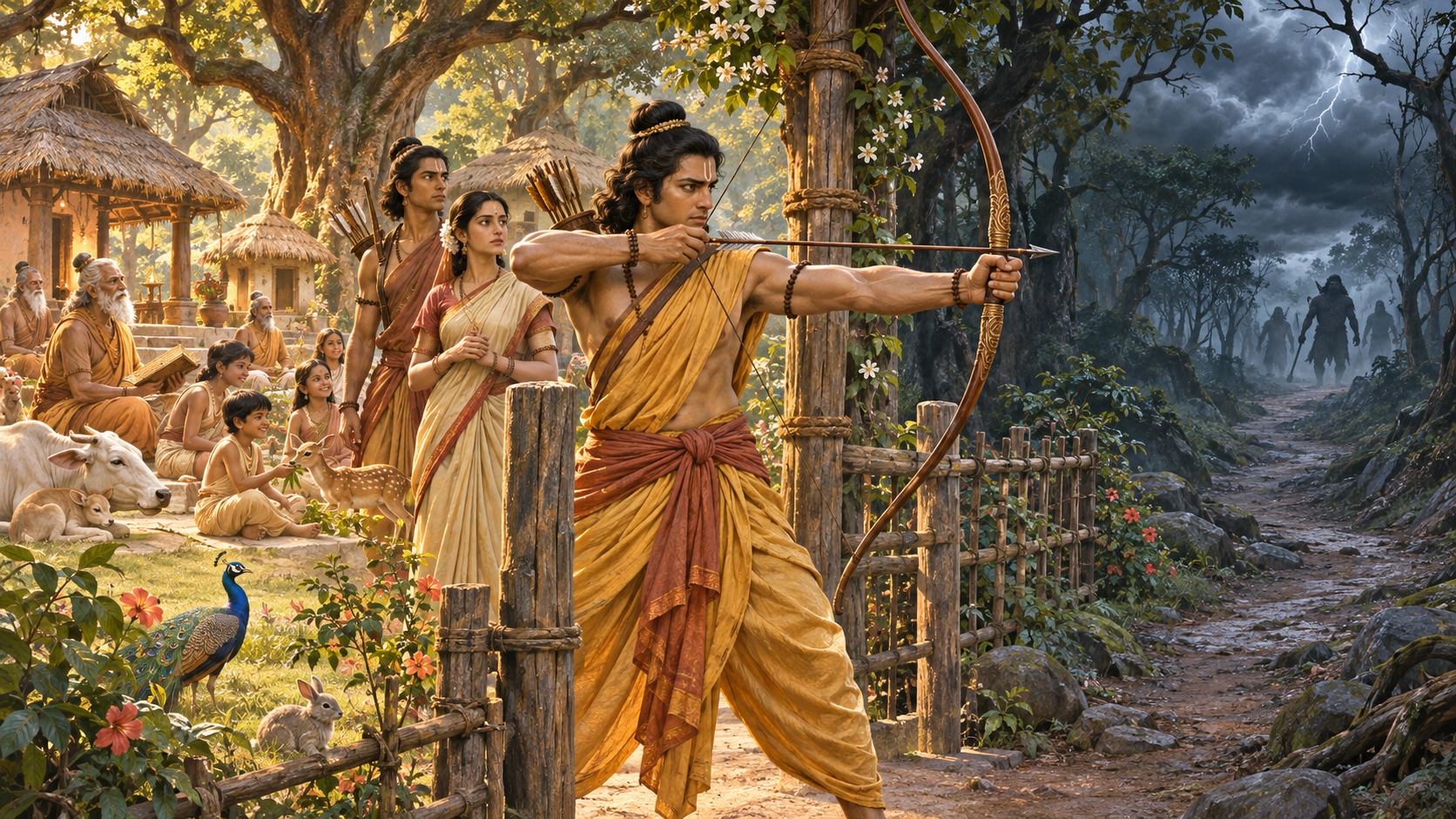
Rama is not answering a personal insult. He is travelling under Vishwamitra’s guidance for a protective purpose: the safeguarding of a yajna. That setting sharply limits what can be drawn from the episode. The action is framed as duty in defence of an endangered good, not retaliation for wounded pride.
This distinction is essential. Force does not become dharmic merely because the person using it belongs to a righteous community, invokes a sacred cause, or identifies an opponent as evil. The direction of justification must run the other way: an identifiable duty and a grave threat may create a narrow case for force. Possessing force does not create the duty, and anger does not prove the threat.
Before accepting a claim that force protects dharma, ask for the protected good in concrete terms. Is someone defending lives, the safety of a community, or the ability to practise a sacred obligation? Or is “dharma” being used as a grand name for prestige, revenge, domination, or humiliation of an opponent? The vaguer the protected good, the easier it is to disguise appetite as duty.
The episode also clarifies a common misunderstanding of ahimsa. Restraint is a governing moral presumption, but restraint cannot be reduced to watching passively while preventable destruction proceeds. At the same time, protection cannot become a permanent excuse for aggression. The force remains answerable to the good it claims to defend, and its justification weakens once that defensive purpose ends.
Dangerous conduct does not justify collective blame
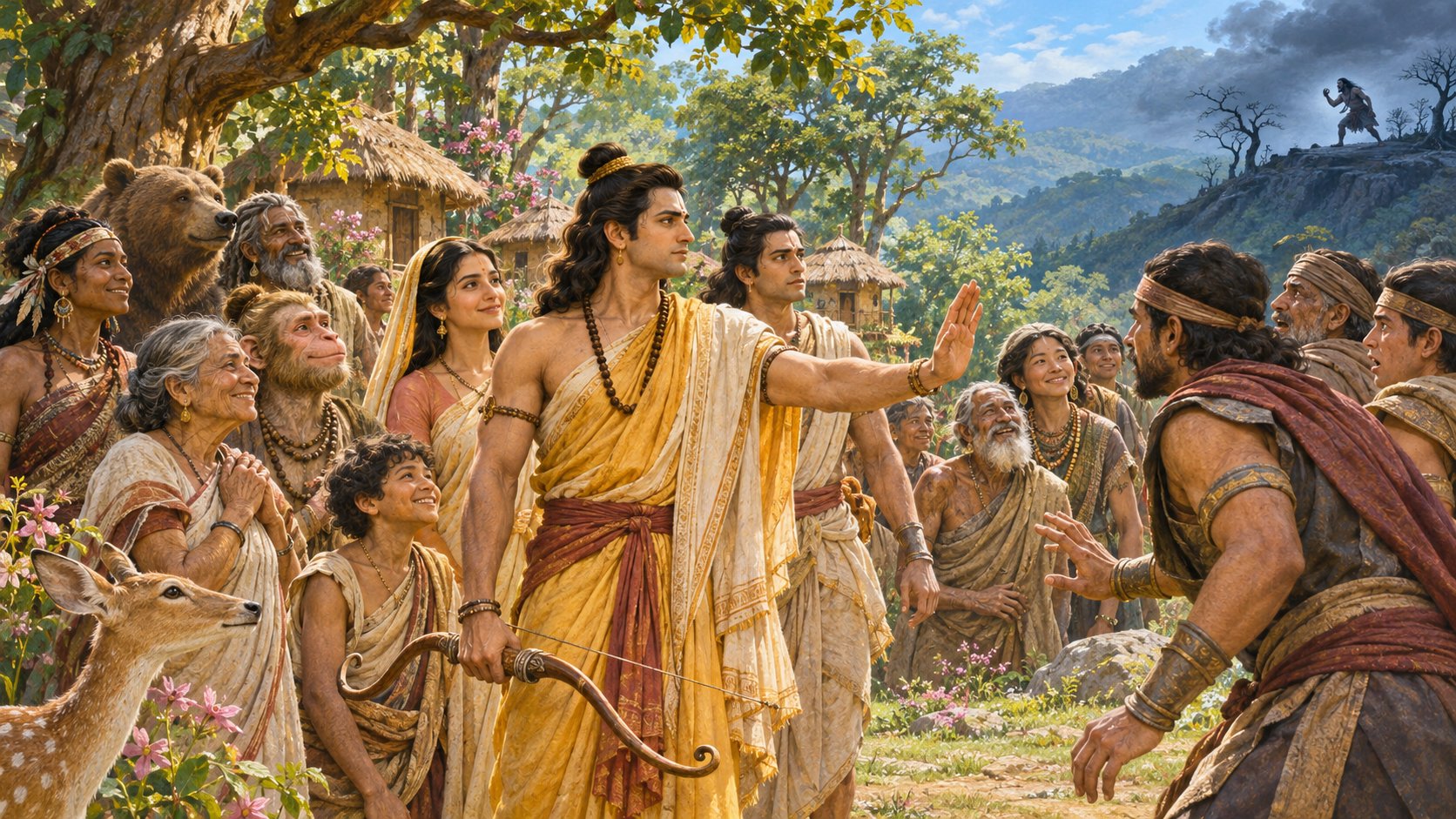
Rama’s concern about Tataka’s sex is not mocked or treated as meaningless. Vishwamitra instead argues that the exceptional severity of the conduct changes what duty requires. The structure is a general restraint with a grave exception, not a declaration that the restraint never mattered.
That structure protects the episode from two opposite misreadings. One misreading turns identity into automatic innocence: no member of a protected category could ever present a danger serious enough to require force. The other turns the exceptional wrongdoer into a reason to condemn an entire category. Neither follows. Individual conduct can overcome a presumption of restraint in an extreme case; it cannot transfer guilt to everyone who shares an identity with the wrongdoer.
This point matters whenever epic language enters a present conflict. Calling an adversary a rakshasa does not establish that the person poses Tataka’s danger. No one becomes a legitimate target merely because a speaker has described them as demonic, impure, hostile, or anti-dharmic. An analogy to the Ramayana must preserve the morally relevant facts: a specific grave threat, a genuine protective duty, and action directed at the responsible agent. Borrowing only the label is religious rhetoric, not dharmic reasoning.
The same limit rules out collective punishment. Harm by one person cannot establish the guilt of a family, sect, ethnicity, or religious population. If the justification cannot distinguish the responsible actor from innocent people, it has already departed from the conduct-based judgment at the centre of Rama’s dilemma.
A six-question test for claims of dharmic force

One short episode cannot supply an entire law of war, policing, punishment, or self-defence. It does, however, provide the beginning of a moral test. A responsible contemporary application must also include evidence, necessity, legal authority, restraint, and accountability. Use these six questions before you endorse force carried out in dharma’s name:
- What exactly is being protected? Name the people, practice, institution, or condition facing harm. “Our honour” or “our side” is not precise enough.
- Is the danger specific, grave, and supported by evidence? Separate an actual threat from offence, rumour, political disagreement, prediction, or fear attached to a group.
- Who has the duty and authority to act? Rama’s position in the episode is not that of a private person seeking revenge. A protective duty cannot simply be self-declared by whoever is angriest.
- Is force necessary to stop the harm? If a less harmful measure can reliably prevent the same danger in time, the case for greater force becomes weaker. Moral seriousness requires examining that possibility before declaring violence inevitable.
- Is the response confined to the threat? The action must distinguish the responsible person from bystanders and must not expand into punishment of a community. Its scope should not exceed its protective purpose.
- What ends the action, and who examines it afterward? A defensive justification needs a stopping condition. Without one, protection can quietly become domination, vengeance, or a habit of power.
If a claim fails one of these questions, do not repair it by adding more sacred vocabulary. A weak factual case does not become strong because it is called dharmic. A private desire for punishment does not become public duty because an epic image is attached to it.
This is especially important outside the epic’s royal and martial setting. The episode is not permission for vigilantism. In modern civic life, coercive force must be judged under applicable law and exercised through lawful authority, except where local law recognises a tightly bounded need for immediate self-defence. If there is an immediate real-world danger, seek emergency assistance rather than treating an epic analogy as operational guidance.
Key takeaways
- Rama’s hesitation is moral discipline, not weakness; serious force should never feel morally routine.
- A general presumption of restraint can face an exceptional case when specific conduct creates grave danger.
- Force can be argued as dharmic only when it remains subordinate to a concrete protective duty.
- Identity neither proves guilt nor supplies absolute immunity; judgment must turn on conduct and evidence.
- The Tataka episode cannot justify private vengeance, dehumanising labels, or collective punishment.
- A credible claim must answer questions of threat, authority, necessity, discrimination, limits, and accountability.
The next time someone invokes the Ramayana to justify force, ask them to answer those six questions plainly. If they cannot name the danger, the duty, the limit, and the innocent people who must remain protected, they are not applying Rama’s moral test. They are avoiding it.
References

Leave a Reply
You must be logged in to post a comment.