
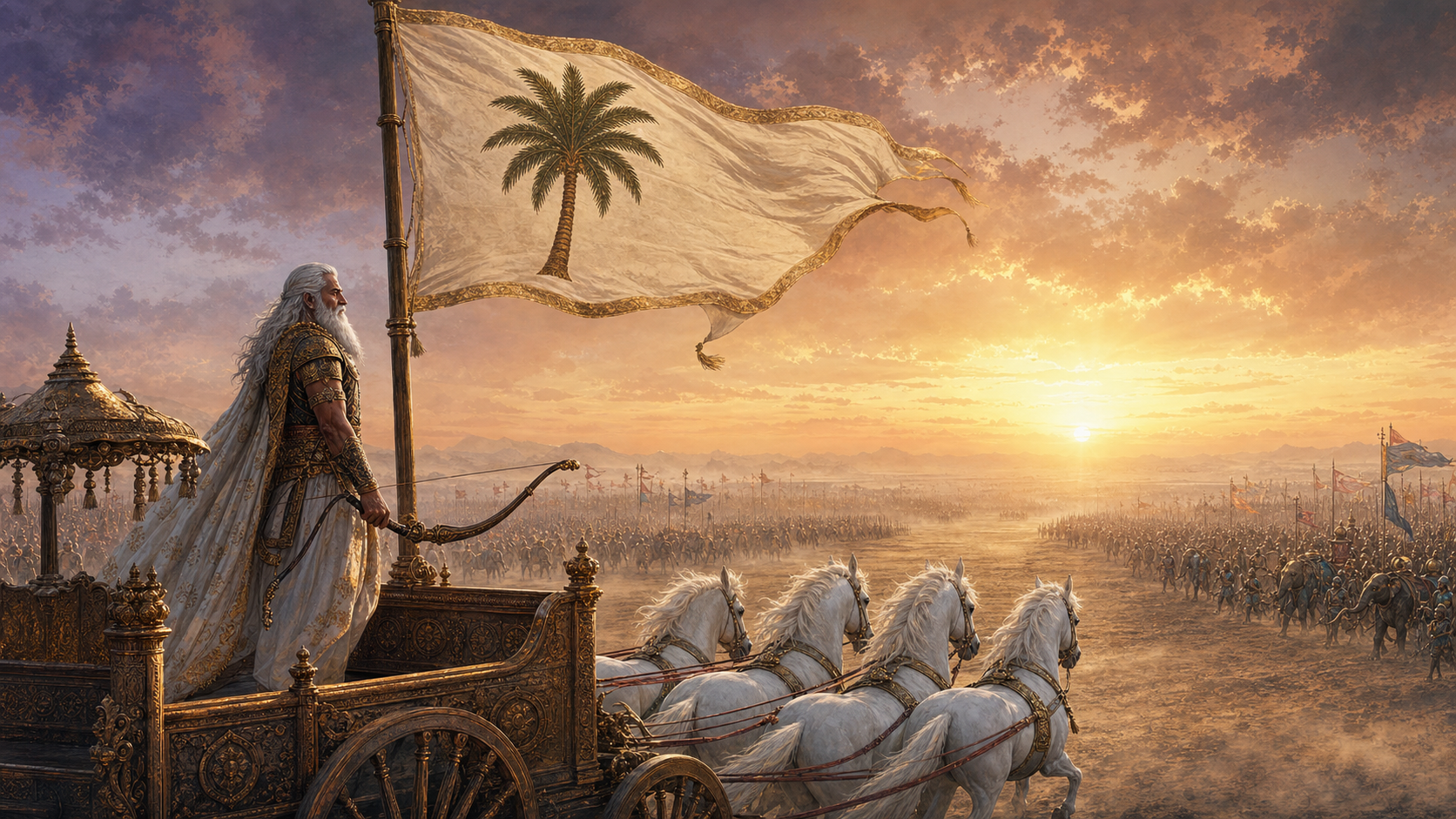
You may know Bhishma’s vows, his authority, and his place in the Mahabharata, yet still wonder why a palm tree flew above his chariot. The short answer is that the Tala Dhvaja makes Bhishma’s defining quality visible: he is a figure of extraordinary steadiness.
But that answer is incomplete. Bhishma also shows you why firmness cannot be judged apart from the cause it serves. Read carefully, his banner is not merely an emblem of strength. It becomes a test of resolve, loyalty, and dharma.
Begin with what the emblem actually tells you
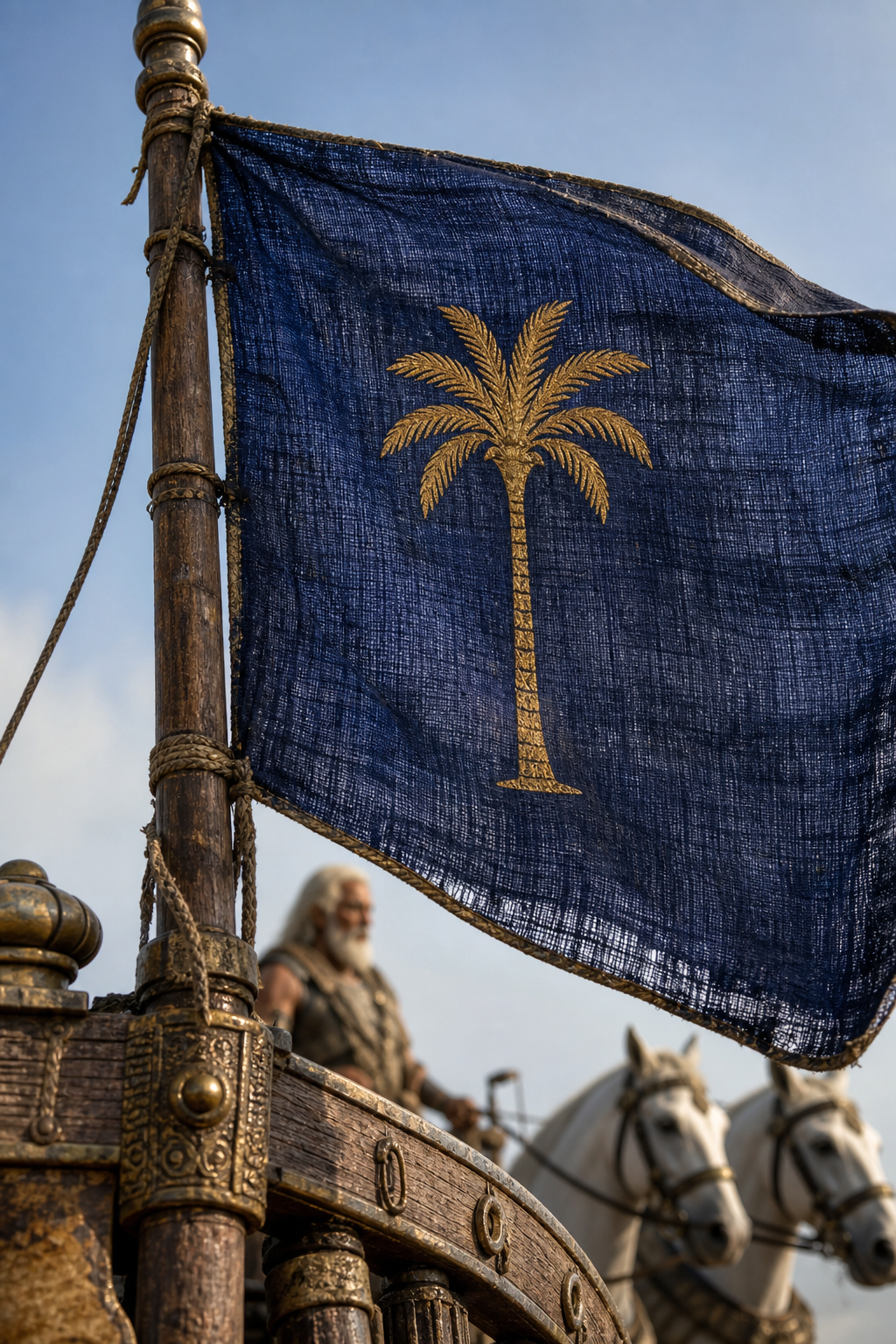
Tala Dhvaja means a standard or banner bearing the palm tree. In the Mahabharata’s visual world, the banner rises above the warrior’s chariot, making identity visible amid the movement and confusion of battle. Bhishma’s standard is distinguished by its sacred palm-tree emblem.
That literal meaning should come first. If you are explaining the symbol to a child, discussing it in a study group, or commissioning an illustration, begin with one clear sentence: the Tala Dhvaja is Bhishma’s palm-tree banner. Only then move to interpretation.
This order matters because an emblem is not a secret code with one mechanically fixed definition. A chariot banner can identify a warrior, reflect qualities associated with that warrior, and provoke reflection in the audience. Those functions overlap, but they are not identical.
It also means you should be careful with visual reconstructions. The palm is the essential identifying feature. Do not present an added color, border, inscription, deity, animal, or weapon as canonical unless you have separate textual support for it. Artistic elaboration is legitimate; calling elaboration textual fact is not.
Why the palm is an apt emblem for Bhishma
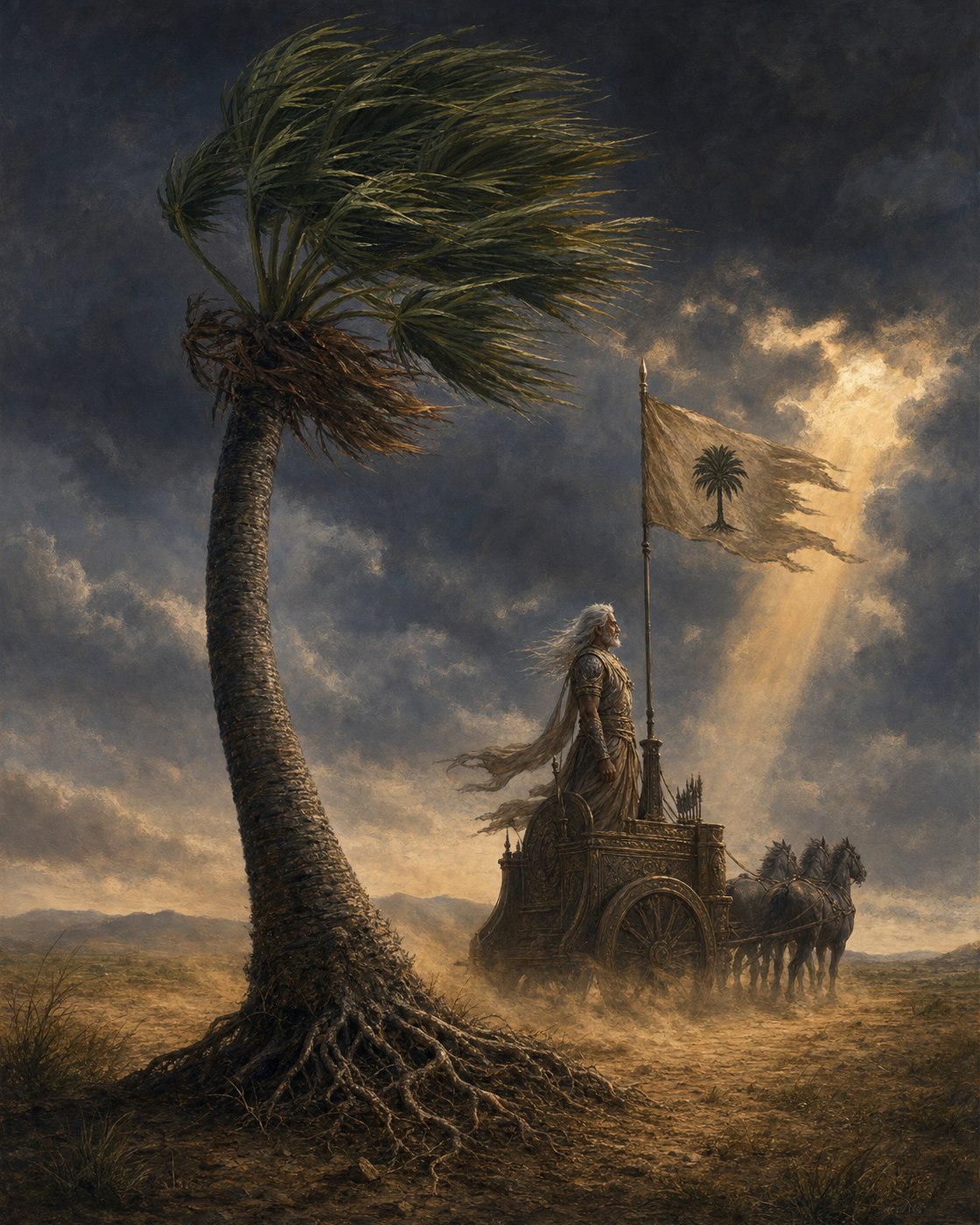
A palm presents a striking silhouette: a largely upright trunk lifts a crown that remains visible from a distance. That visible form readily invites associations with stature, constancy, dignity, and the refusal to bow under ordinary pressure. These are symbolic associations, not a claim that every palm has one universal scriptural meaning.
The associations fit Bhishma because his identity is inseparable from resolve. He is remembered as Pitamaha, the revered elder, and as a formidable warrior whose commitments shape both his life and the larger conflict around him. His strength is not merely physical. It lies in his capacity to remain fixed when others would retreat, bargain, or abandon an obligation.
The Tala Dhvaja therefore works as a public declaration. Before Bhishma speaks or releases a weapon, the raised palm tells you what kind of presence has entered the field: elevated, disciplined, difficult to move, and impossible to overlook.
Yet the Mahabharata does not allow you to turn that firmness into a simple slogan. Resolve is a capacity, not an automatic virtue. Its moral value depends on what the person remains loyal to, who bears the consequences, and whether changing circumstances reveal a higher duty.
This is where the palm banner becomes more than praise. Bhishma’s steadfastness gives him grandeur, but it also binds him. He can see moral complexity without becoming free of the commitments that place him inside it. The same quality that makes him majestic also contributes to his tragedy.
So do not read the upright palm as proof that Bhishma is correct in every decision. Read it as the sign of a man who will stand where he has chosen to stand. The harder dharmic question is whether that position still serves justice.
Use three layers when interpreting the Tala Dhvaja
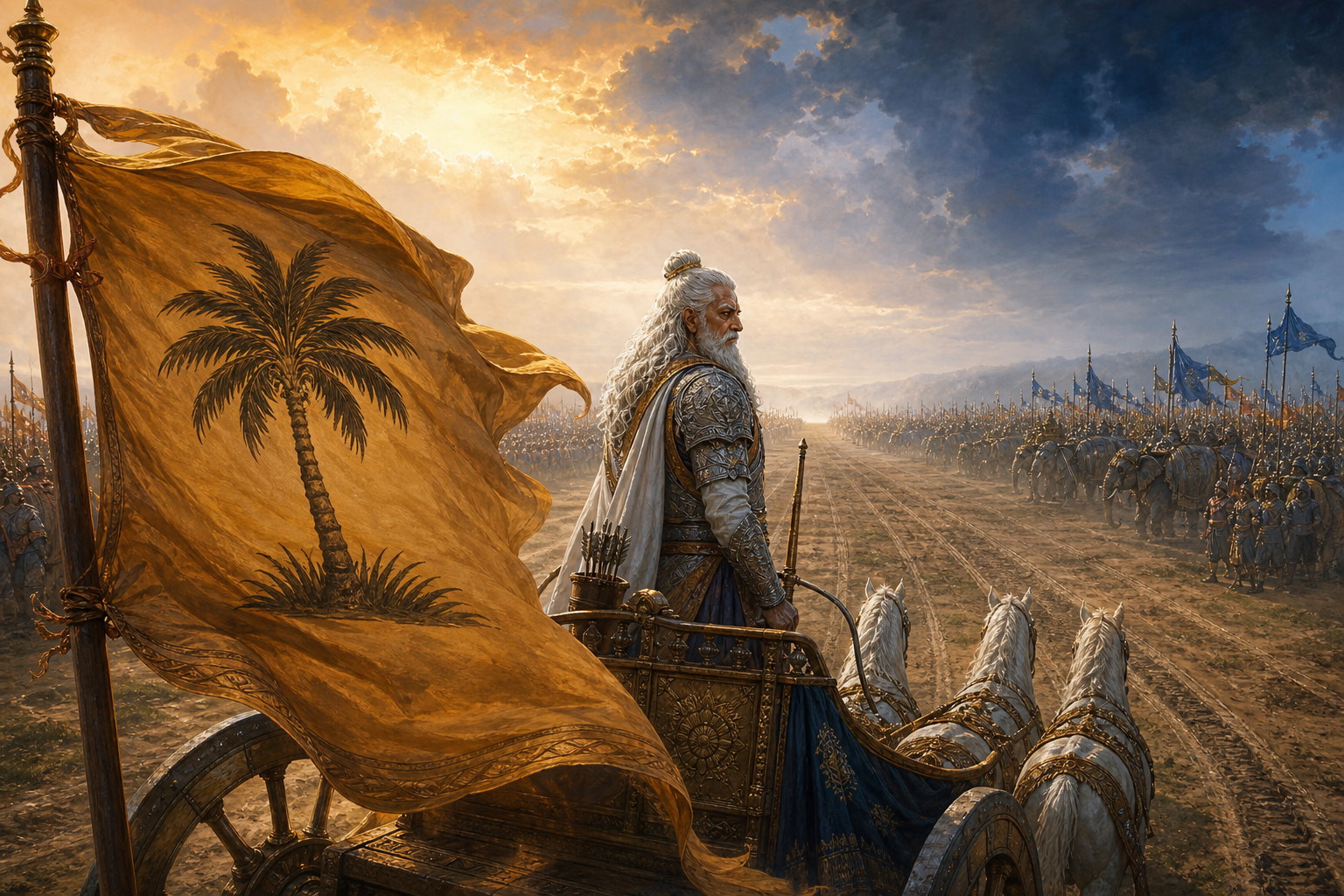
You can avoid both shallow admiration and speculative overreading by separating three layers of meaning. This method also works when you encounter other banners, weapons, vehicles, or natural emblems in an itihasa.
| Layer | Question to ask | What the Tala Dhvaja reveals |
|---|---|---|
| Literal | What is actually depicted? | A palm tree on the banner above Bhishma’s chariot. |
| Character | What quality does the image bring into view? | Uprightness, stature, constancy, and a highly visible resolve. |
| Dharmic | What moral problem does that quality create? | Whether steadfast loyalty remains righteous when duties and consequences come into conflict. |
The literal layer disciplines the reading. You begin with what is present rather than with an attractive theory. The character layer connects the emblem to Bhishma without pretending that the tree is an exhaustive portrait of him. The dharmic layer then asks why the symbol matters to you rather than leaving it as decorative information.
This last step is especially important. A Hindu symbol does not have to deliver a flat moral such as “be strong.” It can place two truths before you at once: constancy is noble, and constancy can become bondage. The tension is not a flaw in the reading. It is where the reading becomes useful.
If you teach or write about the Tala Dhvaja, mark the transition between these layers. Say “the banner depicts a palm” when stating the emblem. Say “the palm can be read as steadfastness” when offering symbolism. Say “Bhishma’s story asks whether steadfastness is enough” when drawing out the ethical problem. Those three formulations carry different levels of certainty.
Avoid the common misreadings of Bhishma’s banner
Do not treat a symbol as a certificate of moral approval. A dhvaja identifies and characterizes; it does not declare that every action performed beneath it is dharmic. Bhishma’s stature should make the moral tension sharper, not make it disappear.
Do not reduce the palm to generic strength. Strength alone tells you little. The more precise quality is sustained firmness: the ability to hold a chosen position under severe pressure. That precision explains both Bhishma’s greatness and the cost of his commitments.
Do not confuse invincibility with integrity. A warrior’s imposing banner may communicate power and presence, but integrity still depends on judgment. Enduring longer than everyone else does not by itself establish that the position being defended is right.
Do not force every feature of a botanical palm into the interpretation. Symbolic reading should begin with the recognizable emblem and the character it accompanies. Claims about roots, fruit, climate, ritual use, or a particular species require their own support. Without that support, they may be creative associations, but they should not be presented as the banner’s settled meaning.
Do not flatten Bhishma into either a flawless hero or a failed elder. Both reductions erase the reason his symbol remains compelling. A weak person trapped by a promise would offer a simple warning. Bhishma is more difficult: immense discipline, knowledge, and authority do not remove the moral danger of loyalty directed toward a compromised order.
These distinctions matter whenever the Tala Dhvaja appears in an image, discourse, or devotional setting. You can honor Bhishma’s discipline without converting reverence into uncritical imitation. Dharma asks for steadiness, but it also asks what your steadiness protects.
Key takeaways, and a way to apply the symbol
- The Tala Dhvaja is the palm-tree banner associated with Bhishma’s chariot.
- The palm can be read as a sign of uprightness, stature, constancy, and resolve.
- The banner reflects Bhishma’s defining firmness, but it does not certify every decision he makes.
- Its deeper dharmic lesson is that steadfastness must be judged by its object, consequences, and capacity to serve justice.
- A careful interpretation distinguishes textual identification from symbolic association and personal application.
You can turn that lesson into a practical examination whenever you find yourself defending a promise, institution, family expectation, inherited position, or long-standing plan. The point is not to become fickle. It is to prevent endurance from disguising attachment.
- Name the commitment without flattering language. Write exactly what you have promised, defended, or refused to reconsider.
- Name the dharmic purpose it was meant to serve. A promise is a means; truth, protection, justice, and responsible duty are possible ends.
- Identify who now benefits and who carries the cost. Do not count only the effect on your reputation or sense of consistency.
- Ask whether changed circumstances have created a competing duty. Remaining unchanged is not morally neutral when the surrounding situation has changed.
- Choose the form of steadiness that serves dharma now. That may mean holding your ground, changing your method, admitting error, or releasing a commitment that has ceased to serve its rightful purpose.
This is the Tala Dhvaja’s most demanding gift. Let the palm remind you to stand upright, but do not stop there. Before you praise yourself for being immovable, look carefully at the ground on which you have chosen to stand.
References
