

You reach the final duel with an uncomfortable question: if Bhima had justice on his side, why did justice require a forbidden strike? And if Duryodhana had lived through adharma, why should a rule of honorable combat still protect him?
The answer matters whenever you must oppose wrongdoing without becoming careless about your own conduct. Bhima’s blow does not offer a convenient excuse for breaking rules. It offers something more demanding: a way to judge an exceptional act without pretending that either procedure or righteous intention can settle the matter alone.
The forbidden blow is the point, not an awkward footnote
After an eighteen-day war, the conflict contracts to Bhima and Duryodhana on a dried lake bed. Armies, formations, and competing claims to the kingdom have given way to two men carrying the memory of everything that brought them there.
The weapon is the gada, the mace. Gada-yuddha is not simply a contest of uncontrolled strength. It has maryada: recognized limits intended to preserve honor even during violence. Duryodhana is a formidable mace-fighter, and his skill is not denied merely because his cause is morally compromised. Excellence remains excellence; it simply cannot erase the larger record of conduct.
Bhima also enters with more than physical power. He carries his vow to avenge Draupadi’s humiliation. Yet when he strikes Duryodhana below the waist, he violates the formal rule of the duel. The act therefore contains two truths that must be held together: Bhima answers a grievous wrong, and Bhima crosses a boundary while doing so.
If you erase the first truth, the combat becomes an isolated sporting event between morally equivalent opponents. If you erase the second, a righteous cause becomes permission to use any method. Neither reading is adequate. The legitimacy of a cause and the legitimacy of every means used in its service are different questions.
This distinction is the first practical lesson. When judging a difficult action, do not begin with the identity of the person who acted. Begin by naming the act, the rule it crossed, the wrong it sought to answer, and the cost of answering that wrong in this way. Loyalty may influence your sympathies, but it cannot be your entire moral argument.
A rule and a righteous cause answer different questions
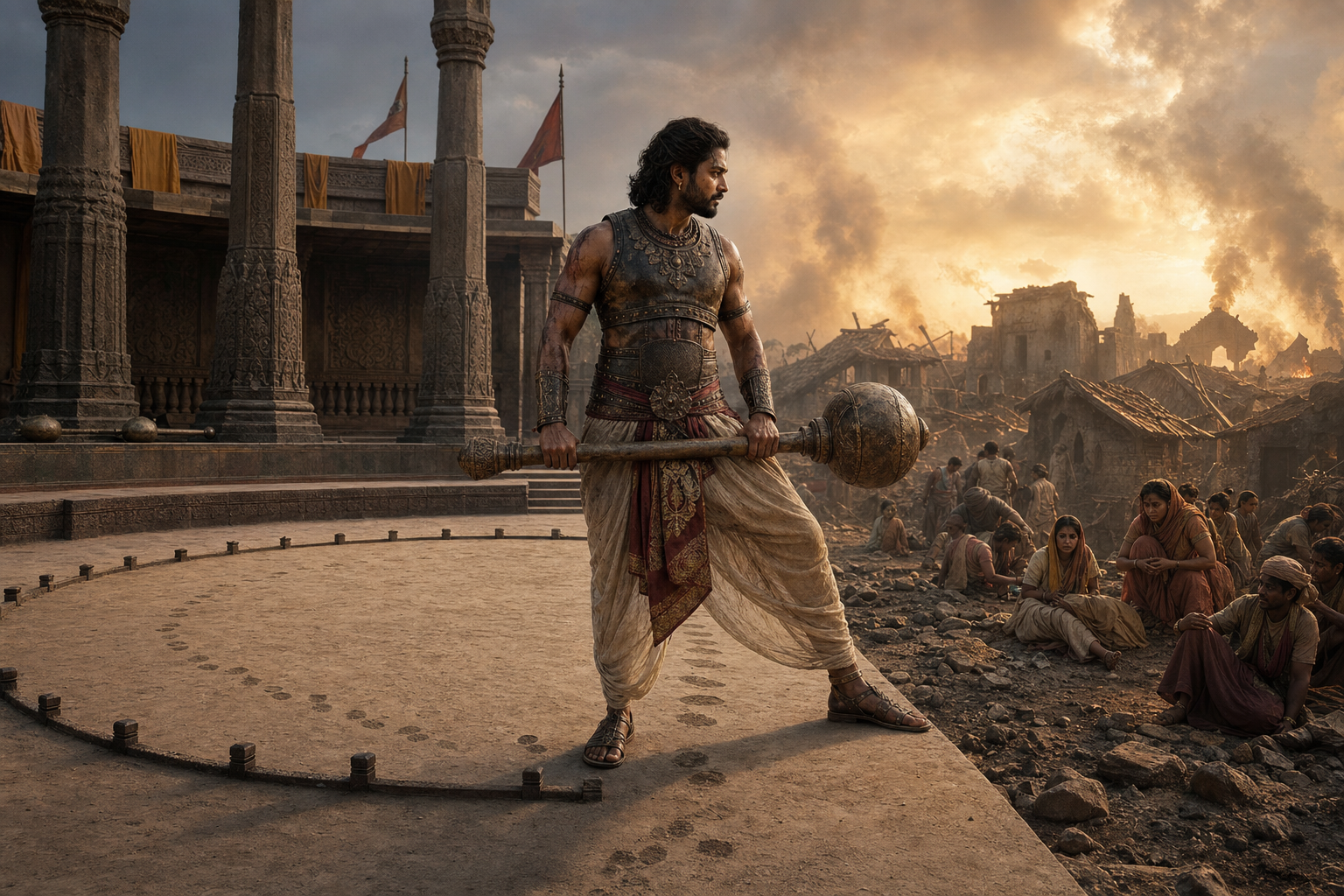
Maryada matters because force cannot be allowed to define its own legitimacy. A combat rule restrains the stronger fighter, preserves a distinction between disciplined valor and cruelty, and prevents every grievance from becoming a limitless warrant for retaliation. If a rule may be discarded whenever someone feels morally certain, it is not a rule at all.
But a procedural rule also has a limited field. The rule of gada-yuddha governs how two fighters strike each other inside the contest. It cannot, by itself, weigh the entire history that produced the contest. It does not measure Draupadi’s humiliation, decide the justice of Bhima’s vow, or dissolve the moral asymmetry between the combatants.
That is where simplistic judgments fail. Saying that the vow automatically sanctified the blow gives intention too much power. Saying that the illegal blow made Bhima and Duryodhana morally equivalent gives procedure too much power. Saying that victory proved the method righteous confuses success with dharma.
The harder conclusion is also the more useful one: context changes the moral weight of a breach, but it does not make the breach disappear. Bhima’s act is intelligible as redress without becoming spotless. The duel allows justice and transgression to occupy the same moment.
This is not the claim that ends justify means. That slogan treats the means as morally irrelevant once a desired result has been obtained. The final duel does the opposite. The result matters, the prior wrong matters, and the forbidden means remains visible. Nothing is laundered by victory.
For your own decisions, keep one distinction clear: an exception may sometimes be morally defensible, but it is still an exception. You should be able to explain why the ordinary rule was insufficient in that particular case, how far the departure extended, and why the same reasoning would not authorize unlimited future breaches.
Four questions for judging action at the edge of dharma

The duel is not a literal model for settling modern disputes. It is a diagnostic model. You can use it when a community rule, institutional duty, political conflict, or family boundary appears to obstruct the correction of a serious wrong. Before you call an exception dharmic, ask four questions in order.
- What rule would be crossed, and what good does it protect? Name the rule precisely. Then name its purpose: fairness, safety, trust, restraint, due process, or protection from arbitrary power. A rule is easier to dismiss when its protective function remains invisible.
- What concrete wrong requires an answer? Describe the harm without slogans. Identify who was harmed, what was done, whether the harm continues, and why ordinary remedies are inadequate. A general feeling that the other side is wicked is not enough.
- What is the actual intention? Distinguish restoration from the desire to humiliate. Ask what condition would count as sufficient redress. If nothing short of the opponent’s degradation will satisfy you, vengeance has begun to govern the decision.
- What result will the breach produce, and who will carry its cost? Consider whether the action is limited to what the situation requires, whether a less damaging option exists, and whether you are willing to accept scrutiny afterward. An exception claimed in the name of responsibility cannot be followed by refusal of responsibility.
Applied to Bhima’s act, the first answer is unambiguous: a strike below the waist violates the combat code. The second answer reaches beyond the duel to Draupadi’s humiliation and the vow made in response. The third recognizes that the blow is intended to fulfill that vow and bring the final confrontation to its reckoning. The fourth leaves a residue: the old wrong receives its bodily answer, but the means damages the very maryada that distinguishes disciplined combat from unbounded force.
A genuine moral dilemma exists only because the answers pull in different directions. If you suppress the inconvenient answer, you are no longer discerning; you are building a justification. Anyone invoking context should be able to state the violated rule as clearly as the grievance. Anyone invoking the rule should be able to face the grievance as clearly as the violation.
One further test is especially useful: reverse the identities. Would you accept the same exception if your opponent claimed it under comparable conditions? The cases will rarely be perfectly symmetrical, but the exercise exposes arguments that depend entirely on affection for one side. Dharma requires attention to moral asymmetry; it does not license tribal reasoning.
The symbols preserve the moral cost of victory

The place of the blow is not incidental. Duryodhana had used his thigh in an obscene gesture toward Draupadi. When Bhima strikes that thigh, the body becomes a ledger on which the earlier deed returns as consequence. The correspondence gives the act its force as a vision of karma and accountability.
That symbolism must not be converted into a general license for personal revenge. Karma is not permission to appoint yourself the infallible distributor of cosmic punishment. The correspondence between gesture and blow explains the moral imagination of this particular scene; it does not abolish restraint, proportion, or uncertainty in your own conflicts.
The dried lake bed widens the frame. A place once associated with water is now emptied, just as the civilization around the duel has been drained by accumulated failures of judgment. The war has reduced a vast political and familial order to two exhausted claimants on barren ground. You are meant to notice not only who wins, but what remains for the winner.
The gada carries a related warning. It represents kshatra, disciplined power placed in the service of order. Power loses that character when domination becomes its purpose. This is why Duryodhana’s prowess can be acknowledged without vindicating him, and why Bhima’s just grievance does not remove the need to judge his use of force.
Across Dharmic traditions, different ethical vocabularies sharpen this judgment. Hindu reflection on dharma and kshatra asks when force retains rightful purpose. Jain and Buddhist attention to ahimsa and intention keeps the harm itself in view. Sikh maryada emphasizes valor governed by discipline rather than domination. These traditions are not interchangeable, and they need not deliver an identical verdict on Bhima’s blow. They converge on a more basic demand: strength must answer to something beyond itself.
This is where moral residue becomes practical. If you make an exceptional choice, do not describe the breach as though it never occurred. State it plainly. Refuse triumphal humiliation. Preserve as much of the underlying norm as possible. Accept examination of your motives and methods. Most importantly, prevent a narrow exception from becoming an easy precedent for the next, less serious dispute.
Accountability after action is not proof that the action was wholly wrong. It is proof that moral seriousness continued after the moment of decision. Bhima’s victory remains troubling precisely because the epic’s ethical world is larger than the winner’s satisfaction.
Key takeaways for conflicts you actually face
- A just cause does not automatically purify every method used to advance it.
- A violation of procedure does not automatically erase the moral difference between the parties.
- Context can change the weight of a rule, but it must be described specifically rather than invoked as a slogan.
- Intention means more than believing yourself righteous; it includes the concrete result you seek and the point at which you will stop.
- A defensible exception should be limited, proportionate to the wrong, and followed by accountability.
- Humiliation is a warning sign. Redress aims to answer harm; domination aims to enjoy the opponent’s abasement.
- Dharma is neither mechanical compliance nor moral improvisation. It is disciplined judgment under the burden of consequence.
The next time a conflict is presented to you as morally simple, make a four-line ledger before choosing a side: the rule, the original harm, the intended remedy, and the cost of the exception. Do not proceed until you can state each line in language that the opposing side would at least recognize as a description of the dispute.
If the rule must still be crossed, cross no more of it than the remedy requires, and do not ask victory to absolve you. That restraint will not make every decision clean. It will keep a hard decision from becoming an excuse for adharma.
References
