
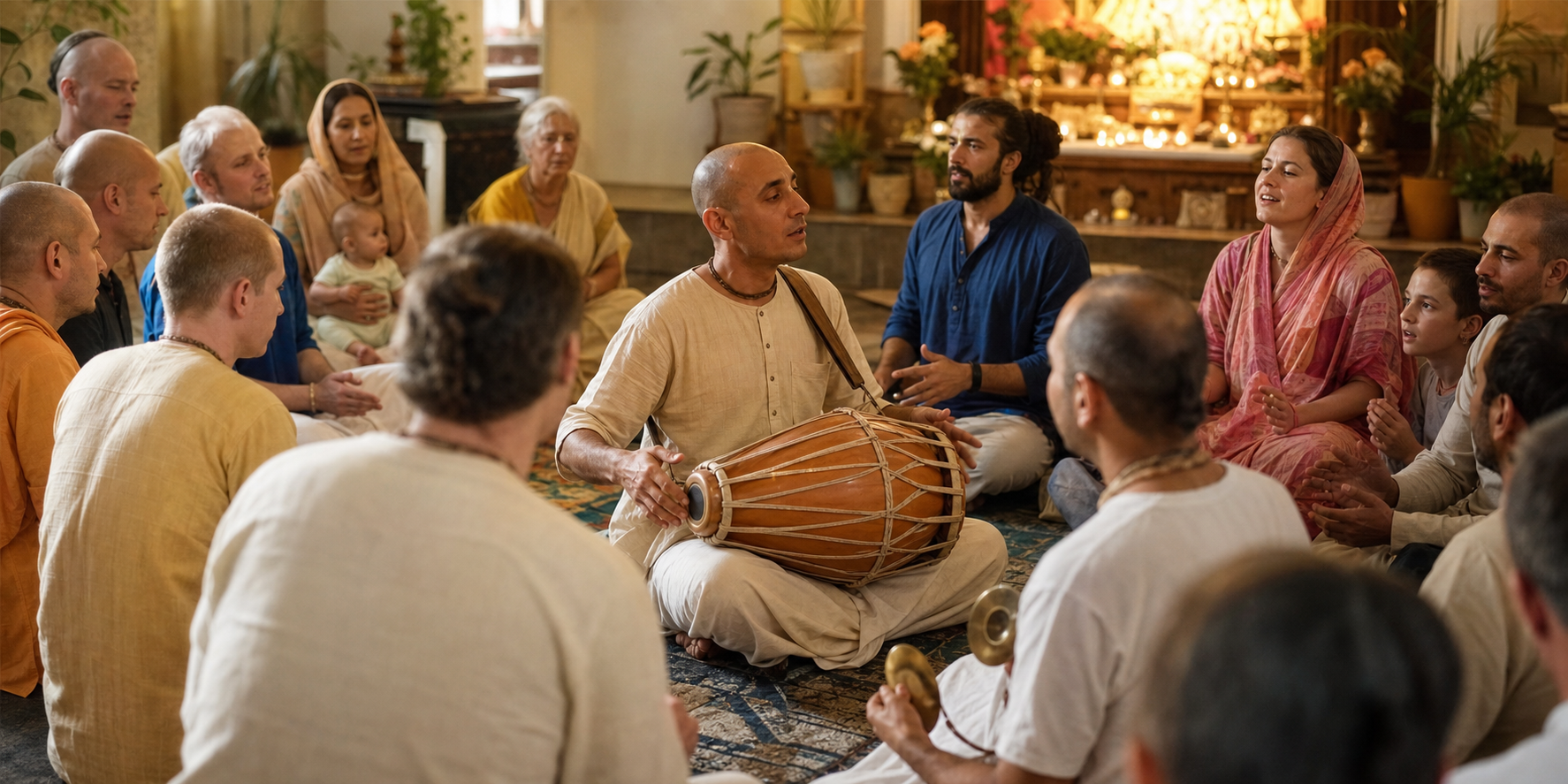
You may be able to carry a melody, keep the rhythm, and draw a strong response. The harder question arrives when you take the leader’s seat: are you helping people remember Bhagavan, or are you teaching them to react to you?
Use one standard to answer that question. Your task is to make sincere chanting and careful hearing easier. Melody, tempo, instruments, vocal strength, and emotional energy all matter, but they remain servants of that purpose. Once this order is clear, many difficult musical and interpersonal decisions become simpler.
Measure the kirtan by remembrance, not reaction

In Gaudiya Vaishnava practice, Krishna is understood to be present in His Name. The mantra is therefore not preliminary material used to warm up a room. Attending to the Name is the central devotional act, and the leader serves that encounter.
This changes the meaning of success. A loud response can be joyful, but loudness does not prove absorption. A complex melody can be beautiful, but complexity does not prove bhava. Visible emotion can be sincere, but the leader cannot use it as a reliable measurement of everybody’s inner life. If you chase these outward signals, you may begin shaping the gathering around the response you want rather than the remembrance you are meant to support.
Look instead for practical signs that attention is being protected. The mantra remains intelligible. The assembly can recognize the call and enter the response. The rhythm carries the chanting without becoming a competing event. People with quieter voices or less musical experience have a place in the sound. Most importantly, you are hearing the Name while you lead it.
Before introducing a melodic change, faster pace, instrumental flourish, or longer phrase, ask:
- Will the words of the mantra remain clear?
- Can the assembly answer without having to study my technique?
- Does this choice deepen attention, or merely increase stimulation?
- Am I listening to the response, or planning my next display while others chant?
- If the musical change fails, can I return calmly to a simple phrase and steady pulse?
A musically plain kirtan can serve deeply when it keeps returning people to the Divine Name. A technically accomplished kirtan can lose that purpose when the congregation becomes an audience. Musical ability is not the enemy of seva. The question is whether ability has accepted a subordinate role.
Prepare the conditions, then lead the return

Kirtan leadership begins before the first audible note. Preparation removes avoidable distractions so that your attention can remain with the mantra and the assembly. It also prevents the leader from using spontaneous musical decisions as a substitute for spiritual presence.
Before the gathering
- Set a working intention. Use a sentence concrete enough to govern your choices: help the assembly chant clearly, hear carefully, and remember the Divine. If a choice does not serve that intention, it is optional.
- Know the mantra you will lead. Pronounce it carefully and decide where the call naturally divides. A phrase that is difficult to return places unnecessary musical work between the chanter and the sacred sound.
- Choose an accessible musical container. Begin with a melody and pulse that let people locate the mantra. There is no need to reveal every variation at the opening.
- Coordinate with accompanists. Establish who holds the pulse, how changes will be cued, and how instruments will make room for the voices. Unclear leadership among musicians easily becomes audible competition.
- Examine what you want from the room. If you are hoping to prove your competence, recover your reputation, or reproduce a previous emotional peak, acknowledge that desire before you begin. You do not have to obey it.
While you are leading
The foundational discipline is uncomplicated: chant with the tongue and hear with the ears. The mind will not always remain settled. Leadership does not require you to pretend otherwise. It requires you to return without resentment and to make that return available to everyone else.
- Sound the mantra clearly enough that the response knows what it is receiving.
- Listen through the response instead of treating it as empty space before your next call.
- Notice whether the words, rhythm, and group are still together.
- If attention becomes scattered, simplify the melody, restore the pulse, and repeat the mantra without embarrassment.
- Allow musical depth to develop only while the assembly can remain with the sacred sound.
This is ekāgratā expressed through service: one-pointed attention that keeps choosing its object. It is also nairantarya abhyase, steady practice sustained through repeated return. One-pointedness does not mean that no distraction ever appears. It means distraction is not given command of the next choice.
Your composure matters here. Irritation after a missed cue redirects attention toward the leader’s authority. An abrupt attempt to overpower a weak response can turn participation into pressure. A calm repetition communicates something more useful: the mantra remains available, and everyone may begin again.
After the final response
Do not evaluate the gathering only by praise, volume, or the emotional peak you remember. Review your service while the details are still clear:
- Where did I stop hearing the mantra?
- Which musical choice helped the assembly enter more fully?
- Did any phrase, tempo, or flourish make participation unnecessarily difficult?
- Did I force intensity when a simpler return would have served better?
- Was there room for accompanists and quieter chanters, or did my voice occupy the whole gathering?
- What single adjustment will protect attention the next time I lead?
This examination should produce a correction, not a performance ranking. Bhakti leadership matures when reflection softens pride and sharpens service.
Do not manufacture bhava when the heart feels dry
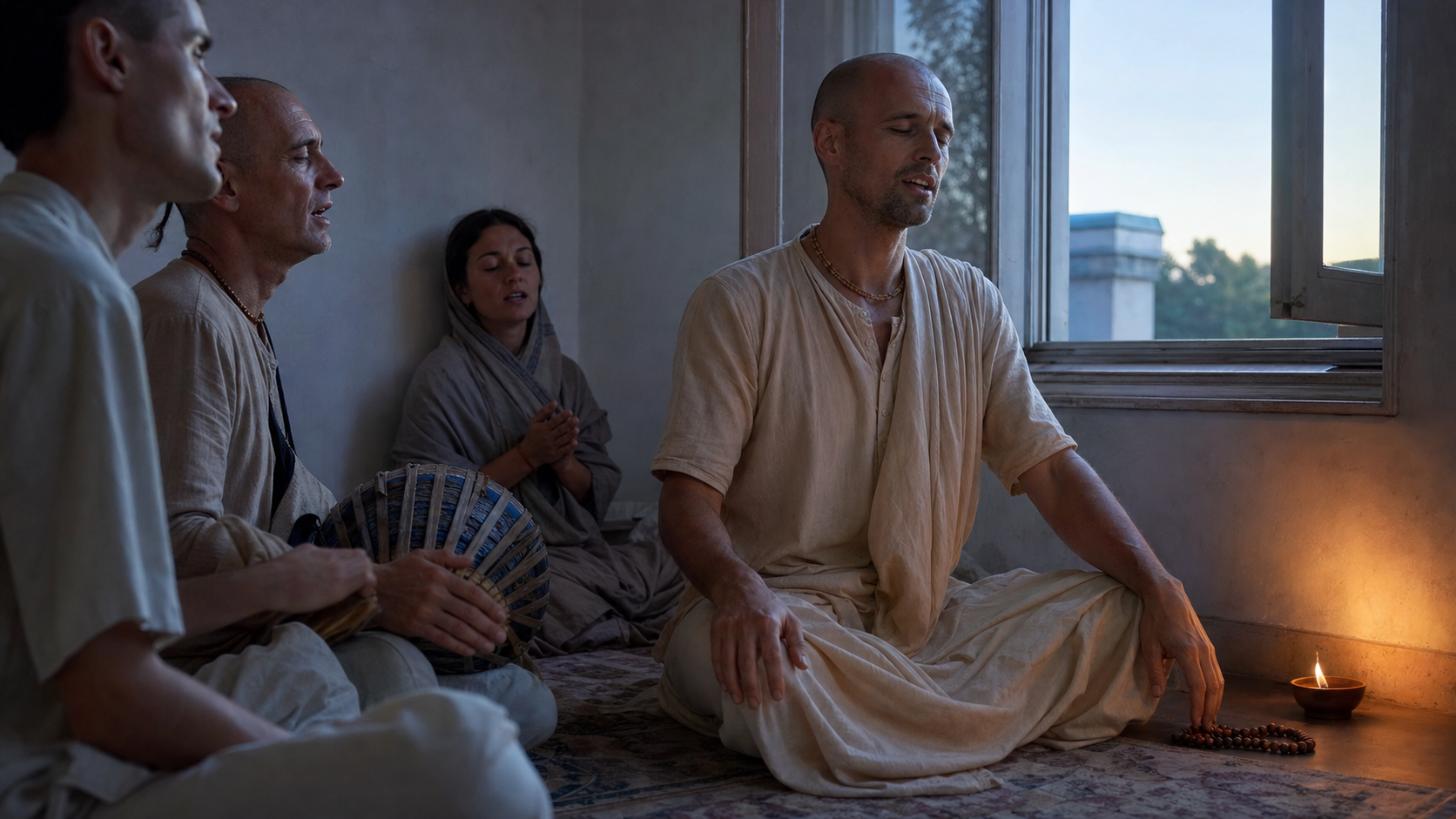
Some kirtans carry an immediate sense of the Lord’s presence. At other times, the chanting may feel distant, heavy, or ordinary. The leader’s responsibility does not change with this inner weather.
Two errors are especially tempting. The first is to treat sweetness as an entitlement and keep changing the music until the desired feeling appears. The second is to interpret dryness as proof that the kirtan has failed. Both errors place an emotional result above faithful chanting and hearing.
Within bhakti, felt presence and apparent concealment can both become occasions for spiritual learning. A vivid experience calls for gratitude without ownership. A dry experience calls for honesty, humility, and continued attention. Neither state gives the leader permission to manipulate the assembly.
When the kirtan feels unresponsive, use the smallest effective correction:
- Return to a clearly pronounced mantra.
- Steady the rhythm rather than adding urgency.
- Reduce ornamentation that is drawing attention away from the words.
- Hear the entire congregational response.
- Bring the mind back each time it begins measuring the room.
Do the same when the gathering feels spiritually powerful. Keep hearing. Keep the mantra clear. Do not turn a moment of grace into evidence of personal mastery. Bhava is not a stage effect produced by the correct sequence of musical devices; it is devotional feeling that must be received and protected rather than demanded.
Gaudiya remembrance may include Krishna in deity form, Srila Prabhupada, and revered spiritual personalities. A leader can hold that lineage remembrance inwardly while allowing participants to attend sincerely rather than requiring everyone to display an identical experience. Shared mantra does not require theatrical uniformity.
Protect the assembly from competition and exclusion

A non-competitive atmosphere is not merely good event etiquette. It protects the devotional purpose of the gathering. When status enters the center, participants start noticing who is impressive, who received the strongest response, whose instrument dominates, and who is permitted to lead. The Name remains audible, but attention has migrated elsewhere.
Competition is not always announced. It may appear as an instrument that repeatedly covers the mantra, a call designed mainly to display range, irritation when another musician contributes, or an assumption that visible enthusiasm is the only acceptable participation. It can also appear in the leader’s private need to make this kirtan more memorable than the last one.
Use these integrity tests during the gathering:
- Intelligibility: Can people still hear the sacred words?
- Participation: Can a less-experienced chanter enter without being exposed or shamed?
- Restraint: Can you decline a musical possibility because the gathering does not need it?
- Cooperation: Are the musicians listening to one another as carefully as they want the congregation to listen?
- Humility: Can you accept a missed cue, a modest response, or a necessary correction without defending your status?
- Coherence: Are the voices being gathered around the mantra, or separated into performers and spectators?
Inclusion does not require disorder. A leader may still give clear cues, maintain the form of the kirtan, and uphold the gathering’s devotional etiquette. The distinction lies in purpose: coordination helps people serve together, while control makes their participation revolve around the leader.
The condition of your pride after leading is worth noticing. If you are preoccupied with being admired, overlooked, or compared, do not disguise that movement as concern for devotional standards. Return to seva. Ask what the assembly needed and whether your choices helped provide it.
Honor Dharmic kinship without erasing distinctions
Kirtan and sacred recitation take distinct forms across Dharmic paths. Sikh kirtan centers on shabad. Buddhist and Jain communities use mantra recitation in disciplines of awareness and compassion. Hindu traditions sustain remembrance through sacred names, bhajana, kirtan, and japa. These are not interchangeable theologies, but they reveal a meaningful kinship in careful listening, sincere intention, and communal respect.
If you lead in an inter-Dharmic setting, do not create unity by claiming that every sacred sound has the same meaning. Name each practice on its own terms. Preserve its words and orientation. Let practitioners establish the appropriate pronunciation and etiquette. Unity becomes more credible when no tradition must surrender its distinctiveness to participate.
The practical lesson for a bhakti leader is simple: reverence travels through attention. You honor your own lineage by serving its Name faithfully, and you honor related Dharmic paths by refusing to reduce their sacred sound to decorative musical material.
Key takeaways for your next kirtan
- The leader’s primary service is to make chanting, hearing, and remembrance easier.
- Judge musical choices by mantra clarity and shared participation, not by complexity or visible excitement.
- Listen to the congregational response before deciding what to sing next.
- When attention scatters, simplify the melody, steady the rhythm, and return to the Name.
- Do not treat spiritual sweetness as a personal achievement or dryness as automatic failure.
- Protect a cooperative space in which musicians, newcomers, and quieter chanters can participate with dignity.
- Honor common Dharmic disciplines of sacred sound without pretending that different traditions are identical.
Before your next kirtan, choose one discipline you can actually keep: hear every response, begin with a more accessible phrase, remove an unnecessary flourish, or make more room for the assembly’s voice. Then let that commitment govern the next musical decision. You do not have to manufacture a sacred moment. Lead the Name clearly, hear it honestly, and allow seva to determine what comes next.
References
