
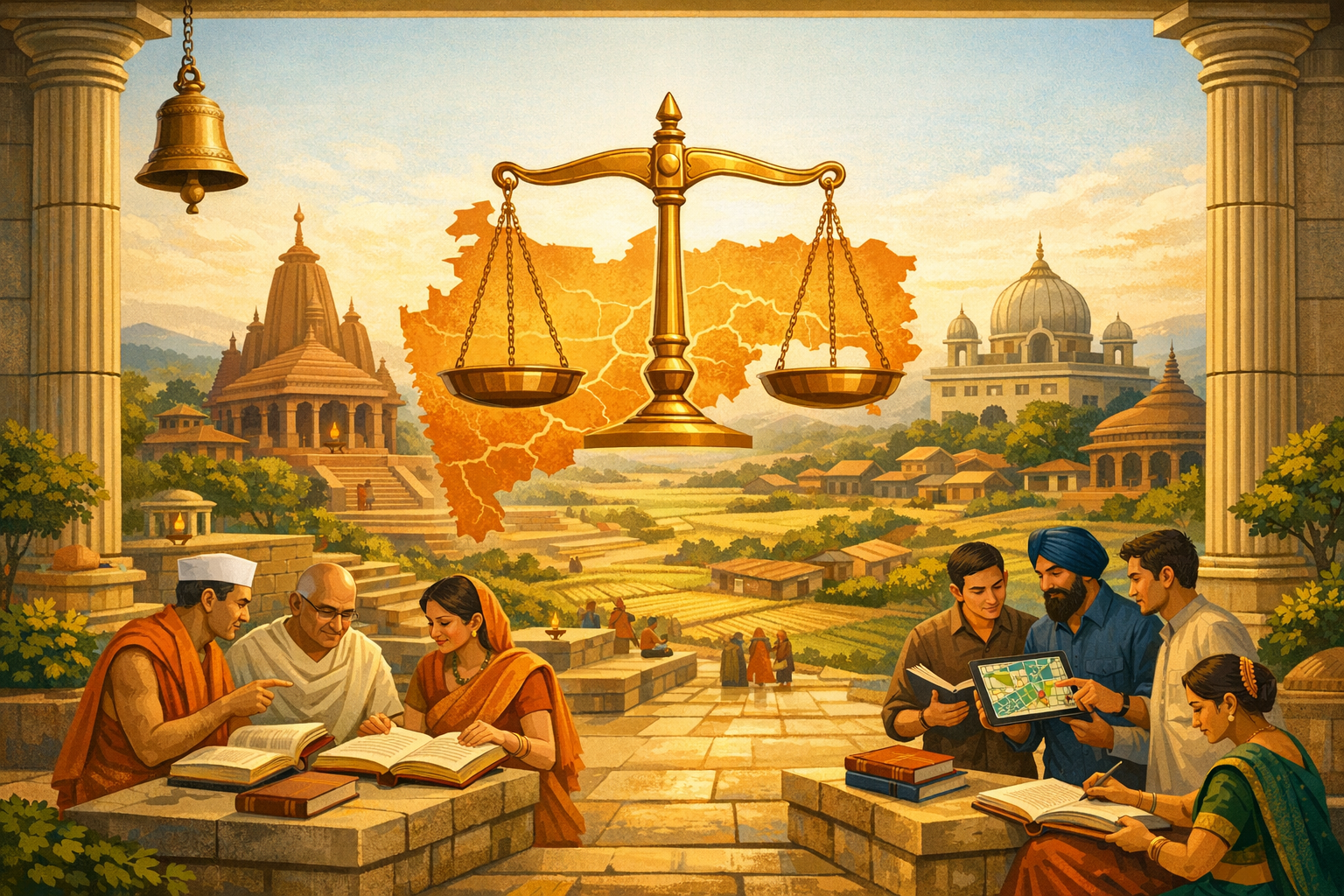
Hundreds of temple trusts across Maharashtra have coalesced to oppose the proposed Maharashtra Devasthan Inam Abolition Act, announcing a calibrated statewide program of legal objections, peaceful protests, and public-awareness campaigns. The trusts frame the initiative as a constitutional struggle to safeguard temple lands, secure religious autonomy, and preserve the long-term viability of Hindu templesprinciples that also resonate widely across dharmic institutions such as Buddhist viharas, Jain derasars, and Sikh gurdwaras.
The controversy centers on what stakeholders describe as a fresh legislative thrustreferred to in public discourse as the proposed Maharashtra Devasthan Inam Abolition Actthat, in their assessment, could expand state control over temple endowments and dilute time-tested systems of self-governance. Temple representatives argue that while reform is legitimate where mismanagement is proven, blanket measures risk weakening constitutionally protected denominational rights, the sanctity of religious customs, and the integrity of endowment lands that sustain worship and public service.
Historically, “Devasthan inams” denoted endowed lands whose income underwrote puja, anna-dana, restoration, and allied charitable functions. Maharashtra’s land-reform era produced several abolition statutes, and the state also operates under the framework of the Bombay Public Trusts Act, 1950 (now the Maharashtra Public Trusts Act), overseen by the Charity Commissioner. Trusts contend that any new or expanded intervention, especially if layered atop existing regulatory architecture, must avoid administrative duplication and ensure that reforms are narrowly tailored to legitimate secular concerns without intruding upon essential religious practices.
The constitutional compass is clear. Article 25 guarantees freedom of conscience and the right freely to profess, practice, and propagate religion, subject to public order, morality, and health. Article 26 independently assures every religious denomination the right to manage its own affairs in matters of religion, establish and maintain institutions, own and acquire property, and administer such property in accordance with law. The Supreme Court’s jurisprudencebeginning with the landmark Commissioner, Hindu Religious Endowments, Madras v. Sri Lakshmindra Thirtha Swamiar of Sri Shirur Mutt (1954)distinguishes between what is essentially religious (beyond the reach of the State) and what is secular (open to regulation for legitimate purposes).
Two other decisions frequently surface in stakeholder dialogues. In Ratilal Panachand Gandhi v. State of Bombay (1954), the Court emphasized that the State cannot regulate religious practices under the guise of administrative control. In Dr. Subramanian Swamy v. State of Tamil Nadu (2014), the Court clarified that state intervention to rectify proven maladministration must be temporary; once the mischief is remedied, administration should revert to the rightful religious authorities. These principles strongly inform current objections to any measure perceived as blanket or perpetual control of temple institutions.
Property rights, while no longer fundamental, remain protected under Article 300A: no person shall be deprived of property save by authority of law. Any law that materially reconfigures temple landholding or income streams must therefore demonstrate public purpose, ensure due process, and conform to standards of reasonableness and proportionality. Trusts warn that sweeping dispossession or reclassification of endowmentswithout adequate safeguards, compensation norms where applicable, and avenues for appealwould invite rigorous constitutional scrutiny.
Beyond doctrine, the practical stakes are substantial. Temple lands finance daily sevas, annadanam, pilgrim amenities, and repairs; they also fund schools, clinics, and relief in times of crisis. In rural Maharashtra, temple-linked ecosystems sustain priests (archakas), musicians, artisans, flower cultivators, dairy suppliers, and small businesses that depend on festival cycles. Many families recount multi-generational livelihoods connected to mandir economies; they fear that uncertainty around endowments could ripple across local markets, festivals, and cultural continuity.
Service inams historically recognized the reciprocal obligations of temple functionariesarchakas, sevayats, and other traditional service holders. If legislative changes unsettle these arrangements, communities anticipate cascading effects: disruption of hereditary knowledge systems, reduced ritual continuity, and heightened precarity for households whose skills and identities are intimately bound to temple service. Stakeholders, including legal scholars and devotees, therefore call for reforms that respect both agama and parampara while enabling transparent, modern governance.
Comparative evidence from other states offers both lessons and caution. Tamil Nadu’s HRCE model, Andhra Pradesh’s Endowments framework, Karnataka’s Muzrai institutions, and Kerala’s Devaswom Boards illustrate that robust oversight, audit, and professional management can coexist with tradition when interventions are precise and time-bound. At the same time, over-centralization, politicization of appointments, and erosion of community voice have periodically drawn judicial and public censure. The current debate in Maharashtra sits squarely within this national learning curve.
To strengthen unity across dharmic traditions, civil society interlocutors recommend a pluralist stewardship charter that applies common governance standardstransparency, probity, and accountabilitywhile honoring the internal norms of each tradition. Sikh gurdwaras, Jain derasars, Buddhist viharas, and Hindu temples share a civilizational ethic of selfless service (seva), custodianship of sacred spaces, and community kitchens. A dialogue-led approach that foregrounds this shared ethic can prevent zero-sum narratives and foster policies that protect all dharmic endowments without privileging or penalizing any tradition.
Trusts have outlined a constructive alternative to blanket abolition: a transparent, technology-enabled regulatory compact. They advocate a state-wide digital register of all temple assets; GIS-based mapping of endowment lands; mandatory publication of audited financials; ring-fenced corpus funds for core rituals and maintenance; and conflict-of-interest safeguards for trustees. They also propose independent boards with meaningful representation for practicing devotees, scholars of agama and shastras, local communities, and government nomineesbalanced to prevent capture by any single interest.
Where mismanagement is credibly established, stakeholders endorse targeted, time-limited state oversight supervised by courts or independent ombuds institutions, with a statutory sunset clause and periodic review. Subordinate legislation could codify minimum service standards, grievance redressal timelines, procurement norms, and ethical guidelines for asset leasing or monetizationensuring that revenue enhancement never compromises sanctity or ritual integrity.
The campaign announced by temple trusts blends courtroom strategy with civic pedagogy. On the legal front, potential writ petitions may test the proposed framework against Articles 25 and 26, Article 300A, and the proportionality standard, while inviting the Court to reaffirm the Shirur Mutt line of cases. On the civic front, outreach programspublic consultations, seminars with legal and economic experts, and heritage walks that showcase temple-linked ecosystemsaim to replace anxiety with informed participation and consensus-building.
Observers describe a mobilization that is resolute yet disciplined. Community elders recount packed courtyards where devotees, artisans, and scholars discuss how endowment income supports not only daily puja but also scholarships, health camps, and relief kitchens. Young volunteers have emerged as vital interlocutors, translating complex legal ideas into accessible language and gathering on-ground data on encroachments, tenancy disputes, and land-record inconsistencies that must be rectified irrespective of the fate of any single bill.
All sides acknowledge that policy clarity matters. If the legislative objective is modernization and accountability, it can be achieved through measured amendments to the Maharashtra Public Trusts Act coupled with targeted land-record reforms, rather than through blanket abolition or permanent state control of sacred assets. If the objective is to address proven abuse, remedies should be specific, proportionate, and reversible, ensuring that administration returns to religious authorities once irregularities are cured.
The immediate path forward is dialogue grounded in constitutional norms, comparative experience, and field evidence. A joint working groupdrawing from temple trusts, legal experts, revenue officials, and dharmic scholarscould produce a consensus draft that protects sacred lands, secures ritual autonomy, elevates transparency, and strengthens social service outcomes. Such a roadmap would honor India’s civilizational commitment to unity in diversity while upholding the rule of law.
In this light, the statewide agitation announced by hundreds of temple trusts should be read as a principled insistence on proportional, rights-consistent reform. By centering Articles 25 and 26, learning from Supreme Court guidance, and embracing technology-enabled transparency, Maharashtra can protect the sanctity of temple lands and secure the future of Hindu templeswhile fostering solidarity with Buddhist, Jain, and Sikh institutions that share the same dharmic commitment to service, stewardship, and spiritual freedom.
Inspired by this post on Hindu Jagruti Samiti.
