
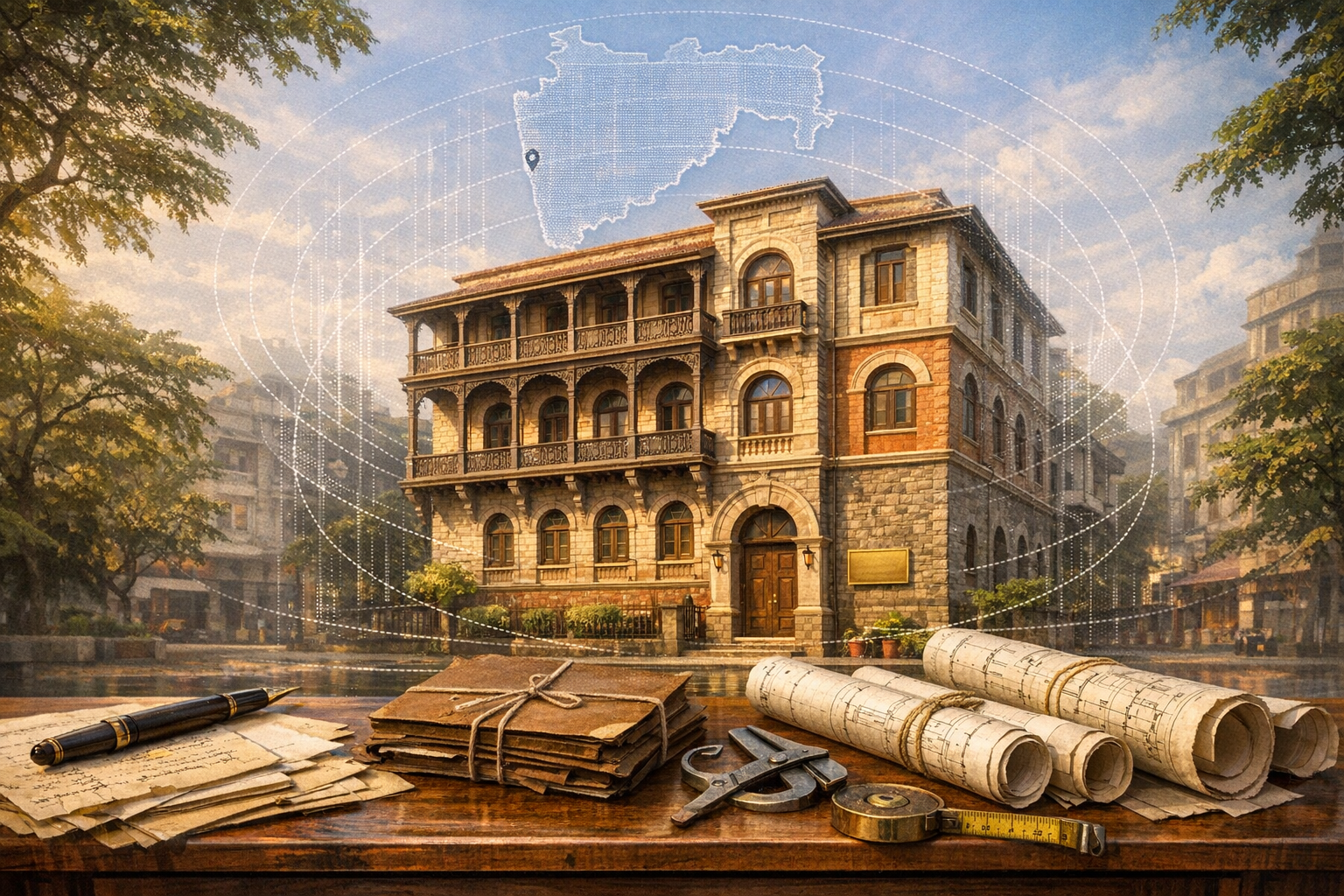
In a significant appeal to safeguard India’s modern heritage, the Hindu Vidhidnya Parishad (HVP) has urged the Maharashtra government to acquire, conserve, and pursue National Monument status for Savarkar Sadan in Mumbai. The request explicitly cites the precedent set when the state preserved Dr Babasaheb Ambedkar’s residence in London as an educational memorial, arguing for parity in heritage policy toward sites that embody the nation’s intellectual and freedom-struggle legacy.
The statement positions Savarkar Sadan as a critical node in twentieth-century Indian history, closely associated with Vinayak Damodar Savarkar (V D Savarkar)a freedom fighter, writer, and political thinker whose corpus and public life shaped debates on sovereignty, social reform, and national self-strengthening. As a lived-in workspace where correspondence, scholarship, and public engagement coalesced, the building functions as a material archive of ideas that influenced India’s transition from colonial subjugation to independence.
Drawing on the Ambedkar House example in London, HVP argues that government-led acquisition followed by professional conservation and curated public programming can translate a historically significant residence into a vibrant civic learning space. The Ambedkar precedent demonstrates how careful interpretation, documentation, and accessibility planning can connect diverse audiencesstudents, researchers, and families across dharmic traditionsto formative episodes in Indian history.
From a policy perspective, the pathway to formal protection is well established. National Monument status in India is effected through notification under the Ancient Monuments and Archaeological Sites and Remains (AMASR) Act, typically administered by the Archaeological Survey of India (ASI). A state government can initiate the process by acquiring the property through purchase or land-acquisition mechanisms, granting interim protection under state law (such as the Maharashtra Ancient Monuments and Archaeological Sites and Remains framework), and recommending national-level notification. If the site lies within Mumbai’s planning jurisdiction, heritage listing via the Mumbai Heritage Conservation Committee can provide additional interim safeguards.
Best-practice conservation would begin with a condition assessment, measured drawings, and materials characterization to inform a treatment plan. Internationally recognized charters in heritage management encourage minimum intervention, reversibility, and authenticity, ensuring that architectural fabric and interior elementsstudy rooms, libraries, inscriptions, and personal effectsare stabilized and interpreted with scholarly rigor. Digital documentation (laser scanning, photogrammetry) can strengthen archival continuity and enable virtual access for the wider public, including the diaspora.
Adaptive reuse as a memorial and research center is likely to yield maximal social value. Inclusive exhibition designmultilingual labels, tactile models, and barrier-free accesscan welcome visitors across Hindu, Buddhist, Jain, and Sikh communities, aligning with the broader dharmic ethos of learning and dialogue. Thematic galleries may situate Savarkar Sadan within longer civilizational continuities, highlighting plural strands of reform, scholarship, and service that collectively shaped India’s public life.
Educational programming can translate archival richness into lived understanding: school modules aligned with curricula on modern Indian history, teacher-training workshops in heritage interpretation, and fellowships for students researching political thought, social reform, and cultural heritage. Many visitors to comparable memorials report a powerful sense of proximity to history; carefully designed tours and community events can kindle that connection while cultivating critical, evidence-based engagement.
Economically, conservation-led regeneration can contribute to local livelihoods by creating skilled employment in documentation, conservation crafts, museum operations, and cultural tourism. Well-managed sites often serve as anchors for small businessesbookstores, crafts, and heritage walksbroadening benefits beyond the monument’s footprint. Transparent governance, clear visitor management, and calibrated ticketing (with concessions for students and researchers) can sustain operations without compromising public access.
Governance architecture will be decisive. A public trust or autonomous board with representation from conservation experts, historians, local stakeholders, and government nominees can balance scholarly integrity, community interests, and financial prudence. Publishing conservation plans, annual audits, and collection policies enhances accountability and reduces politicization risksvital for a site embedded in national discourse.
Comparative cases within IndiaGandhi Smriti in New Delhi, Jorasanko Thakur Bari in Kolkata, and state-supported archivesillustrate how residences of national figures can evolve into dynamic research and learning hubs. Aligning Savarkar Sadan with these exemplars would underscore Mumbai’s leadership in heritage preservation and cultural policy innovation while strengthening India’s distributed network of modern-history institutions.
A pragmatic roadmap could include: property due diligence and stakeholder consultations; interim state protection and emergency stabilization (if needed); a detailed project report covering conservation, interpretation, and operations; phased execution with independent technical review; and a formal proposal to the Union government for National Monument status. Integrating environmental sustainability, risk preparedness, and digitization from the outset would future-proof the institution.
HVP’s appeal ultimately converges on a shared civic aim: preserving sites that carry the intellectual labor and public service of India’s formative thinkers. Treating Savarkar Sadan with the same seriousness extended to Dr Babasaheb Ambedkar’s London residence would not only protect a building; it would strengthen historical memory, support research, and invite intergenerational dialogue across dharmic traditionsthereby deepening unity through informed, inclusive remembrance.
Inspired by this post on Hindu Jagruti Samiti.
