
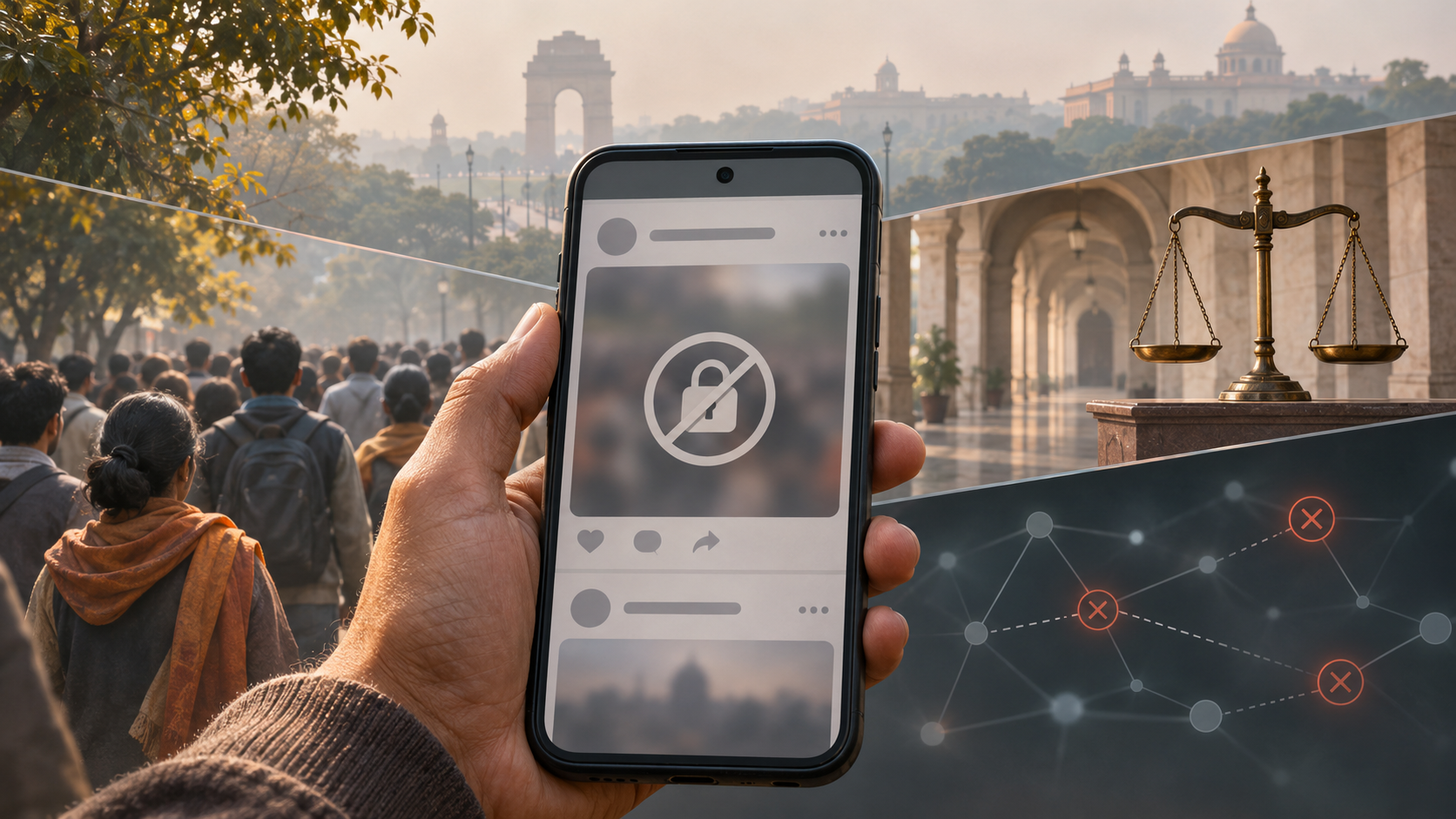
If you have encountered the Delhi protest screenshots, a withheld-post notice, or a claim that the court has already settled the matter, your immediate decision is whether to believe it, share it, or challenge it. None of those decisions should be made from the screenshot or takedown alone.
Three things have been compressed into one controversy: an unproven allegation about protest coordination, a temporary civil-court order, and social-media platforms acting on that order. Separating them lets you take the alleged misuse of Hindu identity seriously without turning suspicion into a verdict.
The order changes access, not the truth status of the chats
On 16 October 2026, Civil Judge Sahil Monga at Delhi’s Tis Hazari Courts granted Vineeta Sharma an ex parte ad-interim injunction. Sharma is an Associate Professor of Economics at Kirori Mal College, University of Delhi. The application was brought under Order XXXIX Rules 1 and 2, read with Section 151 of the Code of Civil Procedure.
The order directed X Corp, LinkedIn and Meta to remove or disable access to specifically identified material. WhatsApp was directed to act in relation to a group in which the disputed messages were allegedly circulated. X subsequently withheld posts from an account called The Story Teller in Bharat.
Those are consequential procedural facts. They establish that a court imposed an immediate restriction and that access to some material changed. They do not, by themselves, establish whether the leaked chats are authentic, whether Sharma wrote or authorised them, or whether every accusation made in the restricted posts was lawful and accurate.
In ordinary legal usage, an ex parte order is made before the opposing side has presented a full answer at that stage. An ad-interim order is temporary. Neither description makes the order meaningless: it has real effects while it operates. But neither converts it into a final judgment after a complete adversarial examination.
Some of the identified online material was alleged to advocate violence against Sharma. That issue must be assessed post by post. Factual criticism, harsh opinion, abuse, disclosure of private information and a threat are not interchangeable categories. A court may provisionally restrain particular material without deciding every disputed fact beneath the wider controversy.
Two popular conclusions therefore go too far. “The posts were withheld, so the leaked chats must be false” does not follow. “The screenshots exist, so the accused person must be guilty” does not follow either. The accurate description is narrower: a temporary order restricted identified material while the underlying accusations remained contested.
Separate the allegation, the evidence and the enforcement
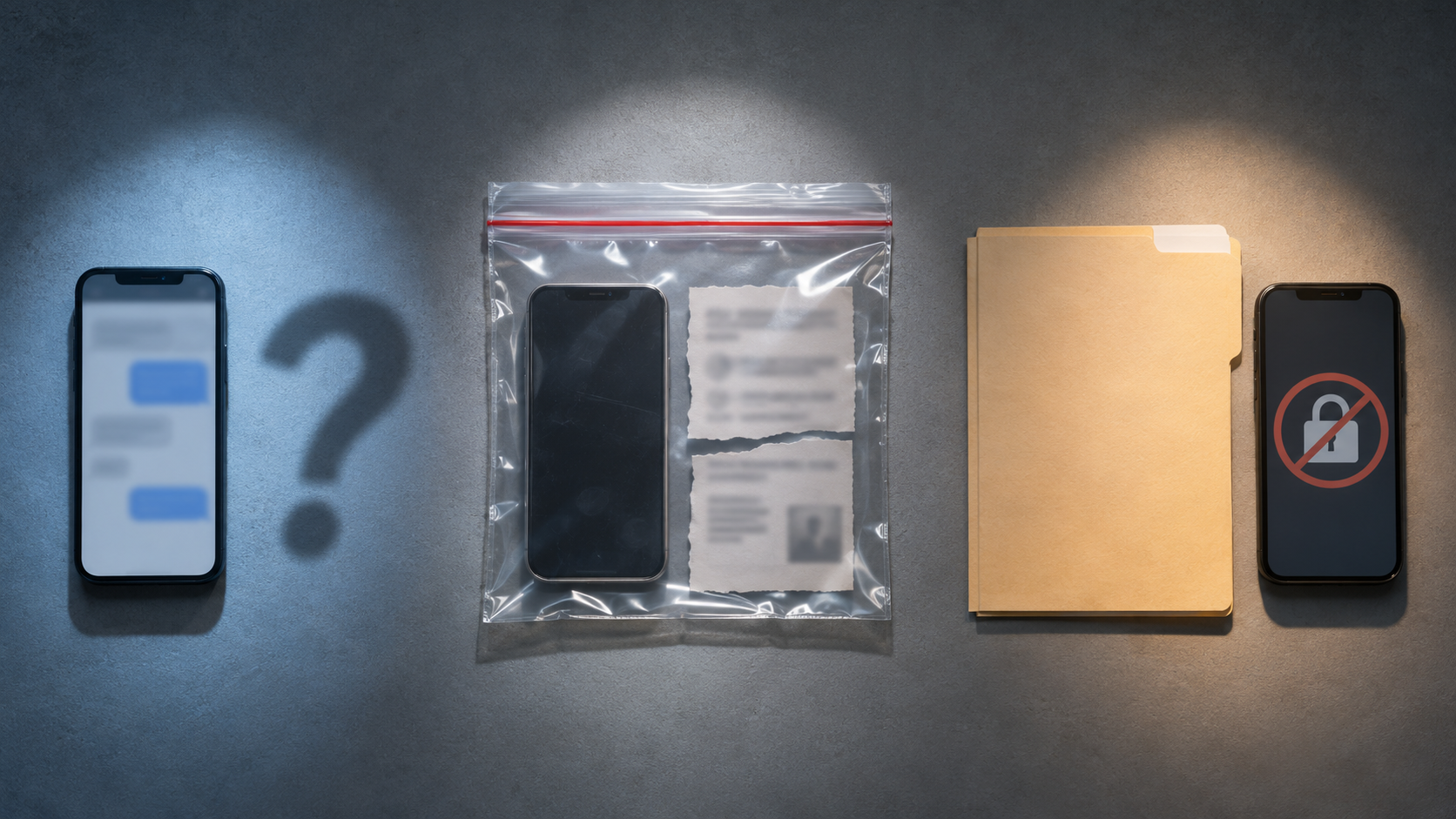
The controversy becomes easier to evaluate when you break it into five questions. Each question requires different evidence, and an answer to one cannot be smuggled in as an answer to another.
- Are the screenshots authentic? A genuine image file is not necessarily a complete record. You still need the surrounding conversation, sequence, date, participants and evidence that the image has not been selectively cropped or altered.
- Who wrote the messages? A display name, saved contact name or group membership does not conclusively identify the person operating an account at a particular moment.
- What did the messages mean? Meaning depends on the full exchange. A forwarded message, a quotation and an instruction can appear similar when isolated from their context.
- Were the public accusations expressed lawfully? Even a legitimate matter of public concern does not justify threats, doxxing or statements that outrun the available evidence.
- Why did a platform restrict access? Compliance with a legal direction establishes that a restriction occurred. It does not show that the platform independently authenticated the chats or adjudicated the accusation.
The first three questions concern the alleged conduct. The fourth concerns the conduct of people publishing about it. The fifth concerns enforcement. Collapsing all five produces the familiar but false choice between treating the allegation as proven and pretending that no investigation is warranted.
Personal and political associations are especially poor substitutes for this analysis. The identity of a lawyer, the lawyer’s other clients, the perceived ideology of an academic, or the politics of an online account cannot authenticate a WhatsApp export. Those details may drive attention, but they do not establish authorship.
A defensible account can be stated in three sentences: A Delhi civil court issued an ex parte ad-interim order directing platforms to disable identified material concerning Vineeta Sharma. Circulating screenshots allegedly contain instructions connected with protest activity and the adoption of Hindu markers. The authenticity, authorship and full context of those screenshots were not resolved merely by the interim takedown.
Why the alleged use of Hindu markers warrants scrutiny

The disputed messages allegedly urged young demonstrators to display “Kasab energy” and wear tilak, kalawa and saffron shawls while confronting police. The phrase invokes Ajmal Kasab, the 26/11 Mumbai attacker, and the use of Hindu identifiers to misdirect attribution.
If genuine and accurately attributed, such instructions would not amount to harmless political theatre. They would suggest an attempt to manufacture the visual identity of a confrontation so that observers, police or cameras associated it with Hindus. The injury would extend beyond one protest: religious markers carried in ordinary life could be made to look like evidence of an organised political role.
A tilak or kalawa is not merely a costume element. Saffron also carries religious, civilisational and political meanings that vary by setting. Using these markers deceptively would exploit that recognisability while shifting risk onto people who wear them sincerely.
The conditional phrase “if genuine and accurately attributed” is essential. If a screenshot were fabricated, edited or falsely assigned, the accusation itself could become a method of branding an innocent person as an anti-Hindu conspirator. Seriousness is a reason to demand stronger evidence, not a licence to lower the threshold.
You should also resist the reverse error: do not assume that every saffron-clad or tilak-wearing person at a protest is a planted actor. Religious appearance cannot prove political affiliation, intent or guilt. Look instead for evidence of an instruction issued before the event, reliable attribution to its author, corroboration from participants and observable conduct consistent with the instruction.
This is where a Dharmic concern for truth has practical force. Defending Hindu symbols does not require accepting every allegation made in their defence. It requires refusing both their deceptive use and the careless use of unverified claims about that deception.
Use this protocol before publishing or forwarding anything

If you run a community page, participate in political discussion, or simply want to forward the claim to family and friends, use a verification process that preserves both accountability and fairness.
- Obtain the operative order. Confirm the court, case name, date, parties, identified URLs and exact directions. Read the operative portion rather than relying on a paraphrased headline. Check whether the restraint concerns specific posts, an account, a group, a geographic territory or some combination of these.
- Record the platform action precisely. Save the notice, URL, account name, date of observation and wording shown to you. Say “withheld in Bharat” if that is what the notice establishes; do not silently enlarge it into “deleted worldwide” or “proved false.”
- Preserve material without evading the order. Keep lawful records needed for verification, but do not mirror restricted content merely to defeat a court direction. If you are named in the proceeding, served with an order or uncertain whether republication is covered, obtain advice from a qualified Indian lawyer before acting.
- Trace the screenshot to its earliest available form. Ask who captured it, from which device or account, whether a full chat export exists, and what appears immediately before and after the disputed lines. A chain of reposts leading back only to another cropped image is not independent corroboration.
- Separate account identity from authorship. Establish who owned the number or account, who had access, whether the message was original or forwarded, and whether another participant can independently confirm the exchange. Do not infer authorship solely from a contact label.
- Seek evidence from more than one side. Look for a response from the accused person, confirmation from participants, the position of protest organisers and any independently preserved copy. Silence is not an admission, and repetition by multiple accounts is not corroboration when all of them rely on the same image.
- Write at the strength of the evidence. Use “alleged,” “appears to show” and “has not yet been authenticated” where those qualifiers are accurate. Reserve “wrote,” “directed” and “organised” for claims supported by evidence that actually establishes those acts.
- Remove threats and personal targeting from the discussion. Do not publish private addresses, phone numbers or calls for confrontation. If you encounter a credible threat, preserve it and report it through appropriate legal or platform channels rather than amplifying it to an audience.
You can criticise the breadth, reasoning or ex parte character of a restriction without claiming that the underlying chats have been proved. You can also demand a proper inquiry into the chats without endorsing harassment. Holding both positions is not evasiveness; it is the discipline required when evidence and procedure are still developing.
Key takeaways
- The 16 October 2026 order imposed an immediate but interim restriction; it was not a final adjudication of the leaked-chat allegations.
- A platform withholding posts in response to a court direction does not authenticate or disprove the material in those posts.
- The alleged instruction to adopt tilak, kalawa and saffron clothing is serious because it could manufacture a Hindu identity for a confrontation, but the screenshots still require authentication and reliable attribution.
- Evaluate the order, the screenshots, authorship, context and platform action as separate questions.
- Do not evade legal restrictions, issue threats or publish private information. Preserve evidence, qualify unresolved claims and seek Indian legal advice if an order directly affects you.
The next responsible step is not silence. It is a fair examination in which the affected parties can answer, the complete digital material can be tested, and the scope of any continuing restriction can be explained. Until that happens, neither a takedown notice nor a viral screenshot can carry the weight of a final finding.
Before you share the controversy, write down one sentence stating what is verified and a second stating what remains unresolved. If you cannot keep those sentences separate, pause. Ask for the order, ask for the provenance of the chat, and refuse to turn a demand for accountability into a campaign of personal abuse.
References

Leave a Reply
You must be logged in to post a comment.