
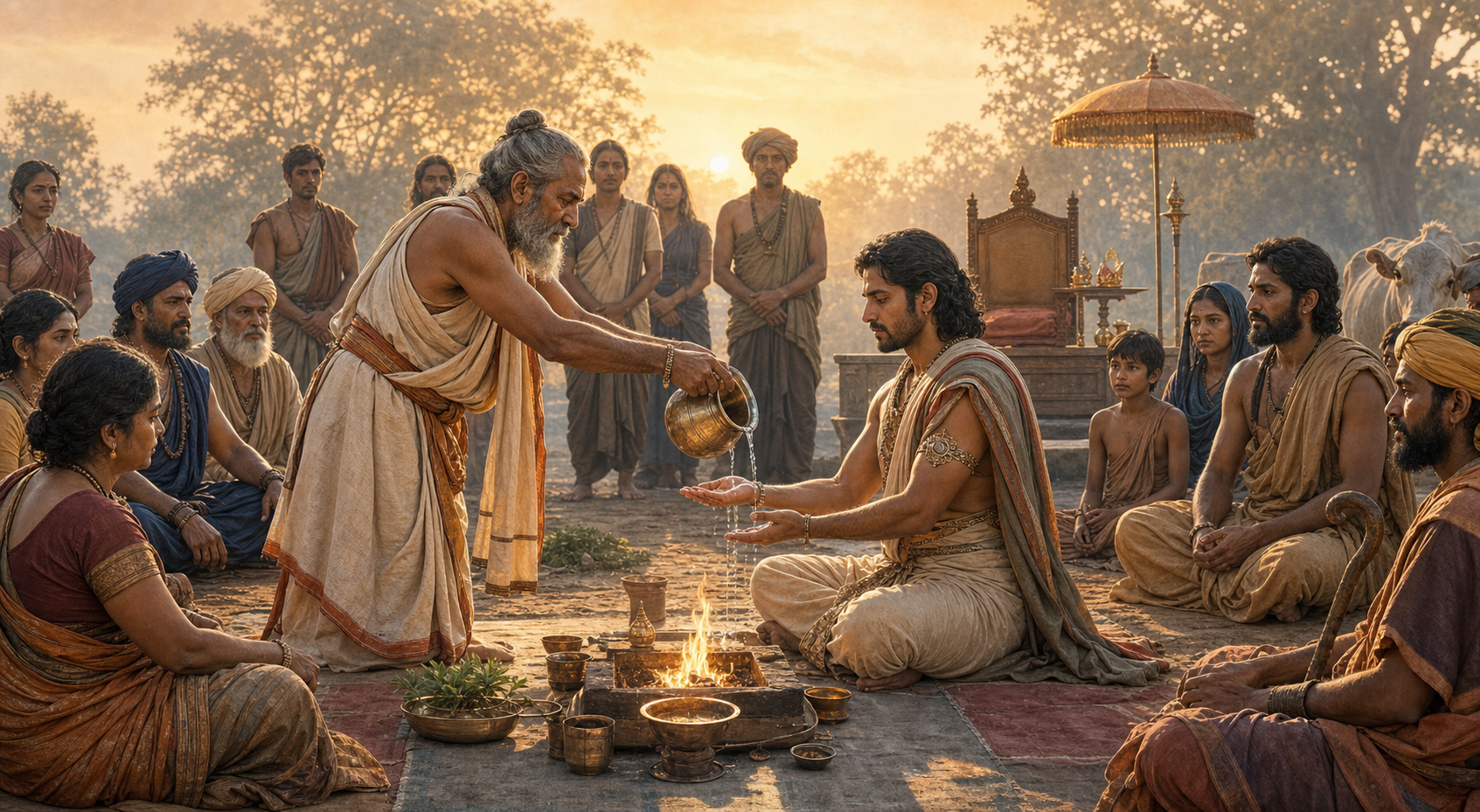
If you are trying to decide whether Bhaujya is merely an old word for kingship or a usable standard of political legitimacy, begin at the coronation. The decisive act is not the ruler displaying power. It is the ruler accepting an obligation.
That changes how you read Vedic sovereignty. The first question is not who stands at the top. It is what binds the person at the top, whom that power must protect, and what forms of self-rule remain beneath or alongside it. Bhaujya helps you separate a Dharmic account of authority from the decorative use of Dharmic vocabulary.
The coronation oath is the hinge of Bhaujya

Bhaujya operates at two connected levels. It belongs to the vocabulary of sovereignty, but it also identifies the oath-bearing dimension of the Aindra Mahabhisheka preserved within the Aitareya Brahmana. Rule is therefore presented not only as a status that the sovereign receives, but as a burden that the sovereign agrees to carry.
The word is associated with a semantic field that includes enjoyment, protection, and lordship. It should not be forced into a single English equivalent. The range itself is instructive. Royal enjoyment is legitimate only within a protective relationship. Lordship cannot be detached from the welfare of those over whom authority is exercised. What might otherwise look like possession becomes stewardship.
The Aindra Mahabhisheka makes that relationship audible and public. Anointing, sacred waters, regalia, vows, and the invocation of Indra’s protective might place royal power inside an inherited sacred order. The sovereign does not create legitimacy simply by wanting office or possessing force. Authority is conferred through a rite that also declares its proper purpose.
This is why consecration should not be mistaken for automatic moral approval. A rite does not make every subsequent decision Dharmic. It establishes the standard by which the ruler can fail. The oath matters precisely because power and Dharma can come apart in practice. Once the obligation has been spoken, royal conduct can be judged against it.
The emphasis also distinguishes the Aindra Mahabhisheka from nearby royal forms. The Rajasuya foregrounds acknowledgment of kingly standing, while the Ashvamedha proclaims uncontested range. The Mahabhisheka places particular weight on moral induction into rule. These rites belong to a related political world, but they do not dramatize the same aspect of sovereignty.
A comparison with a modern constitutional oath can clarify the principle, provided you do not turn resemblance into identity. Both place office under a prior commitment. A Vedic coronation rite, however, is not a written constitution, and the rite by itself does not supply modern mechanisms of legal enforcement. Its restraint is sacred, ethical, public, and political within its own institutional setting.
When you encounter a translation that reduces Bhaujya to royal enjoyment, ask three questions. Who is meant to flourish? What protective duty accompanies the privilege? Where is the ruler’s obligation expressed? If those elements disappear, the translation may preserve one shade of the word while losing its political force.
Five sovereignty terms describe five dimensions of rule
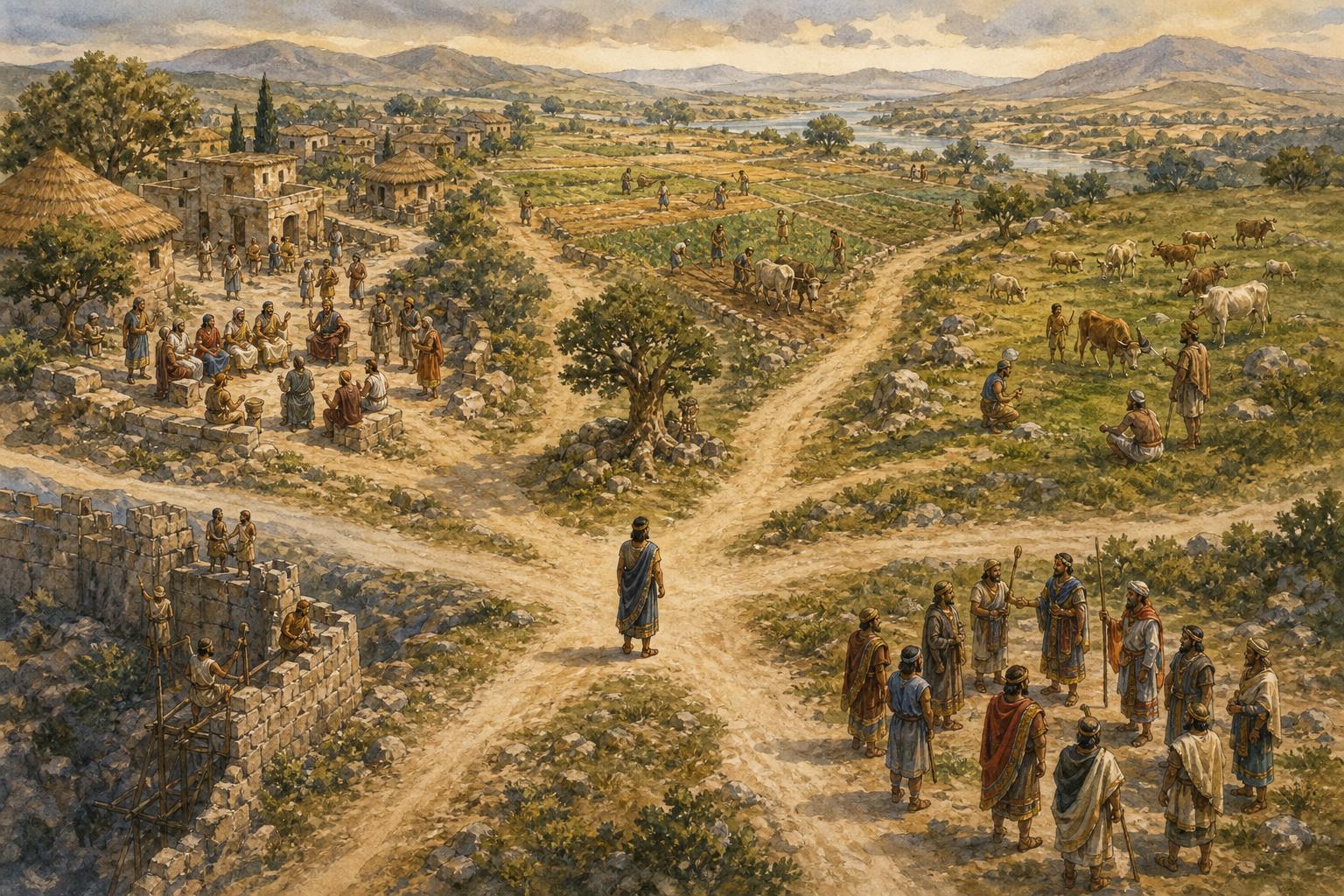
The coronation formula places Bhaujya among five terms: samrajyam, bhaujyam, svarajyam, vairajyam, and paramestya. They should not be treated as ornamental synonyms for supreme power. Each brings a different political relationship into view, and their meanings can shift with context.
| Term | Political dimension | Misreading to avoid |
|---|---|---|
| Samrajyam | Recognized overlordship within a wider network of allied or related polities | Unlimited central control over every local institution |
| Bhaujyam | Lordship joined to protection, shared welfare, and an oath-bound burden | The ruler’s private enjoyment of land and people |
| Svarajyam | Internal self-rule and the capacity to govern one’s own sphere | Isolation from every larger political relationship |
| Vairajyam | Freedom from external domination or a rival overlord | Freedom from Dharma, duty, or accountability |
| Paramestya | A culminating or supra-regal station associated with cosmic assent | A license to override the normative order that legitimates rule |
The most useful distinction is between svarajyam and vairajyam. Svarajyam concerns the positive ability to order one’s own political sphere. Vairajyam concerns freedom from subordination to another power. A community can be free from a foreign overlord yet lack effective self-government. Conversely, a polity can retain meaningful internal autonomy while participating in a wider order. The vocabulary gives you separate names for those separate conditions.
Samrajyam and svarajyam therefore need not cancel each other. Wider coordination can coexist with internal self-rule when authority is layered rather than totalized. The larger order manages common concerns and recognized relationships; constituent communities retain responsibility for matters proper to them. That is the conceptual opening through which confederative, federative, and subsidiary arrangements can be considered, although none of those modern labels should be imposed as an exact translation.
Bhaujyam gives this political spectrum an ethical center. The other terms help answer where authority stands and how one sphere relates to another. Bhaujyam presses the prior question of what the authority is for. Protection and well-being are not benefits that a ruler may add after securing supremacy. They belong to the meaning of rightful lordship.
Paramestya can be misused if apex authority is imagined as release from restraint. Within a Dharma-bound frame, elevation increases the burden of alignment with the cosmic and normative order. The highest seat is not the point at which duty ends. It is the point at which failures of duty have the widest consequences.
You should also resist reading the five words as a rigid ladder through which every ruler had to climb. Their safer use is as a map of political dimensions: wider recognition, protective stewardship, internal competence, external independence, and culminating authority. That reading preserves their distinctions without inventing an administrative sequence that the vocabulary alone cannot prove.
The later language of Swaraj echoes the older svarajyam while changing its political setting. Modern anti-colonial self-rule concerned a people reclaiming political agency, not merely a king receiving consecration. The continuity lies in the claim to govern one’s own sphere; the bearer and institutions of that claim changed. Recognizing both continuity and transformation is more accurate than presenting modern Swaraj as either wholly new or an unchanged survival.
Dharma gives sovereignty a job, a method, and a limit
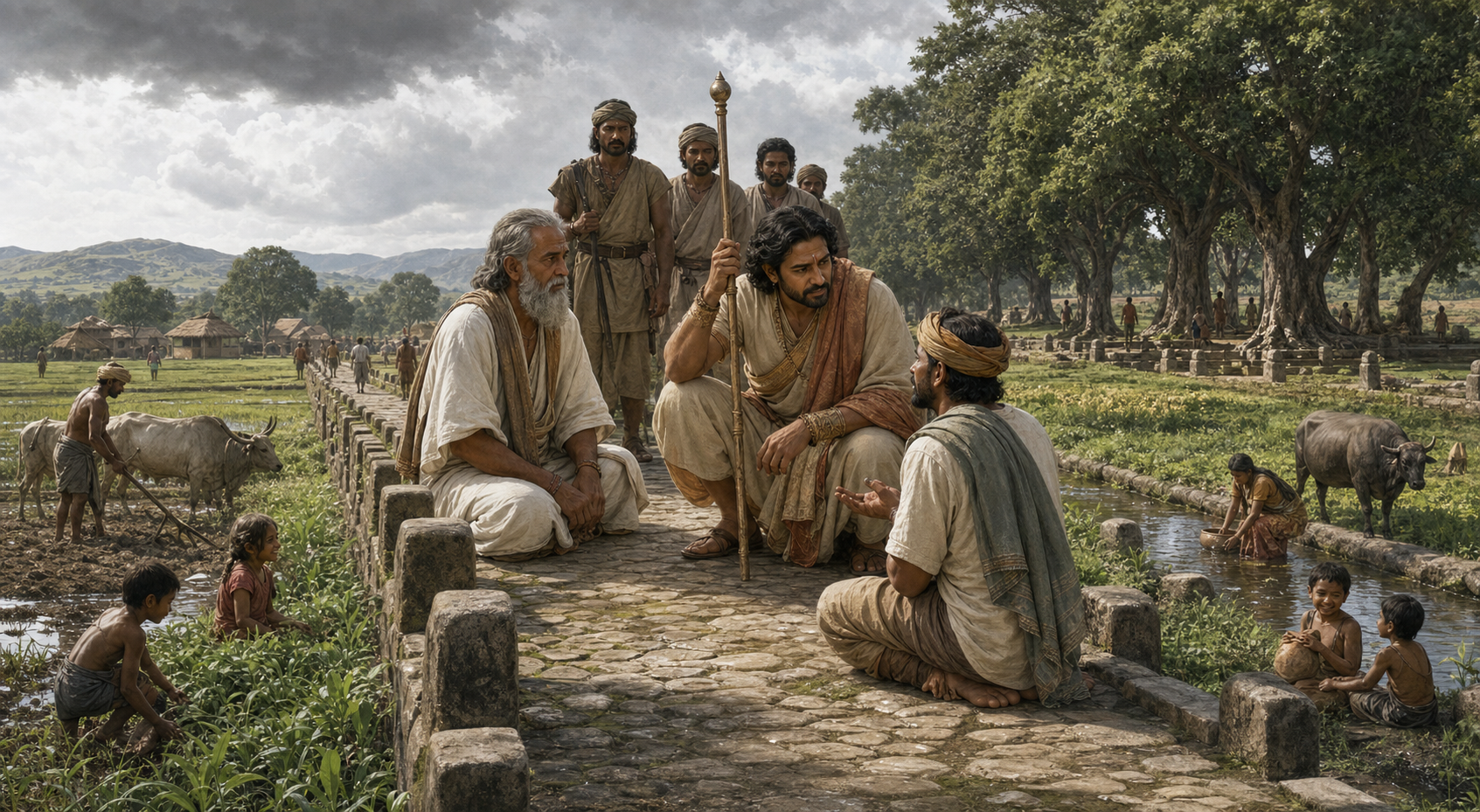
Dharma-bound rule is sometimes reduced to the ruler’s personal piety. That is too narrow. A sovereign may perform rites and still govern unjustly. Political Dharma becomes visible in what power protects, how justice is administered, and whether force remains proportionate to the order it is meant to defend.
- Protection covers life, property, inherited custom, and legitimate ritual practice. Security is not merely protection of the throne.
- Justice requires fair administration rather than unpredictable favor. The wielder of authority is responsible for sustaining order, not free to replace order with appetite.
- Danda, or coercive power, remains available, but its use is measured by Dharma. Bhaujya does not require a powerless state; it requires disciplined force.
- Lokasangraha, the holding together of society, makes social cohesion a duty of rule. Power that deliberately fractures the community for private advantage defeats its own stated purpose.
- Yogakshema joins protection with assured well-being. Survival, stability, and the conditions of flourishing belong in the same field of royal responsibility.
This ethical account still needs administrative capacity. The material elements associated with statecraft include the king, ministers, territory and people, fortifications, treasury, army, and allies. A ruler who professes benevolence but neglects counsel, revenue, defense, or alliances cannot reliably protect the realm. Good intentions without functioning institutions leave the oath unfulfilled.
The distinction explains why the Mahabhisheka, the Arthasastra’s state elements, and rajadharma associated with Dharmasastra and the Shanti Parva illuminate different parts of the same problem. Consecration establishes moral orientation. Statecraft explains the organs and resources through which rule operates. Rajadharma elaborates duties, restraints, and procedures surrounding the exercise of danda. No single layer should be made to carry the whole theory.
Authority also existed in a plural institutional environment that included sabha, samiti, gana-sanghas, guilds, and village assemblies. Their form and influence were not identical in every region or period. Even so, their presence warns against picturing ancient Bharatiya governance as one undifferentiated line of command from ruler to subject.
It would be equally careless to rename this entire world a modern democracy. Community deliberation, corporate bodies, local assemblies, and layered authority do not automatically amount to universal citizenship or contemporary constitutional government. The responsible conclusion is more precise: Vedic and later Dharmic political life could accommodate multiple centers of agency, and royal power often had to work through an institutional landscape rather than erase it.
Keep three distinctions in view when you interpret Bhaujya:
- Separate the normative ideal from historical performance. An oath tells you what conduct was authorized and expected; it does not prove that every consecrated ruler kept it.
- Separate ritual legitimacy from governing competence. Sacred induction can orient power, while ministers, revenue, defense, justice, and local institutions determine whether duties can be performed.
- Separate wider unity from administrative absorption. Samrajyam can coordinate several political spheres without requiring svarajyam to disappear inside a single centralized apparatus.
These distinctions prevent two opposite mistakes. One is romanticism: assuming that sacred vocabulary guaranteed perfect government. The other is reductionism: assuming that ancient sovereignty meant nothing beyond force. Bhaujya matters because it records a serious attempt to bind force to a publicly articulated moral purpose.
The pan-Dharmic parallel is ethical, not identical
Bhaujya becomes more illuminating when placed beside cognate ideas across Dharmic traditions, but comparison requires discipline. Buddhism, Jainism, Sikhism, and the Vedic tradition do not share one interchangeable theology of kingship. Their strongest convergence lies in a civilizational refusal to treat power as self-justifying.
The Buddhist Chakravartin and dharmaraja ideals direct authority toward righteous order. Jain accounts of the Chakravarti stand beside an especially demanding concern with ahimsa in the conduct of rule. Sikh thought joins temporal and spiritual responsibility through miri-piri and directs collective concern toward sarbat da bhala, the welfare of all. Bhaujya joins this conversation by insisting that lordship carries a protective and welfare-bearing obligation.
Ritual comparison needs an even narrower claim. Vedic Mahabhisheka, Buddhist initiatory abhisheka, Jain image abhisheka, and Sikh gurgaddi succession differ in purpose, object, and theology. They should not be collapsed into one rite. At a broad structural level, however, each resists the idea that sacred authority is merely self-created. Responsibility is received through inherited memory, disciplined practice, and a community that recognizes something higher than personal appetite.
If you want to speak of pan-Dharmic unity without erasing differences, use a three-part method:
- Name each tradition’s own concept before comparing it. Do not make Bhaujya a substitute name for Chakravartin, ahimsa, miri-piri, or sarbat da bhala.
- Compare the relationship between power and ethical obligation. That is firmer ground than claiming identical metaphysics, rituals, or political institutions.
- State the boundary of the comparison. Shared concern for restrained and welfare-oriented authority does not eliminate doctrinal differences about violence, renunciation, kingship, community, or liberation.
This approach strengthens civilizational kinship because it does not depend on pretending that every Dharmic path says the same thing. Unity becomes a disciplined recognition of related moral questions: How is authority received? What limits it? Whom must it serve? What good beyond the officeholder gives it legitimacy?
Use Bhaujya as a practical test of political claims
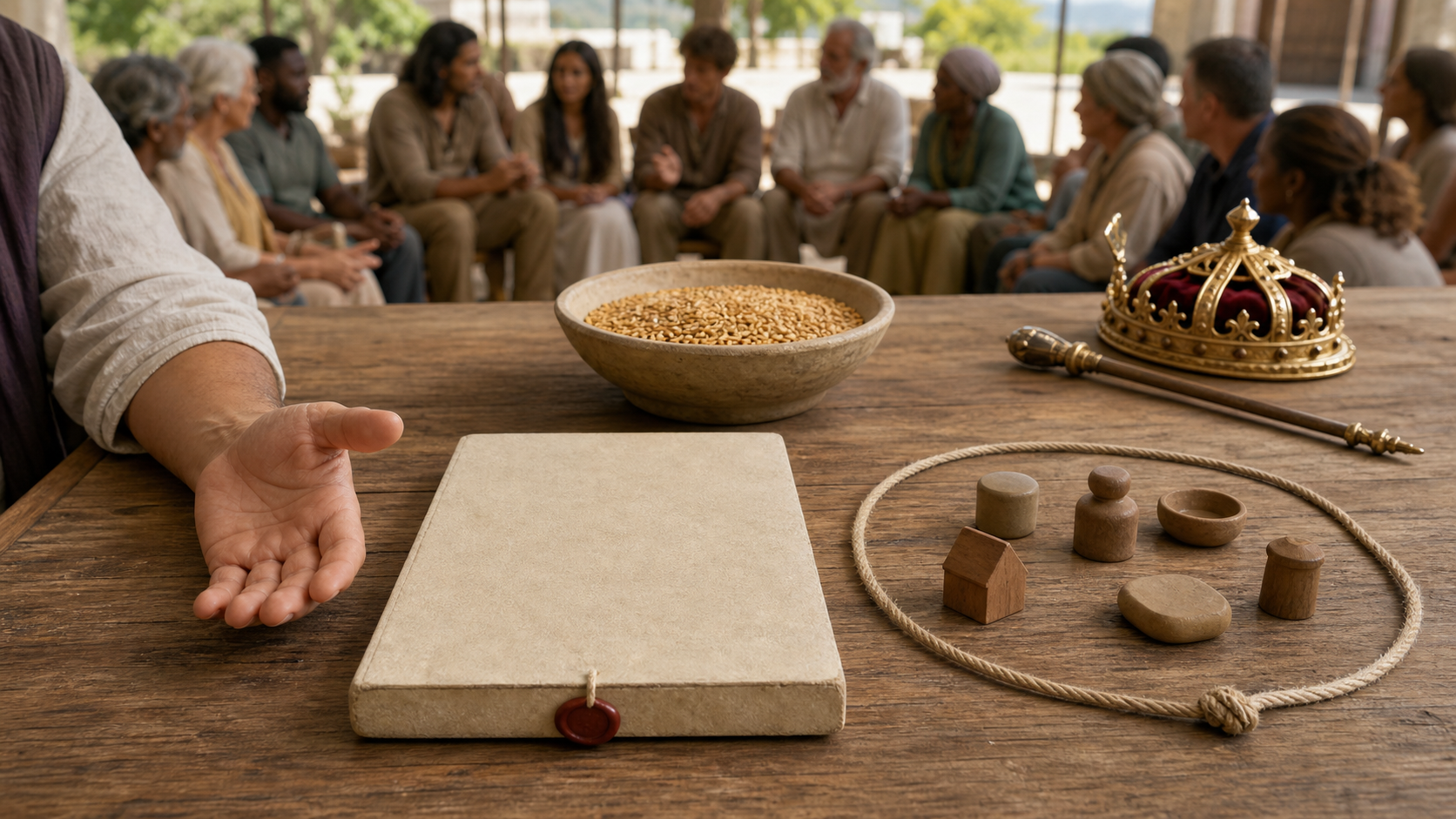
When a speech, manifesto, or historical argument invokes Vedic sovereignty, you do not have to accept or reject it on symbolism alone. Run the claim through five questions. The answers will show whether Dharma is governing power or merely decorating it.
- What binds the ruler before power is exercised? Look for an obligation that precedes privilege. If a political vision celebrates titles, conquest, grandeur, or obedience but cannot name the sovereign’s burden, it has omitted the oath at the heart of Bhaujya.
- Who receives protection and well-being? Ask whether life, property, custom, legitimate worship, justice, and social stability are protected across the community. Welfare reserved for loyal factions is patronage, not lokasangraha.
- What disciplines danda? A serious theory must explain when coercion is justified, how it remains measured, and what prevents it from becoming personal vengeance. Dharma-bound sovereignty is not state weakness, but neither is security a blank authorization.
- Which spheres retain self-rule? Identify what belongs to villages, guilds, communities, constituent polities, or other local bodies. If wider unity requires every lower institution to surrender meaningful agency, samrajyam has swallowed svarajyam instead of coordinating with it.
- Can the state perform what it promises? Examine counsel, territory and people, defenses, treasury, armed capacity, and alliances. Moral language without administrative ability cannot deliver yogakshema; capacity without moral direction turns the state elements into instruments of extraction.
The pattern of failure is revealing. Without a binding promise, sovereignty becomes sacralized preference. Without a clearly protected public, welfare becomes factional reward. Without limits on danda, protection becomes an excuse for domination. Without local agency, unity becomes absorption. Without capacity, the oath becomes aspiration without delivery.
This is not a numerical scorecard, and it cannot settle every modern policy dispute. It is a way to expose incomplete claims. Different institutions may answer the five questions differently, but a recognizably Bhaujya-shaped order must answer all of them.
Key takeaways
- Bhaujya is not just a title of lordship. It is an oath-bearing form of sovereignty in which privilege is joined to protection and public responsibility.
- Samrajyam, bhaujyam, svarajyam, vairajyam, and paramestya identify distinct dimensions of rule rather than five interchangeable words for supremacy.
- Dharma limits both the ends and the methods of government: justice, social cohesion, welfare, and measured force belong together.
- Layered authority allows wider political unity to coexist with meaningful self-rule; coordination need not require total centralization.
- Pan-Dharmic parallels are strongest at the ethical level. Shared resistance to self-justifying power does not make different doctrines or rites identical.
- Modern constitutional comparisons can clarify Bhaujya, but they remain comparisons. The Vedic rite should not be credited with institutions it does not itself establish.
The next time you hear Vedic sovereignty invoked, ask for the vow, the beneficiaries, the restraint on force, the protected spheres of self-rule, and the means of delivery. If these cannot be named, the invocation is ornamental. Bhaujya demands the harder standard: power deserves Dharmic legitimacy only while it bears Dharmic duty.