
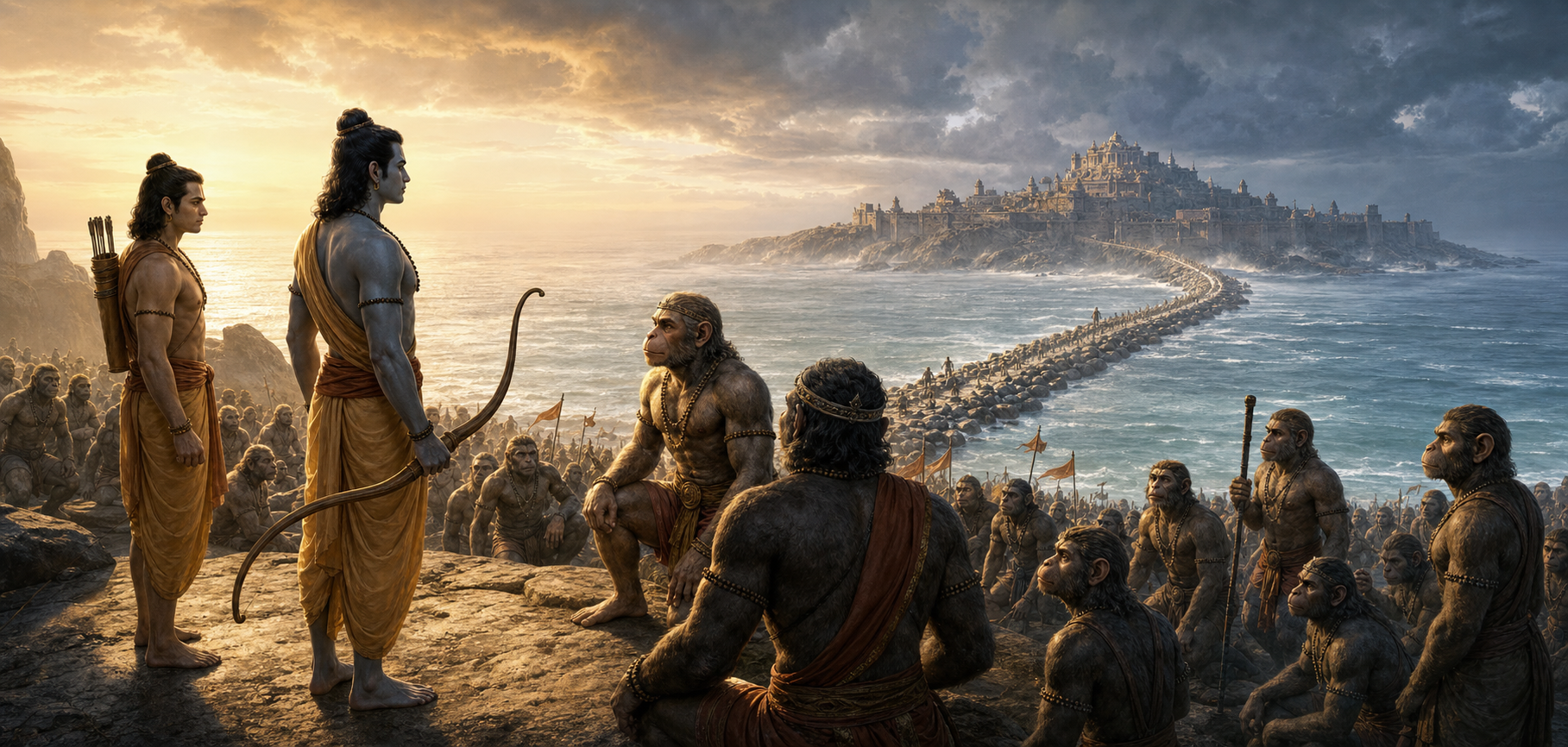
If you want to understand why Rama’s Lanka campaign is remembered as more than a victory tale, don’t begin with the final duel. Begin with the order of decisions: verify Sita’s location, study Lanka’s defences, organize the coalition, solve the sea crossing, offer Ravana a peaceful exit, and only then escalate.
That sequence gives you a disciplined way to read the Yuddha Kanda. Strategy explains how the campaign advances. Symbolism explains why its movements matter. Keep the two together, without confusing later devotional imagery with the earliest narration, and the campaign becomes a practical study of leadership under dharma.
Key takeaways
- Hanuman’s reconnaissance turns grief into a defined mission. Reliable intelligence comes before mobilization.
- Rama Setu is not only a miracle motif. In the Valmiki narration, it is also an achievement of engineering, coordination and logistics.
- Rama approaches the ocean before compelling a response and sends Angada to Ravana before the decisive fighting. Dharma governs the sequence of escalation.
- The Vanara coalition succeeds through distributed command: different leaders carry different parts of the mission according to their abilities.
- The image of Rama riding Hanuman and Lakshmana riding Angada is powerful later iconography, but it is not an explicit scene in the Valmiki Ramayana.
Intelligence makes the campaign possible
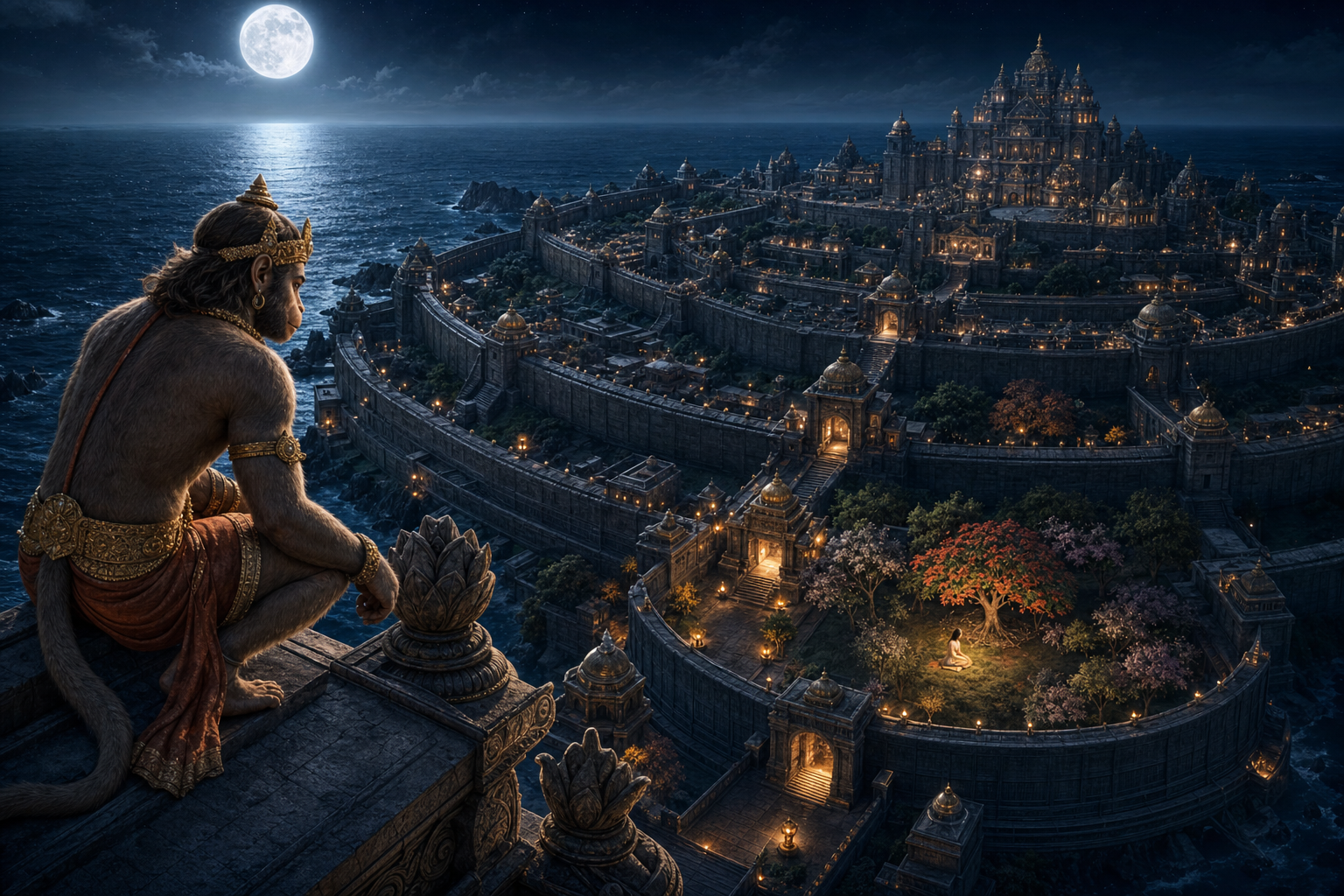
Rama cannot responsibly move an army merely because he believes Sita has been taken to Lanka. He needs confirmation, knowledge of the objective and some understanding of the terrain. Hanuman supplies all three. He returns with Sita’s location in Ashoka Vatika, her chudamani and a working picture of Lanka’s defences.
The chudamani matters strategically as well as emotionally. It authenticates Hanuman’s report and removes a dangerous ambiguity: the army now knows that Sita lives and can be reached. His observations of gates, moats, ramparts and the Rakshasa capacity for surprise and sorcery convert a general desire to act into a concrete operational problem.
Notice what Hanuman does not do. He does not confuse courage with sufficient knowledge. His extraordinary strength enables reconnaissance, but disciplined observation makes the reconnaissance useful. In this episode, bhakti does not replace competence. Devotion gives the mission its fidelity; competence gives that fidelity an effective form.
You can use the same distinction whenever a community faces an urgent decision. Separate what has been directly verified from what has merely been repeated. Identify the objective before discussing methods. Map the route, the obstacles and the opponent’s likely responses. If the facts are still uncertain, more enthusiasm will not repair the plan.
The coalition then organizes around capability. Sugriva assigns responsibilities among Angada, Nala, Nila, Jambavan, Sushena, Rishabha, Gavaya and other commanders. The Vanaras are not a conventional chariot or cavalry force. They exploit mobility, leaping attacks, audible signals and familiarity with difficult terrain. Water, fruit and foraged supplies have to move with the host rather than appearing as an afterthought.
This is distributed command, not disorder. A clear central purpose allows subordinate leaders to act within their strengths. Hanuman is suited to high-risk intelligence and decisive service. Angada combines royal standing with the fearlessness required of an envoy and field commander. Nala and Nila carry the engineering burden. Jambavan contributes experienced judgment. Rama’s willingness to honor Vibhishana’s counsel shows another part of the same discipline: useful truth is not rejected merely because it comes from an unexpected quarter.
The practical test is simple. If every important decision must pass through one person, you do not yet have a resilient coalition. State the mission clearly, assign work by demonstrated capacity, and make each commander’s area of responsibility unmistakable. Loyalty becomes stronger when it has a precise duty to perform.
The setu turns devotion into organized capacity
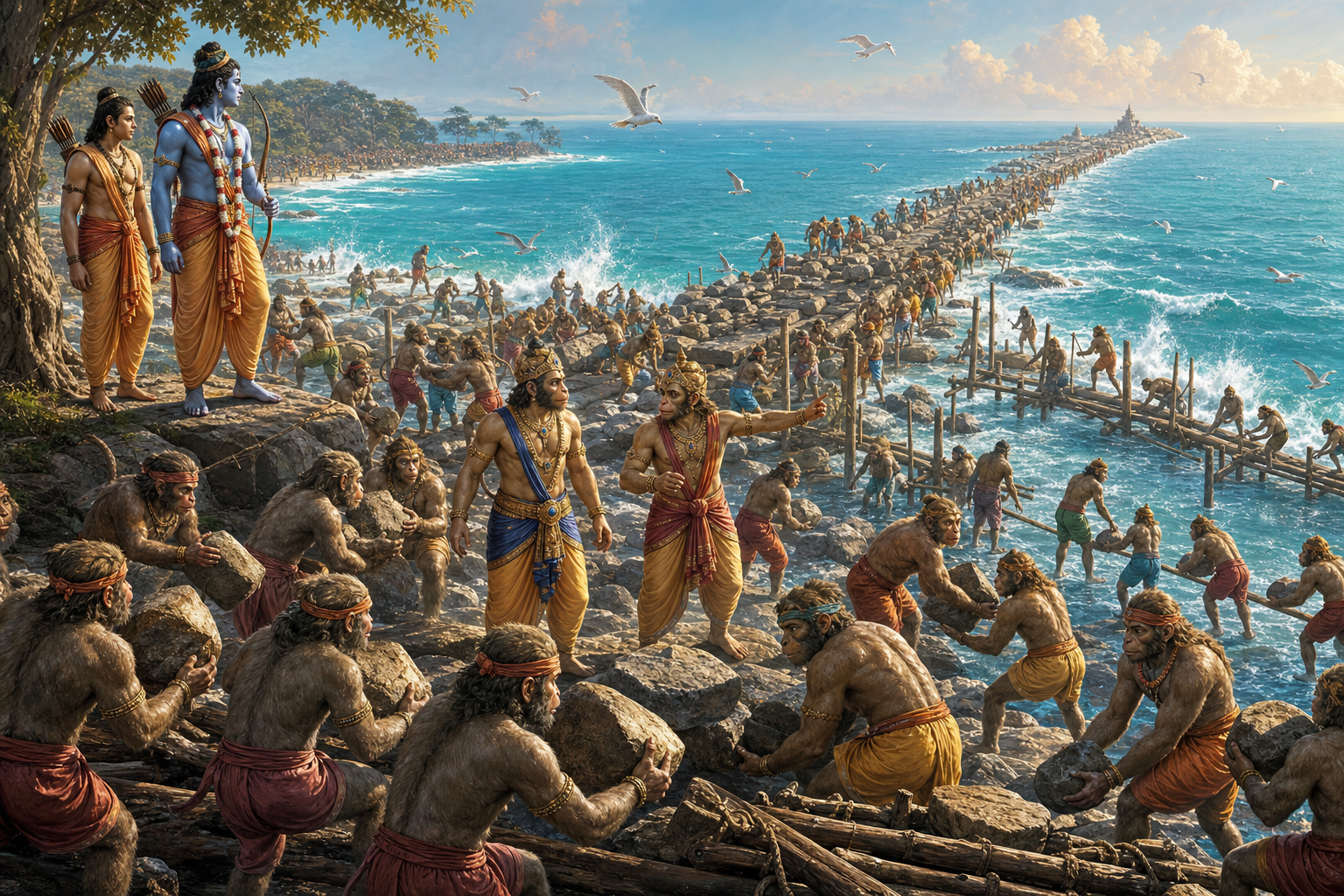
The ocean is the first obstacle that courage alone cannot overcome. An individual Vanara may leap across it, as Hanuman has already shown, but an army needs a route that can carry many bodies, supplies and the confidence that both will arrive together. The difference between a heroic feat and a campaign is repeatability.
Rama first treats the ocean as a presence to be approached, not as inert matter to be seized. In the Yuddha Kanda, he fasts for three days and seeks the cooperation of Samudra Deva. When no response comes, he demonstrates his resolve with an arrow. The ocean then appears and directs him toward an engineering solution.
The order is crucial: appeal, patience, controlled demonstration and practical construction. Restraint is not indecision, because Rama eventually acts. Resolve is not wanton destruction, because force remains bounded by the mission. The encounter refuses two easy errors at once. Reverence does not become passivity, and power does not become permission to harm without limit.
Nala supervises the setu, drawing on the engineering inheritance associated with Vishvakarma, while Nila helps coordinate labor and materials. Vanaras bring trees, logs, rocks and boulders; teams place and stabilize them; the route grows through repeated, organized work. The causeway is completed over several days so that the full army can cross.
Grand dimensions expressed in yojanas communicate epic scale, but they should not distract you from the operational point. Materials must be gathered, transported, placed and checked. The crossing must support the slowest parts of the force, not merely its greatest champions. Morale depends on seeing that a seemingly impossible route has become stable beneath one’s feet.
Later devotional lore celebrates stones bearing Rama’s name that float. The Valmiki account emphasizes Nala’s skill rather than narrating that particular motif. You do not have to discard one to appreciate the other, but you should label them honestly. One belongs to the engineering emphasis of the classical narration; the other expresses a later bhakti conviction that the Divine Name can bear the devotee across what otherwise overwhelms him.
Read in this layered way, the bridge avoids a false choice between faith and skill. Devotion supplies purpose, solidarity and endurance. Engineering gives those qualities material form. Dharma does not abolish physical limits; it arranges people, knowledge and labor so that those limits can be crossed.
The same distinction can improve the way you teach or discuss Rama Setu. Cultural memory identifies the sacred bridge with the chain of shoals between Bharat and Sri Lanka, while geology investigates natural formation. These registers ask different questions. Scientific inquiry need not erase sacred geography, and reverence by itself does not settle every geological claim. Respecting both domains is more responsible than using either one to ridicule the other.
When you face your own institutional ocean, identify the equivalent of the setu. It is usually the unglamorous system that lets everyone else move: a supply line, a schedule, a translation team, a technical platform or an agreed decision process. Do not ask whether your most gifted person can cross alone. Ask whether the whole mission can cross safely and remain coherent on the far side.
Dharma governs the order of escalation
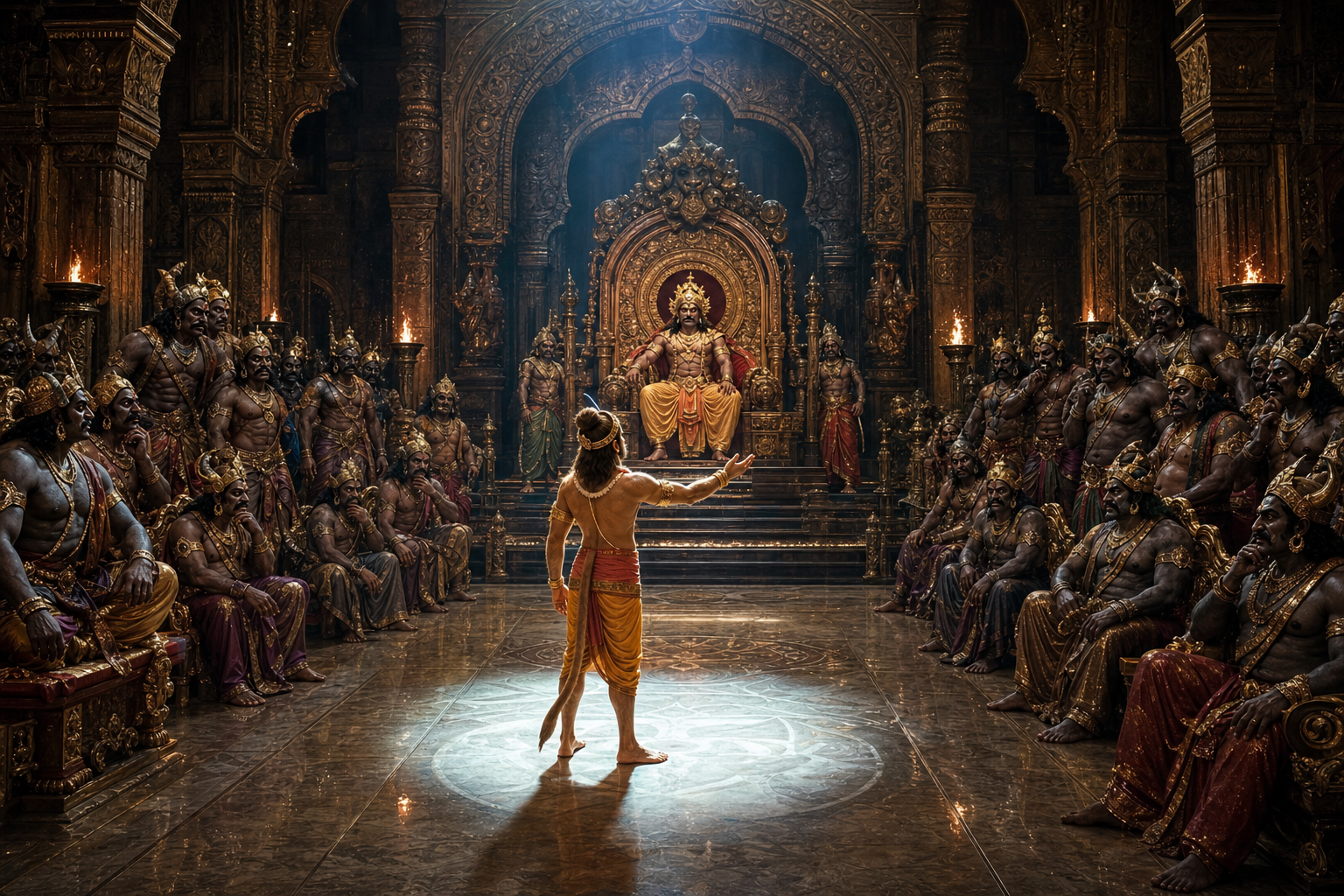
Calling the Lanka campaign a dharma-yuddha does not mean that every act of the righteous side becomes correct merely because its cause is just. Dharma has to appear in method, timing and restraint. Otherwise, it is only a label attached to power.
That is why the embassy of Angada matters. He enters Ravana’s court with a final, intelligible demand: return Sita, restore dharma and avert destruction. The proposal preserves an exit from war without surrendering the purpose of the campaign. Ravana’s refusal closes that exit.
Parley is not weakness here. It tests whether the objective can still be achieved without the costs of battle. It makes the condition for peace explicit. It also shows that Rama’s demand is limited and morally legible: the wrong must be corrected. Diplomacy therefore strengthens the ethical case for force when diplomacy fails for reasons the aggressor himself controls.
The campaign then proceeds through encampment, pressure at Lanka’s gates, coordinated engagements and responses to unconventional weapons. Serpent bindings, illusion and surprise make deception-resilience essential. The confrontations involving Kumbhakarna and Indrajit show that bravery alone is not enough; the coalition must identify and counter particular enemy capabilities rather than treating every danger as interchangeable.
Even the army’s sound and display have strategic value. Roars, banners and the visible achievement of the crossing announce unity before the fortifications are breached. Yet this psychological effect rests on something real. Lanka is shaken because the coalition has completed a formidable movement and arrived in order, not because it has produced empty noise.
For a modern civic or institutional conflict, copy the discipline of escalation rather than the battlefield form. Before acting, write down four things: the precise wrong to be corrected, the peaceful off-ramp available to the other party, the condition that would justify escalation, and the condition that would end it. If you cannot state the stop condition, anger may be determining the mission more than dharma is.
Rama’s conduct toward the ocean and Angada’s conduct in Ravana’s court belong to the same strategic grammar. Respect is offered first, but refusal does not paralyze action. Strength remains available, yet its use is tied to an intelligible purpose. This is the demanding middle path between helplessness and cruelty.
The bearer image is theology, not a missing battle scene
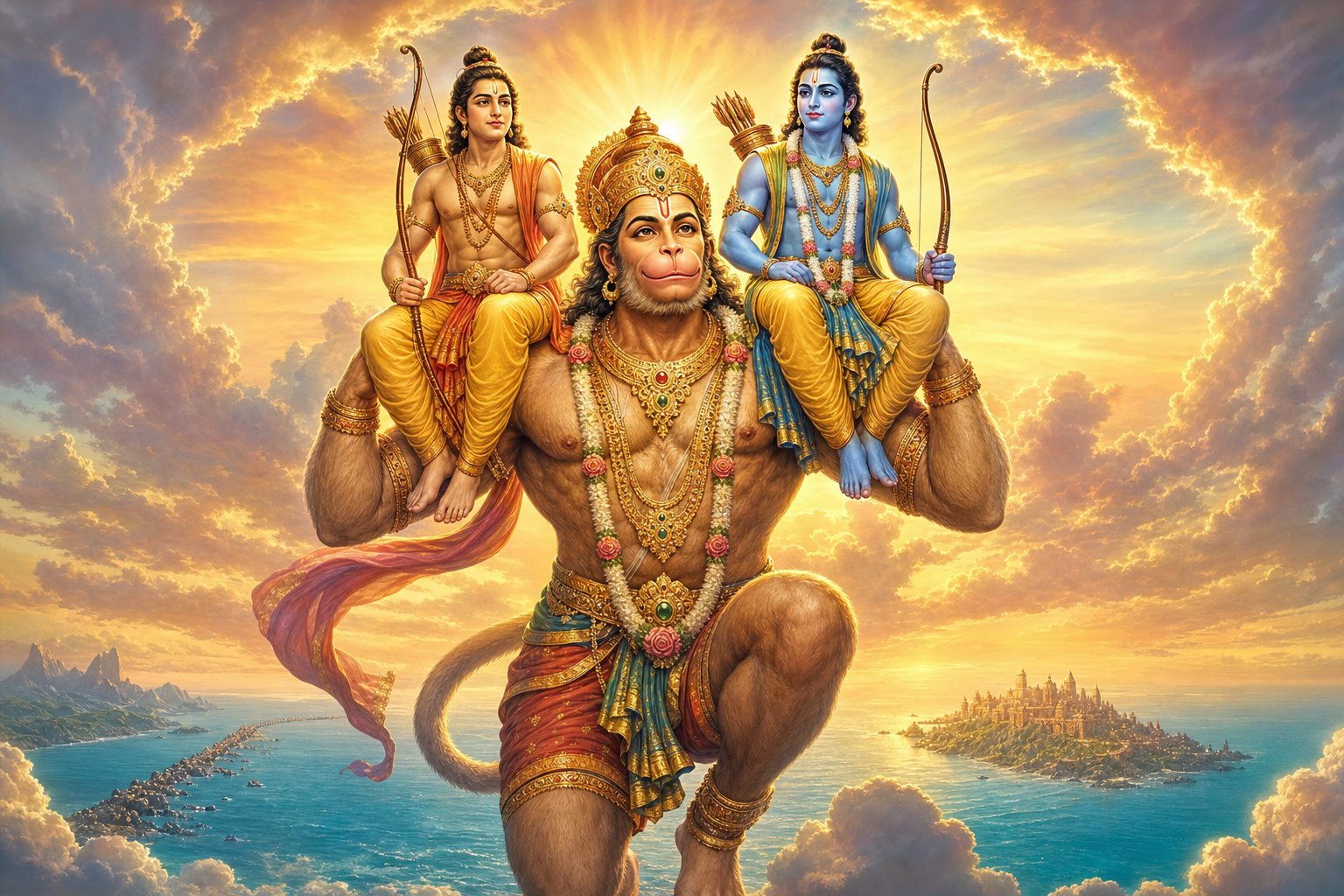
You may encounter paintings, performances or processional images in which Rama rides upon Hanuman while Lakshmana is borne by Angada. The image feels so natural within the campaign that it is easy to assume the Valmiki Ramayana narrates it. It does not explicitly describe that paired scene during the march or siege.
The motif belongs to the wider life of the Ramayana in later vernacular retellings, regional theatre, miniature painting, temple practice and Southeast Asian traditions such as the Thai Ramakien. Temple processions in which a festival form of Rama or Vishnu uses Hanuman as a vahana give the image a particularly clear theological meaning: the devotee’s seva carries the Divine purpose into the world.
Hanuman is an ideal bearer because his strength is governed by devotion, intelligence and reliability. Angada is an apt counterpart because his courage, royal pedigree and performance as an envoy make him capable of bearing Lakshmana’s martial purpose. The image does not reduce them to transport. It honors the bhakta whose disciplined service becomes the vehicle of divine action.
There is also a precise leadership lesson in the motif. Rama’s authority is not diminished by resting on Hanuman’s strength. It becomes effective through that strength. A worthy leader entrusts consequential work to proven lieutenants; worthy lieutenants carry the leader’s intent without turning service into personal ambition. Authority and seva become reciprocal rather than competitive.
This gives you three distinct levels of interpretation. At the textual level, do not claim an explicit Valmiki episode that is not there. At the devotional level, receive the bhakta-as-vahana image as a meditation on loving service. At the strategic level, notice that a mission advances only when trusted people can carry responsibility. The levels enrich one another as long as their boundaries remain visible.
The wider Dharmic reception calls for the same care. The Buddhist Dasaratha Jataka preserves a moral arc shaped by virtue and renunciation. The Jain Paumacariya reworks the Rama narrative through Jain moral commitments, including ahiṃsā-oriented discipline and statecraft. These traditions demonstrate civilizational kinship without erasing doctrinal difference. Shared ethical resonances are real, but unity does not require identical tellings.
When you next read the Yuddha Kanda, mark four kinds of moment: a fact is established, a peaceful exit is offered, a material constraint is solved, or force is applied. Then ask who carries the mission at each stage. That method preserves wonder without losing strategic intelligence, and devotion without sacrificing textual honesty.