
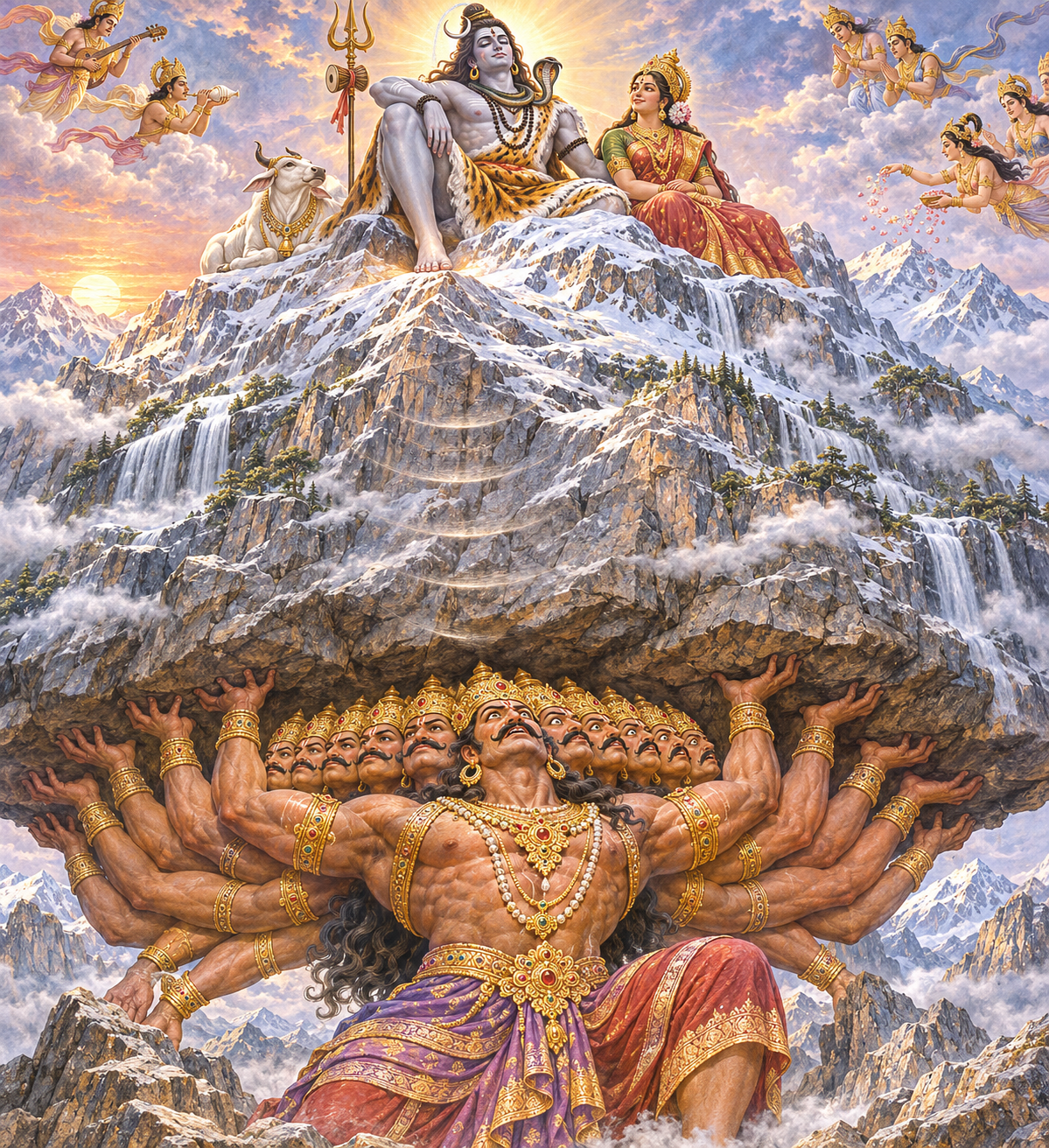
If Ravana was powerful and devoted to Shiva, why would he try to lift Shiva’s own mountain? That apparent contradiction is the point. The episode asks you to notice how devotion can remain genuine while pride quietly turns the sacred into a stage for self-display.
The lesson is not that strength is sinful or that every obstacle deserves passive acceptance. It is sharper: power loses its dharmic direction when it treats every limit as an insult and everything sacred as something to possess, move or master.
What happens between Ravana, Shiva and Kailasa
The narrative is remarkably economical. Ravana, the ten-headed king, brings immense power and an equally immense sense of himself to Mount Kailasa. He attempts to lift the mountain. Shiva answers without entering a contest of spectacle: a movement of his toe subdues the titan and leaves Kailasa unmoved.
That contrast carries the meaning. Ravana strains to demonstrate what he can do. Shiva does not need a demonstration. One figure equates force with authority; the other reveals that true authority can act without agitation, excess or self-advertisement.
When you contemplate the episode, the least useful question is whether Ravana was almost strong enough. The better question is why he assumed that strength gave him the right to disturb the sacred centre at all. His failure is moral before it is physical. He mistakes capacity for permission.
That distinction applies well beyond obvious displays of power. You may have the skill to dominate a discussion, the rank to force a decision, the wealth to get your way or the religious knowledge to silence someone. None of those abilities settles whether using them serves dharma. Before acting, separate these two questions: Can you do it? Should you do it? Ravana answers only the first.
Devotion does not automatically dissolve ahamkara
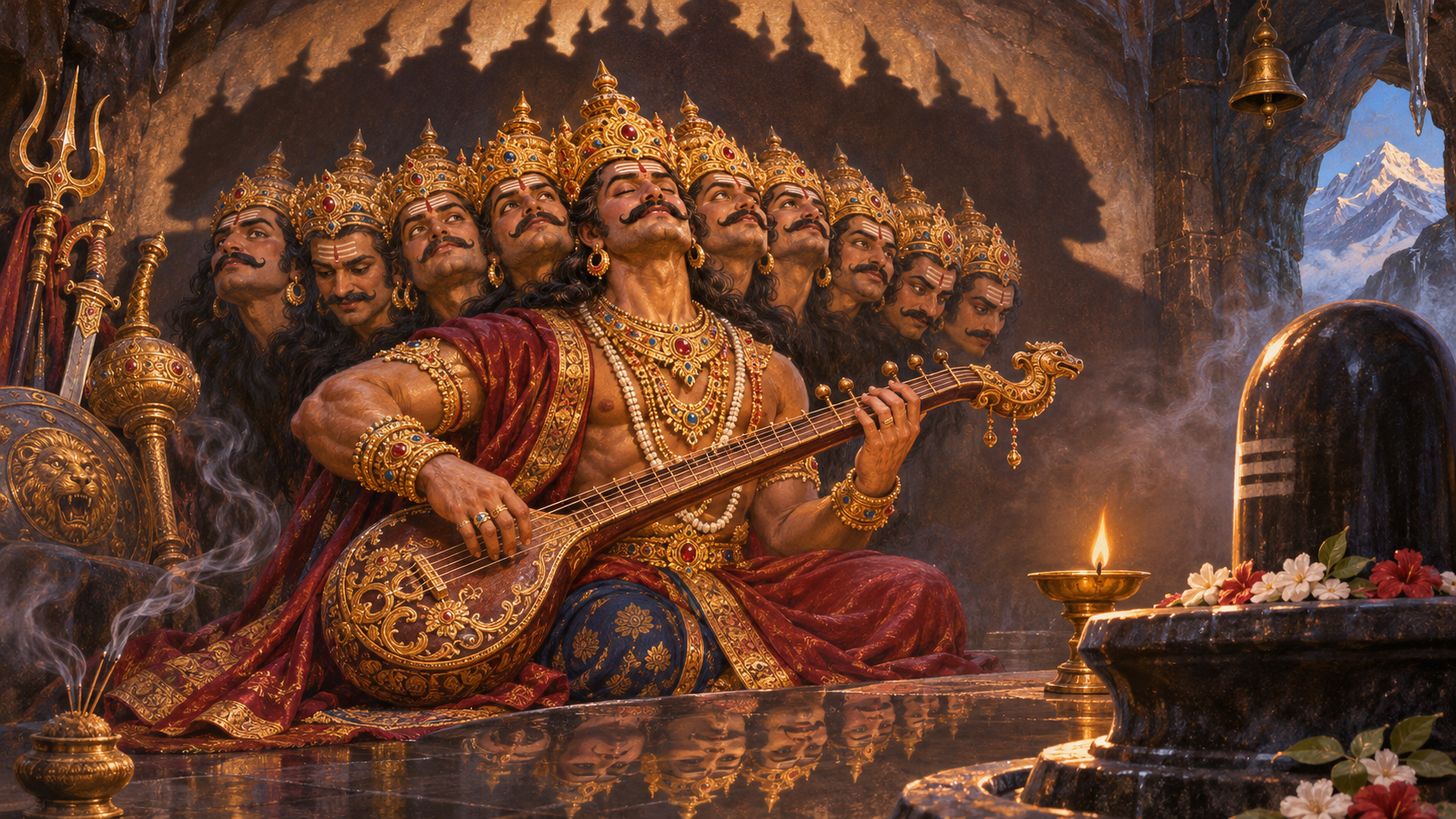
Ravana is spiritually instructive precisely because he cannot be reduced to a simple unbeliever. Devotion and arrogance can occupy the same personality. A person may revere the divine, undertake demanding disciplines and possess real knowledge while still arranging all of it around an inflated sense of self.
Ahamkara is often translated as ego, but ordinary confidence is not the problem. The danger appears when the self claims absolute authorship and ownership: my power entitles me, my learning makes me unquestionable, my devotion proves my superiority. Spiritual practice then becomes another possession displayed by the personality.
You can recognize this distortion through four recurring signs:
- You use devotion as a credential rather than allowing it to correct your conduct.
- You treat an ability as proof that you have the moral right to use it.
- You experience every boundary as disrespect, even when the boundary is legitimate.
- You care more about appearing unconquerable than about preserving harmony and fulfilling duty.
This is why religious identity alone cannot guarantee dharmic action. The practical test is what your devotion does to your relationship with power. Does it make you more teachable, more proportionate and more accountable? Or does it provide sacred language for impulses you had already decided to follow?
Humility does not require pretending that you lack strength. That would also be untruthful. Humility means seeing strength at its proper scale and accepting that it remains answerable to something higher than personal desire. Ravana’s error is not that he knows he is powerful. It is that he lets power define the limits of what he believes he may do.
Why Shiva answers with a toe rather than a spectacle
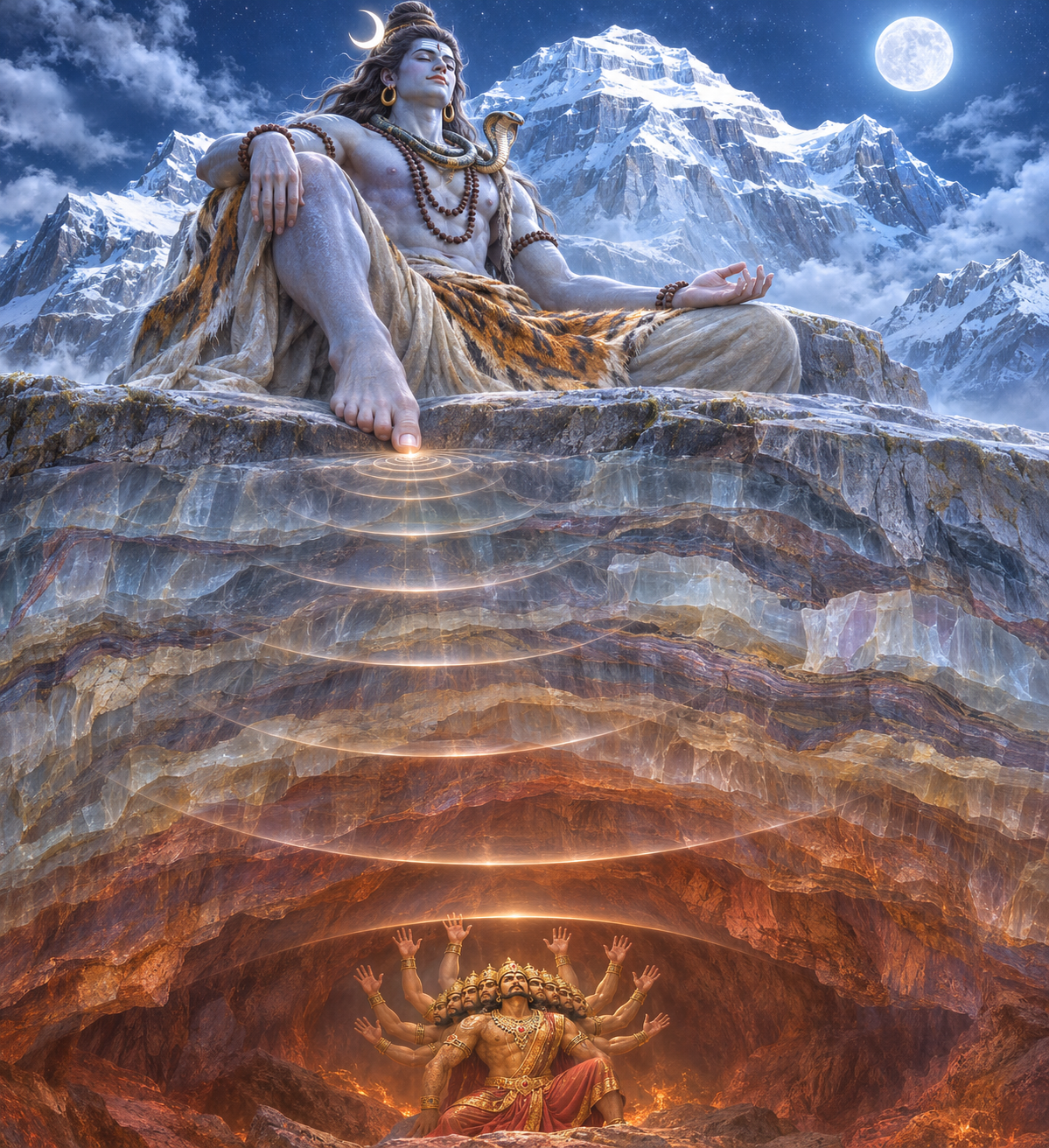
Shiva’s toe is not an incidental detail. Symbolically, the smallness of the gesture reveals the difference between noisy force and settled sovereignty. Ravana attempts an overwhelming feat. Shiva restores proportion with minimal movement.
Three practical principles follow from that image:
- Authority does not need constant performance. If your position is sound, you do not have to turn every challenge into a public test of dominance.
- Proportion is a sign of mastery. Use no more force, speech or sanction than the situation actually requires.
- Correction should restore order, not feed a second ego. Once the necessary boundary is established, continuing to humiliate an opponent merely reproduces the original disorder.
If you lead a family, institution, community or team, this is a demanding standard. Name the boundary clearly. Apply the smallest response sufficient to uphold it. Then stop. Do not enlarge a correct decision into a theatre of personal victory.
The same discipline applies when you are the one being checked. A wounded ego often escalates because accepting a limit feels like losing status. The Kailasa episode offers another interpretation: correction can return you to reality before your power carries you farther into error. The moment of restraint may be the moment in which grace is operating most clearly.
Kailasa marks the boundary between reverence and possession
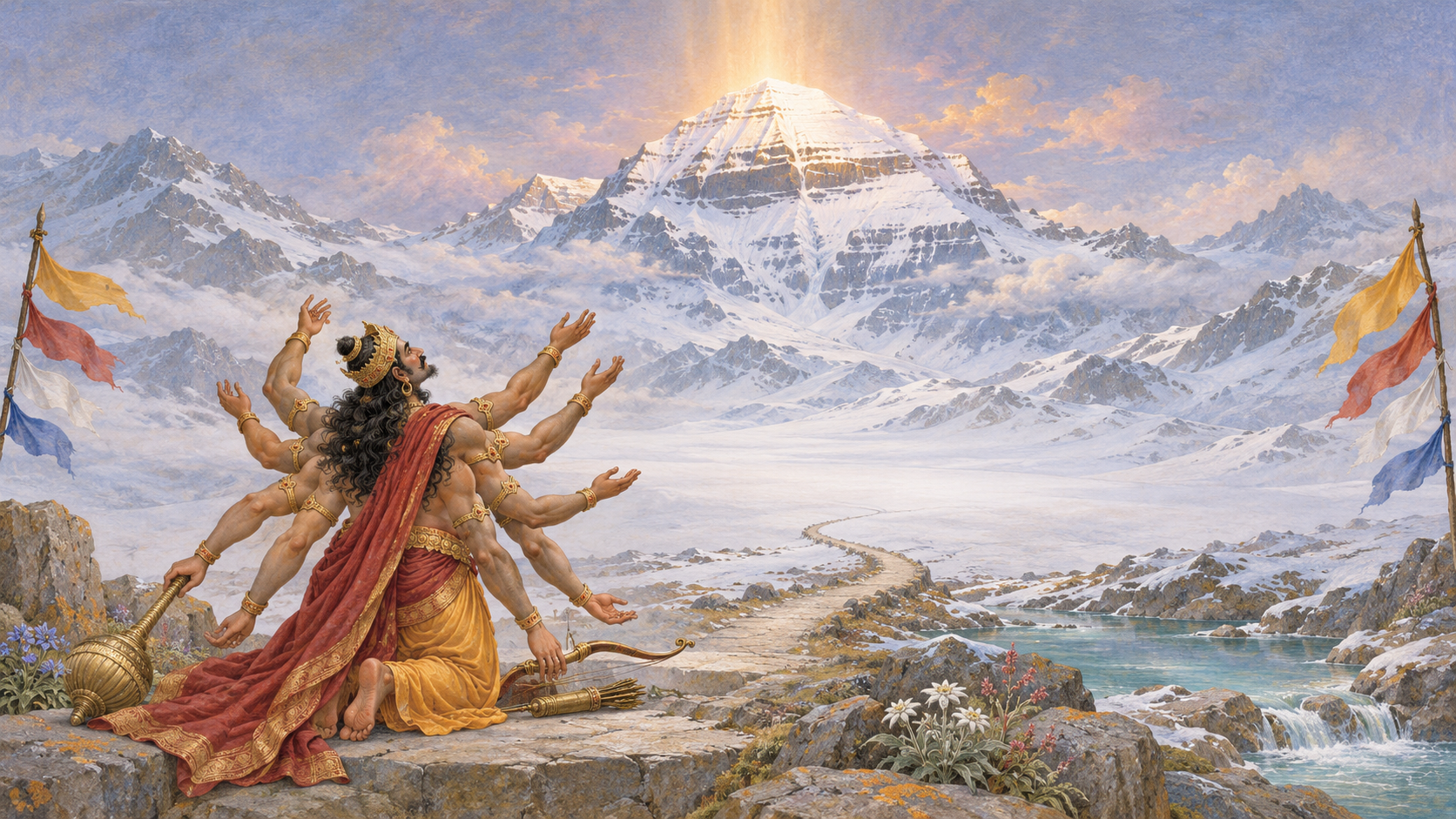
Mount Kailasa is more than a heavy object in this encounter. Within the sacred narrative, it is Shiva’s abode and a centre that does not depend on Ravana’s approval. Ravana approaches it as though even the divine centre must yield to his capacity. Its immovability exposes his category error: the sacred is not another trophy for the powerful.
The symbolic movement is worth reversing in your own mind. Ego demands that the centre move toward the self. Dharma asks the self to orient itself toward the centre. One says reality must confirm me. The other asks how I must change to live truthfully within reality.
This distinction can change the way you approach worship, scripture and sacred places. Do not begin with the demand that they validate every preference you already hold. Begin with a willingness to be instructed. Reverence becomes real when the encounter is allowed to rearrange you.
At the same time, do not label every immovable institution, custom or command as Kailasa. Resistance alone does not make something sacred. An unjust arrangement can also refuse to move, and dharma may require you to challenge it. The episode concerns a powerful ruler imposing himself upon a sacred order; it should not be misused to demand submission from people confronting abuse or adharma.
When a limit confronts you, identify what kind of limit it is. A moral boundary deserves obedience. Another person’s dignity deserves respect. A mere habit may deserve examination. An injustice may deserve firm resistance. Humility is not surrendering discernment; it is refusing to make your own pride the measure of everything.
A four-question test before you force an outcome
You can use the Ravana-Kailasa encounter as a practical pause whenever you feel compelled to push harder simply because something has resisted you. Ask these questions in order:
- What exactly is refusing to move? Name the obstacle precisely: a fact, a moral rule, another person’s agency, an unjust system, a practical constraint or your own fear.
- Which duty would further pressure actually serve? Give a concrete answer. Protecting someone, keeping a promise and correcting an injustice are duties; preserving an image of invincibility is not.
- What part of your urgency belongs to ahamkara? Look for the desire to win publicly, avoid embarrassment, punish disagreement or prove that no one can stop you.
- What is the smallest proportionate action? It may be a firm decision, a respectful refusal, a patient conversation, a pause or an honest acceptance of the limit.
If the answers reveal a genuine duty, act firmly. The story does not condemn strength directed by dharma. If they reveal that your main concern is status, stop escalating. You do not need to abandon the goal immediately, but you should release the demand to conquer the situation and examine it again without the performance of power.
This test also guards against a subtler mistake: admiring Shiva’s restraint while imitating Ravana’s appetite for control. The lesson is not to identify with the most powerful figure in the scene. It is to notice which pattern your next action will embody.
Key takeaways
- Ravana’s central error is confusing the ability to exert power with the right to do so.
- Devotion can coexist with ahamkara when worship becomes a credential for superiority rather than a discipline of alignment.
- Shiva’s toe represents proportionate authority: enough power to restore order, without spectacle or excess.
- Kailasa signifies a sacred centre to which the self must orient itself, not an object the self may possess.
- Humility does not mean weakness or passive acceptance of injustice; it means placing strength under discernment and dharma.
Choose one conflict in which you currently feel an urge to force the result. Write down the duty you are protecting and the image you are protecting as two separate statements. If you cannot distinguish them, do not push harder yet. Find that distinction first, and let your next act carry strength without Ravana’s demand that Kailasa move.
References

Leave a Reply
You must be logged in to post a comment.