
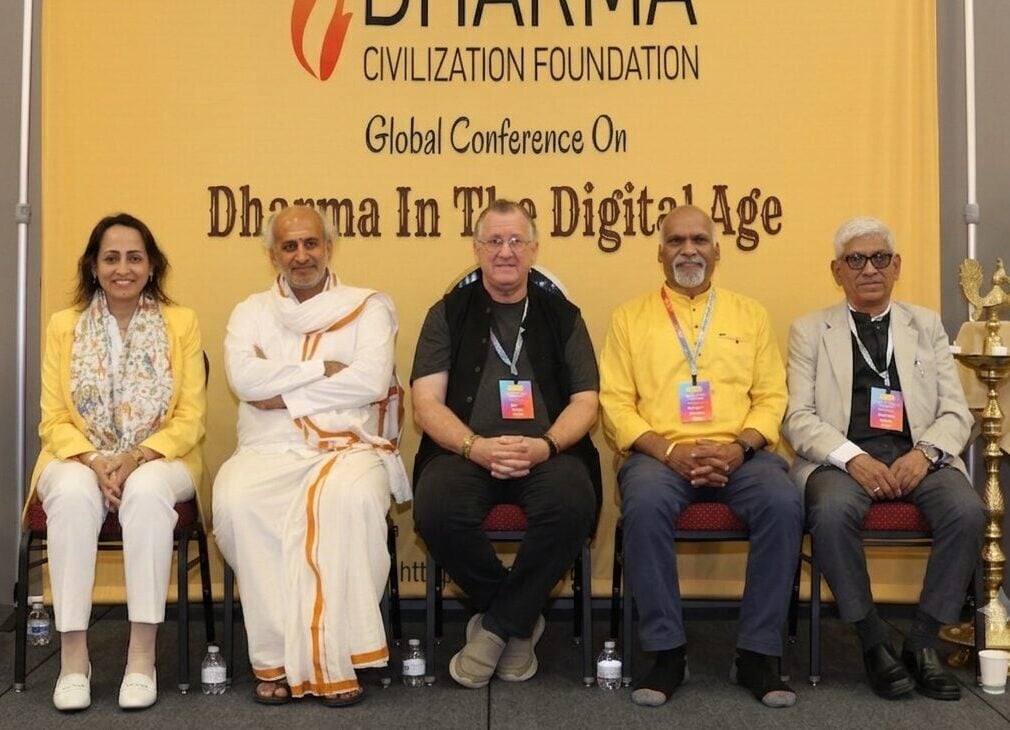
Digital feeds are designed to anticipate the next tap. Dharmic inquiry asks a prior question: who is choosing, and how free is that choice? A Dharma Civilization Foundation account of a June 2026 panel in Houston brought Vedic scholarship, science, management thought and contemplative practice to this problem.
The discussion offers more than advice about reducing screen time. It suggests a civilizational framework in which technology remains useful, but attention, judgment and inner freedom remain under human direction.
Attention Capture Is a Question of Freedom
According to the Foundation’s recap, an audience participant compared external algorithms with samskaras, the internal impressions that condition perception and conduct. The comparison is valuable because it avoids treating distraction as an entirely new problem. Platforms may intensify stimulation, but craving, habit and misperception are longstanding subjects of Dharmic discipline.
R V Hosur used the Bhagavad Gita’s account of decline to explain the danger: repeated dwelling encourages attachment, attachment feeds desire, and frustrated desire can weaken discernment. Jeffrey Long approached the same issue through the Yoga Sutras, presenting the mind as a disturbed lake whose waves obscure clear perception. In both accounts, the decisive capacity is the pause between an impulse and an action.
Dharma Sets the Purpose Technology Cannot Supply
K Ramasubramanian distinguished an algorithm, which directs a process, from spirituality, which directs a life. He described dharma as supporting both abhyudaya, or material flourishing, and nihshreyasa, the highest spiritual good. Efficiency therefore cannot be the final measure of a tool. The relevant question is whether its use supports clarity, responsibility, peace and service.
Sharda Nandram applied that distinction to work. Her reported model separates rational and computational knowledge from experiential and transcendent dimensions that cannot simply be reduced to data processing. The panel also argued that consciousness is fundamental and cannot be manufactured by an algorithm. That is a philosophical position presented in the discussion, not a settled empirical conclusion, but it usefully challenges the assumption that greater computation automatically equals deeper wisdom.
A constructive Hindutva, understood as civilizational self-respect, need not reject modern technology. It can instead insist that technology remain subordinate to dharma and human flourishing.

One Dharmic Discipline, Several Living Paths
The panel drew chiefly from Hindu texts while also including a Buddhist concentration exercise. The wider Dharmic family offers a shared grammar without erasing real differences: Hindu yoga cultivates steadiness, Buddhist mindfulness examines craving, Jain samayika and aparigraha foster equanimity and non-possessiveness, and Sikh simran and seva unite remembrance with service.
These traditions do not teach an identical metaphysics, yet each refuses to define freedom as unlimited consumption. All place disciplined awareness, ethical restraint and responsibility above compulsive appetite. That common ground can strengthen Dharmic unity while allowing every sampradaya and panth to preserve its own teachings and practices.
Key Takeaways
- Attention is an ethical and spiritual resource, not merely a productivity asset.
- The pause between stimulus and response is where discernment becomes possible.
- Technology can execute procedures, but it cannot determine a worthy purpose.
- Dharmic traditions answer digital compulsion through practice rather than panic.
- Shared disciplines can deepen Hindu, Buddhist, Jain and Sikh solidarity without flattening their differences.
A Practical Rhythm for Life With Screens
Protect the first moments of the day
Before opening a feed, create a brief interval for meditation, breath awareness, prayer, simran or quiet reading. The aim is not withdrawal from the world but choosing the mind’s direction before an external system chooses it.
Separate mechanical work from mindful work
Nandram’s reported approach assigns mindless tasks to technology while protecting human attention for judgment, creativity and relationship. This is a useful boundary for AI as well: automate repetition, but retain responsibility for meaning and consequences.
Review conduct before sleep
The panel proposed a detached review of the day: observe actions, questions and moments of encroachment without immediately defending them. Long also recommended recalling recent experiences in reverse order across five days to train memory and concentration. Periodic screen-free time can reinforce the same capacity.
The durable response to persuasive technology will not be fear of innovation. It will be stronger people and stronger communities: rooted in dharma, confident in their inheritance, and capable of using powerful tools without surrendering the inner seat of choice.
Inspired by this post on Dharma Civilization Foundation.

Leave a Reply
You must be logged in to post a comment.