
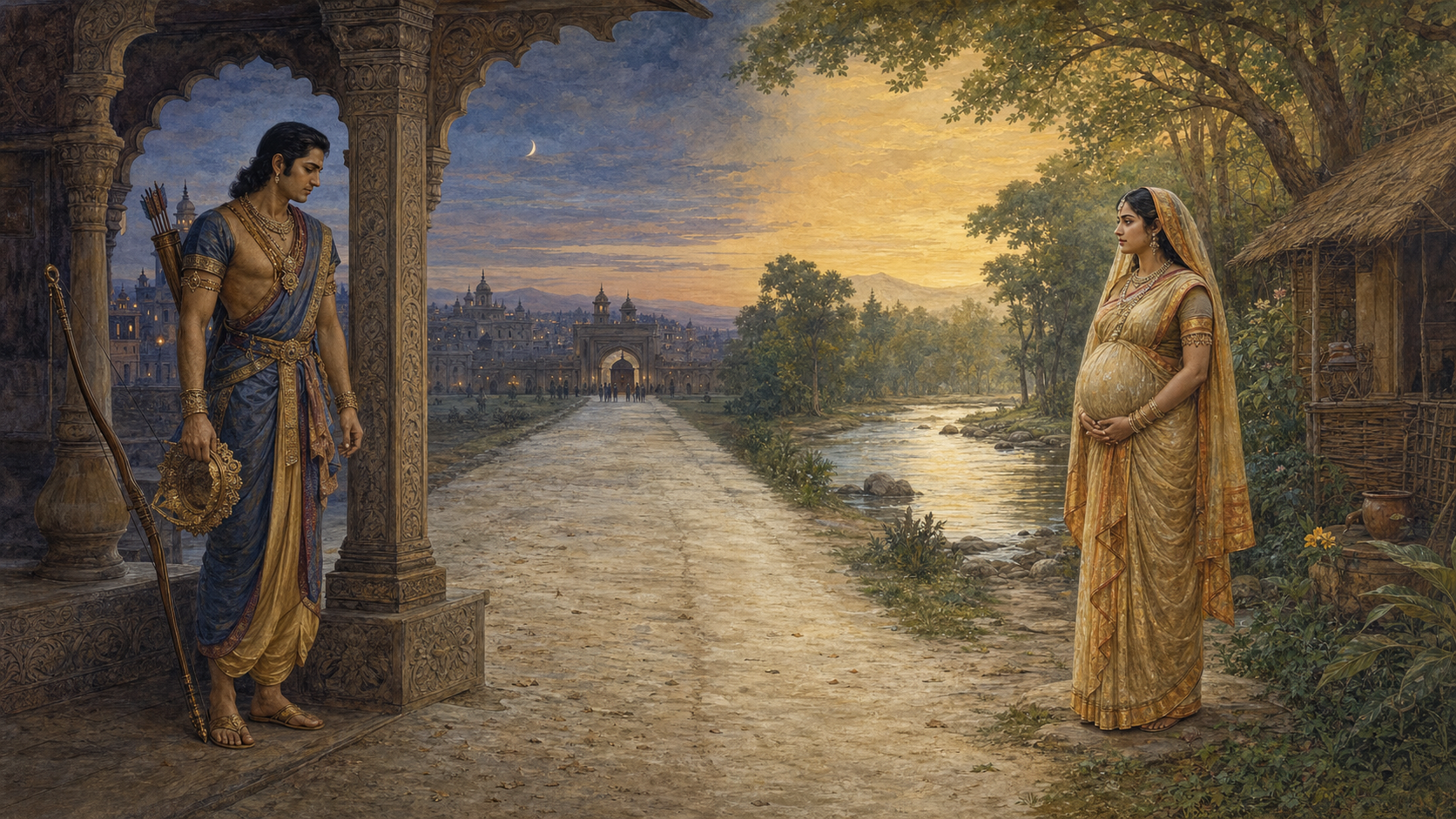
If Sita’s banishment makes it difficult for you to call Rama an ideal king, you do not have to silence that difficulty. Nor do you have to choose immediately between declaring every royal act perfect and dismissing the Ramayana as morally obsolete. The more useful question is harder: what should happen when a ruler believes public trust, marital fidelity, established truth, and the protection of an innocent person pull in different directions?
The episode becomes clearer when you separate four things that are often collapsed into one: the duty attached to an office, the truth about the accused person, the public’s perception of legitimacy, and the human cost of preserving that legitimacy. Once those are visible, Rama and Sita cease to be pieces in a simple argument. They become the two indispensable moral centers of a genuine dharma-sankata.
What the conflict actually contains
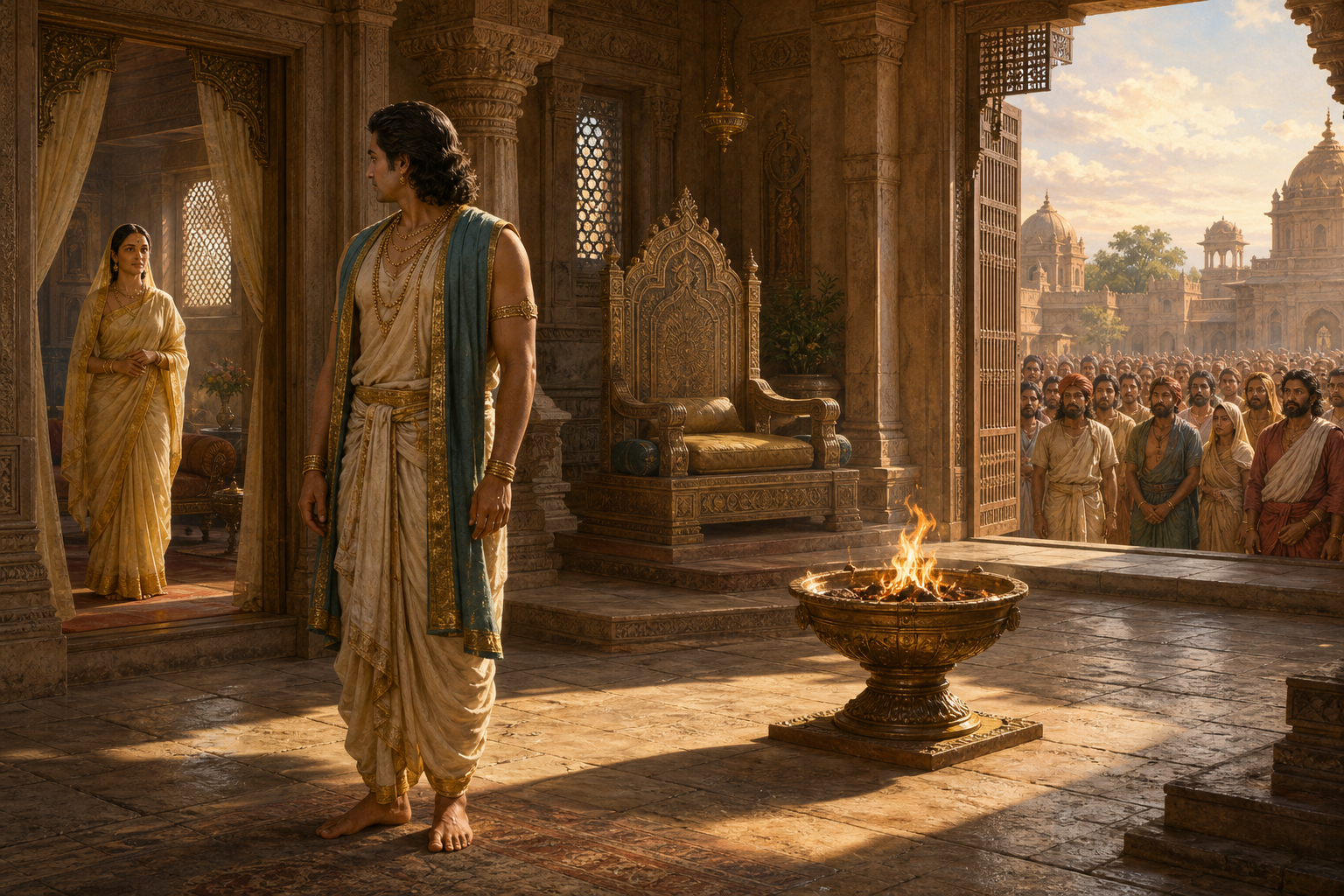
The victory over Ravana does not settle the Ramayana’s deepest political question. Rama returns to Ayodhya and assumes the throne, but kingship creates obligations that victory alone cannot satisfy. The movement from triumph to the painful demands of rule is why the narrative does not close like a royal romance.
A dharma-sankata is not merely a choice between dharma and adharma. It arises when legitimate obligations collide and no available decision preserves every good. Naming those obligations is the first discipline of responsible interpretation:
- Rajadharma concerns the ruler’s duties toward justice, order, legitimacy, and the people who depend on the throne.
- Pati-dharma concerns Rama’s obligations as Sita’s husband, including fidelity, protection, and trust.
- Svadharma concerns the conduct appropriate to one’s own position and responsibilities.
- Apad-dharma concerns conduct under exceptional danger, when ordinary arrangements may no longer be adequate.
These duties overlap, but they are not interchangeable. A husband cannot treat his wife as a problem in public relations. A king cannot reason only as a private husband when the stability of a realm is at stake. Rama occupies both roles, while Sita bears the consequences of how he ranks them.
This distinction prevents two common mistakes. The first is to say that Rama had no choice, as though rajadharma operated mechanically. The second is to say that public opinion should never matter to a ruler. A sovereign does have alternatives, but he also cannot ignore a serious collapse of confidence. The moral question therefore concerns necessity, evidence, proportionality, and cost: which response was required, which was merely available, and who was made to pay for it?
Rajadharma must answer public trust without enthroning rumor
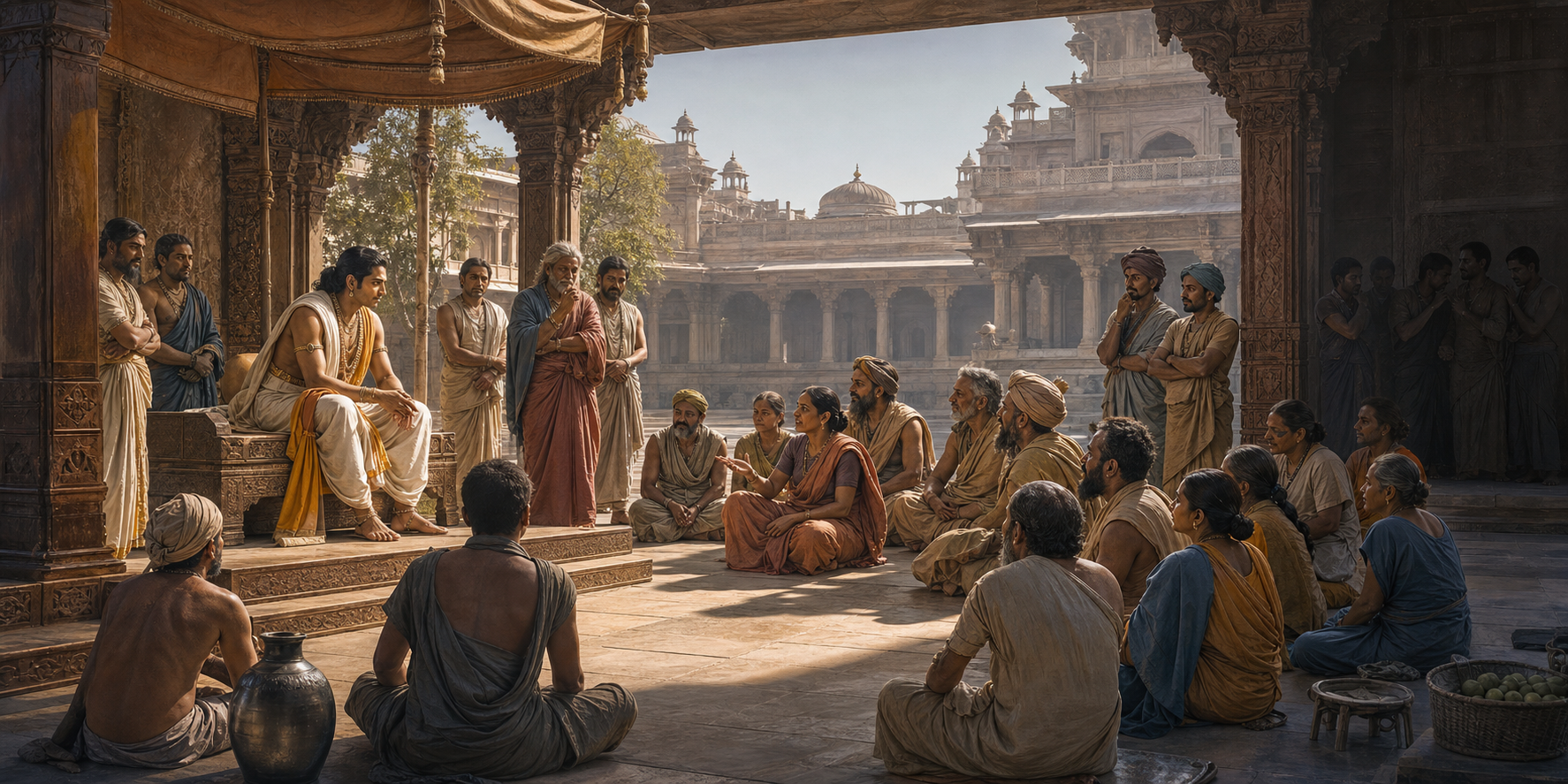
Public confidence is a real object of governance. A ruler who is personally virtuous but widely believed to tolerate wrongdoing may lose the authority needed to uphold justice. Rajadharma therefore cannot be indifferent to perception. Yet public accusation is not the same thing as proof, and popular suspicion does not become true because it is politically dangerous.
That distinction is decisive in Sita’s case. Her purity is vindicated through the Agni Pariksha, but lokavada, or public gossip, continues. The institutional problem survives the establishment of personal innocence. Rama responds to the threat against royal legitimacy; Sita suffers because the public refuses to accept a truth already demonstrated within the narrative.
You should notice the warning embedded here. When an accused person has answered the charge and suspicion continues anyway, demanding another demonstration may no longer serve truth. It may serve appeasement. A process can begin as an inquiry and become an ordeal when the standard of satisfaction keeps moving.
Rajadharma cannot mean treating every rumor as sacred. If it did, the most suspicious voice in the kingdom would effectively rule the throne. Nor can it mean dismissing public concern merely because the ruler knows more than the public. A responsible leader must address the gap between fact and perception without pretending that the gap proves guilt.
In a contemporary institution, the available responses might include a transparent statement of what has been established, an impartial procedure, an opportunity for the affected person to answer, and a clear refusal to reopen a resolved accusation without new evidence. The setting is different from Ayodhya, but the underlying discipline is the same: do not confuse protecting trust with surrendering judgment.
This is also where explanation must not become automatic endorsement. Rama’s concern for social order helps explain the royal decision. It does not require you to declare rumor just, erase Sita’s injury, or turn banishment into a general formula for leadership. The episode gives us a predicament to examine, not a policy template to copy.
Sita’s standpoint changes the moral accounting

Any reading centered only on Rama’s sacrifice is incomplete. Rama loses conjugal happiness and accepts profound personal grief, but Sita loses the protection of her home after her truth has already been vindicated. Calling the outcome a sacrifice by the king can conceal the fact that another person bears its most direct cost.
Sita is not merely the object over whom royal and domestic duties compete. She speaks from an established moral position: she knows her fidelity, refuses inward submission to false judgment, and does not allow public suspicion to define her character. Her dignity is not granted by Ayodhya’s approval.
Her life in Valmiki’s ashrama extends that moral position beyond the palace. Lava and Kusha are born there and learn the Ramayana through recitation. When the princes confront the world of the Ashvamedha, truth returns to royal power from outside its center. The sovereign must encounter a history that the machinery of sovereignty could not contain.
Sita’s final appeal to Bhumi can be read both theologically and ethically. The earth receives her as a seal upon her purity. Her departure also preserves her agency: she does not remain indefinitely available for repeated public verification. Truth may be declared and embodied, but it cannot be forced to perform forever for people determined not to believe it.
This gives you a practical test whenever duty is invoked to justify harm. Ask whether the affected person is allowed to speak, whether established testimony is being ignored, and whether the institution is demanding repeated proof because it lacks the courage to defend its own conclusion. If the burden always falls on the less powerful party, the language of duty may be hiding institutional convenience.
Keeping Sita at the center does not require diminishing Rama. It prevents devotion from becoming selective moral vision. Rama’s anguish matters. Sita’s injury, voice, and final refusal matter as well. The ethical force of the Ramayana depends on our willingness to hold both.
Maryada gives you a limit, not a shortcut

Rama’s title Maryada Purushottama is sometimes treated as though it ended every discussion before it began. Yet maryada points to boundaries, disciplined conduct, lawful restraint, and the refusal to use power merely for personal desire. It describes an ideal of self-limited authority, not a promise that duty will always produce a painless result.
Rama does not preserve his household happiness by ignoring his office, and he does not use kingship to protect himself from sorrow. That restraint is central to the traditional defense of his conduct: the king places what he understands as the realm’s need above his private longing. The difficulty is that Sita’s suffering exposes a further boundary. Public order can become morally compromised when an innocent person is made to absorb the cost of distrust.
For many devotees, Rama’s submission to rajadharma displays divine rectitude. Other readers place greater weight on the injustice experienced by Sita. You do not have to flatten those positions into a false consensus. You can honor Rama’s refusal to govern for private pleasure while still asking whether public suspicion received more authority than it deserved. You can defend Sita without pretending that a ruler’s covenant with the people is trivial.
The textual history requires the same care. Sita’s later separation, the birth of Lava and Kusha, the Ashvamedha, and her return to Bhumi belong to the Uttara Kanda. Philological scholarship often identifies later compositional strata in Book 7, while centuries of communities have received these events as integral to the Ramayana’s moral arc. Composition history and lived scriptural authority are different questions. Evidence about one should not be used as a silent answer to the other.
Different Dharmic retellings also show that fidelity to a civilizational inheritance does not require a single interpretive method. The Buddhist Dasaratha Jataka preserves themes of restraint, filial responsibility, and just rule. Vimalasuri’s Jain Paumacariya reframes the saga through ahimsa and Anekantavada, giving greater moral complexity to figures such as Ravana. Sikh maryada belongs to a distinct tradition, yet it expresses a related conviction that freedom and communal integrity require disciplined limits.
Anekantavada offers a particularly useful reading discipline here: a standpoint can disclose something real without exhausting the whole truth. Rama’s standpoint reveals the burden of office. Sita’s reveals the injury that institutions can impose in the name of order. Ayodhya’s standpoint reveals the political force of social trust, while its gossip reveals how a community can fail in its own dharma. Seeing all four does not remove the need for judgment. It makes judgment better informed.
A six-question test for difficult leadership decisions
You can use the Rama-Sita conflict whenever a leader claims that an institution’s credibility requires a painful decision. The point is not to equate a workplace, family, temple committee, or elected government with ancient kingship. It is to examine the structure of the claim before accepting the sacrifice it demands.
- Which duties genuinely belong to the role? Name them before discussing the outcome. A ruler owes justice to the realm; a spouse owes fidelity and protection; an institution owes fair treatment to those under its authority. Vague appeals to duty make it easy to hide which obligation is being neglected.
- What is established, what is alleged, and what is merely feared? Keep evidence, rumor, and predictions of reputational harm in separate columns in your mind. A decision based on public reaction should be described honestly as such, not disguised as a finding of guilt.
- Has the affected person been heard as a moral agent? Do not discuss someone only as a risk to be managed. Their testimony, dignity, and ability to answer are part of justice, not optional courtesies after the important decision has been made.
- Which alternatives were considered? Look for a public explanation, a transparent inquiry, a temporary measure, a change in procedure, or a leader’s willingness to absorb criticism. A claimed dilemma is not yet a dharma-sankata if less harmful options have not been examined.
- Who bears the cost, and is that distribution defensible? Personal anguish in the decision-maker does not compensate the person who loses safety, standing, or belonging. If the least powerful person pays nearly everything, the institution owes an especially strong justification.
- What precedent and repair will remain? Ask whether the same rule would be just if applied to someone you do not admire. Then ask what restoration is available if the institution later recognizes that preserving confidence produced an injustice. Regret is an emotion; repair is an obligation.
This test does not guarantee a painless answer. It does expose the difference between disciplined responsibility and the convenient use of responsibility as a shield. Rajadharma is demanding precisely because it requires stewardship of both social order and the people who can be injured in its name.
Key takeaways
- Rajadharma requires attention to public trust, but it does not turn public suspicion into proof.
- A dharma-sankata involves competing obligations; it is not permission to stop searching for less harmful alternatives.
- Sita must be read as a moral agent whose truth and dignity do not depend on royal or popular approval.
- Maryada places limits on power, including the power of rulers and communities to demand endless proof from the innocent.
- A sound modern application examines evidence, voice, alternatives, proportionality, precedent, and repair before invoking institutional duty.
The next time someone asks whether Rama was right or Sita was wronged, resist the demand for a one-line verdict. Ask which duty is being defended, which truth has already been established, whose voice is missing, and who is carrying the cost. That is not an evasion of judgment. It is the beginning of judging through dharma rather than through loyalty, outrage, or convenience.