
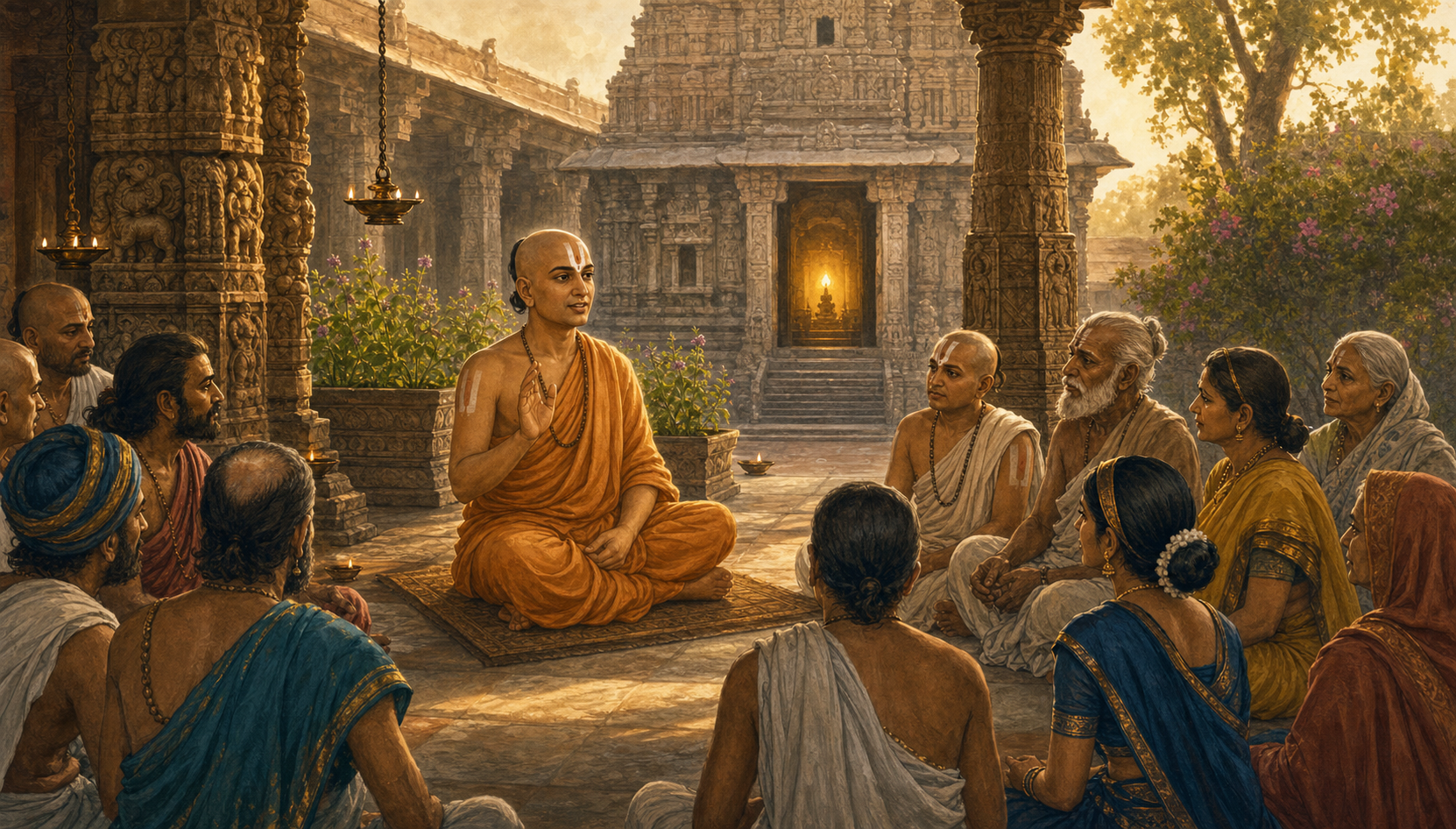
You may be drawn to bhakti yet still feel a tension between devotion and philosophy. If the Divine is one with everything, whom are you worshipping? If the Divine is entirely separate from you, how can devotion become intimate rather than distant?
Ramanujacharya gives you a way to hold both truths without weakening either. Vishishtadvaita preserves oneness while maintaining a real relationship between the Supreme Lord and the individual soul. That balance turns bhakti into more than emotion: it becomes a disciplined way of understanding, living, and serving.
What qualified nondualism asks you to hold together

Vishishtadvaita is commonly rendered as qualified nondualism. The word qualified matters. Reality is unified, but this unity does not erase every meaningful distinction within it. The Supreme Lord and individual souls participate in genuine oneness while remaining distinct. The devotee does not disappear, and the Lord does not become an impersonal placeholder.
This is what allows bhakti to remain a real relationship. If distinction is denied completely, prayer can be reduced to a temporary exercise addressed ultimately to no one other than oneself. If difference is exaggerated into absolute disconnection, the Lord can appear too remote for intimacy. Ramanujacharya’s personalist understanding preserves both divine transcendence and closeness.
When you encounter an explanation of Vishishtadvaita, test it with three questions:
- Does it leave you with a real Supreme Lord who can be known, loved, worshipped, and served?
- Does it affirm an underlying oneness rather than treating the soul as an isolated being with no meaningful relation to the Divine?
- Does it preserve both intimacy and reverence, without reducing one to the other?
An explanation that answers only one side has missed Ramanujacharya’s balance. Oneness should deepen your sense of belonging to divine reality. Distinction should deepen love, humility, and the possibility of service.
This framework also helps you discuss Vedanta more carefully. Ramanujacharya offered a constructive alternative to monistic interpretations that leave no enduring personal relationship between the Lord and the devotee. That does not give you a reason to caricature every monistic school. It gives you a reason to understand exactly what Vishishtadvaita protects: the reality of relationship within unity.
Bhakti becomes credible when knowledge changes conduct
Ramanujacharya did not ask the seeker to choose between clear thinking and heartfelt devotion. His Sri-bhasya, a commentary on the Vedanta-sutra, established the philosophical basis of Vishishtadvaita. Bhakti could therefore be examined, taught, and defended rather than treated as a passing mood.
But intellectual agreement is not the finish line. In this path, bhakti rests on knowledge, ethical conduct, and service. Each corrects a weakness in the others.
The three tests of lived devotion
- Knowledge tests direction. You should know whom you are worshipping and what kind of relationship your worship expresses. Without that clarity, devotion can become sentiment without a stable center.
- Ethical conduct tests sincerity. Compassion, self-discipline, and nonviolence cannot remain ceremonial ideals. If worship leaves your habits untouched, your philosophy has not yet entered your life.
- Service tests self-absorption. Seva carries devotion beyond your private feelings. It asks whether reverence for the Divine has made you more willing to contribute to the well-being of others.
Use those tests after worship instead of measuring a practice only by emotional intensity. A quiet session can still be fruitful if it makes your understanding clearer, restrains a harmful impulse, or leads to a concrete act of service. A stirring session can still be incomplete if nothing changes afterward.
A short audit for the end of the day
- Name one truth about the Lord-devotee relationship that you consciously remembered.
- Identify one choice in which compassion, nonviolence, or self-discipline affected your conduct.
- Name one act that benefited someone without making recognition your condition for doing it.
If you cannot answer one of these, do not manufacture a spiritual success. Let the missing answer show you where tomorrow’s practice needs attention. This turns self-examination into course correction rather than self-condemnation.
Build a practice that joins the heart, mind, and hands
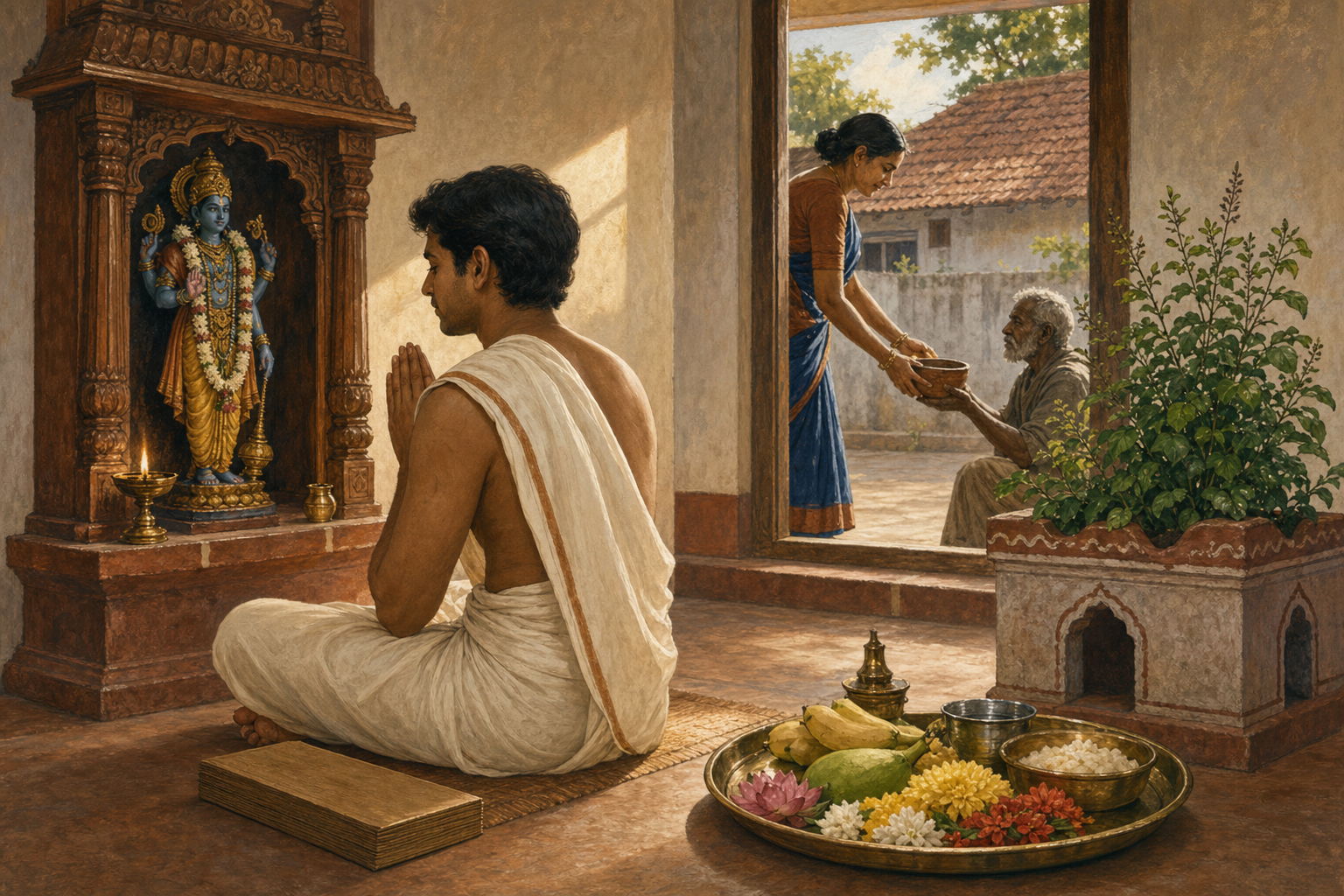
Japa, study, kirtan, meditation, seva, and ethical living do different work. You do not need to force all six into an elaborate daily program. You do need enough integration that devotion is not confined to a prayer corner while the rest of life proceeds unchanged.
- Japa repeatedly returns attention to the Divine. Use a name or mantra already proper to your practice; where your sampradaya requires initiation or instruction, follow the guidance of its acharya.
- Study protects devotion from vagueness. Read a manageable passage from a trusted text or explanation, then state its main point in your own words.
- Kirtan gives devotional relationship an audible form. Treat it as an offering, not a test of musical ability or a performance for approval.
- Meditation lets you remain with the simultaneous truths of unity and distinction instead of merely repeating their definitions.
- Seva gives devotion a beneficiary beyond yourself. Choose a real responsibility rather than waiting for an impressive opportunity.
- Ethical living carries practice into speech, restraint, family duties, work, and community life.
For the next seven days, use one repeatable sequence. The seven-day period is simply a practical experiment, not a traditional rule:
- Begin with your established form of japa or kirtan. Let it place the relationship with the Lord at the center.
- Read one small passage from a text or commentary you trust. Write one sentence explaining what it reveals about oneness, distinction, devotion, or service.
- Sit quietly with both sides of Vishishtadvaita: you are not disconnected from divine reality, and you are not the Supreme Lord whom you adore.
- Select one ethical discipline for the day: greater compassion, firmer self-restraint, or deliberate nonviolence in conduct and speech.
- Complete one act of seva, however ordinary, that answers an actual need.
At the end of the week, review integration rather than volume. Did study clarify your worship? Did worship affect your conduct? Did conduct open into service? Keep the parts that reinforced one another. If one element consistently became mechanical, simplify it and reconnect it to the Lord-devotee relationship.
This prevents a common split. Philosophy without devotion can become an exercise in winning arguments. Devotion without reflection can become unstable sentiment. Service without a spiritual center can lose its devotional intention. Ramanujacharya’s approach asks each part to strengthen the others.
Carry bhakti from private practice into community
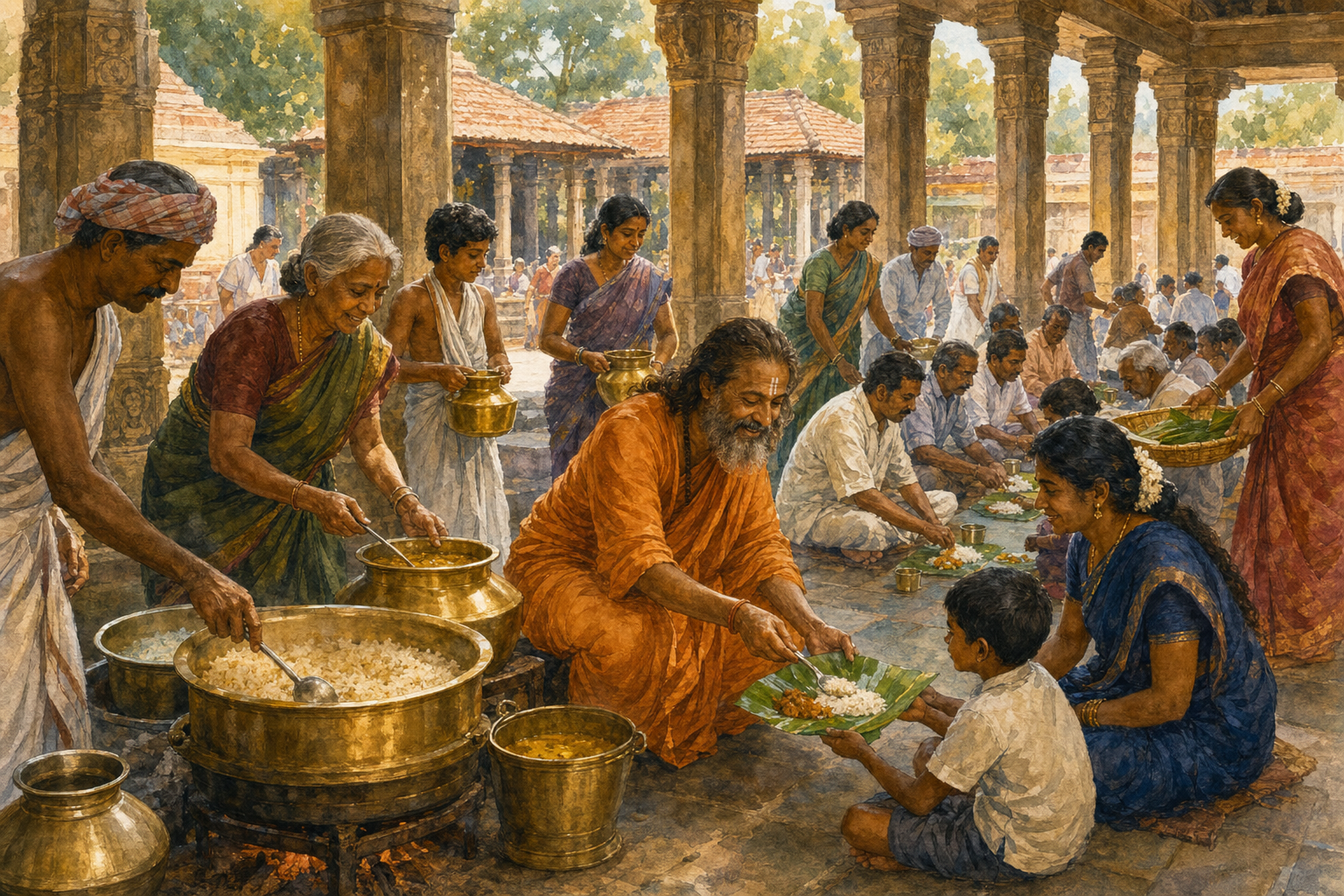
Ramanujacharya’s legacy was institutional as well as philosophical. He traveled across Bharat, engaged scholars, clarified doctrine, and developed communities capable of preserving study and devotion. The scale attributed to his leadership is striking: seventy-four centers of Sri Vaishnavism, seven hundred sannyasis, twelve thousand brahmacharis, and thousands of householders, including kings and other community leaders.
The practical lesson is not that everyone must found an institution. It is that bhakti needs social forms if it is to survive beyond one person’s enthusiasm. A durable practice usually requires three kinds of support:
- A source of instruction: an acharya, sampradaya, or trustworthy body of teaching that can correct misunderstandings.
- Companions in practice: people with whom you can study, worship, and remain accountable without turning devotion into display.
- A field of service: a temple, household, community, or recurring responsibility where spiritual principles become useful action.
This communal dimension also gives dharmic unity a more honest basis. Hindu, Buddhist, Jain, and Sikh traditions can recognize shared commitments such as compassion, self-discipline, nonviolence, and transformative practice without pretending that their doctrines are interchangeable. Respect becomes stronger when it does not depend on erasing real differences.
When speaking across dharmic traditions, name a shared value precisely, explain your own position without claiming it for everyone, and look for cooperation through service or ethical action. Harmony does not require uniformity. Vishishtadvaita itself trains the mind to see unity without demanding that every distinction disappear.
This is also a fitting way to observe Sri Ramanujacharya’s Disappearance Day. Remembrance should not stop at biography or ceremonial praise. Renew one neglected discipline, return to serious study, strengthen a community responsibility, or offer seva in a form that can continue after the observance has passed.
Key takeaways
- Vishishtadvaita affirms oneness while preserving a real distinction between the Supreme Lord and individual souls.
- That balance protects both divine transcendence and an intimate relationship of devotion.
- Ramanujacharya’s bhakti joins knowledge, ethical conduct, and service; emotion alone is not the measure of progress.
- Japa, study, kirtan, meditation, seva, and ethical living are most effective when each informs the others.
- Dharmic unity is strongest when shared values support cooperation without erasing genuine doctrinal differences.
Begin with one change today. Take your next act of worship and connect it to one clear teaching, one ethical restraint, and one useful act of seva. Repeat that connection until bhakti is no longer a separate religious activity but the organizing relationship of your life.
References
