
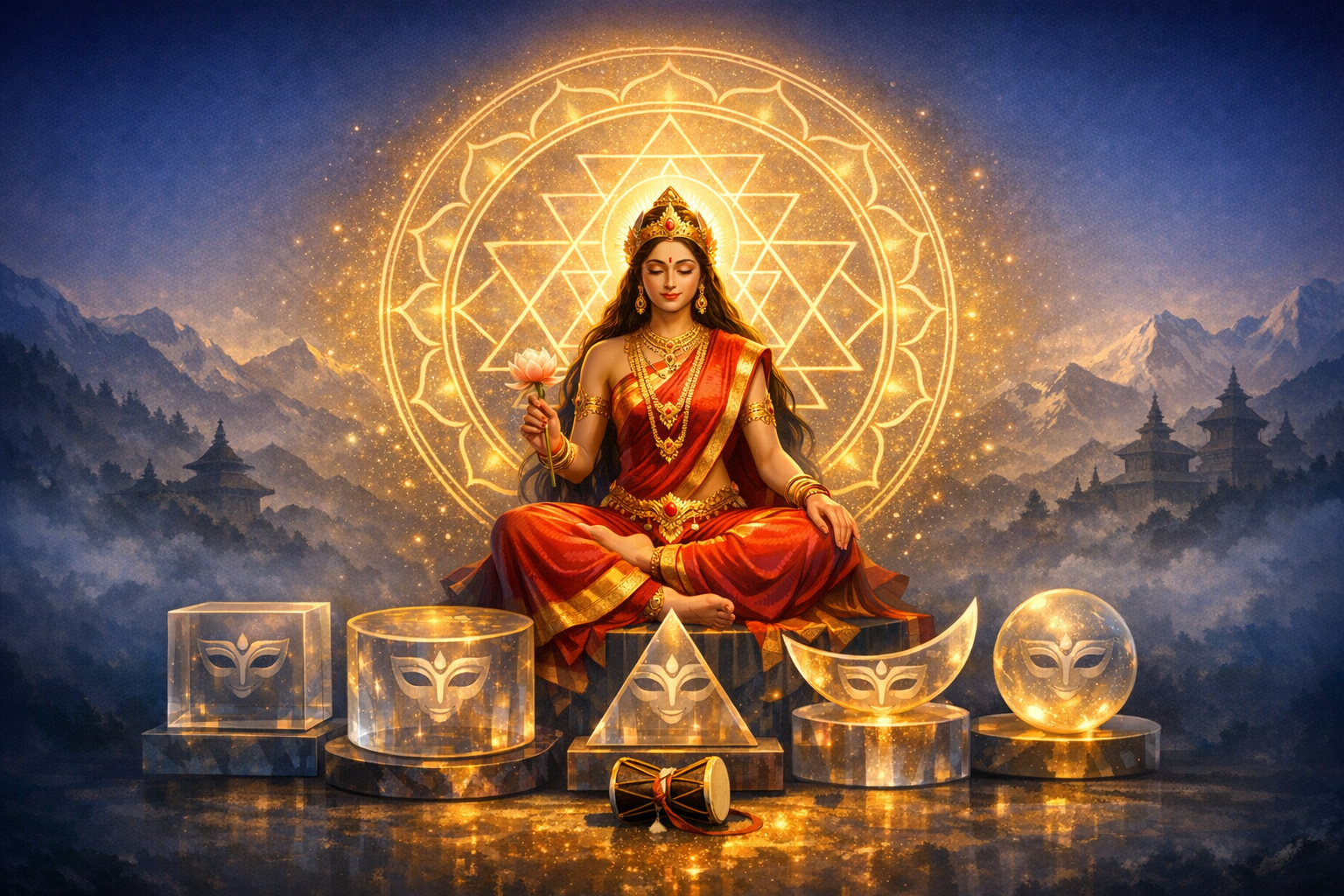
“Without Shakti, even gods are pretas” captures a core axiom of Tantric Hinduism: consciousness bereft of its inherent dynamic power remains inert. The doctrinal expression of this axiom is the teaching on the Pancha Mahapretasliterally, the Five Great Inert Oneswhose symbolism clarifies why divinity itself is understood as functionally quiescent until animated by Shakti. Far from denoting malevolent spirits, the “pretas” in this context name foundational, cosmic supports that are lifeless as potentials until the goddess empowers them.
The idea is especially vivid in Nepalese Tantric lineages, including damaru-centered Shaiva–Shakta practice sometimes glossed locally as “Damaraga,” and it is equally at home in broader Shakta and Sri Vidya traditions across the Indic world. Iconographically, the image recurs as a goddess enthroned upon a seat of five skulls (pañca-preta-āsana) or adorned with a five-skull crown. Doctrinally, it resolves a perennial metaphysical puzzle: if the Absolute is changeless, how do creation, maintenance, and transformation occur? The answer given by Tantra is ShaktiDivine Powerwhose movement (spanda) enables function without compromising nondual awareness.
At the heart of this teaching lies a precise philosophical vocabulary. “Preta” does not primarily signify a ghost in this setting; it designates inertnessan inactive, support-like condition. The five are “mahā,” or great, because they name the supreme supports of cosmic functioning. In classical Shakta expositions, they are correlated with the five faces or forms of Shiva (often called the Pancha Brahmas): Brahma, Vishnu, Rudra, Īśvara, and Sadāśiva, each bearing a distinct cosmological role. As long as they are unempowered by Shakti, those roles remain in mere potential.
Nondual Shakta metaphysics renders this in memorable terms: Śiva as pure, undifferentiated consciousness (śuddha-caitanya) is “śava”a metaphor for inertnesswithout Shakti. The well-known verse attributed to the Saundarya Lahari crystallizes the claim: “Śivaḥ śaktyā yukto yadi bhavati śaktaḥ prabhavitum, na cedevaṁ devo na khalu kuśalaḥ spanditum api.” In other words, only as united with Shakti does Shiva function; otherwise, even divine action does not stir.
Tantric sources align the Pancha Mahapretas with the five cosmic acts (pañcakṛtya): sṛṣṭi (emanation/creation), sthiti (sustenance), saṁhāra (reabsorption), tirobhāva (veiling), and anugraha (grace). In many Shakta accounts, these acts correspond respectively to Brahma, Vishnu, Rudra, Īśvara, and Sadāśiva, with the proviso that the acts themselves are Shakti’s own play through those deities as modalities. This mapping is not merely theological; it is a contemplative grammar that helps practitioners intuit how still awareness and dynamic power interrelate.
Iconography gives the doctrine an immediate, striking presence. The goddess seated upon the pañca-preta-āsana demonstrates that all divine functionsno matter how exaltedform her throne and are enlivened by her Sakti. In Sri Vidya, Lalita Tripurasundari’s throne is described in layered fashion as resting on the five “pretas” identified with the five Brahmas; thus, her sovereignty (rājya) presupposes and animates the totality of cosmic processes. In the Mahavidya stream, forms such as Kālī and Chinnamastā emphasize the same truth through skull-garlands, corpse-seats, and five-skull crowns.
The five-skull motif is polyvalent. In many traditions it simultaneously encodes the five elements (pañca-mahābhūtas: earth, water, fire, air, space), the five senses (pañcendriyas), the five vital winds (pañca-prāṇa: prāṇa, apāna, samāna, udāna, vyāna), and the five sheaths (pañca-kośa) described in the Upanishads. Each set functions as a “support,” yet each is inertstructurally real but lifelessuntil Shakti animates perception, breath, cognition, and embodiment. The skulls signify finitude; Shakti is the principle that renders finitude luminous.
Nepal’s Shaiva–Shakta landscape, especially within Newar communities, preserves this symbolism with distinctive clarity. Bhairava–Bhairavī worship, damaru-bearing processions, and ritual art repeatedly stage the drama of inert supports and animating power. In this milieu, the Pancha Mahapretas are less an abstract metaphysic and more a felt grammar for practice: drums mark pulsation (spanda), masks freeze gesture into visible form (inert support), and mantra rekindles the movement of meaning (Shakti).
The label “preta” can be misread as macabre unless its technical sense is kept in view. Tantric hermeneutics frequently employs paradox to teach nonduality. A “corpse” seat does not celebrate death; it announces that even the highest divine modalities are, in themselves, quiescent supports awaiting activation by Shakti. The point is not morbidity but metaphysical precision: structure without power is stillness; power without structure is unchanneled; together they are the fullness of experience.
Sri Vidya texts such as the Yoginīhṛdaya (as cited by later expositors) and the Lalitā-related traditions elaborate the throne imagery in detail, associating it with the Śrīcakra as a cosmic diagram of Shakti’s sovereignty. The throne’s legs, seat, and back are assigned to the five Brahmas, indicating that the goddess’s play is structurally grounded across all stages of manifestation. The teaching retains consistency with Upanishadic insights while rendering them ritually accessible and contemplatively vivid.
Kashmir Shaivismclosely aligned with Shakta Tantraoffers a complementary philosophical frame. The 36 tattvas (principles of manifestation) culminate in Śiva–Śakti beyond all categories. The doctrine of spanda (vibration) articulates how immutable awareness vibrates as freedom (svātantrya-śakti), giving rise to all cognitive and material processes without forfeiting its nondual nature. In this light, the Pancha Mahapretas name the quiescent facets of divinity that Shakti stirs into purposive agency.
Ritual practice translates these doctrines into disciplined embodiment. The celebrated pañcamuṇḍi-āsanaonce associated with ascetics of the Kāpālika and Aghora streamsserves, in its symbolic and ethical modern adaptations, as an emblematic seat for meditation. Contemporary practitioners consistently employ substitutions (e.g., carved wood, clay, or drawn yantras) to represent the five “skulls,” aligning with ahiṁsā and the broader dharmic commitment to reverence for life. The intent is contemplative clarity, not transgression.
A meditative approach often begins by visualizing the five supports within the body: the five prāṇas as subtle movements, the five senses as apertures of knowing, the five elements as the body’s architecture. Practitioners then attend to the animating pulse of awareness-powerShaktias that which illumines sensation, breath, and thought. As breath steadies (prāṇāyāma) and attention refines (dhāraṇā–dhyāna), the felt sense emerges that structure and power are inseparable aspects of one reality.
Vajrayāna Buddhism, which evolved in the same Indic civilizational matrix, presents parallel fivefold grammars. The five Tathāgatas (Vairocana, Akṣobhya, Ratnasambhava, Amitābha, Amoghasiddhi), the five wisdoms, and the five aggregates rearticulate how emptiness and dynamic knowing cooperate. Tantric Buddhist deities (Heruka, Cakrasaṁvara) likewise display skull-crowns and corpse imagery to announce the transformation of inertia into wakeful energy. The family resemblance is unmistakable and enriches inter-traditional understanding without erasing distinct identities.
Jain philosophical reflection contributes a complementary lens. Though Jain Dharma does not posit a creator deity, it teaches that the jīva possesses innate, infinite capacities (ananta-jñāna, ananta-darśana) obscured by karmic accretions. When those obscurations fall away through right conduct and insight, the soul’s luminosity shines forth. In a comparative register, this shares with Shakta Tantra the motif of latent potential (inert support) becoming manifest luminosity (effective power), achieved ethically and meditatively.
Sikh scripture and liturgy also speak of Divine Power in resonant terms. The invocatory line “pritham bhagauti simar ke” in the Ardās has been read, within Sikh traditions, as a remembrance of the Divine as all-conquering Power and as the sword of discernment (bhagautī). Across these dharmic traditions, language varies yet a common intuition arises: Reality includes both stillness and force, presence and movement, inseparably.
Common misconceptions deserve careful address. The Pancha Mahapretas do not promote necromancy or the veneration of destructive energies; rather, they are a disciplined way of saying that forms, functions, and facultieshowever exalteddo not act of themselves. By calling them “pretas,” Tantra acquires a linguistic lever to lift attention from reified deities to the unified field of Shakti that empowers all. The aim is an integrative nonduality, not sensationalism.
Kālī’s ubiquitous imagestanding upon the supine figure of Śivasummarizes the same metaphysic. Śiva, as inert ground, bears Kālī, as the kinetic force of time and transformation. Her garland of skulls, hands, or letters is frequently read as the fifty Sanskrit phonemes, encoding language itself; when combined with the five-skull crown, it can signify phonemic structure vivified by meaning and consciousness. None of this is a triumph of chaos; it is a grammar of awakening.
Another widespread correspondence links the five skulls with the five syllables of the Pañcākṣarī mantra “na-ma-śi-vā-ya.” In many lineages, each syllable maps to one element, and their recitation aligns the practitioner’s body with cosmic order. Here too the five “supports” are stabilized and illumined by mantra-śakti, underscoring that speech, breath, and awareness are one continuum.
Upanishadic anthropology adds yet another layer through the five sheaths (anna, prāṇa, mano, vijñāna, ānanda). These layers are real modes of embodiment but are not self-luminous. Meditation unveils that Shakti, as pervasive sentience, renders each sheath a vehicle of cognition and bliss rather than a closed container. The “pretas” thus correspond to sheaths awaiting the dawning of experiential insight.
Practice traditions in Nepal often cultivate this understanding through percussion (damaru), mantra, and mudrā in liturgical sequences. The drumbeat evokes spanda; mudrā shapes inert form; mantra unlocks semantic Shakti. Practitioners commonly report that, over time, the imagery of five skulls ceases to be macabre and becomes a precise diagram of how perception is reanimated by presence.
From a historical perspective, the Pancha Mahapretas likely crystallized through dialogue among early Shaiva ascetic currents, later Shakta elaborations, and regional ritual arts. Textual references multiply in medieval Tantras, while commentarial traditionsespecially in Sri Vidya and Kashmir Shaivismsystematize the correspondences with the five acts, elements, and faculties. Nepal’s role in preserving syncretic Shaiva–Shakta forms has given the doctrine a living lineage that complements South Indian Sri Vidya elaborations.
Ethically, contemporary lineages emphasize symbolic representation for skull-seats and related rites, aligning with ahiṁsā and dharmic compassion. Substitutions (clay models, diagrams, sacred woods) are affirmed as fully efficacious because the ritual’s purpose is interior realization, not external display. This evolution harmonizes Tantric practice with the broader commitments of Hindu Dharma while safeguarding its contemplative potency.
Philosophically, calling the five divine modalities “pretas” neutralizes the tendency to objectify gods as external agents. It returns attention to the nondual matrix in which forms arise and subside. In this view, Shakti is not an add-on to awareness; Shakti is awareness in motion, awareness as freedom, awareness as the power to appear, know, and liberate.
In lived practice, this becomes a refinement of attention. The practitioner notices that breath without presence is mechanical, thoughts without presence are repetitive, and rituals without presence are formalism. Introduce Shaktithe vibratory aliveness of attentionand breath becomes pranāyāma, thought becomes mantra, ritual becomes yoga. The doctrine of the Pancha Mahapretas thus tutors an experiential shift more than it asserts a dogma.
Inter-traditional dialogue benefits from this clarity. Buddhists can translate “Shakti” as the dynamic of wisdom-compassion illumining emptiness; Jains can speak of the soul’s luminous capacities stripped of karmic inertia; Sikhs can name the Divine Power that cuts through delusion. Different metaphors; shared orientation toward liberation, ethical life, and contemplative depth. This is unity in diversity, not uniformity.
Read carefully, the term “preta” deconstructs spiritual triumphalism. No function, however divine, is self-sufficient. Power and form are correlates: power without form is formless potential; form without power is a husk. The goddess upon the five skulls is the statement that wholeness is realized when both are held together in nondual intimacy.
For practitioners whose path includes deity yoga, the five-skull symbolism also refines visualization. One contemplates a luminous body (form), stabilized by five elemental supports, suffused by a pervasive radiance (Shakti). Perception of the deity becomes perception of one’s own awareness-power, and devotion matures into recognition (pratyabhijñā) rather than projection.
For readers shaped by the Upanishadic tradition, the doctrine harmonizes with “yā devī sarvabhūteṣu śakti rūpeṇa saṁsthitā”the Devi present as Shakti in all beings. The Pancha Mahapretas simply supply the analytic scaffolding to articulate how that presence informs elements, senses, breaths, sheaths, and cosmic functions. It is an anatomy of divinity aligned with an anatomy of experience.
Ultimately, “Without Shakti, even gods are pretas” is not a polemic but a contemplative reminder. It urges re-cognition of the animating presence at the heart of perception and world. In doing so, it speaks across Hinduism, Buddhism, Jainism, and Sikhism in a shared Indic idiom: the Absolute is living, compassionate, and liberative power as well as quiescent being; practice is the art of realizing both together.
Approached in this spirit, the Pancha Mahapretas cease to be esoteric décor and become a disciplined map for meditation, ritual, and ethical life. They teach reverence for the structures that stabilize experience and devotion to the power that illumines it. Their enduring relevance lies precisely here: in integrating metaphysical clarity with lived compassion across dharmic traditions.
Inspired by this post on Hindu Blog.
