
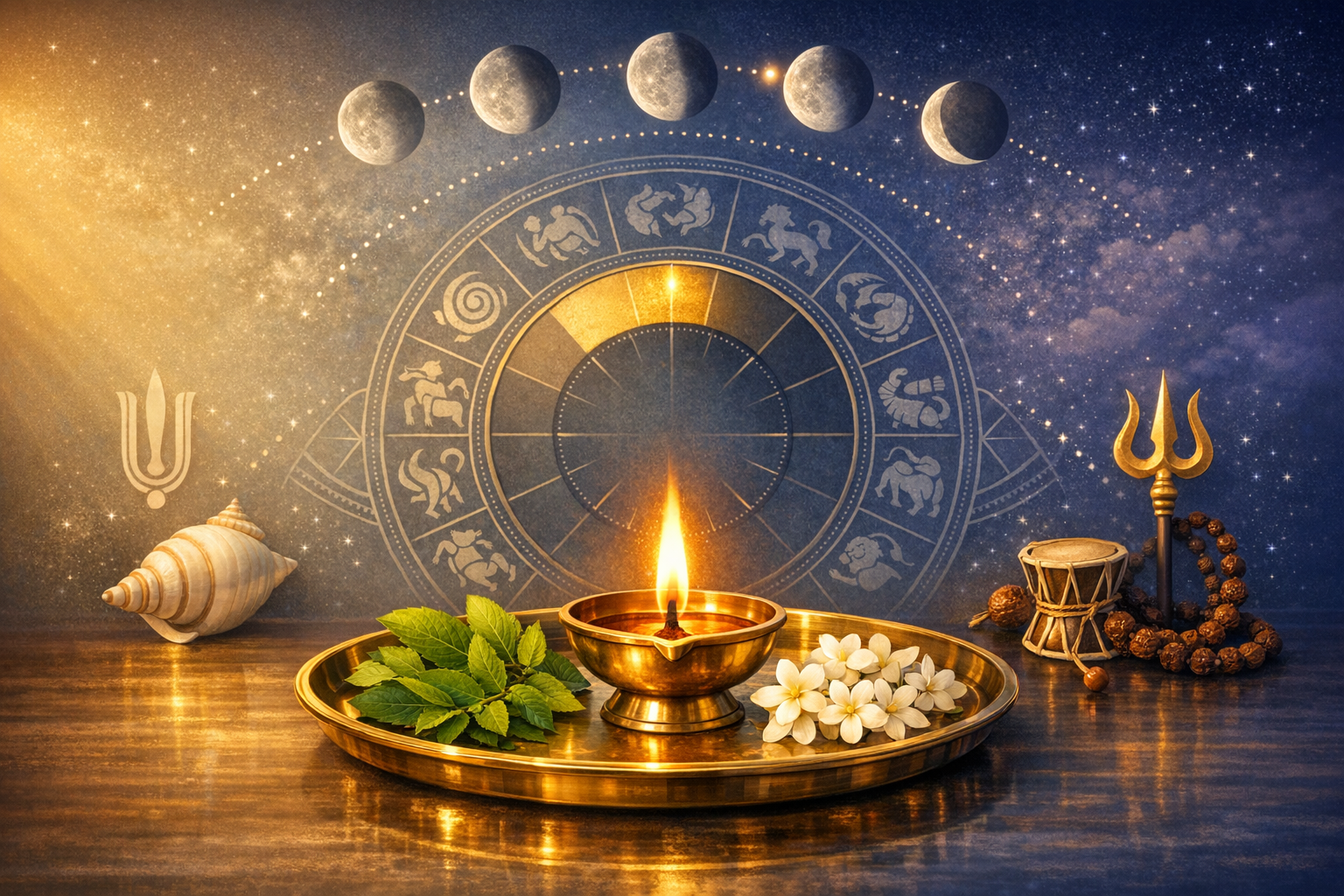
On Friday, June 12, 2026, the Panchang for most regions marks a significant transition across the lunar day. It is Krishna Paksha Dwadashi tithi or the twelfth day during the waning or dark phase of moon in Hindu calendar and Panchang in most regions. It is Krishna Paksha Dwadashi tithi or the twelfth day during the waning or dark phase of moon till 3:51 PM on June 12. Then onward it is Krishna Paksha Trayodashi tithi or the thirteenth day. This shift, occurring late in the afternoon, shapes when observances such as Ekadashi Parana (on Dwadashi) and Pradosh Vrat (on Trayodashi) are scheduled in many traditions.
Understanding Tithi within the Panchang framework is central to daily dharmic practice. A tithi is defined by the evolving angular separation between the Sun and the Moon, not by the civil clock. Consequently, a tithi can begin and end at any time of the day and its observances are anchored to the precise moment the tithi is in effect. The designation Krishna Paksha signals the waning fortnight, a time often associated with introspection, simplification, and inner consolidation across dharmic paths.
The transition from Krishna Paksha Dwadashi to Krishna Paksha Trayodashi on this date yields both practical and spiritual implications. Many practitioners experience the waning Moon fortnight as supportive of restrained activity, disciplined sadhana, and reflective study. Households and shrines commonly use such days to emphasize seva (service), japa (mantra recitation), and quiet evening worship, aligning routine responsibilities with the Panchang’s subtle timing cues.
Dwadashi holds special meaning in Vaishnava observances. Those who observed Ekadashi fast the previous day commonly perform Ekadashi Parana on Dwadashi morning, ideally within the Parana window published for their locale. Given that Dwadashi extends until 3:51 PM on June 12, Parana generally falls in the morning-to-midday span, though exact intervals vary by place and sunrise. Many find that concluding the vrata with satvic meals and gratitudethemes that resonate across Hindu, Buddhist, Jain, and Sikh sensibilitiesnurtures clarity and steadiness.
Trayodashi, commencing after 3:51 PM on this day, is closely linked with Pradosh Vrat in the Shaiva tradition. Pradosh is observed during the twilight band around sunset (the pradosh kala), provided Trayodashi prevails then. When this condition is met, devotees honor Shiva with simple, heartfelt worship, milk-water abhisheka, and contemplation on restraint and benevolence. The evening of June 12, 2026 is therefore a likely candidate for Pradosh Vrat in many regions, since Trayodashi begins late afternoon and typically continues through the pradosh window, though practitioners should confirm their local timing. Together, Dwadashi (Vaishnava emphasis) and Trayodashi (Shaiva emphasis) on the same civil day beautifully illustrate the complementary unity of dharmic traditions.
“Good Time” (Shubh Muhurat) selection for initiatives on this date benefits from a blend of tithi awareness and daily planetary periods. A widely referenced general muhurat is Abhijit Muhurat, centered on local solar noon and spanning roughly 24 minutes before and after it. While Abhijit Muhurat is often considered auspicious for starting important tasks, local sunrise and longitude shift its exact clock time, so consulting a precise Panchang for one’s city ensures accuracy. For spiritual activities, the early morning brahma muhurtam before sunrise typically enhances mantra-japa and pranayama, complementing the inward tone of Krishna Paksha.
Avoidance periods are equally important. Rahu Kaal, Gulika Kaal, and Yamaganda are typically reserved from initiating new, critical undertakings. For a conventional 12-hour daylight model (for example, 6:00 AM to 6:00 PM), Friday’s baseline spans are often cited as Rahu Kaal ≈ 10:30 AM–12:00 PM, Gulika Kaal ≈ 7:30 AM–9:00 AM, and Yamaganda ≈ 3:00 PM–4:30 PM. In practice, these windows scale with actual sunrise and sunset, so local computation is essential. Many families plan routine chores freely through the day yet schedule first-time launches, financial agreements, or travel starts outside these intervals as a matter of prudence.
Nakshatra and Rashi further fine-tune the day’s character. Nakshatra (the Moon’s mansion) supplies a qualitative flavorsupportive for certain vows, study, or travelwhile Rashi (the Moon’s sign) indicates the broader emotional climate. Because both are highly time-and-place dependent, their exact names and spans on June 12, 2026 differ by region. A reliable local Panchang or trusted almanac can identify the prevailing Nakshatra and Rashi for one’s city, enabling decisions that are both spiritually and practically aligned. Including these two markers with the tithi produces a balanced, actionable “June 12 2026 Tithi” profile for the day.
Yoga and Karana complete the classical five limbs of the Panchang. Yoga, derived from the combined longitudes of Sun and Moon, speaks to the day’s overall tenor and can suggest receptivity to study, pilgrimage planning, or modest home rites. Karanahalf a tithihighlights micro-windows used in more technical electional astrology. While the tithi transition at 3:51 PM anchors this date’s primary observances, practitioners who pursue detailed muhurta can incorporate the current Yoga and Karana for added precision.
Practical scheduling on this Friday integrates these layers. Those concluding Ekadashi may complete Parana on Dwadashi morning with gratitude and light, nourishing foods. Personal or community seva (service), study of scripture, and quiet mantra-japa are all well suited to the waning fortnight. With Trayodashi active by evening, Shaiva households may observe Pradosh during sunset, focusing on simplicity, charity (daan), and compassionate conduct. In many communities, these rhythms echo values shared across Hindu, Buddhist, Jain, and Sikh lineagesrestraint, service, and remembrance (smarana/simran)underscoring a living unity amid diverse practices.
Regional calendars may name the lunar month differently (for example, Jyeshtha in many North Indian traditions versus solar-linked month names like Aani in Tamil regions). Despite nomenclature differences, the operational principle is consistent: tithi-based observances follow the precise lunar day in effect. Because sunrise, sunset, and local time zones can shift clock times substantially, practitioners often confirm city-specific Panchang data for final decisions on Parana, Pradosh, and Shubh Muhurat.
In summary, Friday, June 12, 2026 presents a meaningful sequence: Dwadashi continues until 3:51 PM and Trayodashi begins thereafter, guiding both Vaishnava and Shaiva observances on a single civil date. Aligning plans with Shubh Muhurat, and avoiding Rahu Kaal and similar periods, supports ease and clarity. Confirming Nakshatra and Rashi locally completes the day’s Panchang profile. Approached with humility and shared intent, these time-honoring practices strengthen harmony across dharmic traditions and bring mindful structure to modern life.
Inspired by this post on Hindu Blog.
