

You may have heard life described as lila, divine play, and wondered what you are actually being asked to believe. Is the world unreal? Are painful events part of a cosmic game? Does spiritual maturity mean watching everything with a smile?
None of those conclusions follows automatically. Lila can loosen the ego’s grip without weakening your moral seriousness, but only when you understand where the idea belongs, where other Dharmic traditions merely resemble it, and where the comparison must stop. The practical aim is not to pretend that suffering is pleasant. It is to participate fully without treating your present role, victory, loss, or emotion as the whole of reality.
Begin with the distinction that prevents most confusion
Lila is first and most properly a Hindu way of speaking about the relationship between the ultimate and the changing world. It presents manifestation not as a task forced upon an incomplete deity, but as free expression: being discloses itself through becoming. Creation, preservation, and dissolution can therefore be understood as movements within a sacred rhythm rather than disconnected events.
The English word play can mislead you. Here it need not mean frivolity, make-believe, or entertainment at someone else’s expense. It points to freedom, creativity, movement, relationship, and action not driven by deficiency. A musician at play can be disciplined. A dancer at play can follow an exact form. In the same way, divine play does not imply a universe without order or consequence.
This is why karma and dharma remain indispensable. Karma means that actions shape experience and character. Dharma asks you to act in alignment with truth, duty, and the sustaining order of life. If your interpretation of lila gives you permission to neglect either, you have converted a spiritual teaching into an excuse.
It is also a mistake to turn lila into a single doctrine supposedly shared without qualification by every Dharmic religion. Hindu, Buddhist, Jain, and Sikh traditions can illuminate one another, but they do not make identical claims about God, self, world, causation, or liberation. A responsible comparison begins with three questions:
- What is ultimately real? The answer may involve Brahman, Shiva, Shakti, dependent arising, a plurality of souls and substances, or Ik Onkar.
- What keeps a person bound? Different paths diagnose ignorance, attachment, karma, ego, false identification, or resistance to cosmic order in different ways.
- What kind of participation leads toward freedom? Discernment, devotion, meditation, non-violence, remembrance, service, and disciplined action are not interchangeable, even when they reinforce similar virtues.
Ask those questions whenever someone claims that all Dharmic paths teach the same thing. Shared civilizational vocabulary is real, but unity does not require erasing philosophical precision.
Within Hindu traditions, lila does not have only one meaning
The most important internal difference concerns the status of the changing world. Hindu schools can all speak meaningfully of sacred manifestation while disagreeing about how the world, individual selves, and the divine are related. You therefore need to know which philosophical grammar is being used before deciding what a statement about lila means.
Advaita: change rests in nondual being
Advaita Vedanta, associated with Adi Sankara, understands Brahman as nondual being-consciousness-bliss. The many forms of experience appear through maya, yet they possess no existence independent of Brahman. Calling this world an appearance does not mean that your hunger, grief, obligations, or actions are mere hallucinations. It means that changing names and forms should not be mistaken for self-sufficient, ultimate reality.
For an Advaita practitioner, the useful movement is from exclusive identification with the role to recognition of the awareness in which every role appears. You still answer the email, care for the child, keep the promise, and correct the injustice. What changes is the claim of possession: this role is occurring, but it is not the entirety of what I am. Lila becomes a way to participate without being imprisoned by the character you presently play.
Vishishtadvaita and Dvaita: relationship is not an illusion
Vishishtadvaita gives the cosmos and finite beings a real place within an integral divine whole. Becoming is meaningful participation in that whole, not a disposable error to be mentally cancelled. Dvaita maintains real distinction among the divine, individual selves, and the world. On that account, devotion, moral action, dependence upon grace, and the relationship between worshipper and worshipped cannot be reduced to stages on the way to declaring that only undifferentiated identity exists.
This difference matters in practice. If you approach lila devotionally, the right question may not be, “How do I discover that the role is unreal?” It may be, “How do I perform my real part in loving relation to the divine?” The first question emphasizes discernment; the second emphasizes fidelity, surrender, and grace. Both can reduce egoism, but they do so through different understandings of reality.
Krishna, Shiva, and Devi make play experiential
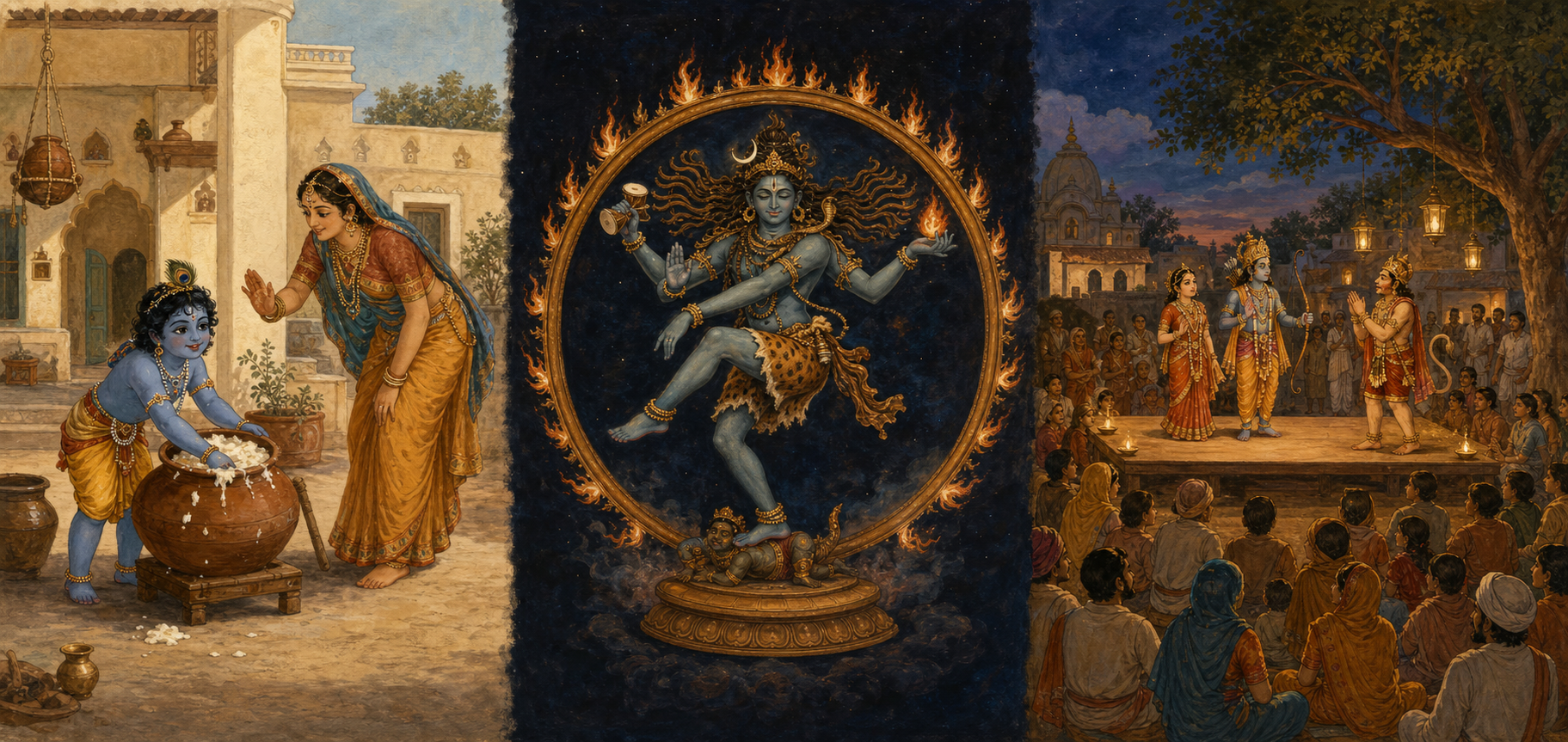
Bhakti traditions do not leave lila at the level of metaphysics. Krishna’s lilas invite the devotee into relationship through distinct devotional moods, or rasas. The practitioner does not merely analyze divine presence; one learns to love, remember, serve, and respond to it. Emotion is trained rather than rejected.
Shaiva and Shakta traditions bring another emphasis. Becoming can be understood as the expression of consciousness and power, Shiva and Shakti, rather than as a fall away from sacred stillness. Kashmir Shaivism uses the language of spanda, a pulse or vibration of consciousness. Shiva Nataraja gives this intuition an embodied image: stability and motion, manifestation and dissolution, concealment and grace belong to one cosmic dance. Devi traditions likewise recognize creative power as sacred rather than treating dynamism as spiritually inferior to stillness.
These approaches converge in one practical correction: stillness and action need not be enemies. Meditation can disclose the ground of experience; worship can orient feeling; Karma Yoga can purify action; and devotion can turn ordinary participation toward the divine. The paths meet in disciplined non-possessiveness, not in a demand that every school use identical metaphysics.
Buddhist, Jain, and Sikh resonances must be named carefully
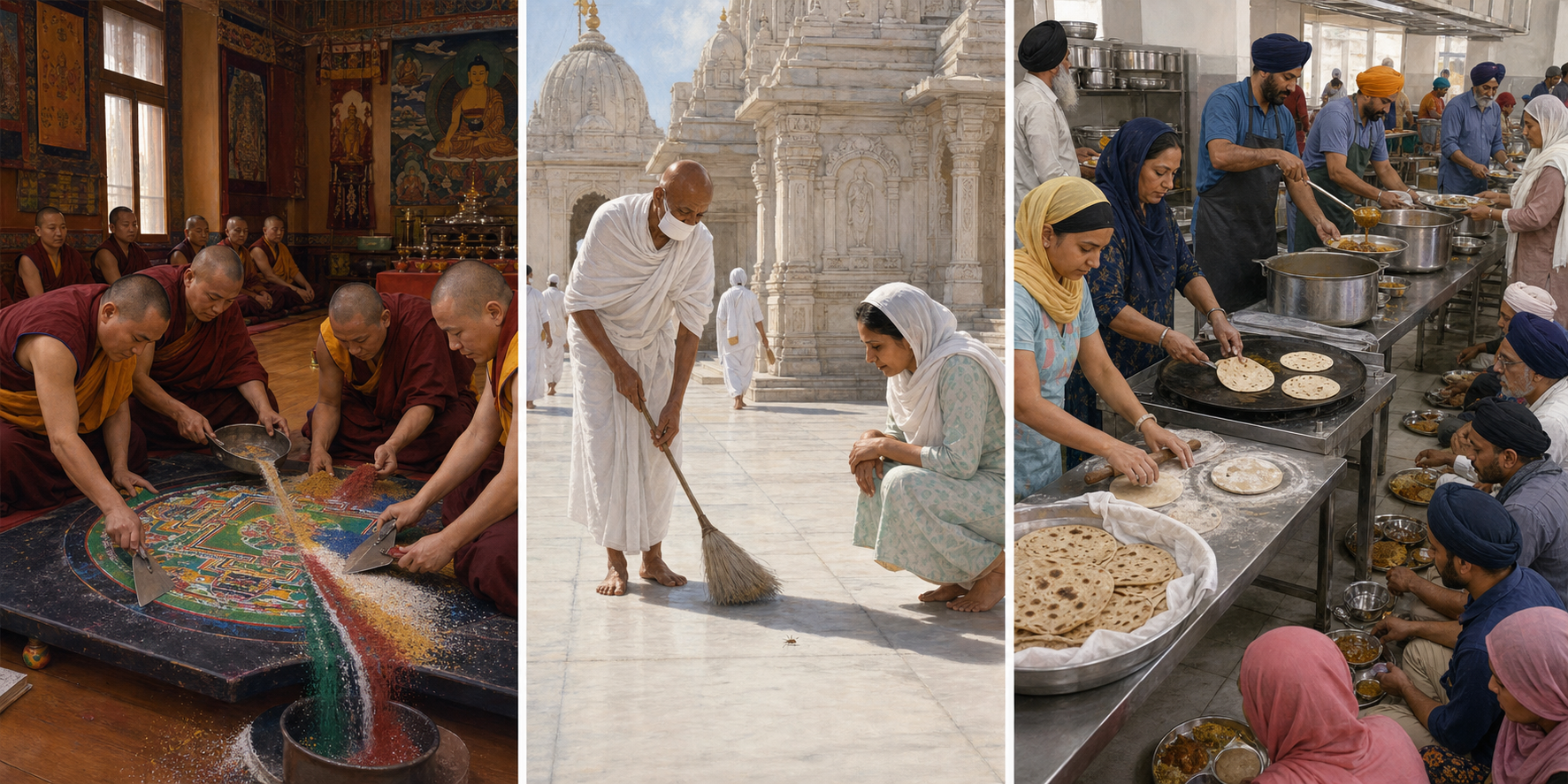
Across Dharmic traditions, you repeatedly encounter a world of change, the danger of egoic fixation, moral causation, disciplined attention, and liberation from bondage. That family resemblance makes comparison fruitful. It does not authorize us to transplant Hindu theology into every neighboring path.
Buddhism: process without a fixed self
Lila is not a central category of Buddhist philosophy. The more accurate points of contact are impermanence, dependent origination, and anatta, or the absence of a fixed, independent self. Experiences arise through conditions and cease when conditions change. The practical task is to observe this arising and ceasing without grasping at a permanent owner behind it.
Some Mahayana and Vajrayana settings describe phenomena as a luminous display. That can sound like divine play, but the resemblance should not be used to smuggle in a metaphysical claim the Buddhist framework is not making. The sound comparison concerns how you meet experience: clearly, without fixation, and with compassion grounded in interdependence.
Try the Buddhist lens when an emotion seems to define you. Replace “I am anger” with a more exact observation: anger has arisen under particular conditions; it is changing; acting from it will create further conditions. This is not wordplay. It interrupts the move from a temporary process to a permanent identity.
Jainism: many-sided reality and disciplined restraint
Jain philosophy contributes anekantavada, the recognition that reality is many-sided, and syadvada, the discipline of making conditional claims. These principles do not mean that every statement is equally true or that reality is invented by opinion. They mean that a finite standpoint usually captures only an aspect of a complex whole.
The practical resemblance to lila lies in freedom from the ego’s insistence that its present viewpoint exhausts reality. The distinctively Jain consequence is rigorous humility joined to ahimsa. When your knowledge is partial and other living beings have their own standpoint and vulnerability, restraint is rational as well as compassionate.
Use this lens in conflict by qualifying your claim before defending it. Say what is true “from this standpoint” and identify the condition under which it holds. Then ask what the other perspective reveals that yours does not. This need not weaken conviction. It prevents a partial truth from hardening into intellectual violence.
Sikh thought: divine play under hukam
Sikh thought holds transcendence and immanence together through Ik Onkar and the language of nirgun and sargun, the divine beyond attributes and manifest with attributes. Existence may be described as khel, play, but it unfolds under hukam, cosmic order. Human response therefore takes the form of remembrance, truthful living, courage, and service.
Hukam should not be confused with passive fatalism. Simran and seva turn recognition of divine order into inner recollection and outward responsibility. If you invoke cosmic play but become less available for service, you have missed the Sikh resonance. A lighter grip on ego should make responsible action easier, not optional.
The comparison can now be made without flattening anyone: Hindu lila concerns sacred manifestation in several theistic and nondual grammars; Buddhist insight loosens attachment to impermanent, dependently arisen processes; Jain many-sidedness disciplines certainty and supports non-violence; Sikh khel is lived under hukam through remembrance and service. The consonance lies in less grasping and more skilful participation, not in a hidden creed that makes every distinction disappear.
Use responsibility to test any interpretation of cosmic play

The hardest objection to lila is also the necessary one: how can anyone call existence play when living beings suffer? A shallow answer tries to solve the discomfort by zooming out until another person’s pain looks insignificant. A Dharmic answer has to preserve both scales at once. The cosmos may exceed your present drama, yet the being before you still deserves truth, care, and protection.
Never tell a grieving person that a death, betrayal, illness, or injustice is “just lila.” The word may help you loosen your own demand that reality obey your preferences. It does not give you authority to reinterpret someone else’s pain from a safe distance. Grief can be held within a wider vision without being denied, hurried, or made into a lesson for the person enduring it.
Three tests expose spiritual bypassing quickly:
- The consequence test: Does the interpretation acknowledge that actions produce effects? If it erases karma, accountability, or repair, reject it.
- The duty test: Does it clarify what compassion, dharma, ahimsa, or seva requires now? If it makes another person’s need less urgent merely because “everything is play,” reject it.
- The ego test: Who becomes lighter? A sound application reduces your possessiveness and self-importance. A corrupt application reduces the weight you give to other people’s suffering.
This also clarifies non-attachment. It is not indifference to results. It is freedom from treating a preferred result as personal property or as the sole measure of right action. You prepare carefully, act firmly, and learn from the consequence. What you release is the fantasy of total control and the demand that the world certify your ego.
The distinction is especially important in public life. Seeing the world as sacred play does not require you to call adharma harmless. It can help you resist injustice without allowing hatred to become your identity. Serious action and inward spaciousness can coexist. In fact, action often becomes steadier when it is no longer fueled entirely by outrage, fear, or the desire to dominate.
Turn lila into a practice rather than a slogan
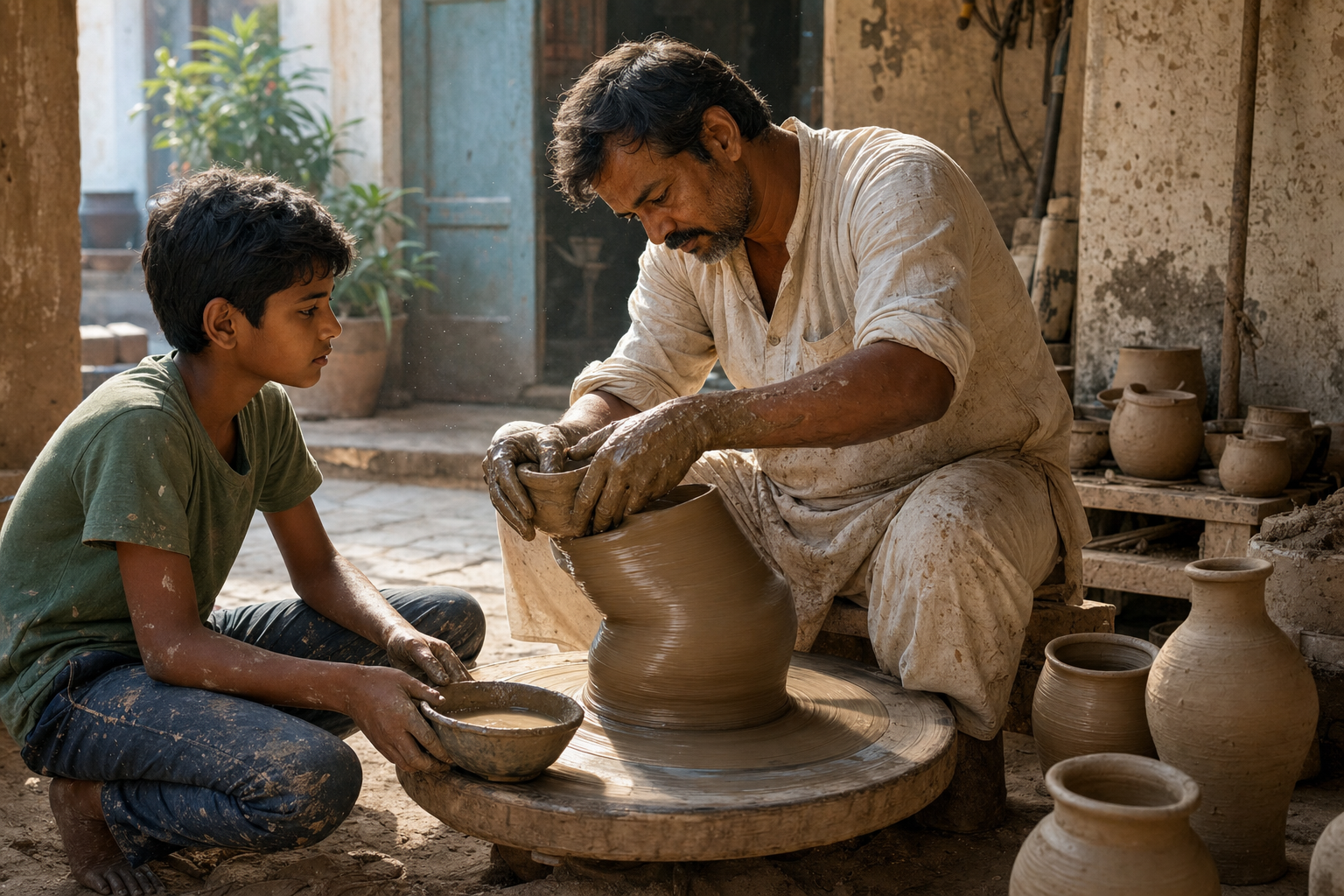
You do not need to impose one philosophy upon every moment. Choose a lens consistent with your path, then use it to create a small gap between what is happening and the ego’s immediate claim about it. The following sequence can be used during work, disagreement, disappointment, or a difficult decision.
- Name the movement. State the change plainly: “A plan failed,” “praise arose,” “anger is present,” or “this role is ending.” Avoid turning an event into a total identity.
- Remember the larger frame. An Advaita practitioner may return to witness-awareness; a bhakta may remember the divine presence; a Buddhist may notice conditions and impermanence; a Jain may seek the missing standpoint; a Sikh may recollect hukam through simran.
- Locate the obligation. Ask what dharma, compassion, ahimsa, or seva requires from you. This step prevents spaciousness from degenerating into passivity.
- Act without claiming ownership of the whole field. You control neither every condition nor every response. Perform the part actually given to you: apologize, protect, speak, serve, decline, persist, or wait.
- Read the consequence. Notice whether the action produced greater clarity, reduced harm, and weakened possessiveness. If it merely made you feel spiritually superior, revise the practice.
The method changes how common situations look. At work, Karma Yoga means doing the task well without making recognition the price of your integrity. In conflict, Jain many-sidedness asks you to distinguish a real disagreement from the fantasy that only one standpoint exists. In emotional turbulence, Buddhist attention tracks an experience as a process instead of crowning it as the self. In devotion, lila turns remembrance from an abstract belief into relationship. Under hukam, service becomes the concrete answer to a world you cannot completely command.
It also changes how you use sacred images. Krishna’s play can train loving attention. Shiva Nataraja can remind you that stillness is not destroyed by movement. Devi can help you recognize creative power as sacred. These forms are not decorative shorthand for “everything will work out.” They are contemplative disciplines for perceiving order, presence, and possibility amid change.
Key takeaways
- Lila is a major Hindu idiom, not a universal doctrine that can be assigned unchanged to every Dharmic religion.
- Hindu schools disagree about the status of the world, the self, and divine relationship; identify the school before interpreting the term.
- Buddhist impermanence, Jain many-sidedness, and Sikh khel under hukam offer genuine resonances without becoming versions of Hindu metaphysics.
- Any use of “divine play” that weakens accountability, compassion, non-violence, or service has failed its ethical test.
- The practical fruit is serious participation with less possessiveness: a lighter ego, not a lighter duty.
Begin with one recurring situation in which you become trapped inside a role. When it next appears, name the movement, return to the larger frame taught by your path, identify the duty, and act. That is enough for lila to stop being an attractive idea and become a disciplined way of meeting change.
References
