
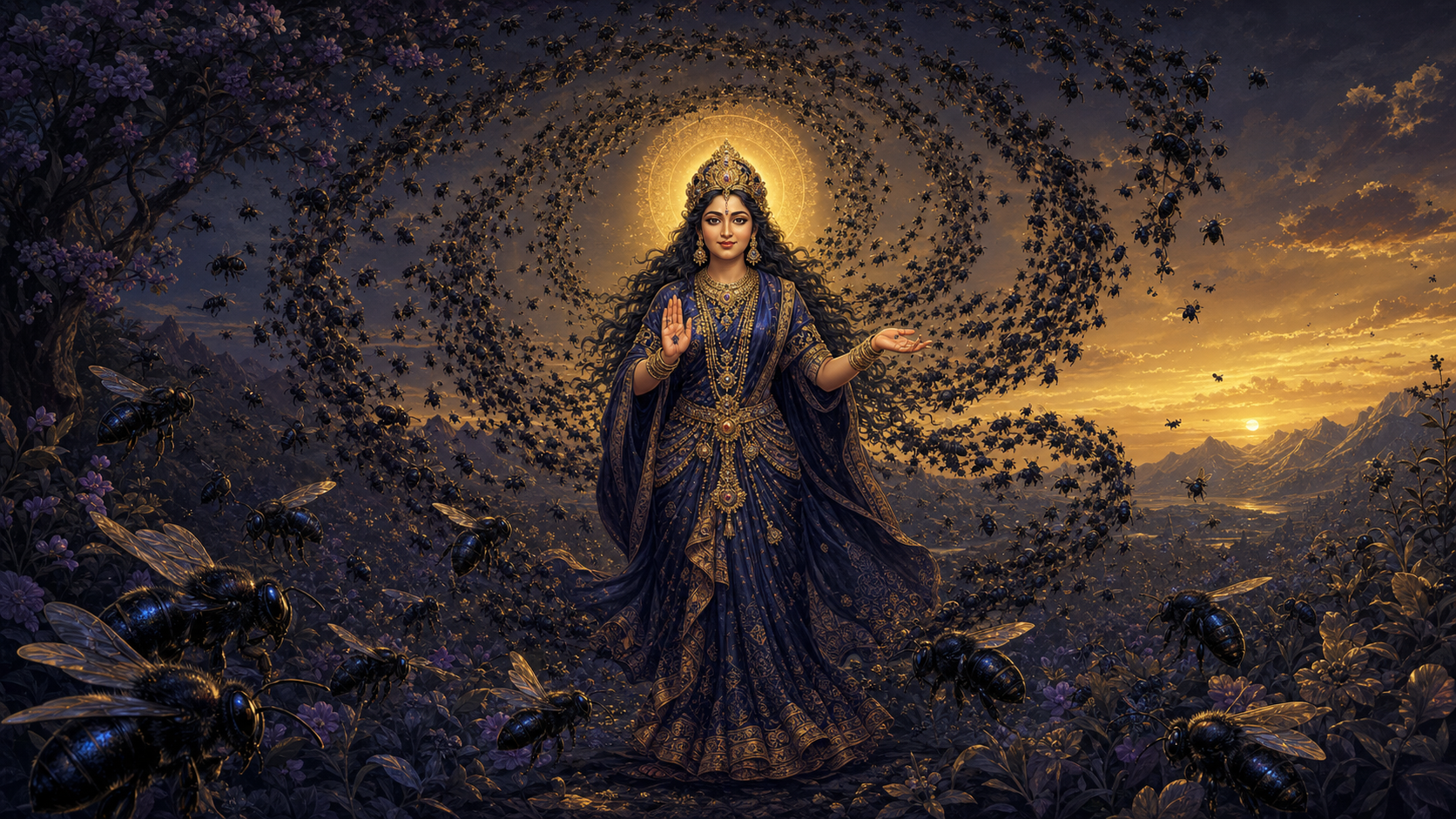
You may have seen Bhramari Devi surrounded by black bees and wondered whether the image is ominous. It is better read in the opposite direction. The black bee signifies concentrated awareness, protective power and many small forces moving with one purpose.
Once you know how to read the symbol, it becomes more than unusual iconography. Bhramari offers you a practical discipline: gather scattered energy, respond to large problems through coordinated right action, seek sweetness without grasping and protect the living world that sustains you.
Read the bee, the darkness and the swarm together
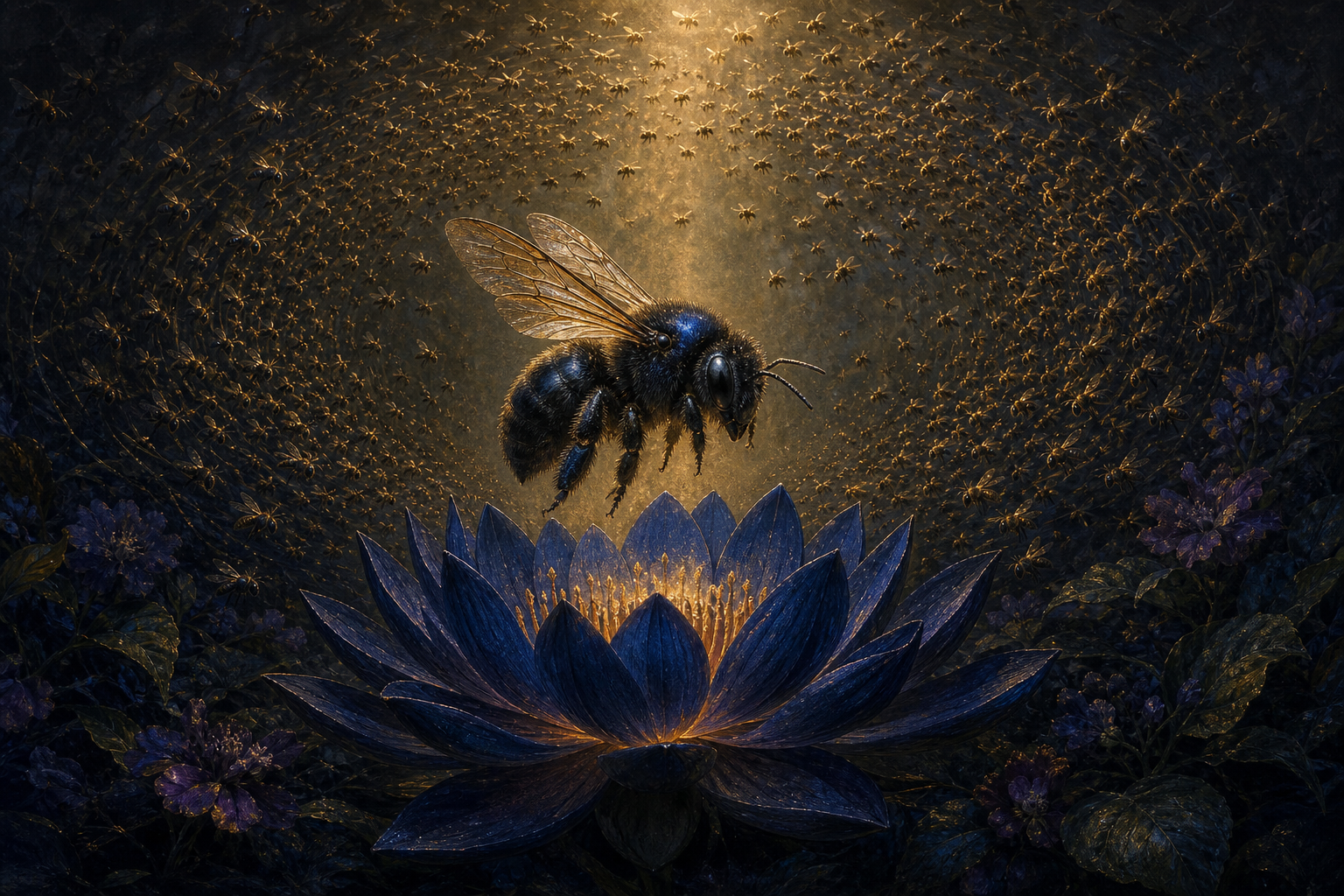
The name Bhramari is rooted in bhramara, the bee. Its wider field of meaning evokes movement, vibration and humming. That matters because the Goddess is not represented by a bee merely as a decorative emblem. Sound, motion and concentrated attention belong to the theology of this form.
Three features need to be held together when you encounter Bhramari Devi:
- The hum represents power made perceptible as vibration. It draws attention away from scattered mental noise and toward a steady center.
- The black radiance represents the depth and containing power of Shakti. It should not be reduced to a sign of evil or misfortune.
- The swarm represents countless powers acting as one intelligence. No single bee carries the whole force, yet the force is present through all of them.
The darkness is especially easy to misread. In a Shakta frame, dark forms such as Kali and Kalaratri do not make darkness morally corrupt. Darkness can signify the fertile unmanifest, the cosmic depth from which forms arise and into which they return. It is capacious rather than empty. Bhramari makes that dark potential audible and mobile: the night does not merely surround creation; it hums with Shakti.
This does not mean Bhramari, Kali and Kalaratri are interchangeable names. Each form has its own devotional and theological setting. The comparison helps with one precise point: fierce or dark iconography can express auspicious protection. When you see black bees around the Goddess, begin with the symbol’s Shakta grammar instead of importing an assumption that black must mean sinister.
The bees may also be understood as energetic rays or powers cohering around a single divine will. This gives you a useful way to examine an image of Bhramari. Do not look only for one central figure and treat everything around her as background. Notice the field. The Goddess’s presence includes the innumerable agents through which her protection operates.
Why the Goddess overcomes the demon as a swarm
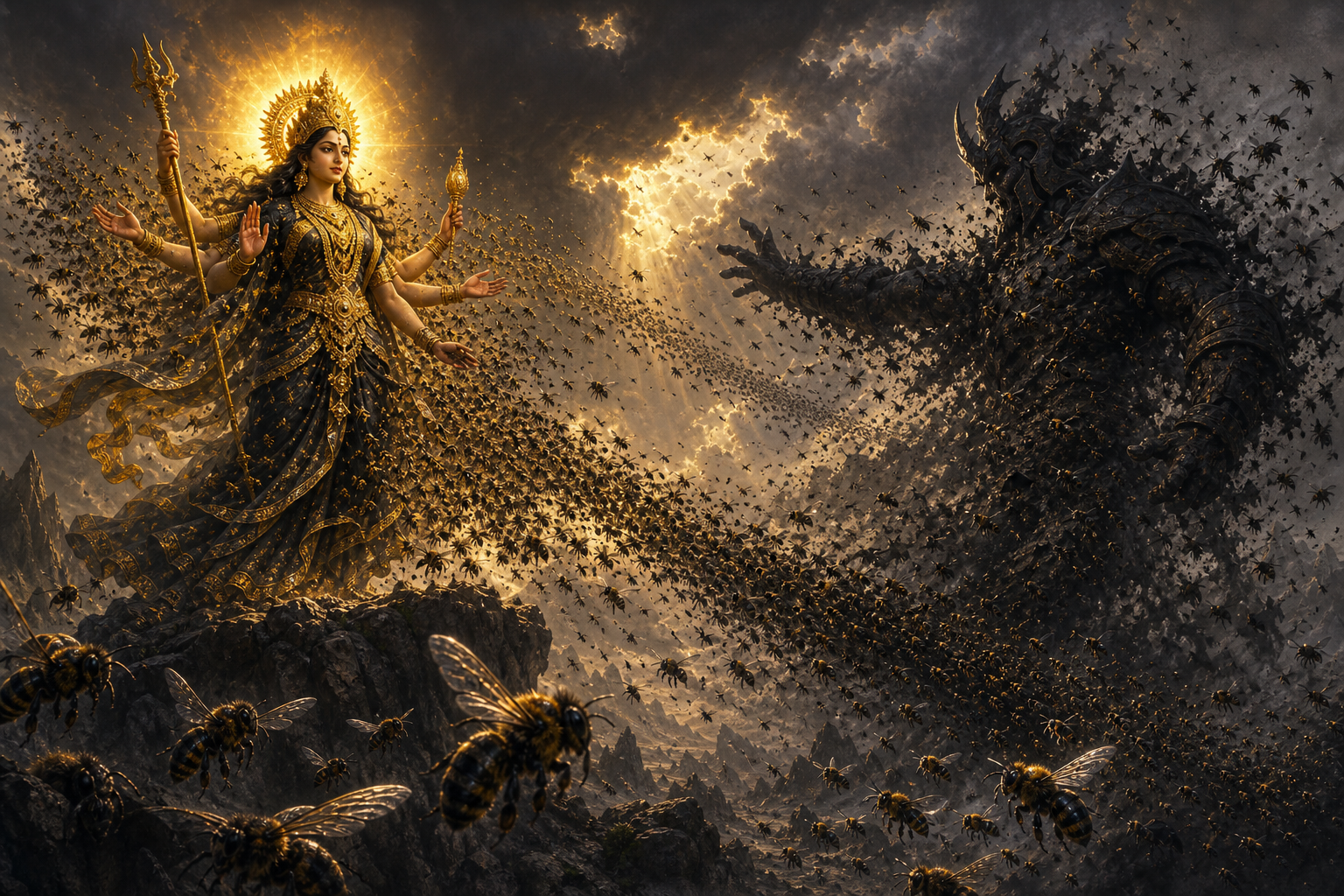
Puranic and regional tellings preserve a recurring narrative pattern. A destructive being is protected by unusual conditions, making ordinary weapons or familiar forms of attack ineffective. The Goddess answers by manifesting innumerable bees. What cannot be defeated by one conventional instrument is overcome by a coordinated multitude.
The point is not that divine power has run out of strength. The constraint reveals another configuration of strength. Shakti does not have to become a larger version of the weapon that already failed. She can become subtle, distributed and difficult to resist because she acts through countless small bodies at once.
This motif remains important in the Bhramaramba tradition at Srisailam and the Durga Parameshwari lore of Kateel in coastal Karnataka. Local accounts vary, so they should not be forced into one artificial sequence of events. If you visit or study either shrine, learn its own sthala-purana and ritual vocabulary. Shared symbolism does not erase local memory.
The social lesson is not blind conformity. A crowd can magnify confusion as easily as it can magnify service. Bhramari’s swarm is powerful because its members are aligned toward a dharmic end. Coordination has moral value only when the purpose and the means are themselves worthy.
If you are facing a cultural, community or ecological task that feels too large for one person, use the swarm as a decision-making lens:
- Name the protected obstacle. Identify why the familiar response keeps failing. The problem may persist because effort is arriving in the wrong form, not because too little effort has been applied.
- Define one dharmic outcome. A group cannot align around a vague wish. State what protection, repair or preservation would look like in practice.
- Divide the work into small, repeatable actions. Give each person a contribution that can actually be sustained. The Bhramari principle is multiplication through alignment, not dependence on one exhausted hero.
- Create a shared rhythm. Bees symbolize communication through movement and vibration. Human cooperation likewise needs a dependable way to signal progress, correct errors and keep the purpose visible.
- Check the means for harm. Collective force does not become dharmic merely because many people support it. Review whether the work protects life, truth and rightful relationship.
This is the difference between borrowing an attractive metaphor and learning from the deity. The swarm asks you to reconsider the shape of effective action. When a blunt response repeatedly fails, smaller coordinated interventions may reach places that one dramatic gesture cannot.
Follow the bee through sound, honey and devotion

Bhramari belongs to a much wider Indian language of bees and honey. The meanings are related, but they are not identical. You can read them accurately by asking three questions: What is the bee doing? What does the sweetness represent? What discipline is the image asking a person to cultivate?
In the Upanishadic Madhu-Vidya, especially in the Chandogya and Brihadaranyaka Upanishads, madhu or honey becomes a way of contemplating interdependence. Beings are not sealed units existing by themselves. Each participates in relationships through which life is received, transformed and shared. The practical implication is demanding: enjoy the sweetness of existence without pretending you produced it alone.
The Bhramara-gita in the Srimad-Bhagavata Purana, at 10.47, places a bumblebee within the intense devotional world of the gopis. The bee operates as a messenger and a catalyst for speech about longing, fidelity and divine absence. Here the bee is not chiefly the martial swarm of Bhramari Devi. Its movement between fragrance and flower becomes part of the emotional language of bhakti.
Classical kavya adds another register by imagining Kama-deva’s bowstring as a line of bees. Fragrance, attraction, vibration and desire converge in one image. The same creature can therefore signify protective Shakti, devotional longing, interdependence or desire depending on what it is doing within a particular sacred or literary setting.
Related images also appear across the Dharmic family:
- Buddhist teaching: The Madhupindika Sutta, MN 18, uses the honey image within a discourse concerned with perception and conceptual proliferation, or papanca.
- Jain discipline: Madhukari bhiksha compares taking small amounts of alms from several households to a bee gathering nectar. The practice embodies non-possession and non-harm by avoiding an excessive burden on any one household.
- Sikh devotion: The bee’s focused attraction to fragrance becomes a fitting image for the mind drawn steadily toward Naam through simran.
These parallels show a shared civilizational sensitivity to attention, sweetness and restraint. They do not prove that Hindu, Buddhist, Jain and Sikh teachings are saying the same thing. To honor kinship without erasing difference, keep each metaphor attached to its practice: Shakta protection, Upanishadic interdependence, Vaishnava longing, Buddhist examination of mental proliferation, Jain non-possession or Sikh remembrance.
This distinction will help whenever you encounter bee symbolism in a temple, scripture or poem. First identify the tradition and setting. Then look at the bee’s action. A bee gathering lightly, a bee carrying a message and a swarm confronting adharma may share an imaginative world, but they teach through different relationships.
Turn Bhramari’s symbolism into a careful daily practice
Bhramari Pranayama, often called bee-breath, gives you a direct way to work with humming and inward attention. It should not be confused with the whole worship of Bhramari Devi. The breathing practice and the deity share a symbolic language of resonance, but a pranayama technique is not a substitute for mantra, puja, ethical conduct or theological understanding.
A simple Bhramari-centered observance can be done at dawn or dusk:
- Sit without strain. Keep the spine comfortably aligned. Relax the jaw and facial muscles, and let the tongue rest rather than pressing it against the mouth.
- Establish the image. Contemplate Bhramari Devi’s dark radiance as protection, alertness and gathered power. You do not need to manufacture an elaborate visualization.
- Inhale naturally through the nose. Avoid taking an exaggerated breath merely to make the sound longer.
- Hum on the exhalation. Keep the lips gently closed and make a low, steady sound. Attend to the vibration in the face, sinus region, throat and chest without forcing it into any particular location.
- Begin with five to seven rounds. Let each exhalation remain comfortable. The purpose is stable attention, not an endurance test. Stop if the practice produces discomfort, and do not treat it as a replacement for medical or psychological care.
- Add devotion if it belongs to your practice. Recite a Shakti mantra you already use or sit briefly with the after-vibration. Some practitioners place attention near anahata, the heart center associated with the unstruck sound, but this is an optional contemplative frame rather than a requirement.
- Conclude with dedication. Offer the merit or intention of the practice for the well-being of humans, animals and the pollinators on which living systems depend.
The slow, sonorous exhalation and felt vibration can support inward attention, steadier focus and reduced reactivity. Do not chase unusual sensations. A quieter mind, a less impulsive response or a clearer next action is a more useful measure than the intensity of the hum.
Honey may be offered in forms of Shakta worship where it is customary, but sweetness is not the only offering the symbol asks from you. Devotion to a bee-associated Goddess should never involve capturing bees, disturbing a hive or treating living pollinators as ritual objects. The image points toward reverence for their life, not possession of it.
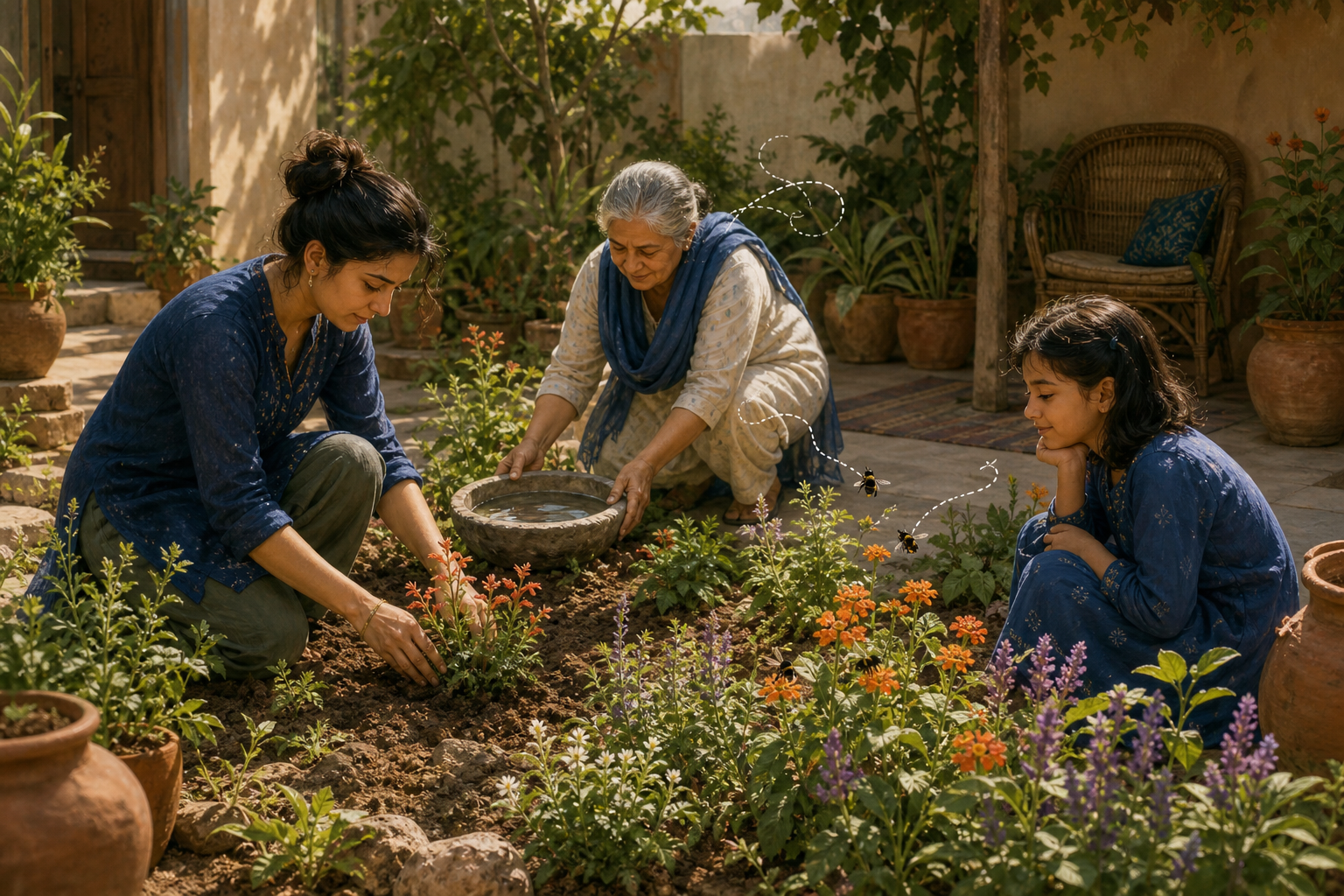
Carry the observance into the physical world by protecting flowering habitat, preserving wildflower corridors where possible and supporting lower-chemical forms of cultivation. If you have influence over a garden, community space or agricultural decision, make room for pollinators without approaching or disrupting nests. This is where symbolism becomes seva: the hum honored in prayer is also the hum protected in the landscape.
Key takeaways
- Bhramari Devi’s bee imagery joins humming, movement and concentrated awareness in one form of Shakti.
- The black bee is not inherently ominous. In a Shakta reading, darkness can express fertile depth, containment and auspicious protection.
- The demon-slaying swarm represents distributed Shakti: many small powers become decisive when they act toward one dharmic end.
- Bee and honey images recur across Hindu, Buddhist, Jain and Sikh settings, but each must be interpreted within its own doctrine and practice.
- A beginner can explore the sound dimension through five to seven comfortable rounds of Bhramari Pranayama without forcing the breath.
- Ecological stewardship completes the symbol: honoring Bhramari includes protecting bees, flowering habitat and less harmful cultivation.
At your next dawn or dusk practice, choose one task that has remained too large for solitary effort. Make the hum steady, name the dharmic outcome and identify the smallest coordinated action that can begin now. Bhramari’s teaching becomes living when vibration gathers attention, attention guides service and service protects life.
References
