

If someone points to Lakshmi near Vishnu’s feet and declares that Hindu tradition places wives beneath their husbands, you do not have to accept the premise. Nor should you answer with the equally shallow claim that every sacred image expresses modern social equality.
The better response is to read each image as a complete theological scene. Posture matters, but so do the deity’s character, the action being performed, the setting, and the relationship the image is meant to reveal. Once you restore that context, Lakshmi and Parvati stop looking like contestants in a hierarchy of women.
A sacred pose is a scene, not a social rule

Religious iconography is a visual language. A figure’s location can communicate service, intimacy, protection, authority, dependence, welcome, or participation. It does not function like a seating chart in which the highest place always belongs to the most valuable person.
This distinction is especially important in a Hindu setting because feet do not carry only one meaning. Bowing at someone’s feet can express reverence. Touching an elder’s feet can express respect. The feet of a deity can become the focus of surrender and refuge. Physical lowness in such an act can therefore represent spiritual devotion rather than humiliation.
That does not mean every image is beyond criticism, or that people have never used religious imagery to defend unequal customs. It means the criticism must address what the image is actually doing. Turning a voluntary act of sacred service into a command that every wife must obey is not interpretation. It is the conversion of theology into a convenient social rule.
Before drawing a gender conclusion, ask a basic question: are you looking at a permanent ranking of persons, or at one meaningful action within one particular relationship? That question prevents most careless readings.
Lakshmi near Vishnu’s feet: service without inferiority

Vishnu is often presented through royal imagery, while Lakshmi appears near his feet. In that composition, the viewer is not merely being shown where a husband and wife happen to sit. The scene presents divine order, repose, prosperity, and attentive service as parts of one harmonious whole.
Lakshmi embodies prosperity and auspiciousness. Her presence is not decorative. A royal scene without her would be materially grand but symbolically incomplete: sovereignty needs well-being, abundance, and grace if it is to become a flourishing order rather than bare power.
Her proximity to Vishnu’s feet can therefore be read through seva, or sacred service. Seva is not valuable because the person serving is lesser. It is valuable because attention freely offered to the beloved or the divine is itself a form of power. Care sustains what authority alone cannot sustain.
There is also intimacy in the scene. Lakshmi is not depicted as a distant subject waiting outside the royal presence. She occupies its innermost space. Nearness, trust, and participation are easy to miss when a modern viewer notices only vertical position.
You should still avoid forcing a single explanation onto every representation of Lakshmi and Vishnu. Their forms vary, and Lakshmi does not always occupy the same position. When she is seated or standing beside Vishnu, the emphasis changes. That variation is evidence that Hindu iconography possesses a vocabulary of relationships, not one unchanging diagram of marital rank.
Parvati beside Shiva: visible partnership and active power

Parvati beside Shiva makes partnership immediately legible. The two figures share a visual field, and neither can be reduced to an accessory of the other. The arrangement can express companionship, mutual presence, and the union of consciousness with active divine power.
The setting also changes the meaning. Vishnu’s royal repose and Shiva’s austere character do not pose the same artistic problem. An image organized around repose naturally gives service a prominent place. An image organized around the meeting of ascetic stillness and the power of household, relationship, and manifestation naturally emphasizes conjunction.
Parvati’s place beside Shiva should not be used to claim that she has somehow achieved a status denied to Lakshmi. That would preserve the original mistake: judging divine feminine forms by their distance from a male figure’s feet. Lakshmi and Parvati reveal different dimensions of sacred relationship. One scene foregrounds sustaining service and auspicious presence; the other makes shared power and partnership more visually explicit.
Nor does a side-by-side pose automatically settle every question about human gender relations. Sacred images disclose theological truths; they are not photographs of an ordinary household or ready-made policy statements. They can shape ethical imagination, but their symbols must be interpreted before they are applied.
How to test a gender claim made from an image
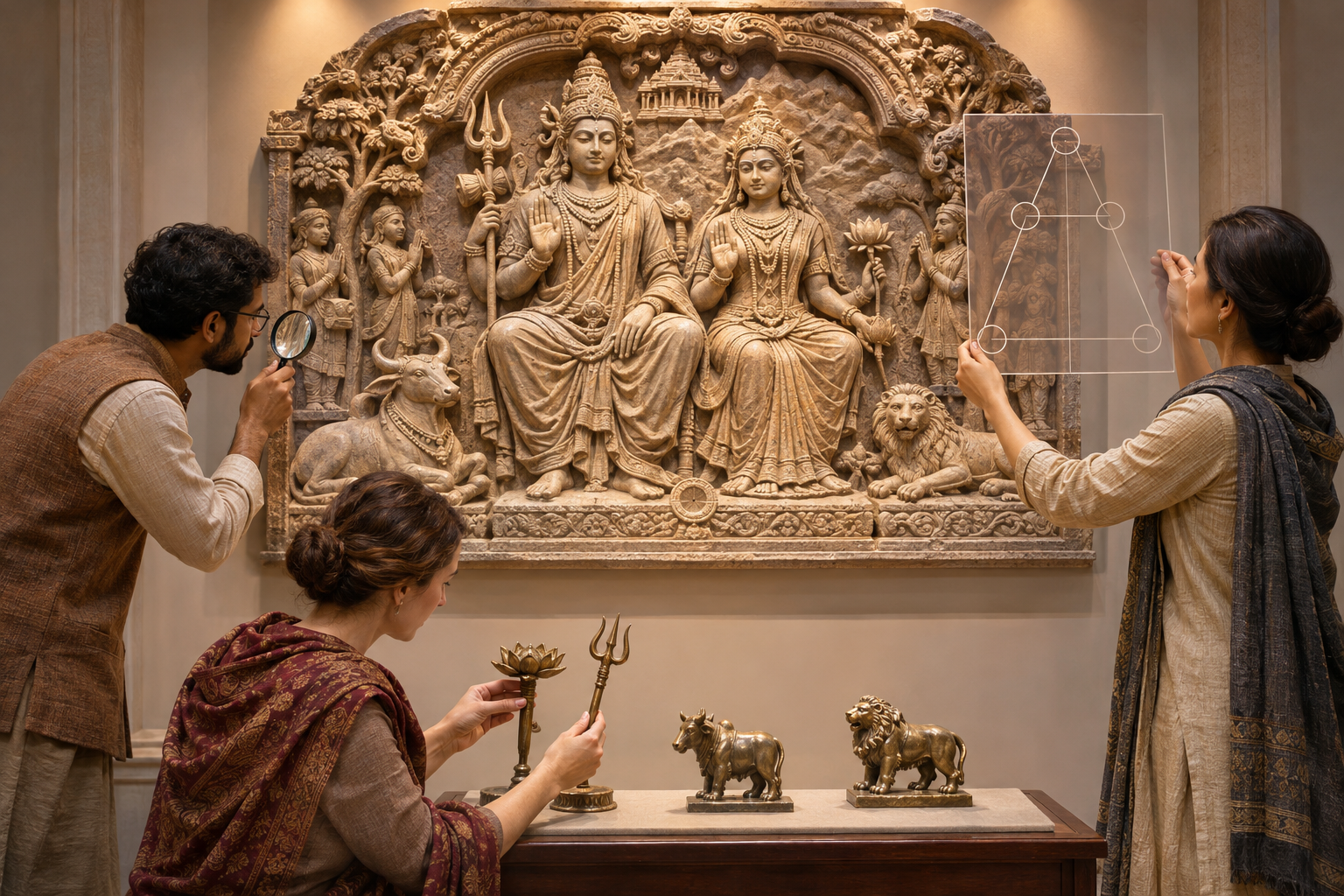
When a social-media post, classroom discussion, or family argument turns one divine image into proof of what Hinduism supposedly demands from women, use this sequence:
- Describe the visible action precisely. Do not begin with “Lakshmi is subordinate.” Begin with what can actually be seen: she is seated near Vishnu’s feet, touching them, attending to him, or occupying a particular place in the composition.
- Read the feet within Hindu practice. Ask whether they indicate contempt in this scene, or whether they are connected with reverence, refuge, devotion, and sacred service.
- Identify the scene’s governing mood. Royal repose, ascetic stillness, family intimacy, worship, and divine action use space differently. The same physical position can carry a different meaning in each.
- Examine the feminine deity’s own identity. Is she merely present, or does the composition depend on the prosperity, power, protection, wisdom, or grace she represents? A necessary presence cannot honestly be described as an expendable servant.
- Look for variation before making a universal claim. If the same deity appears beside, apart from, or independently of her consort elsewhere, one pose cannot establish a permanent rank.
- Separate symbol from social prescription. Even when a scene praises service, it does not follow that service may be coerced, assigned only to women, or detached from reciprocity. Voluntary seva and compulsory subordination are morally different things.
This method also works in the opposite direction. If someone claims that every paired divine image proves complete social equality in every historical Hindu community, apply the same discipline. Iconography can challenge narrow gender assumptions, but it should not be made to erase the complexity of lived society.
Key takeaways
- Do not convert spatial position into human worth without reading the action and setting.
- Lakshmi’s position near Vishnu’s feet can communicate seva, intimacy, auspicious presence, and the care that sustains order.
- Parvati beside Shiva makes partnership and active divine power more immediately visible.
- The two compositions express different relationships; they do not rank Lakshmi below Parvati.
- No single sacred pose is sufficient evidence for a universal rule governing husbands and wives.
The next time one of these images is used to prescribe a woman’s place, slow the discussion down. Name the action, restore the theological setting, and ask whether a freely offered sacred relationship is being turned into compulsory social obedience. That one distinction protects both the dignity of women and the integrity of the image.
References

Leave a Reply
You must be logged in to post a comment.