
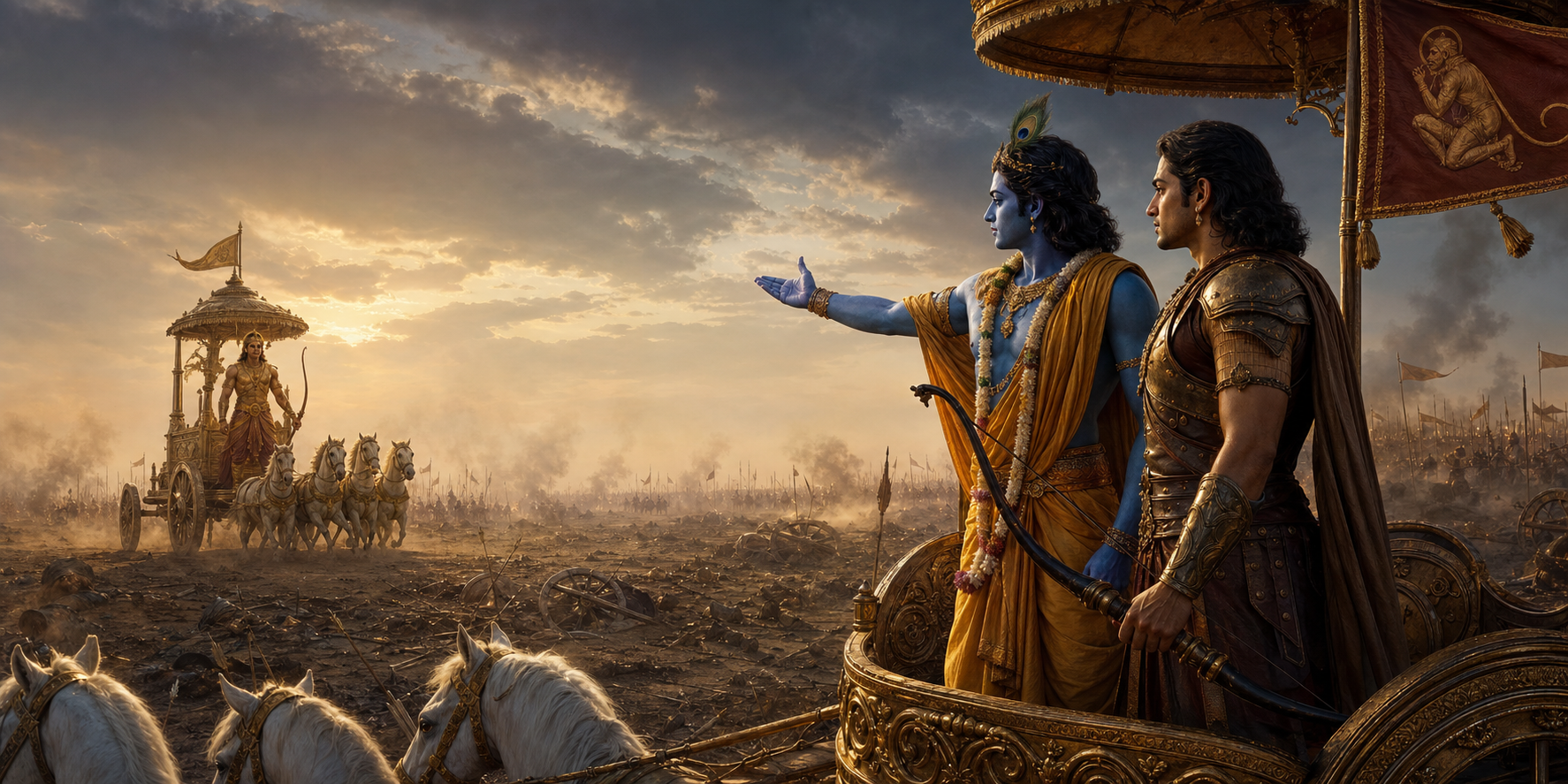
If you have heard this battlefield story and wondered whether Krishna was declaring Karna greater than Arjuna, the answer is more precise. Krishna was correcting a bad measurement. Arjuna judged the arrows by how far a chariot moved; Krishna judged their force against the resistance they had to overcome.
That distinction matters whenever you compare two people, defend a hero, assess an opponent, or judge your own success. Visible results are real, but they rarely reveal the whole structure of power.
What Arjuna’s comparison failed to measure

In a popular Mahabharata-based teaching tale, Arjuna and Karna meet in a fierce duel at Kurukshetra. Arjuna’s arrows drive Karna’s chariot far backward, while Karna’s arrows move Arjuna’s chariot by a much smaller distance. Arjuna naturally sees the greater displacement and expects his achievement to be recognised.
Krishna, however, praises Karna’s power. Within the logic of the tale, Arjuna’s chariot is not an ordinary object. Krishna is its charioteer, and Hanuman is present upon its banner. Karna is therefore striking a chariot sustained by an extraordinary protective presence. Moving it at all is presented as evidence of formidable force.
The lesson does not require you to pretend that distance is irrelevant. Arjuna’s arrows still produce the larger visible effect. Krishna’s correction is that distance alone cannot answer the deeper question. The same result can require very different power when the resistance is different, and different results can conceal comparable effort when the conditions are unequal.
Treat this as a teaching retelling rather than a verse to quote casually as though it were a self-contained passage from the Mahabharata. Its value lies in the distinction it makes: an outcome tells you what happened, but not necessarily how much force, support, protection, or difficulty stood behind it.
Krishna corrects Arjuna without diminishing him
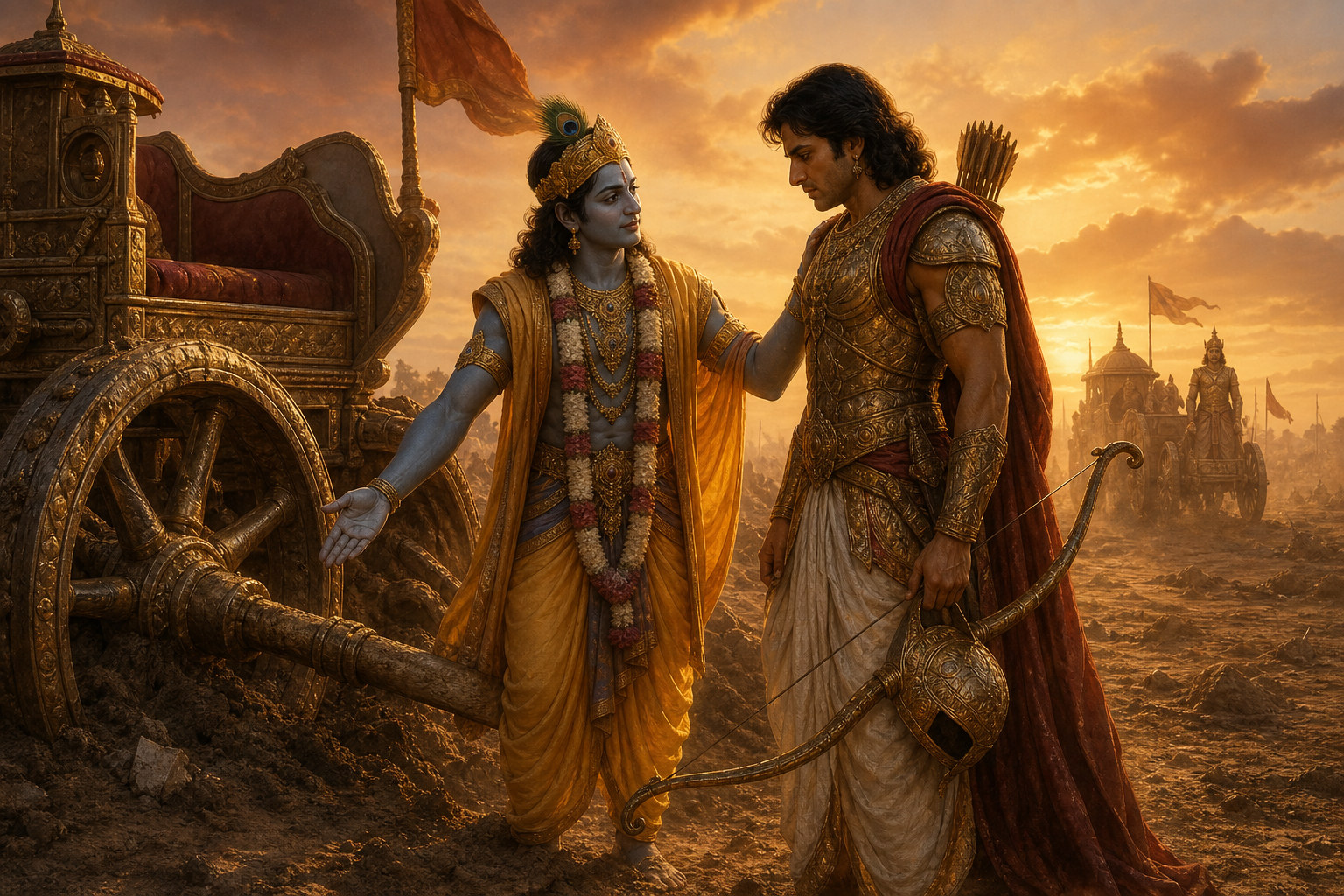
Krishna’s response is not an argument that Arjuna lacks strength. Nor is it a declaration that Karna must therefore be superior in every respect. He is correcting the pride that turns one impressive result into a total verdict about two human beings.
This is where the tale becomes personally demanding. When you succeed, the mind quickly edits out everything that held you up: teachers, family, training, timely help, inherited advantages, loyal companions, and circumstances you did not create. Your effort may be genuine, but it is not the only cause. Krishna’s presence in the chariot makes that hidden support impossible to ignore.
The right response is not false modesty. You do not need to deny your discipline or speak as though your achievement happened without you. You need to describe it accurately. Name what you did, name what helped you, and resist converting success into proof that another person is insignificant.
The same discipline applies when you feel overlooked. Hidden resistance can explain why your visible progress is smaller, but difficulty is not itself an accomplishment. Identify the obstacle, show what you managed despite it, and continue improving the result. Krishna’s lesson gives you a fairer measure; it does not give anyone permission to replace performance with grievance.
Power, virtue, and dharma are separate judgments

Krishna can recognise Karna’s might without making might the final standard. This is essential. Physical power, technical skill, courage, generosity, loyalty, judgment, and adherence to dharma are not interchangeable qualities. A person may possess one in abundance and fail gravely in another.
Karna’s demonstrated capacity cannot by itself settle whether his allegiance and choices in the war were dharmic. In the same way, condemning a person’s choices does not require you to lie about that person’s ability. Dharma does not become stronger when we make an opponent smaller than he is.
This guards you against two opposite mistakes. Hero worship turns every talent into moral innocence: because someone is brave, gifted, wounded, or loyal, admirers excuse whatever that person supports. Partisan hostility commits the reverse error: because someone stands on the wrong side, critics insist that the person has no admirable quality at all. Neither response is truthful.
A more Dharmic judgment asks three distinct questions. What power does this person actually possess? What purpose is that power serving? What action does dharma require from me now? You can answer the first with admiration, the second with disapproval, and the third with firm opposition without contradicting yourself.
This also clarifies the difference between respect and surrender. Accurately recognising an adversary’s strength helps you prepare, remain humble, and act intelligently. It does not require you to imitate the adversary, accept an unjust cause, or abandon your duty.
Use three lenses before you compare two people
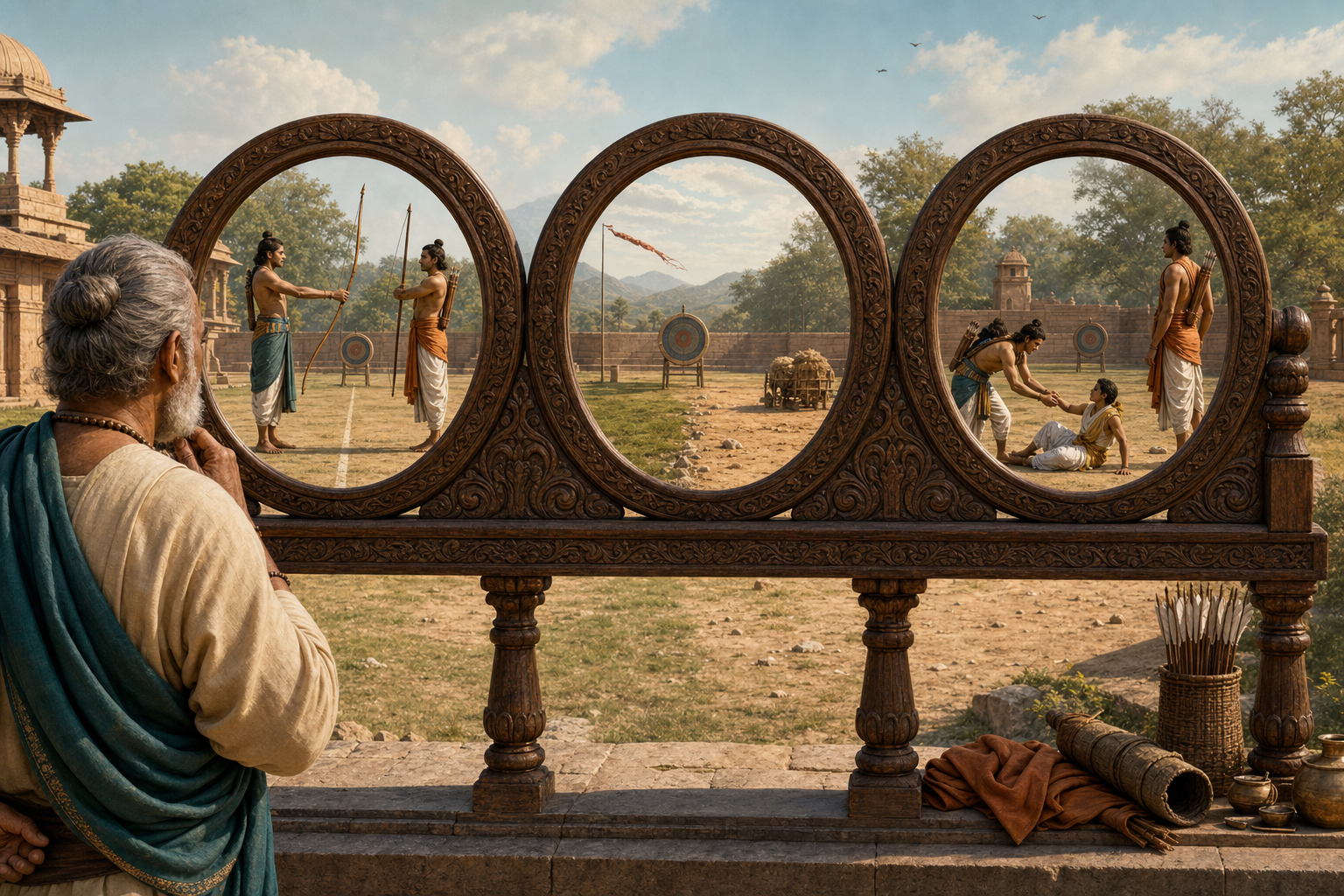
When a comparison matters, run it through three lenses: support, resistance, and purpose. This works in study, work, leadership, family life, public debate, and sadhana because it prevents one visible result from carrying conclusions it cannot support.
| Lens | Question to ask | Error it corrects |
|---|---|---|
| Support | What people, training, protection, resources, or favourable conditions helped produce this result? | Crediting the individual as though no one and nothing else mattered |
| Resistance | What difficulty, constraint, opposition, or responsibility had to be overcome? | Assuming a smaller visible result always means weaker effort or ability |
| Purpose | What is this capacity being used to defend, build, or enable? | Confusing effectiveness with righteousness |
Start by defining what you are measuring. “More powerful” is usually too vague. Do you mean greater force in one encounter, better judgment, steadier discipline, greater endurance, more reliable performance, or stronger moral courage? Krishna’s response works because it exposes a mismatch between the metric Arjuna is watching and the conclusion he is drawing.
Next, compare like with like. If one person performs with abundant support and another performs under severe resistance, raw output remains relevant, but it should not be mistaken for a complete measure of capacity. State both pieces of information. Say, for example, that one result was larger while the other required overcoming greater constraints. You do not have to erase either truth.
Finally, refuse to turn capacity into a certificate of virtue. Someone can be highly effective at serving an unworthy end. Someone else can hold a worthy intention but lack the competence needed to fulfil it. A Dharmic decision requires both right orientation and the disciplined ability to act on it.
You can apply the method immediately. When another person’s success makes you defensive, name the support and resistance on both sides before judging. When your own success makes you proud, identify the help you received and offer credit precisely. When an opponent appears dangerous, describe the opponent’s strongest real capability instead of taking comfort in insults. When you admire a gifted person, ask what that gift is serving before you offer allegiance.
Key takeaways
- Krishna’s praise of Karna corrects an incomplete measurement; it does not reduce the entire duel to a simple ranking.
- Visible movement shows an outcome, while power can be understood only in relation to the resistance overcome.
- Recognising Karna’s capacity does not automatically vindicate his allegiance or every choice he made.
- Arjuna’s divine support does not erase his own skill; it places his achievement in its full context.
- A fair comparison examines support, resistance, and purpose before reaching a judgment.
- The practical antidote to pride is accurate accounting: acknowledge your effort, the help you received, and the real strength of others.
The next time success tempts you to boast, failure tempts you to resent, or loyalty tempts you to deny an opponent’s strength, pause before delivering a verdict. Name the support, measure the resistance, examine the purpose, and then act according to dharma. That is the discipline hidden inside Krishna’s praise of Karna.