

You may know when your family lights the lamp, which mantra accompanies a rite, or how a festival is observed, yet still hesitate when a child or colleague asks what any of it means. That hesitation does not prove the tradition is empty. It reveals a break in the chain connecting practice, concept, purpose, and context.
You do not repair that break by collecting more slogans or forcing every Sanskrit term into a neat English equivalent. You repair it by recovering the relationships that make a Dharmic idea intelligible. That is the practical work of restoring civilisational memory.
The danger is misrecognition, not mere disappearance
We usually imagine cultural loss as something visible: neglected temples, unread texts, discontinued festivals, or a language no longer spoken. Those losses matter. But a civilisation can also forget itself while retaining its outward forms. It may preserve sacred words and repeat inherited practices while losing the conceptual relationships that once made them intelligible.
This is why vocabulary alone is a poor measure of continuity. Terms such as dharma, karma, yoga, moksha, tantra, and avatāra remain widely recognisable. Yet recognition can conceal a change in meaning. A word may become more popular precisely as the world around it disappears.
Consider avatar. In ordinary digital usage, it means an image, character, or virtual identity representing a user. An avatāra in Hindu thought is not merely a representation. It is a divine descent into the world, associated especially with Vishnu’s intervention when cosmic order requires restoration. Remove the relationships among divinity, descent, time, disorder, and renewed dharma, and the surviving word points into a different conceptual universe.
You can detect this kind of forgetting by asking three questions whenever a familiar Dharmic term appears:
- Can you explain the term without replacing it immediately with one English word?
- Can you name the other concepts that give it meaning?
- Can you show how its application changes with aim, role, circumstance, or path?
If you cannot, the problem is not necessarily ignorance of a definition. You may be missing the grammar: the mostly unspoken rules that determine which ideas belong together, which distinctions matter, and which questions the tradition is trying to answer.
Recover the web around dharma and karma

Translation is necessary, but it is never neutral. Every translation foregrounds one feature and leaves others behind. Duty, religion, morality, law, righteousness, and ethical obligation can each illuminate dharma in a particular setting. None should be mistaken for a complete substitute.
The decisive feature is relational context. Dharma may depend on responsibilities, circumstances, stage of life, and the kind of path a person is following. A householder and a renunciant therefore need not enact virtue in identical ways. The renunciant may withdraw from possessions, family obligations, and sensual attachment. The householder fulfils important obligations through family, productive work, intimate relationships, and participation in society. Honouring both does not require pretending that their disciplines are the same.
This does not mean that anything can be justified as someone’s personal dharma. It means that ethical judgement cannot always be reduced to applying one abstract rule without examining who is acting, toward whom, under what obligations, and for what end. Translate dharma only as universal moral law, and that structure becomes difficult to see.
Karma is flattened in a similar way when it becomes shorthand for instant reward or punishment. The familiar phrase about consequences returning to the doer captures only a sliver of the idea. Karma concerns how action and intention participate in causation, shape the conditions of life, relate to rebirth, and bear upon liberation. It is not merely a promise that every visible wrong will quickly receive a matching visible penalty.
Use a four-pass reading whenever you encounter a major Dharmic term:
- Retain the original term. Give a provisional gloss, but do not allow the gloss to erase the Sanskrit word.
- Map its neighbours. Ask which ideas must be understood alongside it. Karma, for example, cannot be adequately discussed without action, intention, causation, rebirth, and liberation.
- Test more than one context. Look for how the term operates across different roles, stages of life, schools, narratives, or practices.
- Identify its purpose. Ask what human, ethical, or spiritual problem the concept is meant to illuminate.
This method prevents a useful translation from quietly becoming a false equivalence. It also gives you something better than a memorised definition: a concept you can reason with.
Plurality is not the same as philosophical confusion
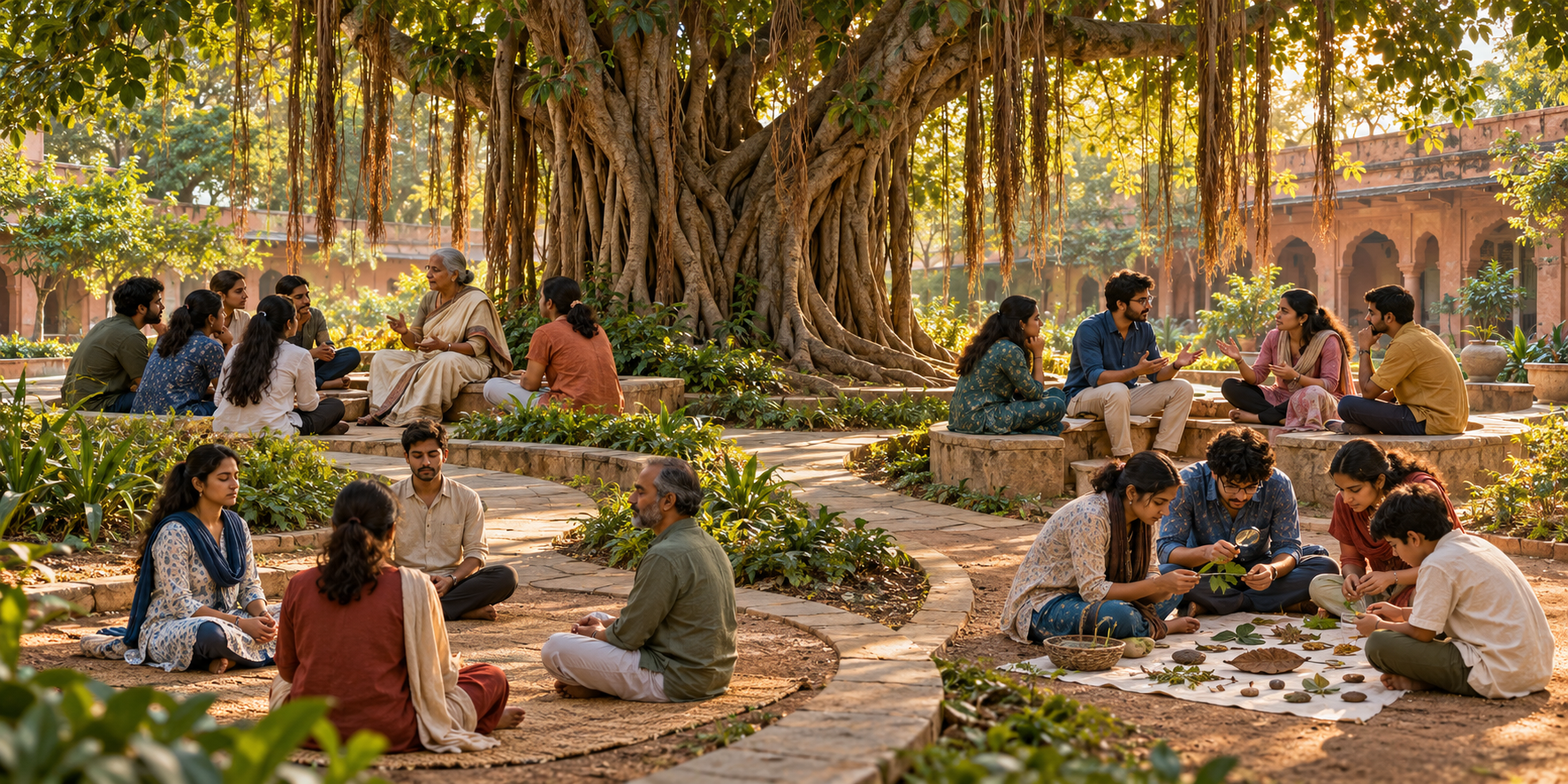
A modern reader often asks for the one authoritative position: Is desire good or bad? Is worldly life inferior to renunciation? Is the body sacred or an obstacle? Is the divine ultimately formless or embodied? The demand for one answer may tell you more about the framework of the question than about the traditions being questioned.
Hindu traditions developed through long conversations among practices, schools, disciplines, communities, and ways of life. Ascetics can discipline or renounce sexuality while householders marry and raise families. Philosophies can seek freedom from attachment while the framework of the puruṣārthas recognises kāma, desire and pleasure, as a legitimate human aim. The divine can be approached through austere abstraction in one setting and richly embodied form in another. These positions need not be compressed into a single formula before they can belong to one civilisation.
That does not make every tension benign. A tradition may venerate a goddess as cosmic power while a society restricts actual women. That is not a paradox to admire from a safe distance. It can expose a serious gap between sacred imagination and social conduct. Civilisational recovery requires enough confidence to preserve genuine plurality and enough honesty to criticise injustice.
When two teachings appear to contradict each other, sort the tension before trying to eliminate it:
- Different context: Are the teachings directed toward different roles, life stages, circumstances, or spiritual disciplines?
- Different aim: Is one concerned with flourishing within worldly life while another is concerned with liberation from attachment?
- Doctrinal disagreement: Do distinct schools actually hold competing positions? If so, name the disagreement instead of inventing a harmony.
- Social contradiction: Does an elevated ideal coexist with a practice that violates it? If so, do not use philosophical plurality to shield the practice from criticism.
The key question is not, “Which sentence is the real Hinduism?” Ask whether the statements address the same person, problem, level of inquiry, and end. If they do not, the contradiction may have been created by removing their contexts. If they do, you may be looking at a real disagreement or an unresolved moral failure. Both deserve to be seen clearly.
Turn surviving practice back into intelligible memory

A practice does not become meaningless merely because its participants cannot give a philosophical lecture about it. Communities transmit memory through gesture, sound, architecture, food, repetition, pilgrimage, family roles, and the disciplined use of the body. Explicit explanation is only one mode of transmission.
But an unexplained practice remains vulnerable. When the inherited rationale fades, someone will eventually supply another one. The new explanation may be a harmless family story, a commercial slogan, an embarrassed apology, or a framework imported from elsewhere. The action survives, but its place within a Dharmic way of seeing can change without anyone announcing the change.
Choose one living family or community practice and make a simple reconstruction record. Do not begin by claiming to have found its single ancient origin. Record what you actually know:
- Name: What is the practice called in the language of the people who perform it?
- Sequence: What is done, and in what order?
- Participants: Who performs it, who receives it, and who observes it?
- Stated purpose: What do practitioners say it accomplishes or expresses?
- Conceptual connections: Which ideas, deities, relationships, stories, seasons, duties, or aims make the actions coherent?
- Scope: Is this usage familial, regional, sectarian, textual, or shared more widely?
- Uncertainty: Which parts remain unexplained or disputed?
This last field matters. Honest uncertainty preserves memory better than a confident invention. “Our family does this, but we do not yet know why” keeps inquiry open. “All Hindus have always done this for this reason” can turn one local explanation into a false universal claim.
When you explain the practice to a younger person, connect action to relationship. Do not stop at “we light a lamp because it is auspicious.” Ask what the light is oriented toward, which distinction it marks, what disposition the act cultivates, and how its meaning changes in another ritual setting. One recovered relationship is more valuable than a page of decorative symbolism.
Build civilisational competence one concept at a time

You do not need to reconstruct an entire civilisation before the next festival, class, or family conversation. Start with one word that you already use. The aim is not to possess every interpretation. It is to recover enough of the surrounding structure that the term can no longer be reduced to a slogan.
- Select a living word or practice. Dharma, karma, avatāra, a household rite, or a festival observance is more manageable than “Hindu philosophy” as a whole.
- Write down your current explanation. This exposes where an English equivalent is doing all the work.
- Add the missing relationships. Identify the roles, aims, neighbouring concepts, and assumptions needed to understand it.
- Find a counterexample to your first definition. If dharma means duty, ask why the duties of a householder and renunciant differ. A good counterexample reveals what the short definition omitted.
- Mark the level of every claim. Distinguish what belongs to your family, a region, a sampradāya, a philosophical school, or a broader civilisational vocabulary.
- Use the richer explanation in a real setting. At the next observance or discussion, explain one relationship between the practice, the participant, and its purpose.
If you teach, translate, or write for the public, apply the same discipline. Retain an important original term on first use. Offer a clear but provisional English gloss. State the context in which that gloss works. Then include a case in which it does not. This small habit makes translation transparent instead of allowing it to rearrange the tradition invisibly.
Key takeaways
- Civilisational memory can weaken even while words, festivals, temples, and rituals remain visible.
- A Dharmic concept is best recovered through its relationships, purposes, contexts, and counterexamples, not through a one-word translation.
- Different teachings may address different roles or aims; test their contexts before declaring them contradictory.
- Plurality must not become an excuse for ignoring a genuine doctrinal disagreement or social injustice.
- A surviving practice carries embodied memory, but its family, regional, sectarian, and textual layers should be identified honestly.
- The most useful first step is to reconstruct one term or practice well enough to explain it in a real conversation.
Before your next ritual, festival, or discussion, choose one inherited word and refuse to let its shortest translation be the final answer. Map what it relates to, where it applies, where it does not, and what kind of life it is meant to shape. Civilisational memory returns through that disciplined act of reconnection.
References

Leave a Reply
You must be logged in to post a comment.