
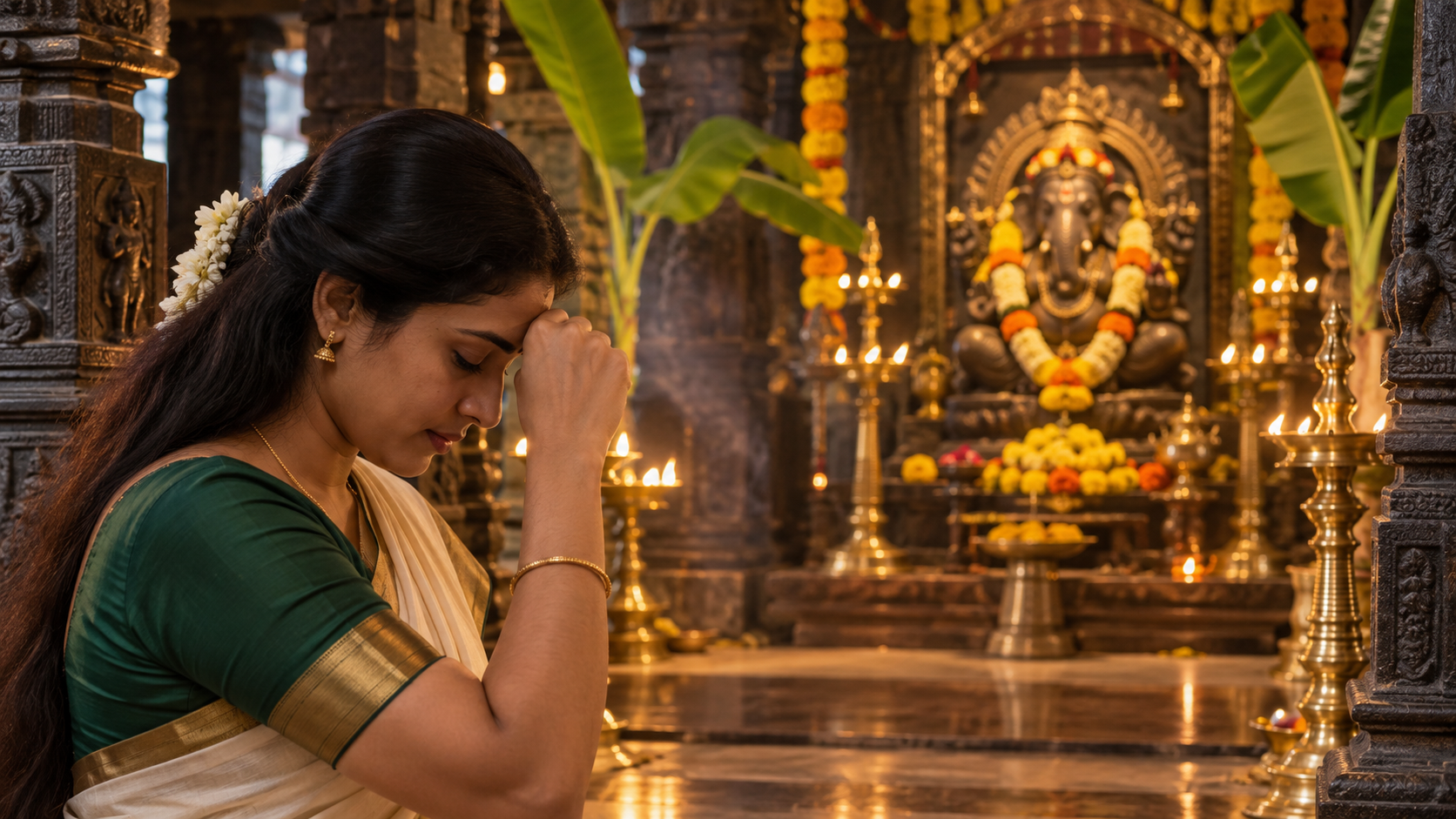
If you have watched devotees touch their knuckles to their foreheads before Ganapathi, you may wonder whether you should do the same. The movement is easy to copy. Its meaning is worth understanding first.
The gentle forehead tap seen in Ganapathi temples recalls a moment when Ravana’s pride collided with divine wisdom. Properly understood, it is not an act of self-punishment. It is a compact confession: the obstacle before you may begin within you.
The Ravana legend behind the knuckle tap
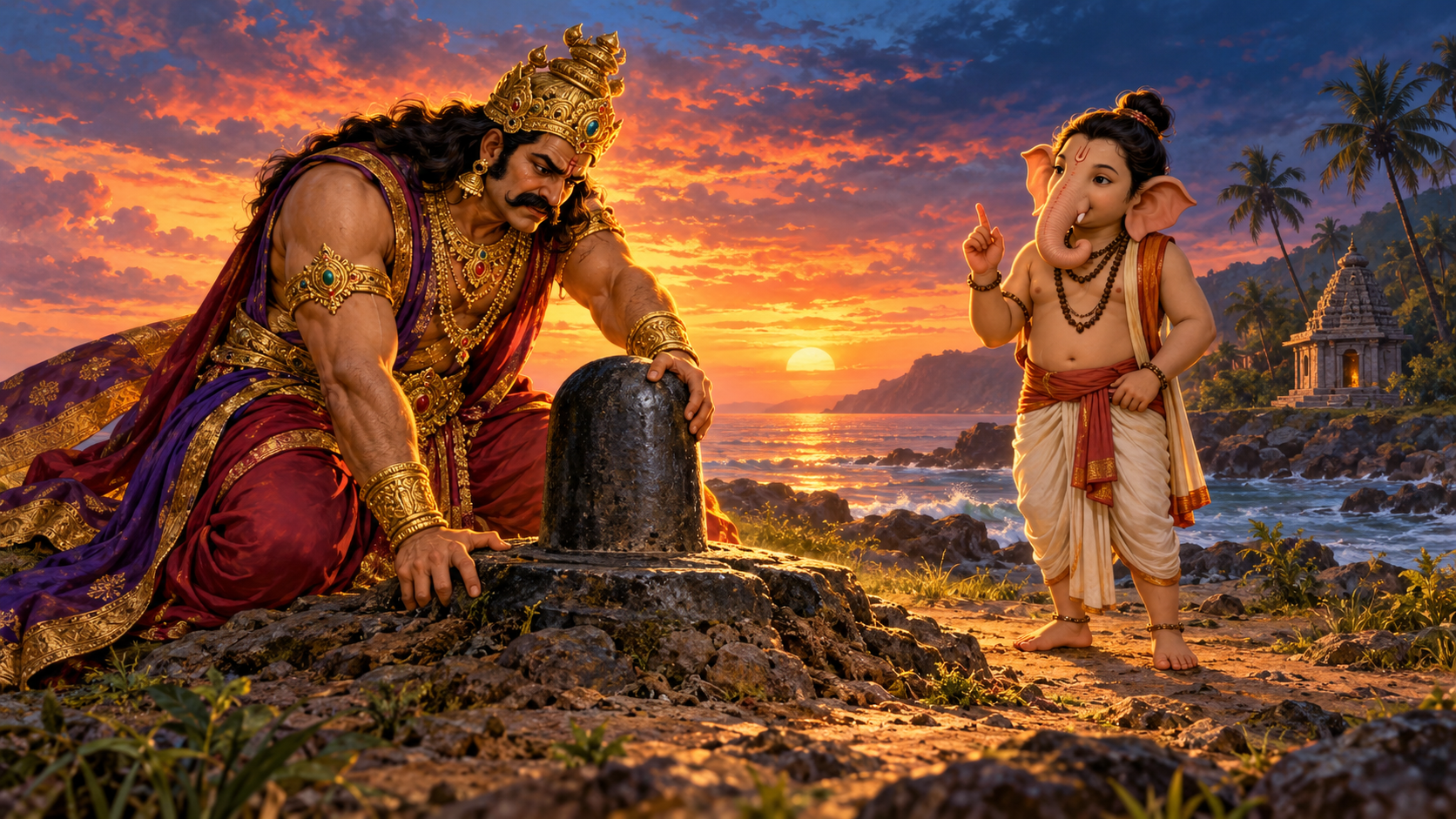
In the popular legend associated with this custom, Ravana obtains the sacred Atma Linga from Shiva and intends to carry it to Lanka. He must not put it on the ground during the journey. Ganapathi intervenes by appearing as a young boy, relying on intelligence rather than matching Ravana’s immense strength.
Ravana entrusts the Atma Linga to the boy temporarily. The boy warns that he will not hold it indefinitely and later places it on the ground when Ravana does not take it back in time. Once it has been set down, Ravana cannot lift it despite his power.
Anger overtakes discernment. Ravana strikes the boy on the head, only to discover that the apparent child is Ganapathi. Recognition changes the meaning of the moment. Ravana, confronted by his own impulsiveness, turns the gesture upon himself and bows in repentance. The encounter between Ravana, Ganapathi, pride and surrender becomes the remembered basis for the devotee’s forehead tap.
Retellings can differ in their smaller details, as oral and temple traditions often do. The ethical hinge remains the same: strength without self-command becomes helplessness, while wisdom can accomplish what force cannot. Ravana’s defeat is not merely that he fails to lift the Atma Linga. It is that he allows frustration to rule him before he understands what is happening.
This is also why the legend should not be reduced to a simple contest between a clever deity and a foolish antagonist. Ravana is remembered as powerful, learned and intensely devoted. Those qualities make the warning sharper. Learning and devotion do not automatically remove ahamkara, the possessive sense of self that insists, controls and lashes out when opposed.
What your body is saying when you tap your forehead
A ritual gesture can teach before the mind has finished explaining it. Here, an outward blow is transformed into inward examination. You are not repeating Ravana’s aggression against Ganapathi. You are repeating the moment in which Ravana recognizes and corrects himself.
- The knuckles recall the anger that acted before understanding.
- The forehead turns attention toward thought, judgement and pride.
- The gentle touch converts a blow into a reminder rather than an injury.
- The bow that follows places wisdom above self-will.
The sequence matters. First comes recognition; then surrender. If you perform the movement mechanically while holding tightly to resentment, the body has enacted a teaching that the mind has refused. If you pause and identify the stubbornness you are carrying, even a small motion can become sincere sadhana.
Ganapathi is approached as the remover of obstacles, but the legend directs your attention to a difficult possibility: not every obstacle is an enemy outside you. Impatience, wounded pride and the demand to control an outcome can obstruct right action more effectively than an external opponent. The tap asks you to examine those obstacles before requesting that every circumstance bend to your wishes.
This interpretation gives you a practical test. Before tapping, ask: where am I behaving like force alone should settle the matter? The answer might concern a family disagreement, a decision you have rushed, or advice you rejected because it challenged you. You do not need to narrate the entire problem during darshan. Name the fault honestly, then place it before Ganapathi.
How to observe the custom respectfully
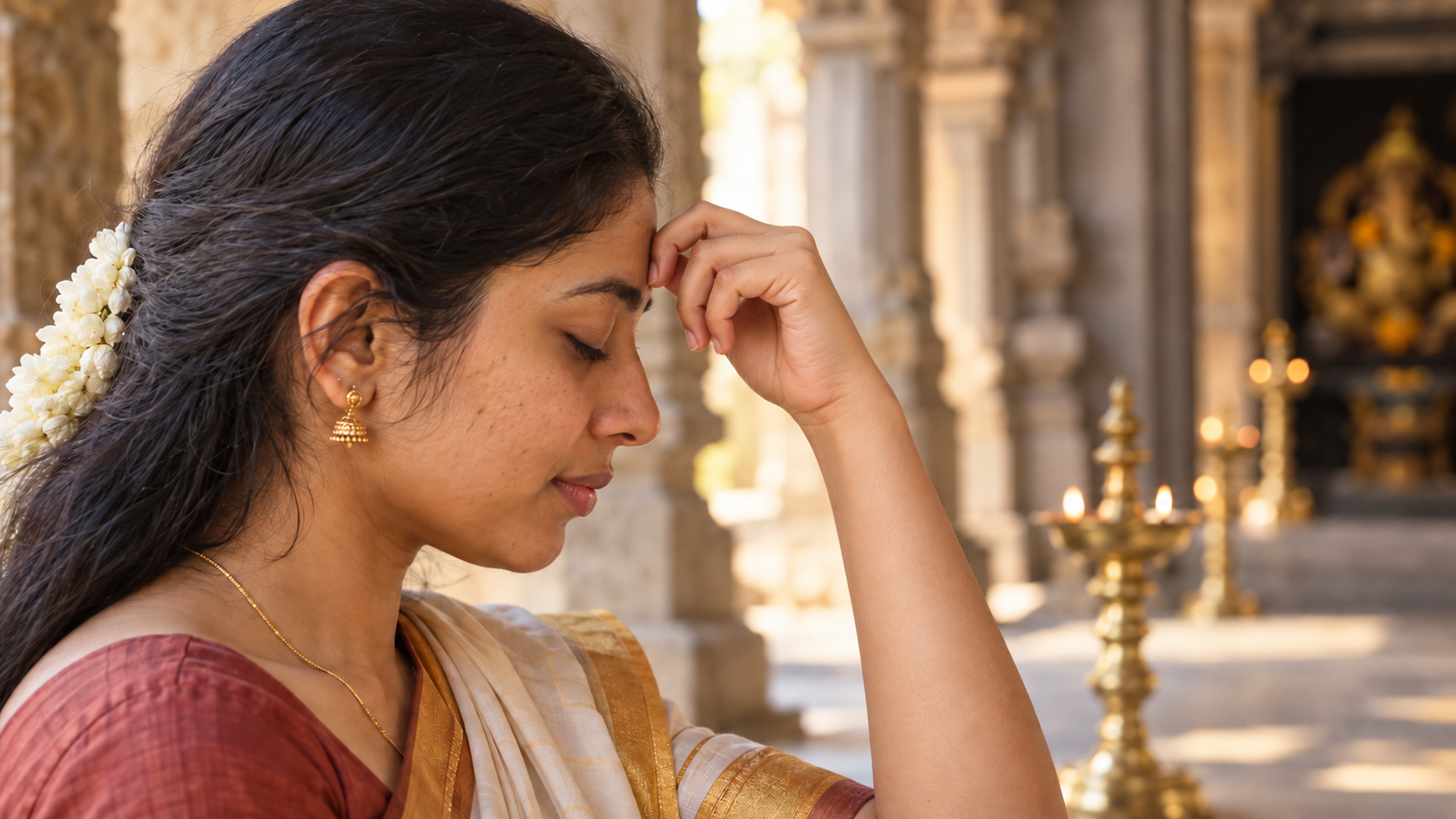
There is no need to imitate another devotee hurriedly or turn a local convention into a universal rule. Temple and family customs can vary in the number of taps, the exact hand movement and the point in worship when the gesture is made. When you are visiting an unfamiliar temple, observe quietly and follow its established practice.
- Stand before Ganapathi and let your attention settle. Do not begin the movement merely because the person ahead of you did it.
- Hold your hand or hands loosely. Bring the knuckles to the forehead with a light touch. The gesture should be gentle; pain adds nothing to its devotional meaning.
- Recall the turn in Ravana’s story: anger gave way to recognition, and pride gave way to surrender.
- Form a simple intention. You might inwardly say, “May wisdom correct my pride,” or ask Ganapathi to remove the stubbornness that prevents you from seeing clearly. This is a personal prayer, not a prescribed mantra.
- Bow, and connect the gesture to one action. Listen before answering, reconsider a rash decision, admit a mistake or make amends where your pride has harmed someone.
If age, pain or disability makes the motion uncomfortable, a quiet bow and the same inward acknowledgement can carry its meaning. Devotion is not measured by the force, range or visibility of a physical movement.
You also do not need to perform the gesture if the temple or lineage you follow does not use it. Hindu practice contains regional and familial forms that need not be forced into one standardized procedure. Respecting a custom includes respecting its context.
What the custom does not ask you to do
- It does not celebrate Ravana’s blow. The devotional act remembers his remorse and surrender, not his loss of control.
- It does not require you to hurt yourself. The original aggression is deliberately softened into a gentle reminder. Striking hard mistakes violence for sincerity.
- It does not establish a single test of Hindu observance. A person who follows another temple or household custom is not less devoted.
- It does not make repentance automatic. A tap cannot replace an apology, repaired conduct or a decision to respond differently next time.
- It does not turn Ravana into a one-dimensional figure. His power, knowledge and devotion are part of the warning: great capacities can coexist with an undisciplined ego.
The last distinction is especially important. Ritual is not a device for feeling absolved while continuing unchanged. Ravana’s recognition has meaning because the direction of the gesture changes. What had been projected outward is brought back to the self. Your observance becomes honest when it produces the same turn in attention.
Suppose you enter the temple after an argument in which you spoke harshly. The useful question is not whether the correct count of taps will erase the incident. It is whether you can recognize the pride beneath your anger, bow without defending it, and leave prepared to repair what you damaged. That is the difference between reproducing a motion and receiving its instruction.
Key takeaways
- The forehead tap recalls a legend in which Ravana strikes Ganapathi in anger and then recognizes his own error.
- Devotees repeat the movement as a gesture of repentance, humility and surrender to wisdom, not as approval of the original blow.
- The tap should be gentle. Pain and force do not make it more authentic.
- Exact forms can vary among temples, regions and families, so follow the custom of the place where you worship.
- The ritual reaches its purpose when it leads to changed conduct: listening, reconsidering, apologizing or relinquishing pride.
The next time you stand before Ganapathi, do not rush the movement. Identify one place where insistence has outrun discernment. Tap gently, bow, and carry one correction out of the temple with you. That is how an old legend stops being folklore at a distance and becomes a living discipline.
References

Leave a Reply
You must be logged in to post a comment.