
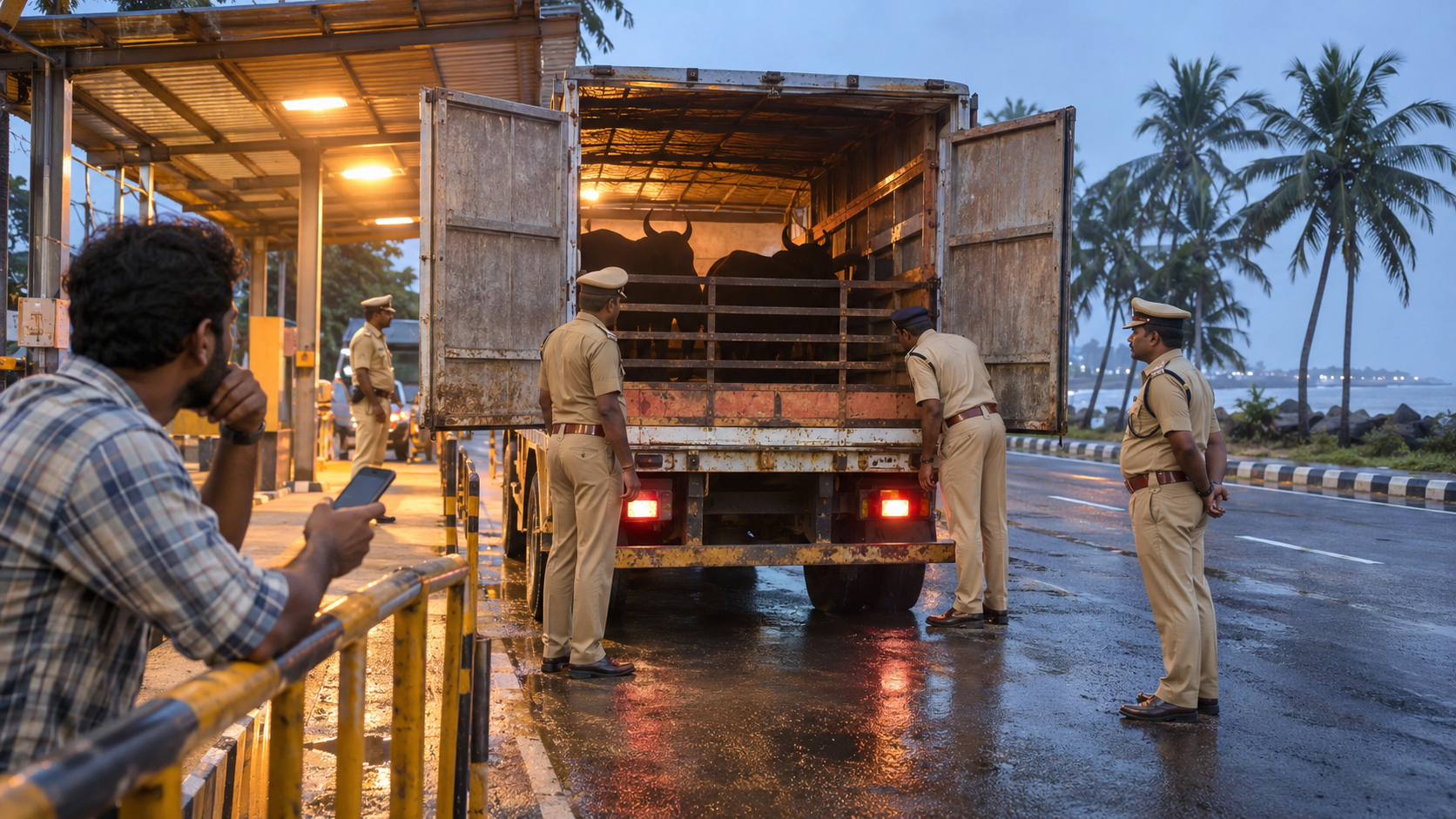
If you see a lorry that may be carrying cattle illegally, your first impulse may be to stop it or circulate a video. Do neither. The useful response is to observe from safety, report precise facts to the police, and preserve any original evidence without turning an allegation into a public verdict.
A recent interception near Mangaluru shows why disciplined reporting matters. The alleged concealment was inside an ordinary commercial vehicle, so specific intelligence and a lawful police inspection—not a roadside confrontation—made the difference.
What the Mangaluru interception actually establishes
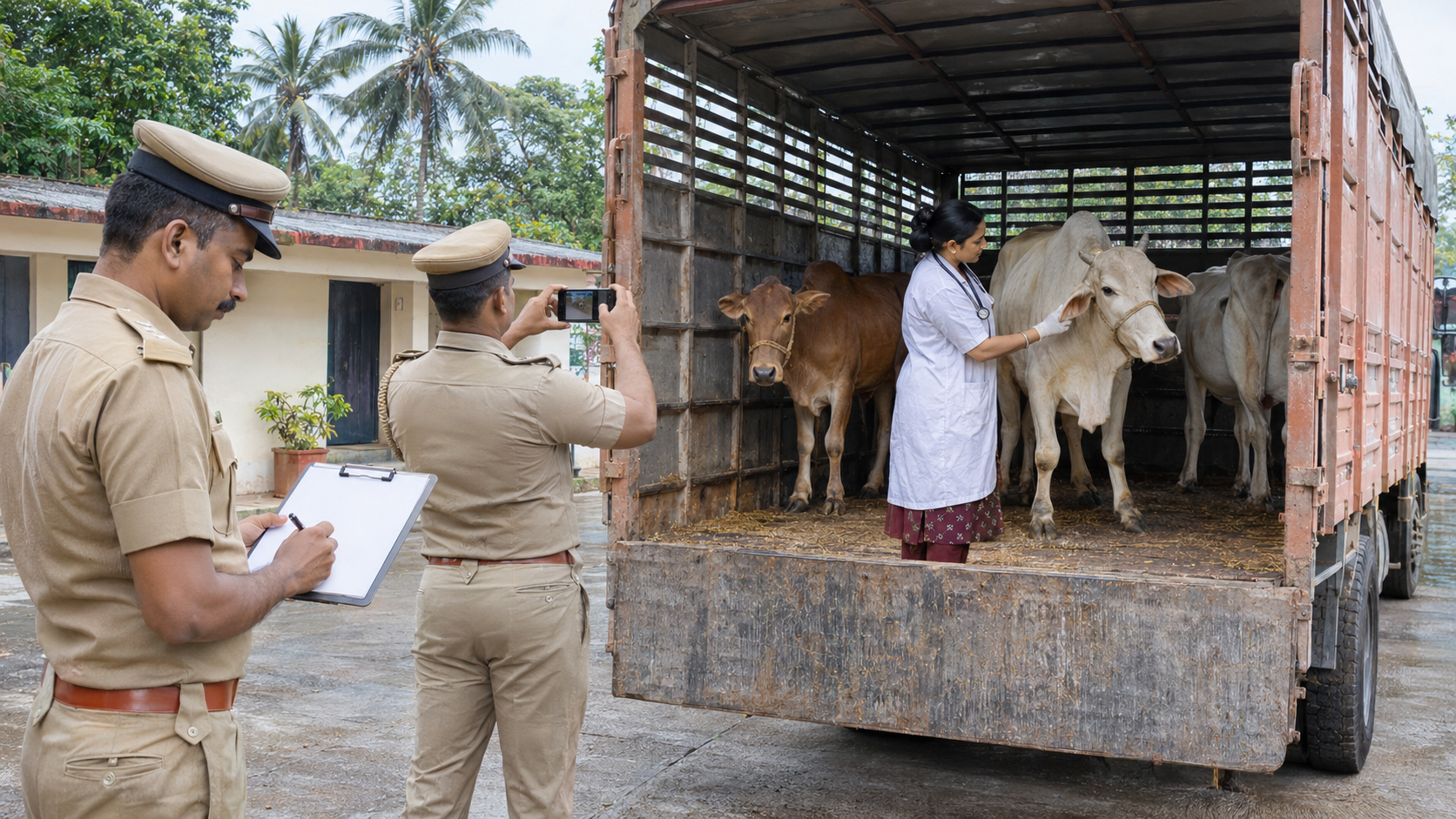
Personnel from Kankanady Town Police Station intercepted an egg container lorry near Pumpwell and found 16 bulls concealed behind stacks of egg trays. Police reportedly acted on specific information concerning cattle transport along the Mangaluru–Kerala National Highway.
The preliminary police investigation linked the cattle to Yamakamaradi in Karnataka’s Belagavi district and alleged that they were being taken to a slaughterhouse in Kasaragod, Kerala. Police arrested the driver, identified as Rafiq, 52, and another accused, Rehman, and seized the vehicle. The bulls were subsequently moved to a cow shelter in Pajir, Konaje.
Those facts describe an interception and an investigation. They do not establish a judicial finding of guilt. Whether the journey formed part of a wider transport network also remains under investigation. If you discuss the case, use accurate verbs: police intercepted, found, arrested, seized, alleged and are investigating. Do not replace them with convicted, proved or confessed unless a later court record supports those words.
This distinction is more than legal caution. Exaggeration makes reliable information harder to identify, gives misinformation an easy opening and can expose innocent people to collective blame. The names of accused persons do not justify an accusation against an entire religious or social community.
Recognise evidence without declaring guilt yourself
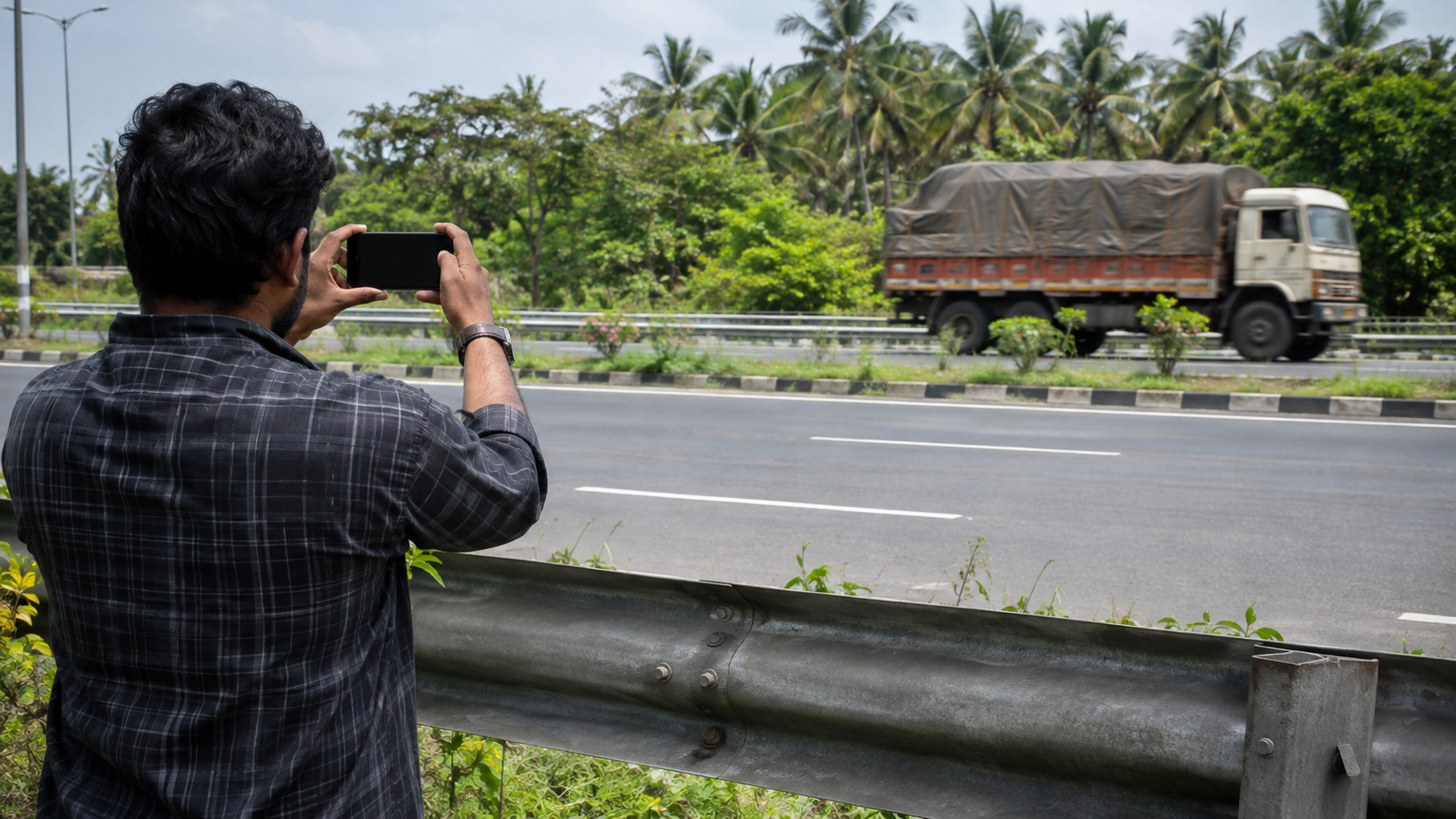
A livestock vehicle is not automatically an illegal vehicle. Nor does a Kerala destination, an interstate route or the identity of a driver prove an offence. The striking feature in the Mangaluru case was the alleged use of egg trays to conceal the bulls. Even then, police—not passing motorists—had to stop and inspect the lorry.
If you encounter a suspicious vehicle, concentrate on details that can be observed without trespassing, opening the vehicle or obstructing traffic:
- The exact location, road and direction of travel.
- The time you observed the vehicle.
- The registration number, vehicle type, colour and any distinctive markings, but only if you can note them safely.
- What you directly saw or heard, such as visible animals, movement inside a closed cargo space, animal sounds, concealment or loading and unloading activity.
- Any immediate danger to animals, motorists or bystanders.
- Where a photograph or video was taken and whether you recorded it yourself or received it from somebody else.
Do not guess the number or species of animals when you could not see them clearly. Do not claim that slaughter was the destination merely because a vehicle was moving toward Kerala. Do not infer the occupants’ religion, caste, ownership of the animals or membership in a network. Those conclusions require investigation.
The legal status of a journey can depend on facts you cannot determine from the roadside, including the applicable state law, the animals involved, the purpose of transport, the documents carried and the conditions inside the vehicle. Crossing a state boundary does not by itself settle whether the movement is lawful. Give the police the observable facts and let the competent authorities examine the rest.
Report a suspicious vehicle without creating another danger
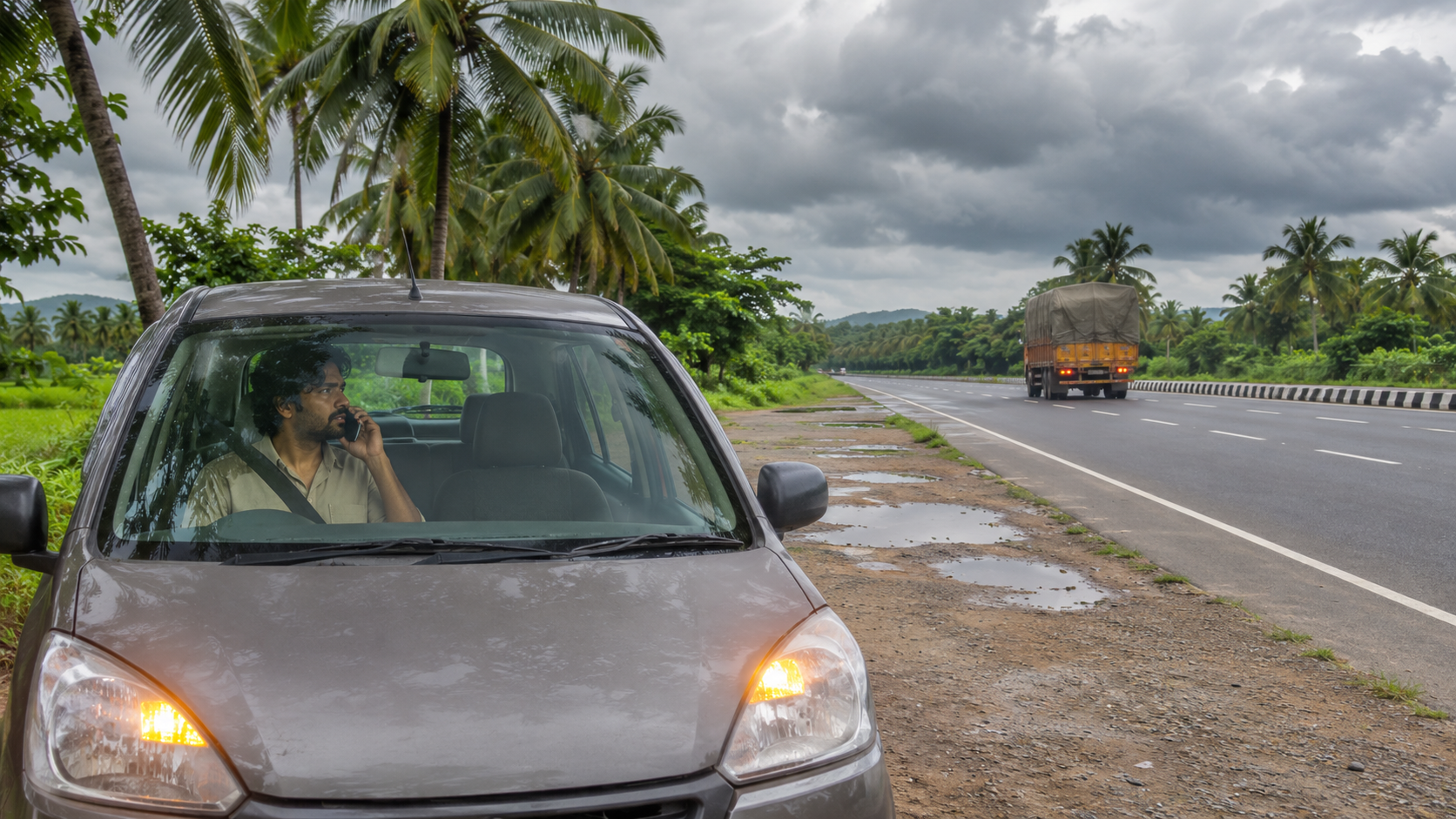
Cattle protection does not require you to chase a lorry, block a highway or confront its occupants. Those actions can cause a collision, frighten confined animals, provoke violence and interfere with a police operation. If there is an immediate threat to life or road safety, contact the local police emergency channel from a safe place.
- Put distance and safety first. Stay off the carriageway. Do not follow the vehicle at speed, force it to stop, surround it or attempt to enter it.
- Record the basic facts. Note the time, location, direction and registration number. A short, accurate description is more useful than a long commentary filled with assumptions.
- Separate observation from inference. Say, for example, that you heard animal sounds from a closed cargo compartment. Do not convert that into a claim about the number of cattle, ownership or destination unless you directly know those facts.
- Report promptly and privately. Give the information to the police with jurisdiction over the location. Mention any immediate welfare or traffic danger so officers can assess urgency.
- Preserve original material. Keep the unedited photo or video, its original timestamp and any response or reference details from the police. Do not add accusatory captions or publish faces, phone numbers and addresses.
A useful report can be simple: “At approximately [time], I observed [vehicle description and registration] travelling toward [direction] near [precise location]. I directly saw or heard [observation]. I have an original photo or video and can provide it privately.” If part of the information came from someone else, say so.
If you only have a forwarded clip, do not present yourself as a witness. Send the police the original sender’s details if that person has consented, or encourage the actual witness to make the report. Reposting a cropped clip can strip away the location, time and other context that investigators need.
Keep gau raksha anchored in dharma and the rule of law
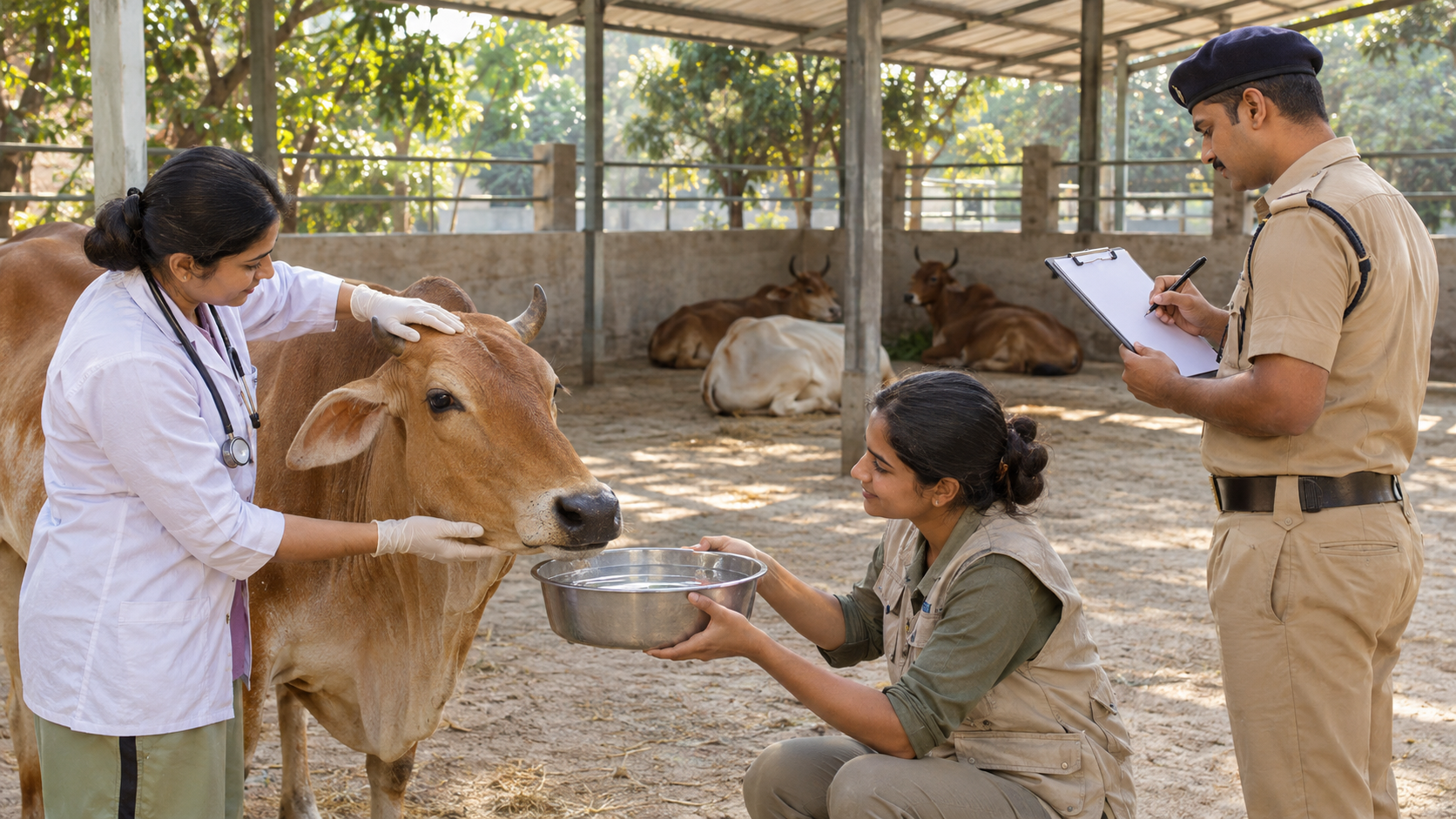
For a Dharmic community, gau raksha should mean the protection of vulnerable life through restraint, truth and responsible action. Ahimsa is not served by a road chase, a beating or collective punishment. Satya is not served by attaching an unverified accusation to a dramatic video. The animals gain nothing when concern for them becomes an excuse for vigilantism.
Precision also matters within the language of protection. The rescued animals in this case were reported as bulls. “Cow protection” is often used as a broad cultural expression, but a factual incident report should identify the animals as accurately as the available evidence permits.
Once authorities have intervened, community action can move from suspicion to verifiable welfare. A local organisation can:
- Ask the local police which channel they prefer for time-sensitive reports about suspected cattle transport.
- Train volunteers to document vehicles from safe, lawful locations without following or confronting anyone.
- Keep a confidential incident log containing dates, locations, police reference details and the status of any evidence submitted.
- Verify that a shelter has received rescued animals before raising money in its name, and confirm what assistance the shelter actually needs.
- Seek case updates through lawful official channels instead of treating social-media claims as court outcomes.
- Correct false captions even when they support a conclusion you personally favour. Credibility is part of protection.
The reported transfer of the 16 bulls to a shelter in Pajir, Konaje, was the immediate animal-welfare outcome of the Mangaluru interception. That is the standard worth keeping in view: animals secured, evidence preserved, suspects handled through law and unresolved questions left to investigation.
Key takeaways
- In the Mangaluru case, police reportedly found 16 bulls concealed behind egg trays in a lorry bound for Kasaragod.
- An arrest begins a legal process; it is not a conviction.
- Concealment and direct observations are reportable facts. A Kerala destination or a person’s identity is not proof of illegality.
- Do not stop, chase, surround or enter a suspected vehicle. Report it from safety.
- Give police the time, location, direction, registration number and exactly what you observed.
- Keep original media private and unedited so that it retains investigative value.
- Lawful gau raksha protects animals while refusing vigilantism, communal blame and unsupported claims.
The next time a suspicious vehicle comes to your attention, pause before forwarding the image. Establish whether you are a witness, write down only what can be verified, and send those facts to the police. A careful report can help an animal; a reckless confrontation can endanger everyone on the road.
References

Leave a Reply
You must be logged in to post a comment.