
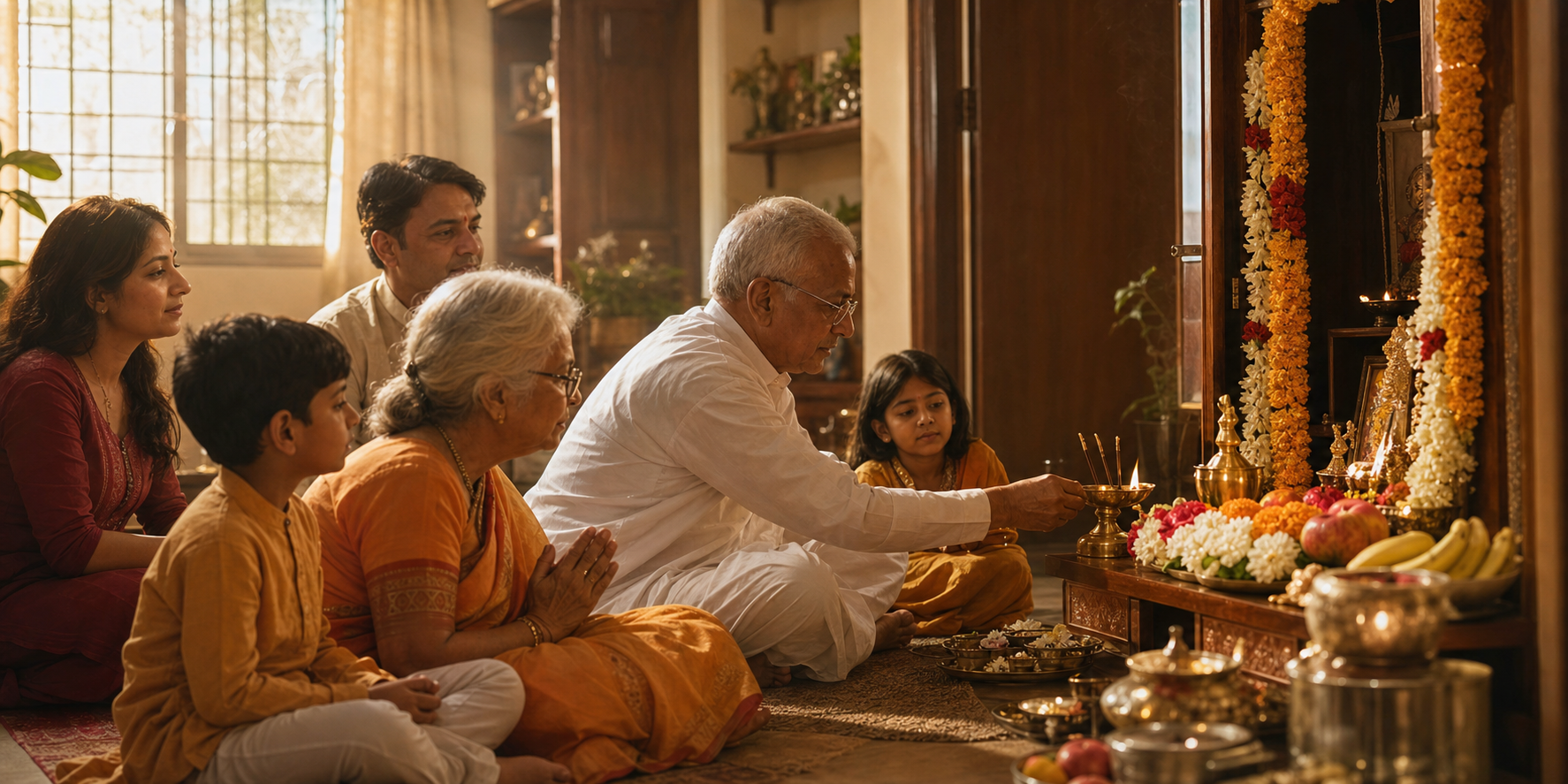
Ritual continuity is often treated as the preservation of ceremonies, while Grihastha Dharma is discussed as a code of personal and family responsibility. Read together, the two source articles show that these are interdependent: household Dharma supplies ritual with ethical purpose, and ritual gives Dharma a form that can be practised, witnessed, and inherited.
This relationship clarifies why the home has remained so important to Hindu cultural continuity. A household transmits more than beliefs. Through its routines, relationships, use of resources, and responses to difficulty, it teaches what deserves reverence and how responsibility should be lived.
The householder connects spiritual discipline with social support
The article on Grihastha Dharma places household life within the four-ashrama framework of Brahmacharya, Grihastha, Vanaprastha, and Sannyasa. It describes the householder stage as a supporting foundation because householders sustain dependants, education, charitable activity, ritual life, and the people following other paths. The claim is not that earning and consumption are inherently sacred, but that resources and relationships become Dharmic when governed by responsibility.
This interpretation draws its inner discipline from the Bhagavad Gita. As the source explains through Chapter 2, Verse 47, Karma Yoga requires necessary action without making personal reward the sole motive. In a household, that principle applies to work, parenting, care for elders, financial planning, and service performed without guaranteed recognition or success. Detachment, in this account, does not mean neglecting outcomes. It means acting carefully while refusing to let anxiety, vanity, greed, or possessiveness determine the action.
The article on ritual continuity approaches the same institution from a cultural direction. It argues that Hindu civilisation has been carried not only by monuments or central institutions, but also by homes, temples, festivals, pilgrimage, oral traditions, and repeated acts of reverence. The two perspectives converge on an important point: the household is simultaneously a field of spiritual practice and an infrastructure of cultural transmission.
Ritual makes household ethics visible and repeatable
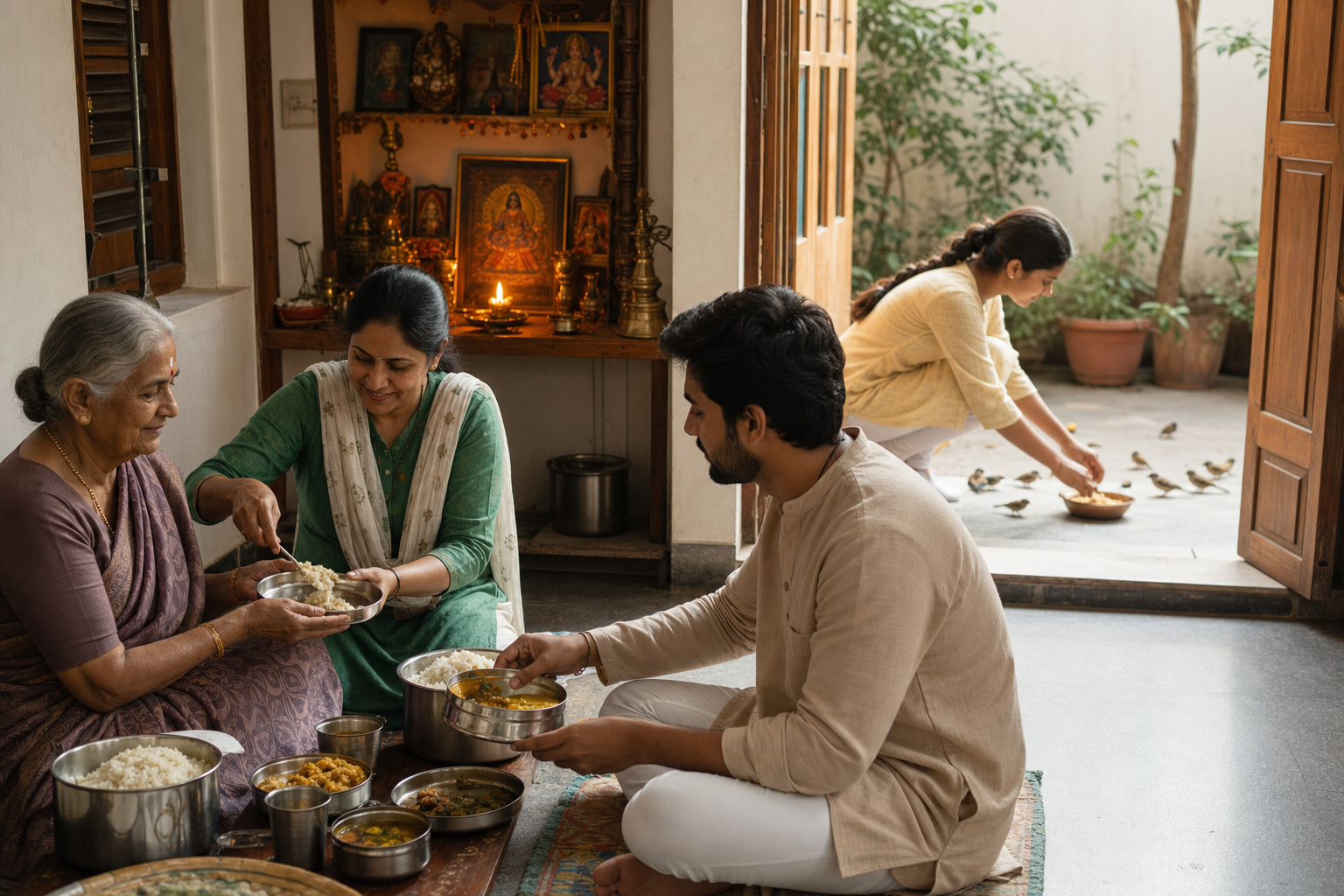
Duty can remain abstract unless it acquires a rhythm. The ritual-continuity source describes such practices as lighting a diya, conducting daily puja, offering food before eating, bowing to elders, reciting mantras, singing bhajans, and recounting scriptural or regional sacred narratives. These actions place ideas such as gratitude, humility, attention, and reverence into forms that family members can share.
The significance lies partly in repetition. A child may encounter Dharma first through the sound of a prayer, the sight of a flame, the treatment of food, or the way an elder welcomes a guest. The source characterises these practices as household micro-habits: modest actions that accumulate into emotional memory and moral orientation. Festivals then enlarge the same process by joining domestic worship to storytelling, music, food, seasonal observance, and community participation.
The Grihastha Dharma source broadens ritual responsibility beyond the prayer space. Drawing on the Gita’s discussion of sattvic charity in Chapter 17, Verse 20, it presents giving without expectation of return as a purification of ownership. Hospitality, assistance to people in distress, support for learning, care for elders and animals, and contributions to cultural or religious institutions become ways of directing household prosperity toward social well-being.
Ritual continuity, therefore, is not adequately measured by how many ceremonies a family retains. Its deeper test is whether repeated practices shape conduct. Offering food can cultivate gratitude; receiving a guest can challenge self-enclosure; charity can loosen possessiveness; and shared worship can establish a pause in a life otherwise governed by speed and outward achievement.
Transmission depends on example as much as instruction
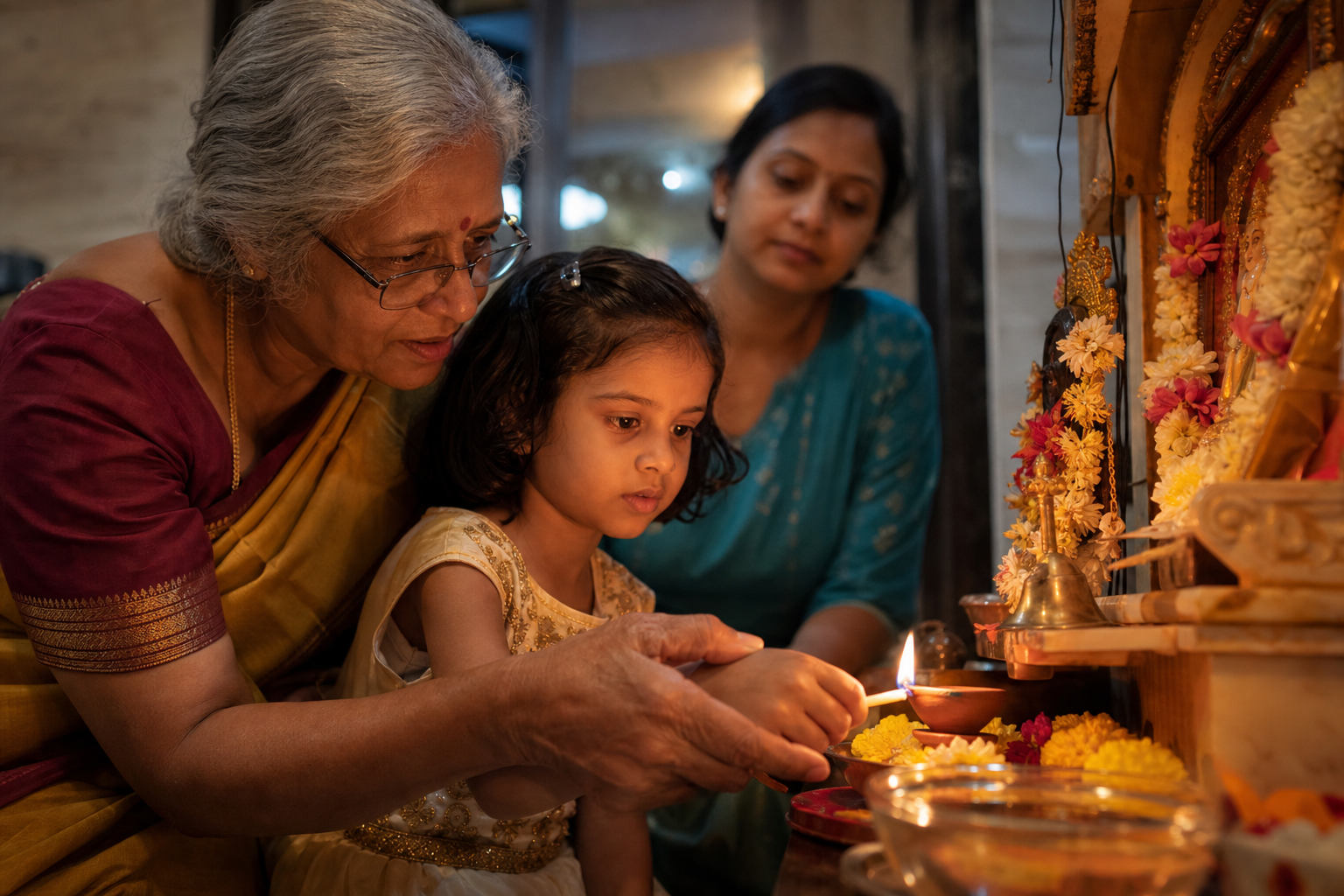
The strongest bridge between the sources is their emphasis on observation. The Grihastha Dharma article invokes Bhagavad Gita Chapter 3, Verse 21 to explain that people follow the standards embodied by those they regard as exemplary. Applied to family life, this makes adult conduct a primary means of education. Children notice whether promises are kept, anger is restrained, food is respected, guests are welcomed, and moral language is reflected in ordinary decisions.
The ritual-continuity article similarly argues that identity is formed through repeated household experience rather than abstract instruction alone. It also qualifies practices such as Charan Sparsh: intergenerational respect is more likely to become meaningful when its purpose is explained sensitively instead of being enforced as an unexplained gesture. That distinction is central to continuity. Participation compelled without understanding may preserve an outward form while weakening its relationship to Dharma.
A durable tradition consequently requires three elements to reinforce one another: a practice that can be repeated, an intelligible meaning, and conduct consistent with that meaning. Practice without explanation risks becoming empty routine. Explanation without practice can remain intellectual and fragile. Both are undermined when elders teach restraint, truthfulness, or generosity while modelling their opposites.
Adaptation can preserve substance across changing settings
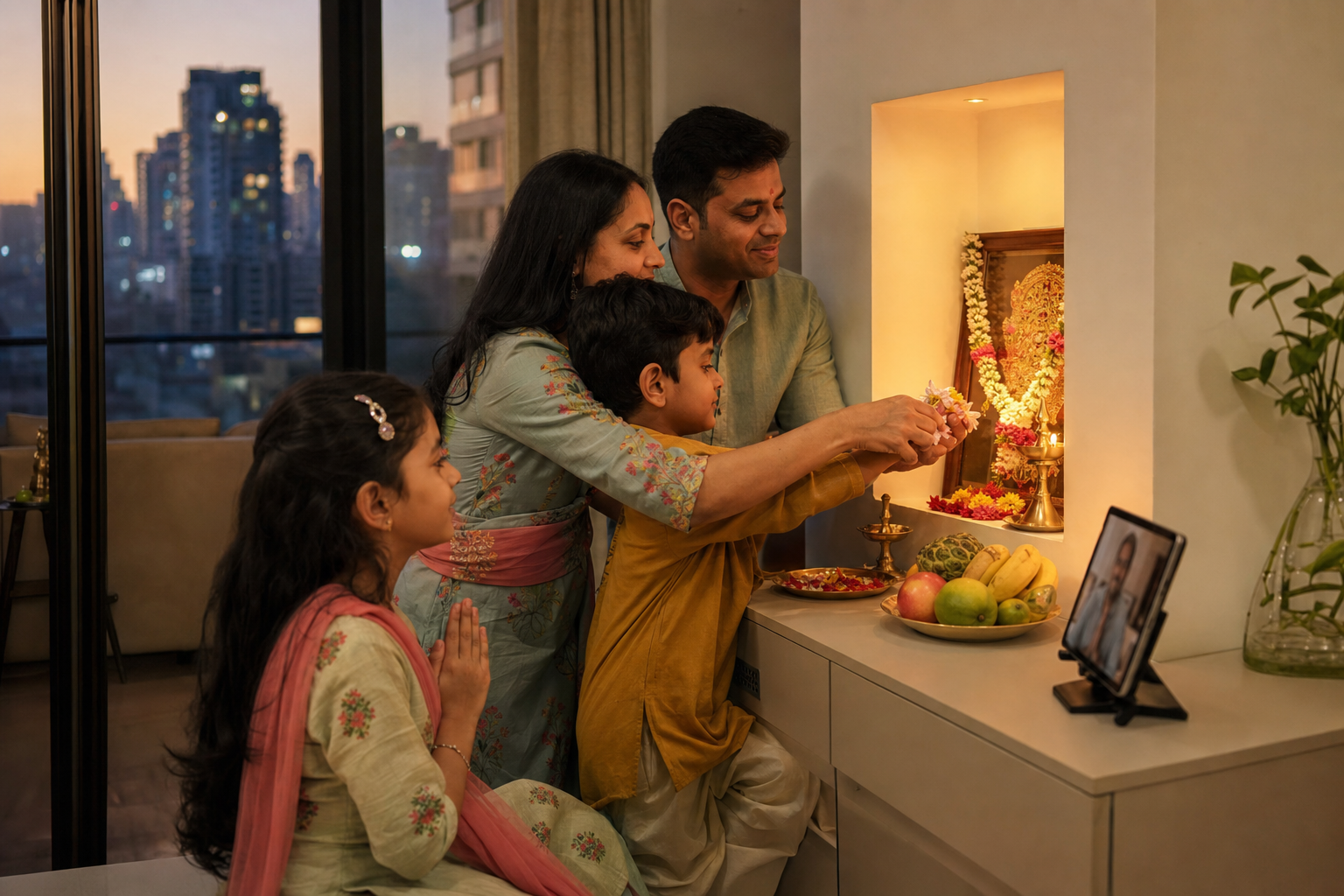
The ritual-continuity source describes Hindu traditions as regionally diverse and philosophically plural, encompassing household, temple, sectarian, folk, tribal, and guru-parampara settings. It also notes that festivals take different forms across regions of Bharat and among diaspora communities. Continuity in this account has never required every Hindu household to perform an identical set of observances.
Grihastha Dharma offers a way to evaluate adaptation without reducing it to a contest between rigid preservation and abandonment. The relevant question is whether a changed form still serves its Dharmic purpose. A shortened household observance can retain meaning if it sustains attention, gratitude, and participation. A festival adapted to a new location can remain a vehicle of memory if its story and ethical significance accompany its celebration. Conversely, an elaborate event can lose continuity when it becomes detached from discipline, responsibility, or reverence.
This approach also protects diversity. Families may inherit different deities, languages, calendars, stories, and ritual details while transmitting overlapping commitments to self-control, hospitality, care, learning, devotion, and generosity. The continuity lies neither in bare sameness nor in unrestricted reinvention, but in keeping form answerable to meaning.
Key takeaways
- Grihastha Dharma gives ritual an ethical test: household practice should cultivate responsibility, restraint, generosity, or reverence rather than merely display identity.
- Ritual gives Dharma a repeatable form through worship, offerings, respectful gestures, sacred stories, hospitality, charity, and festivals.
- Children receive tradition most persuasively when the conduct of elders supports the values expressed in family observances.
- Explanation turns inherited actions into intelligible participation, while repetition helps philosophical principles enter memory and habit.
- Adaptation can preserve continuity when changes in form retain spiritual meaning, a sustainable rhythm, and shared participation.
The future of household tradition will depend less on reproducing every inherited detail than on reconnecting practice, meaning, and character. Where families make that connection deliberately, Grihastha Dharma can continue to turn domestic life into both spiritual discipline and a living bridge between generations.
References
- DharmaRenaissance Blog — Grihastha Dharma in the Gita: A Powerful Path to Sacred Family Life and Social Harmony
- DharmaRenaissance Blog — Powerful Hindu Rituals That Preserve Cultural Identity Across Generations